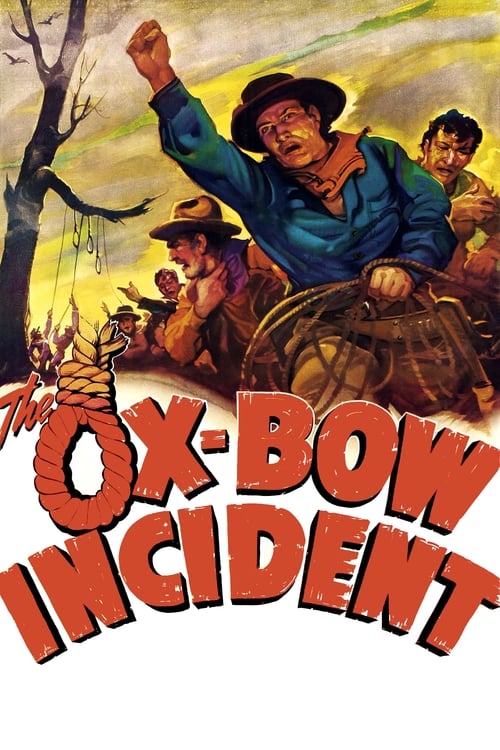
The Ox-Bow Incident
1943 · William A. Wellman
For when you want a film that makes you angry in a useful way — a short, sharp watch that starts an argument about justice and stays with you for days. Challenge, not comfort.
What it's about
In 1885 Nevada, word reaches a small town that a well-liked rancher has been murdered and his cattle stolen. A posse forms fast — part law, part liquor, part boredom — and rides into the hills, where it corners three strangers camped for the night. What follows is a standoff not between good men and outlaws but inside the posse itself: a handful of voices pleading for a trial against a mob that wants justice done by sunrise.
The experience
Tense, compact, and morally suffocating — at 75 minutes it wastes nothing, tightening like a noose as the arguments run out. It's the rare Western that leaves you shaken rather than satisfied.
Performances
Henry Fonda anchors it as a drifter whose conscience wakes up too slowly, and Dana Andrews, as one of the accused men, gives the film its devastating human center — ordinary, frightened, and dignified.
The craft
William A. Wellman shoots it like a chamber play in the open air: tight groupings, firelit night scenes, faces studied one by one as each man decides what he'll go along with. The stylized studio landscape adds to the sense of a world with no exit, and the lean script gives every character a position without a wasted line.
Why it matters
A famous box-office failure that became one of Hollywood's most respected message films, it proved the Western could carry serious moral argument and stands as an early landmark of the genre turning its guns on itself. It's still the movie people cite when they talk about mob justice on screen.
Snapshot
The Ox-Bow Incident is a Western in setting only; in substance it is a chamber drama about the collapse of due process into mob violence. In 1885 Nevada, two drifters, Gil Carter (Henry Fonda) and Art Croft (Harry Morgan, then billed Henry Morgan), ride into the small town of Bridger's Wells and are swept up in the formation of a posse after word arrives that a local rancher, Kincaid, has been murdered and his cattle rustled. The posse rides into the hills, corners three strangers camped at the Ox-Bow, and, despite scant evidence and the protests of a handful of dissenters, hangs them — only to learn afterward that Kincaid is alive and the real rustlers already in custody. At roughly 75 minutes, the film is unusually compact and morally airless, refusing the genre's customary release valves of action and redemption. Produced and adapted by Lamar Trotti for 20th Century-Fox and directed by William A. Wellman, it is now regarded as a landmark "message Western" and one of Hollywood's most uncompromising studio-era statements against vigilantism.
Industry & production
The film originated not in the studio system's appetite but against it. Wellman, a contract director with a reputation built on action pictures (Wings, The Public Enemy), had read Walter Van Tilburg Clark's 1940 novel and pursued the adaptation as a personal project. The standard account — repeated by Wellman himself in interviews and his memoir, and broadly consistent across the historical record — is that Fox production chief Darryl F. Zanuck considered the material commercially hopeless and agreed to greenlight it only as part of a bargain in which Wellman committed to directing more conventional, profitable pictures in exchange. The precise terms of that arrangement are recounted somewhat differently in different sources, so the deal is best described as a trade of prestige risk for commercial obligation rather than reconstructed verbatim.
The result was a frankly small picture by major-studio standards: a contained budget, a short shooting schedule, and a running time well under the feature norm. Lamar Trotti, one of Fox's most reliable writer-producers, both adapted the novel and produced, which gave the film an unusual unity of authorial intent for a studio assignment. Commercially it disappointed on release, confirming Zanuck's wariness; the film recouped little and was not a popular success. Critically, however, it was taken seriously, and it earned a single Academy Award nomination — for Best Picture, in the crowded 1943 field ultimately won by Casablanca. That it received that nomination and no others (no directing, acting, writing, or craft nods) is itself telling: the film was honored as a statement more than as a showcase.
Technology
The Ox-Bow Incident is a conventional product of early-1940s Hollywood technology: 35mm black-and-white photography, optical sound, standard Academy ratio. There is no technical novelty to claim, and inventing one would falsify the record. What is notable is the film's deliberate refusal of the location-shot scale that Westerns increasingly used to justify their budgets. Rather than the sweeping exteriors of Monument Valley then being popularized by John Ford, the picture was shot largely on Fox soundstages and the studio backlot, with painted backdrops and artificial sets standing in for the Nevada landscape. This was partly an economy — the bargain with Zanuck demanded thrift — but it also produced an aesthetic, discussed below, in which the "natural" world is conspicuously stage-bound. The studio-bound look is the film's most distinctive technological-cum-stylistic fact.
Technique
Cinematography
The photography is by Arthur C. Miller, one of Fox's premier cinematographers, whose credits include Oscar-winning work on How Green Was My Valley and The Song of Bernadette. Miller renders the film in a low-key, high-contrast register that pushes it toward the noir idiom emerging concurrently in the early 1940s. The night sequence at the Ox-Bow — the bulk of the film — is lit with hard, directional sources that carve faces out of darkness and throw the lynching into a theatrical chiaroscuro. The constructed landscape, with its painted skies and gnarled studio trees, photographs as a closed, almost expressionist space, which suits a story about people sealed off from reason. Miller's framing favors the group: tight clusters of faces in the firelight, the accused and the accusers compressed into the same shallow plane, so that the moral proximity of mob and victim is made literally compositional.
Editing
Cut by Allen McNeil, the film is built for compression and inexorability. Its short running time is not a limitation but the point: there are almost no digressions, and the editing drives the posse — and the audience — toward the hanging with a momentum that feels procedural and unstoppable. The rhythm tightens as the lynching approaches, then deliberately slows for the aftermath, where the cutting lingers on faces absorbing the news of the men's innocence. The film withholds the conventional cathartic montage; instead it holds on stillness and shame.
Mise-en-scène / staging
The staging is essentially theatrical, and consciously so. Long stretches play out in the saloon, on the main street, and in the firelit clearing as if on a stage, with characters arranged in debating blocs. Wellman choreographs the crowd as a single shifting organism, isolating the dissenters — the storekeeper Davies, the reluctant Gil Carter, a Black preacher named Sparks (Leigh Whipper) — as figures who step out of the mass and are pulled back into it. The artificial sets reinforce the sense of a moral experiment conducted in a sealed laboratory rather than an open frontier. The hanging tree and the ox-bow bend of the river are the production's central pieces of constructed geography, and their evident artifice keeps the emphasis on human conduct rather than landscape.
Sound
The score is by Cyril J. Mockridge, a Fox staff composer, and it is used with restraint; the film does not lean on music to manufacture suspense or grief. The most discussed sonic element is spoken rather than scored: the reading aloud, in the final passages, of a letter written by one of the condemned men, Donald Martin, to his wife — a text about law, conscience, and what one man owes another. Delivered in voice within the saloon after the fact, it functions as the film's moral summation. Beyond that, the soundtrack is dominated by voices in argument; this is a film of talk, and the sound design serves the primacy of debate.
Performance
The ensemble is the film's true subject, and the performances are pitched toward restraint rather than star display. Henry Fonda, top-billed as Gil Carter, plays a man who is neither hero nor coward but a passive witness — implicated by his silence as much as redeemed by his discomfort — and Fonda's underplaying makes the character's moral hesitancy legible without melodrama. Dana Andrews, as the doomed and dignified Donald Martin, gives the victims their human weight; his restraint in the face of certain death is the emotional center of the lynching sequence. Anthony Quinn plays the Mexican Juan Martinez, and Francis Ford (brother of John Ford) the addled old man, completing the trio of the accused. Among the accusers, Frank Conroy's Major Tetley — a martinet who turns the lynching into a test of his son's manhood — supplies the film's portrait of authority curdled into cruelty, while Harry Davenport's Davies is its conscience, the storekeeper who argues for the law and fails to stop the killing. The casting against type and the ensemble's collective discipline are central to the film's documentary-of-the-soul quality.
Narrative & dramatic mode
Dramatically the film is closer to tragedy and to the courtroom-debate play than to the action Western. Its engine is moral argument: the bulk of the running time is given to the contest between those who insist on returning the suspects to the law and those who demand immediate justice. The narrative is structured around a foregone, dreaded outcome — the audience suspects the men are innocent and the hanging will proceed anyway — so that suspense derives not from "what happens" but from whether any of the dissenters can arrest the machinery. Crucially, they cannot, and the film's most radical formal choice is to deny the last-minute rescue that genre convention demands. The reversal — Kincaid alive, the real culprits caught — arrives only after the irreversible act, converting the structure into an indictment. The coda, with the letter read aloud and Gil and Art riding off to deliver the dead man's money to his widow, refuses consolation: guilt, not closure, is the residue.
Genre & cycle
The Ox-Bow Incident belongs to the Western by setting, costume, and iconography, but it is routinely and rightly classed as an "anti-Western" or "message Western" — a film that uses the genre's furniture to interrogate the very frontier mythology the genre usually celebrates. Where the classical Western tends to vindicate the man who takes the law into his own hands, this film treats extralegal justice as the original sin of the frontier community. It stands as an early and influential entry in a cycle of socially critical Westerns that would flower after the war, anticipating the moral-test structure of High Noon (1952) and the genre's broader mid-century turn toward self-examination. It also belongs, thematically, to Hollywood's intermittent lineage of anti-lynching films, a tradition that includes Fritz Lang's Fury (1936) and Mervyn LeRoy's They Won't Forget (1937), though Ox-Bow relocates the subject to the mythic West.
Authorship & method
The film is most strongly stamped by William A. Wellman, whose passion drove it into production and whose direction prizes terseness, momentum, and an unsentimental eye for group behavior — qualities continuous with his earlier work even as the subject is uncharacteristically austere. But it is unusually a producer-writer's film as well: Lamar Trotti both adapted Clark's novel and produced, lending the project a singular authorial coherence and protecting its bleak fidelity to the source. The source itself — Walter Van Tilburg Clark's 1940 debut novel — is essential to the authorship question; it was a literary Western that took the form seriously as a vehicle for moral inquiry, and the film's refusal of genre comfort is inherited from it. Among collaborators, cinematographer Arthur C. Miller supplies the noir-inflected visual scheme, editor Allen McNeil the compressive drive, and composer Cyril J. Mockridge a deliberately spare score. The ensemble cast, anchored by Henry Fonda and Dana Andrews, completes the method: a film made by subordinating individual showcase to collective statement.
Movement / national cinema
The film is a product of the Hollywood studio system at its height, specifically of 20th Century-Fox under Zanuck, and it is best understood within American cinema rather than any formal movement. That said, its visual debt to the low-key, high-contrast style associated with film noir — itself partly an inheritance of German Expressionism filtered through émigré craftsmen in Hollywood — places it at the intersection of the studio Western and the darkening American screen of the early 1940s. It can also be read within a Popular Front–adjacent strain of socially conscious American filmmaking that used genre vehicles to deliver liberal moral arguments.
Era / period
Released in 1943, the film is inseparable from its wartime moment. Its parable of a community abandoning law and reason to collective frenzy carried obvious resonance in a world at war against fascism, and the picture is frequently read as an argument for due process and against mob rule precisely when democratic values were being defined in opposition to their enemies. The film's commercial failure may owe partly to a wartime audience disinclined toward so grim a domestic self-critique; its later canonization owes much to the way its themes outlived the immediate context. The specific weight contemporary audiences and reviewers placed on its wartime topicality is something the historical record addresses unevenly, so it is safer to note the resonance than to overstate a documented reception.
Themes
The film's governing theme is the fragility of law and the ease with which a community substitutes the satisfaction of vengeance for the discipline of justice. Around it cluster several others: moral cowardice and the guilt of the bystander, embodied in Gil Carter, who disapproves yet does not act; the corruption of authority and masculinity, in Major Tetley, who weaponizes the lynching to shame his son and is destroyed by the aftermath; conscience as a lonely and finally insufficient force, in Davies, whose arguments are correct and impotent. The Martin letter crystallizes the film's central proposition — that law is not an external constraint but the conscience of a community, and that a man who lets others die unjustly has murdered his own. The picture is notably pessimistic: the dissenters fail, the innocent die, and the survivors carry shame rather than learn redemption.
Reception, canon & influence
On release the film was a commercial disappointment but a critical success, taken seriously as a work of unusual moral seriousness for a Western and recognized with a Best Picture Oscar nomination in 1943 — its sole nomination, a fact that underscores how it was valued as a whole statement rather than for any single craft. Its reputation has grown steadily since; it was selected for preservation in the National Film Registry by the Library of Congress as a culturally significant work, and it is now a fixture in discussions of the Western's mid-century maturation.
Looking backward, the film's influences run primarily through its literary source — Clark's revisionist novel — and through the existing Hollywood anti-lynching tradition exemplified by Lang's Fury; visually it draws on the emerging noir sensibility of its era. Looking forward, its legacy is substantial. It helped license the "adult" or revisionist Western that questioned frontier mythology, and its structure — a community placed on moral trial, the law pitted against the crowd — anticipates High Noon and resonates with the jury-room moral combat of 12 Angry Men (1957). More broadly, it stands as a touchstone whenever critics trace the genre's capacity for self-criticism, and as one of the clearest demonstrations that a Western could be, in essence, a tragedy of conscience. Its enduring stature rests less on spectacle — of which it has almost none — than on the rigor and pessimism with which it followed a single moral question to its unbearable conclusion.
A Deleuzian reading
Picture the firelight at the Ox-Bow.
The full Deleuzian reading of The Ox-Bow Incident →
Reception
A box-office flop in 1943 — wartime audiences wanted escapism, not a grim 75-minute morality play — yet it still snagged a Best Picture nomination (losing to Casablanca) and is now canonized as the great anti-lynching western that paved the way for the genre's psychological turn.
How The Ox-Bow Incident was received, from release to now →
Influences: the films it descends from and the films it influenced
- Fury (1936) — The template Ox-Bow descends from: Lang films the lynch mob as a single expressionist organism, low-key light raking inflamed faces, indicting the crowd's psychology rather than any villain.
- They Won't Forget (1937) — Warners' anti-lynching social-problem cycle — a community convicting on circumstantial evidence and a deliberately withheld last-minute rescue — supplies Ox-Bow its pessimistic refusal of genre comfort.
- The Informer (1935) — Ford and Dudley Nichols compress a single night of moral reckoning onto fog-bound, stylized studio sets, the chiaroscuro-and-confinement chamber drama Ox-Bow restages on a Western street.
- M (1931) — Stages the trial-by-mob — a crowd arrogating the law's function in a kangaroo court — as a chiaroscuro set-piece, the structural engine Ox-Bow inherits whole.
- The Grapes of Wrath (1940) — Establishes Henry Fonda's moral-witness persona — the still, restrained conscience anchoring an ensemble — over Gregg Toland's low-key social realism, both of which Ox-Bow recruits directly.
- Stagecoach (1939) — Recasts the Western as a confined ensemble of frontier types under moral pressure, licensing the 'serious' A-Western whose prestige Ox-Bow exploits and darkens.
- High Noon (1952) — Places a whole community on moral trial and pits the law against the crowd, sustained by the same compressed near-real-time structure and spare, near-scoreless austerity.
- 12 Angry Men (1957) — Distills the jury-room moral combat to a single-set theatrical confinement with ensemble-restraint acting, interrogating a foregone verdict exactly as Ox-Bow interrogates a foregone hanging.
- Try and Get Me! (The Sound of Fury) (1950) — Carries the anti-lynching cycle forward, dramatizing mob hysteria storming a jail with the same documentary pessimism and denial of rescue.
- The Gunfighter (1950) — Builds an austere, studio-controlled Western around foregone-tragedy structure — a marked man moving inexorably to his end — the same fatalism Ox-Bow announces in its title.
- Bad Day at Black Rock (1955) — Confronts a complicit town over a concealed killing in terse one-day compression, the ensemble of guilty bystanders that Ox-Bow's posse first anatomized.
- The Searchers (1956) — Exemplifies the 'adult'/revisionist Western Ox-Bow licensed, turning the genre's frontier mythology into sustained self-criticism.
- Hang 'Em High (1968) — Takes the wrongful vigilante hanging that ends Ox-Bow and makes it the premise, building a revenge Western from the trauma of mob 'justice.'
- To Kill a Mockingbird (1962) — Extends the foregone-injustice trial-of-conscience — a doomed defense argued in low-key shadow before a prejudiced community — with the same ensemble restraint and refusal of consolation.
- Unforgiven (1992) — Carries the genre's self-criticism to its end, reckoning with the moral cost of killing in low-key, near-monochrome light — the tragedy-of-conscience Western Ox-Bow inaugurated.
- Paths of Glory (1957) — Wellman's procedural staging of an extrajudicial hanging — each preparatory step held at full duration, one man's dissenting advocacy rendered structurally futile — establishes the witnessing-as-indictment rhythm Kubrick adopts for the condemned soldiers' final sequence.
- Red River (1948) — Wellman established the collective-witness structure in the adult Western — a group watching institutional authority commit a moral wrong — which Hawks directly transposes into the mutiny sequence where Garth's challenge is ratified by the assembled drovers' gaze.
- Shane (1953) — Wellman's decision to stage Western violence as grinding physical horror rather than adventure spectacle established the adult Western's de-glamorized ethos that Stevens extended into Shane's amplified gunshot sound design and the mud-and-weight saloon fight choreography.
- The Tin Star (1957) — Returns Fonda to a plot hinged on halting a lynch mob, the moral re-education of a town against frontier blood-justice that is Ox-Bow's unfinished argument.
- Track of the Cat (1954) — Wellman again adapts Walter Van Tilburg Clark into an austere, studio-bound chamber drama, draining color toward near-monochrome to match the source's bleak fidelity.
- Lifeboat (1944) — A contemporaneous Fox deliberative-plot picture in which the drama is entirely a group talking itself into an execution, staged so the camera polls faces for assent — the same reaction-shot-as-vote grammar transferred to a lynch mob.
Similar films
- Stagecoach (1939) — influence & lineage
- High Noon (1952) — influence & lineage
- Unforgiven (1992) — influence & lineage
- 12 Angry Men (1957) — influence & lineage
- The Grapes of Wrath (1940) — influence & lineage
- The Searchers (1956) — influence & lineage
- The Man Who Shot Liberty Valance (1962) — shared sensibility
- My Darling Clementine (1946) — shared sensibility
All the films related to The Ox-Bow Incident →