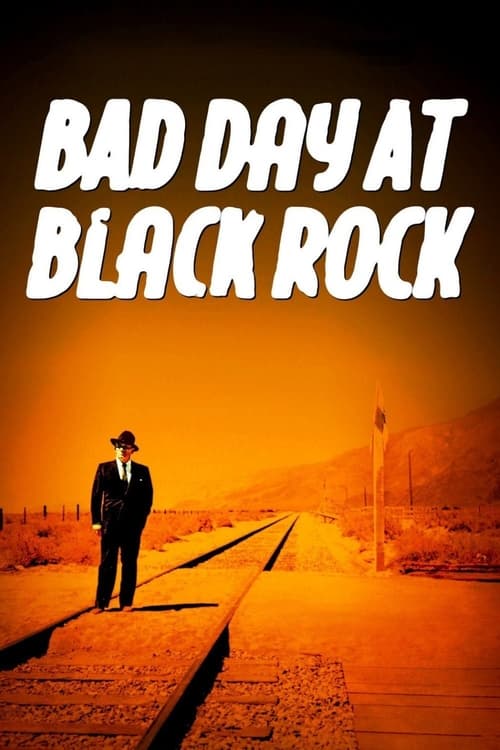
Bad Day at Black Rock
1955 · John Sturges
For when you want something taut and grown-up you can finish in one sitting — a slow-squeeze suspense picture with a moral backbone. Great when you're in the mood for old-Hollywood craftsmanship that doesn't waste a frame.
What it's about
A one-armed stranger steps off the train at Black Rock, a desert whistle-stop so small the streamliner hasn't stopped there in years, and asks after a Japanese-American farmer named Komoko. The whole town stiffens. Over a single scorching day, the veteran keeps asking his quiet questions while the local men close ranks around a secret they've kept since the war — and it becomes clear they'd rather he never leave than let him find the answer.
The experience
Lean and coiled — eighty-odd minutes of dread built from stares, silences, and one dusty street, tightening until it snaps. It's a thriller that generates its menace almost entirely from men standing too close to each other.
Performances
Spencer Tracy carries the film with almost eerie calm — a man whose stillness is his weapon — while Robert Ryan radiates controlled menace as the town's boss and Ernest Borgnine and Lee Marvin make unforgettable heavies.
The craft
John Sturges uses the widescreen frame like a vise, stranding lone figures against enormous empty desert so the town's isolation becomes the threat itself. The script strips every scene to essentials; the famous one-armed fight scene is a master class in doing more with less.
Why it matters
One of Hollywood's earliest reckonings with wartime anti-Japanese racism, smuggled inside a crackerjack thriller — and a blueprint for every story about a stranger arriving to force a town to face its buried crime.
Snapshot
A one-armed stranger steps off the streamliner into a desert nowhere and, over the course of a single day, forces a whole town to confront a murder it has buried. Bad Day at Black Rock compresses the machinery of the Western, the postwar thriller, and the social-problem picture into roughly eighty-one taut minutes, most of them set within sight of a single dusty street. Spencer Tracy plays John J. Macreedy, an aging veteran seeking the family of a Japanese-American soldier who saved his life; what he finds is a community bound together by a shared crime. Directed by John Sturges for MGM under production chief Dore Schary, shot in CinemaScope and Eastmancolor, the film is at once a lean genre exercise and one of Hollywood's earliest oblique reckonings with wartime anti-Japanese hysteria and, by implication, the conformist terror of the McCarthy years. It earned Academy Award nominations for Tracy, Sturges, and screenwriter Millard Kaufman, and it has aged into a touchstone for the "stranger rides into a guilty town" thriller.
Industry & production
The film was produced at Metro-Goldwyn-Mayer during the tenure of Dore Schary, the studio's production head, whose personal commitment to socially conscious "message pictures" is inseparable from the project's existence. Schary had made his reputation partly on liberal problem films, and Bad Day at Black Rock fits squarely within that program: a commercial genre package carrying a pointed civic argument. The screenplay by Millard Kaufman derives from a short story by Howard Breslin ("Bad Time at Honda," published in the late 1940s), with an adaptation credit to Don McGuire; the precise division of labor among source, adaptor, and screenwriter is the sort of contractual detail that the surviving public record renders only in broad strokes, so I will not parse it more finely than the credits allow.
The production is notable for its economy and discipline. Sturges was, by this point, a studio contract director known for bringing pictures in efficiently, and the film's near-observance of the classical unities — one place, roughly one day — is as much a production virtue as an aesthetic choice, minimizing sets and shooting days. The bulk of the film was shot on location in the arid California landscape (the desert set is widely associated with the Lone Pine / Owens Valley region, though I would treat the exact site as a reported rather than certified fact). MGM's decision to release such an intimate, morally serious picture in the studio's premium widescreen format signals the era's larger economic anxiety: in the mid-1950s the majors were leaning on CinemaScope and color as weapons against television, and even a chamber thriller was expected to justify the big screen.
Technology
Bad Day at Black Rock is a document of Hollywood's technological transition of the early-to-mid 1950s. It was photographed in CinemaScope, the anamorphic widescreen system 20th Century-Fox had introduced in 1953 and licensed across the industry, and in Eastmancolor, the single-strip color negative that was rapidly displacing the cumbersome three-strip Technicolor process. The pairing is significant: color and scope were the industry's answer to the small monochrome television image, and the film deploys both as more than novelty. The wide frame is used here against type — not for cavalry charges or landscapes of grandeur, but to strand human figures in empty horizontal space and to make a four-building town feel like the only inhabited point in a hostile emptiness. That the era's most spectacle-oriented format could be bent toward claustrophobia and menace is one of the picture's quiet technical arguments.
Technique
Cinematography
William C. Mellor's photography is the film's most celebrated craft element. The CinemaScope frame is composed to isolate: Macreedy is repeatedly placed alone in a vast, sun-flattened width, dwarfed by land and sky, while the townsmen cluster at the edges of the image, watching. The desert light is harsh and unmodulated, giving the color a bleached, hostile cast rather than a romantic one. Mellor and Sturges exploit depth and lateral space to stage surveillance — a man at a window, a truck idling at the far end of the street — so that the geography itself becomes a system of intimidation. The camera tends to hold and observe rather than chase, reinforcing the sense of a man exposed in the open.
Editing
Cut by Newell P. Kimlin, the film runs to an unusually lean length for a widescreen studio release, and its editing rhythm is calibrated to a slow-burn structure that tightens toward eruption. Long stretches of watchful, dialogue-driven confrontation are punctuated by short, decisive bursts of violence, the most famous being the diner scene in which the one-armed Macreedy fells the hulking Coley Trimble. The cutting there is abrupt and shocking precisely because the film has trained the viewer to expect the stranger's helplessness; the release is engineered by contrast with the preceding restraint.
Mise-en-scène / staging
The staging is governed by the near-unity of place. Nearly everything happens along one street and in a handful of interiors — the hotel, the diner, the telegraph office, the sheriff's office. Sturges choreographs the town as a closed social organism: the same faces recur, hemming Macreedy in, and the physical smallness of Black Rock becomes a moral trap from which information cannot escape and into which no help can arrive. The recurring image of the train — arriving at the start, longed for as an exit throughout — anchors the geography and the suspense alike.
Sound
André Previn's score is percussive and propulsive, keyed to the tension of pursuit and to the mechanical menace of the train and the vehicles that stalk Macreedy through the flats. The film also makes expressive use of environmental sound and silence — the wind, the emptiness, the intrusion of an engine — so that the arrival of a motor in the stillness reads as threat. As with the cinematography, the sound design works to convert open space into unease.
Performance
The acting is the film's engine, and its ensemble is remarkable. Tracy's Macreedy is a study in banked stillness: he underplays, keeps his damaged arm and his purpose half-hidden, and lets moral authority accumulate through restraint rather than declaration. Against him, Robert Ryan gives Reno Smith a coiled, articulate malevolence — a rancher whose bigotry is rationalized rather than merely brutish — while Ernest Borgnine and Lee Marvin embody the town's muscle as swaggering, casually cruel henchmen. Walter Brennan (as the town's conscience, Doc Velie), Dean Jagger (the alcoholic, compromised sheriff), Anne Francis, John Ericson, and Russell Collins round out a gallery of citizens ranged along a spectrum of guilt, cowardice, and belated courage. The film's drama is essentially the drama of these faces deciding whether to speak.
Narrative & dramatic mode
Structurally the film is a mystery built on withheld information: the audience, like Macreedy, does not initially know what happened to the man he seeks, and the plot advances through the stranger's steady, dangerous extraction of a secret from people who will kill to keep it. Its dramatic mode is close to classical tragedy in its compression — the observance of unity of time and place lends the action an almost theatrical inevitability — but its idiom is the taut suspense thriller. The revelation, when it comes, is a moral one as much as a factual one: the "crime" is not merely a murder but the collective complicity and silence that followed it. The arc bends toward redemption, but a qualified, exhausted kind — the town is not so much healed as forced into the light.
Genre & cycle
The film is a hybrid, and its power comes from the collision of its parts. It wears the costume of the Western — the desert, the lone rider (here a train passenger), the lawless town where the sheriff is bought or broken — but it is set in the contemporary postwar present, and its violence and paranoia belong to film noir and the social-problem picture. It can be read as a modern-dress Western, as a "town tamer" narrative inverted (the stranger brings not a gun but a question), and as an entry in the postwar cycle of Hollywood films examining prejudice and mob conformity. It also anticipates the revisionist Western's interest in the settled community's buried violence.
Authorship & method
John Sturges directs with the efficiency and spatial clarity that would define his subsequent career as a maker of muscular ensemble action films (he would go on to Gunfight at the O.K. Corral, The Magnificent Seven, and The Great Escape). Bad Day at Black Rock is arguably his tightest and most disciplined work, and it demonstrates his gift for staging groups of men in tense physical relation to one another and to landscape. His key collaborators here are essential to the result: cinematographer William C. Mellor, who bent CinemaScope to intimate menace; composer André Previn, whose driving score sharpens the suspense; editor Newell P. Kimlin, whose cutting sustains the slow burn and detonates the violence; and screenwriter Millard Kaufman, who shaped the source material into a model of compression, giving each townsman a distinct moral position. Overseeing all of it, Dore Schary functioned as an auteur of intention, the executive whose social agenda selected and protected the project. Authorship here is genuinely distributed between a director's craft and a producer's conscience.
Movement / national cinema
The film belongs to mainstream American studio cinema at the height of the classical system's final, defensive phase. It is not part of a formal movement, but it sits within two identifiable currents: the postwar Hollywood social-consciousness film (the cycle of pictures confronting racism, antisemitism, and mob behavior that flourished in the late 1940s and early 1950s), and the industry-wide turn to widescreen and color as a survival strategy against television. Its national specificity is deep — the crime it uncovers is rooted in the anti-Japanese sentiment of the American home front — and it is one of the earliest Hollywood features to address that history at all, however obliquely.
Era / period
The film is a product of the mid-1950s and of the political weather of the McCarthy era, and it is frequently read as a coded parable of that moment: a story about the cost of communal silence, the danger of scapegoating, and the courage required to break with a fearful consensus. Its setting is the immediate postwar aftermath — the wounds of the Second World War are literally embodied in Macreedy's arm and in the dead soldier whose family he seeks — and its subject, the wartime persecution of Japanese-Americans, was still a raw and largely unspoken chapter of recent national history. The film thus straddles two eras: the war it remembers and the anxious peace in which it was made.
Themes
The film's central themes are moral cowardice and complicity — the way an entire community can be implicated not by committing a crime but by agreeing not to see it. Around this sits its treatment of racism and xenophobia: the murder that anchors the plot is a hate crime driven by wartime bigotry, and the film indicts not only the perpetrator but the bystanders. Other threads run through it: the redemptive burden placed on the individual conscience (Macreedy as reluctant catalyst); the idea of a debt owed across the color line, since the stranger's quest honors a Japanese-American soldier's sacrifice; and the fragility of civic institutions when the sheriff is a drunk and the law is captured. Physical disability is woven into the meaning as well — Macreedy's single arm marks him as damaged and underestimated, which makes his eventual, decisive action all the more pointed.
Reception, canon & influence
Critically, the film was well received on release and has held its reputation firmly; its recognition by the Academy — nominations for Tracy's performance, Sturges's direction, and Kaufman's screenplay — reflects the industry's own esteem, and Tracy was also honored at the Cannes Film Festival for his performance. (I am stating these as the well-established awards facts; I will not attach box-office figures, since I cannot verify specific numbers from memory.) Over time it has been widely canonized as a model of narrative economy and as one of Hollywood's first films to grapple, however indirectly, with the wartime treatment of Japanese-Americans.
Looking backward, the film draws on several lineages: the classical Western's "town" archetype and the lone lawbringer; the postwar social-problem film's confrontation with American prejudice; and the tight, real-time suspense construction associated with stage-derived drama and with the noir thriller. Its near-observance of the unities gives it a theatrical rigor uncommon in the genre.
Looking forward, its influence is substantial and specific. The premise — a mysterious stranger arriving in an isolated town that harbors a guilty secret, provoking escalating violence — became a durable template, and the film is frequently cited as a structural ancestor of later "one man against a hostile town" thrillers, the lineage that runs toward pictures like First Blood and a long line of desert-set standoff films. Sturges himself carried its ensemble-under-pressure craft into his later hits. More broadly, Bad Day at Black Rock helped establish that a widescreen genre entertainment could carry a serious moral argument without sacrificing tension — a proof of concept whose echoes persist wherever a thriller uses a stranger's arrival to force a community to face what it has hidden.
A Deleuzian reading
A man stands in the middle of a screen that is far too wide for him.
The full Deleuzian reading of Bad Day at Black Rock →
Reception
A hit in its day — Oscar nominations for Tracy, Sturges, and the screenplay, plus a Best Actor prize for Tracy at Cannes — and it never really fell out of favor; it's since been enshrined in the National Film Registry as a model of lean, purposeful Hollywood storytelling.
How Bad Day at Black Rock was received, from release to now →
How to watch Bad Day at Black Rock: what to notice on a first viewing
- Watch how alone Macreedy looks in the wide frame. Mellor's CinemaScope repeatedly strands him in a vast, sun-flattened width while the townsmen cluster together at the frame's edges, watching him. The width doesn't open up space for him. It just gives him more open ground to be exposed in.
- Watch how few locations the whole film ever uses. Nearly everything happens on one street and in a handful of interiors, the same faces recurring until the small town feels like a closed system. The smallness itself becomes the trap: there is nowhere for information, or for Macreedy, to go.
- Listen for an engine breaking a long stretch of silence. Previn's score stays percussive and sparing, and the film leans on wind, emptiness, and the sudden arrival of a motor to turn open space into threat. A car engine in that much silence tells you someone is coming before you ever see them.
- Watch how still Tracy keeps his face and his damaged arm. He underplays throughout, half-hiding both his arm and his purpose, letting moral authority build through restraint instead of any declaration. The less he shows you, the more the town has to expose about itself just by reacting to him.
- Watch for the train Macreedy arrived on. It anchors the whole film's geography and its suspense, the one way in and the only way out of a town that otherwise has none. A train schedule becomes the clock the entire day's tension is set against.
The whole guide to watching Bad Day at Black Rock, with the keys for a rewatch →
Influences: the films it descends from and the films it influenced
- The Petrified Forest (1936) — Establishes the stage-derived, single-location desert standoff — strangers and locals trapped in one roadside outpost — whose dialogue-driven, unity-of-place suspense Kaufman's screenplay compresses into Black Rock's diner and hotel.
- Fury (1936) — Prototype of the social-problem drama that indicts an entire town's collective guilt in mob violence, supplying Black Rock's structural engine of a whole community sharing complicity in a buried crime.
- Stagecoach (1939) — Codifies the ensemble of distinct moral types placed under pressure and dwarfed against Western landscape — the group-in-terrain staging Sturges directly inherits and would carry through his later ensemble pictures.
- The Ox-Bow Incident (1943) — Turns the Western into a moral tribunal on mob complicity and silence, fusing genre entertainment with an explicit social argument — the exact hybrid Black Rock revives in modern dress.
- Shadow of a Doubt (1943) — Perfects the withheld-information suspense of an arrival that slowly exposes the poison beneath a sunlit, ordinary town, the reveal-by-degrees mechanism Black Rock runs on Reno Smith's Black Rock.
- High Noon (1952) — Tightens the Western toward the classical unities and near-real-time compression while making the town's cowardice the true antagonist — the abandoned-lone-man-versus-complicit-community structure Black Rock adopts wholesale.
- The Gunfighter (1950) — Transposes the compressed-timeframe, town-conspires-against-the-outsider architecture into the modern-dress thriller, retaining the structure in which the entire population functions as a single hostile organism observing the stranger.
- The Magnificent Seven (1960) — Extends Sturges's signature staging of groups of men in tense physical relation to one another and to a hostile community, the ensemble-under-pressure craft first disciplined in Black Rock.
- Straw Dogs (1971) — Takes the outsider-besieged-by-a-rural-community premise and pushes the slow-burn-to-eruption structure to its limit, detonating banked menace into sustained violence as Black Rock detonates its climax.
- High Plains Drifter (1973) — Direct descendant of the guilty-town template: a stranger rides into an isolated settlement harboring a collective secret of complicity in a murder, forcing the community to face what it hid.
- First Blood (1982) — The canonical modern heir to Black Rock's one-man-against-a-hostile-town structure — a drifter's arrival provokes a small town into escalating persecution that erupts into violence.
- A History of Violence (2005) — Modern-dress reworking in which a buried past surfaces to shatter a quiet community, built on a banked-stillness lead performance masking latent violence exactly as Tracy masks his mission.
- No Country for Old Men (2007) — Modern-dress Western exploiting widescreen desert isolation and withheld information, replacing orchestral scoring with percussive restraint to sharpen suspense the way Previn's driving cues did.
- The Hateful Eight (2015) — A unity-of-place chamber Western shot in intimate 70mm — widescreen turned inward on a confined room — structured around withheld information and a patient slow burn to eruptive massacre.
- Wind River (2017) — Modern-dress Western in which an outsider investigates a crime a remote community would rather bury, foregrounding racism against a marginalized people (Native Americans) as Black Rock foregrounded anti-Japanese racism.
- Tremors (1990) — Establishes a one-street Owens Valley desert town in widescreen as a fully legible map — every doorway, distance and sightline fixed in the first reel — so later violence can be followed without re-establishing geography; Perfection is staged on the same spatial contract.
- Wake in Fright (1971) — Establishes the encirclement grammar Kotcheff reuses in the Yabba bars: an outsider held by a transport schedule while the townsmen close a physical ring around him in wide compositions, so complicity is blocked spatially rather than spoken.
- East of Eden (1955) — Released the same year, it likewise bends the new CinemaScope frame away from spectacle toward intimate psychological menace, proving widescreen could isolate a single tense face rather than fill a vista.
- Last Train from Gun Hill (1959) — Sturges reworks his own template — a determined outsider pressuring a town that shields a guilty man — sustaining the banked-stillness lead and slow-burn-to-eruption cutting he refined at Black Rock.
Similar films
- High Noon (1952) — influence & lineage
- Fury (1936) — influence & lineage
- The Magnificent Seven (1960) — influence & lineage
- Stagecoach (1939) — influence & lineage
- The Outlaw Josey Wales (1976) — shared sensibility
- The Defiant Ones (1958) — shared sensibility
- The Searchers (1956) — shared sensibility
- 3:10 to Yuma (1957) — shared sensibility