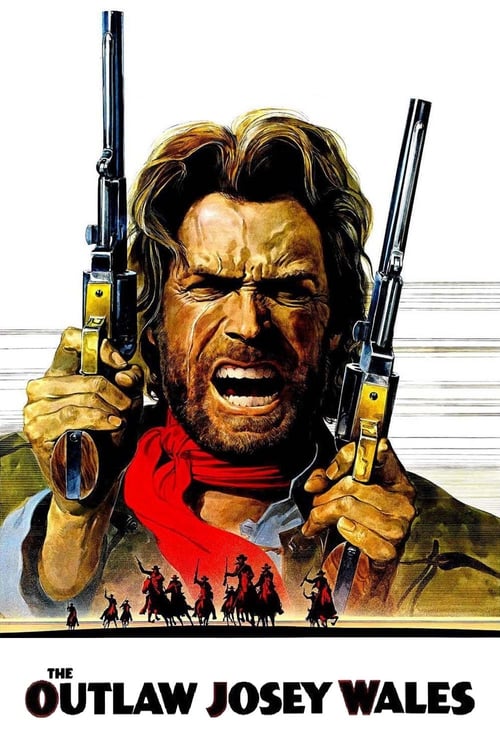
The Outlaw Josey Wales
1976 · Clint Eastwood
For a full-course Western evening — when you want gunfights and grit but also want the film to take you somewhere emotionally by the end. Comfort viewing for anyone who loves the genre, and a great gateway for anyone who doesn't yet.
What it's about
A Missouri farmer's family is slaughtered by Union-aligned militia, and he rides through the Civil War and out the other side as a hunted outlaw with a price on his head. He wants to travel alone, but strays keep attaching themselves to him — an old Cherokee man, a displaced family, other castoffs of a broken country — and the loner finds himself, almost against his will, protecting a makeshift community.
The experience
It starts scorched and vengeful, then slowly opens up — the violence stays sudden and hard, but the film keeps making room for dry humor, campfire companionship, and wide, unhurried landscapes. By the end it feels less like a revenge story than a long exhale.
Performances
Clint Eastwood's squinting, tobacco-spitting antihero is one of his defining roles, and Chief Dan George nearly steals the film as Lone Watie, playing weathered wisdom with impeccable deadpan timing.
The craft
Eastwood directs with unfussy confidence, letting the widescreen frontier landscapes carry the film's sense of scale and loss. The pacing is a lesson in the episodic Western — each encounter on the road adds a character or a theme without ever feeling like a detour. It rewards a big screen for the vistas alone.
Why it matters
One of the films that established Eastwood as a major director rather than just a star, and a bridge between the classic Western and the more morally weathered, revisionist mode the genre moved toward.
Snapshot
The Outlaw Josey Wales is a post–Civil War revenge Western in which a Missouri farmer, his family murdered by pro-Union "Redleg" militia, becomes a Confederate bushwhacker and then a hunted fugitive who, almost against his own will, gathers a surrogate family of society's castoffs. It is the fourth feature Clint Eastwood directed and among the most durable of his career — a film that begins in scorched-earth vengeance and drifts, unexpectedly, toward reconciliation and the making of a home. Adapted from a novel by a Cherokee author writing under a pseudonym, produced through Eastwood's Malpaso company and released by Warner Bros., the picture is remembered both for its lyrical widescreen landscape work and for the behind-the-scenes rupture in which Eastwood took over direction from the credited writer-director Philip Kaufman. It stands as a pivot in Eastwood's evolution from star to full-fledged filmmaker and as one of the key revisionist Westerns of the 1970s.
Industry & production
The film was produced by Malpaso, Eastwood's production company, and distributed by Warner Bros., the studio with which Eastwood had by the mid-1970s established a long and mutually profitable relationship. It was adapted from the 1973 novel The Rebel Outlaw: Josey Wales (later reissued as Gone to Texas) by Forrest Carter — a figure whose biography later became notorious, as "Forrest Carter" was revealed to be a pseudonym for Asa Earl Carter, a former Alabama segregationist speechwriter. This authorship controversy is well documented and worth noting plainly, though it postdates and sits somewhat apart from the film's own production.
The best-known production fact is the change of directors. Philip Kaufman co-wrote the screenplay (with Sonia Chernus) and was originally set to direct; during the shoot Eastwood assumed directing duties and Kaufman departed the project. The episode is frequently cited as a direct catalyst for the Directors Guild of America's so-called "Eastwood Rule," which barred an actor or producer on a film from replacing its director — a reform commonly attributed to this production. Beyond that widely repeated account, the granular details of the on-set dispute rest largely on later recollection rather than contemporaneous documentation, and should be treated with corresponding caution. The film was shot on location across the American Southwest, using Arizona, Utah, and other regional landscapes to stand in for the Missouri–Kansas–Texas geography of the story.
Technology
The Outlaw Josey Wales was made with the standard professional filmmaking apparatus of mid-1970s Hollywood: 35mm color cinematography, anamorphic widescreen composition for a Panavision-format 2.35:1 frame, and location shooting supported by conventional camera, lighting, and optical-sound recording technology of the period. It is not a film associated with any technological innovation — there were no new camera systems, lenses, or effects processes pioneered here. Its technical distinction lies entirely in the confident deployment of established widescreen tools: the anamorphic frame is used expansively for landscape, and the film relies on natural light and real exteriors rather than the studio-bound artifice of the classical Western. Where earlier accounts might overstate technical novelty, the honest description is that this is a craft achievement within existing technology, not a technological milestone.
Technique
Cinematography
The film was photographed by Bruce Surtees, Eastwood's frequent collaborator of the period, sometimes nicknamed "the Prince of Darkness" for his comfort with low-key, underexposed interiors and hard, naturalistic light. Surtees's work here alternates between two registers: intimate, often shadowed close work on faces — Eastwood's squint, the weathered features of the ensemble — and broad anamorphic vistas that place small figures against enormous skies and terrain. The landscape photography is central to the film's meaning: the widescreen frame renders the West as both refuge and wilderness, and the recurring image of riders moving across vast open country carries the story's tension between flight and settlement. Surtees favors available light and muted, dusty palettes over the saturated Technicolor of earlier Westerns, contributing to the film's grounded, elegiac texture.
Editing
The film was edited by Ferris Webster, another regular Eastwood collaborator. The cutting is classical and unhurried, patient with landscape and with the rhythms of Eastwood's laconic performance, and it lets scenes breathe rather than accelerating them. The action set-pieces — ambushes, gunfights, the river-ferry sequence — are cut for legibility rather than fragmentation, so that geography and consequence remain clear. The overall structure is episodic, a picaresque accumulation of encounters as Wales moves south, and the editing supports that additive, journey-based shape.
Mise-en-scène / staging
Staging emphasizes the gathering of the ensemble: the film repeatedly frames Wales as a solitary figure into whose orbit others drift — an old Cherokee, a Navajo woman, a Kansas grandmother and her granddaughter, a wandering dog. Interiors (a trading post, a rundown ranch) are dressed with a lived-in, frontier plainness, and the climactic settling at a Texas ranch is staged as the physical construction of a home and a defensible community. The recurring motif of Wales spitting tobacco juice — on a dog, on a scorpion, on the dead — is a piece of behavioral staging that doubles as characterization, marking his contempt and his stubborn survival.
Sound
The score is by Jerry Fielding, a composer known for his work with Sam Peckinpah, and his music leans toward the plaintive and folk-inflected rather than the bombastic, underscoring the film's elegiac tone. Fielding's score was recognized in awards conversation of the period, consistent with its prominence in the film's emotional design. Beyond the score, the sound design foregrounds the environmental — wind, hoofbeats, the reports of gunfire across open space — and the film's dialogue rhythm depends heavily on Eastwood's near-whispered delivery set against the more voluble supporting characters.
Performance
Eastwood's Josey Wales is a study in minimalism: a hooded gaze, clipped speech, and an economy of movement that lets the surrounding ensemble supply warmth and comedy. The film's performances are notable for their texture. Chief Dan George, as the elderly Cherokee Lone Watie, delivers the film's most celebrated supporting turn, blending deadpan humor with dignity and pathos; his dry monologues (on being "civilized," on sneaking up on things) provide the film's comic and moral counterweight to Wales's grimness. The ensemble — including Sondra Locke as the young woman Laura Lee, and character players filling out the ragtag community — gives the film its central movement from isolation toward belonging. The performances collectively enact the film's thesis: that a killer can be, however grudgingly, drawn back into human society.
Narrative & dramatic mode
The film operates in a picaresque, journey-structured mode: a linear southward flight organized as a series of episodic encounters, each adding a member to Wales's improvised family or a pursuer to his trail. Its dramatic arc is a double movement — outward vengeance giving way to inward reconciliation. The opening establishes a classic revenge engine (family murdered, killer sworn to hunt the killers), but the film subverts the revenge Western's usual trajectory: rather than driving toward a single cathartic confrontation, it disperses its energy into community-building, and its emotional climax is less a shootout than a negotiated peace. A recurring theme of the story is the tension between the war that will not end — embodied by the Redleg leader Terrill and the Union man Fletcher — and Wales's own wish to lay down arms. The famous late exchange about how "dyin' ain't much of a livin'" and the tacit agreement to call the war over crystallizes this mode: the drama resolves not in blood but in the possibility of ceasing to fight.
Genre & cycle
The Outlaw Josey Wales belongs to the revisionist Western cycle of the late 1960s and 1970s — the same broad movement that produced Peckinpah's The Wild Bunch (1969), Robert Altman's McCabe & Mrs. Miller (1971), and Eastwood's own earlier High Plains Drifter (1973). These films interrogated the myths of the classical Western: the moral clarity of the gunfighter, the triumphalism of settlement, the treatment of Native and marginal peoples. Josey Wales participates in this revision by centering a Confederate irregular (a morally freighted choice), by giving sympathetic weight to a Cherokee and a Navajo character, and by depicting the "civilizing" of the frontier through the state's violence (the Redlegs as an instrument of punitive federal power) rather than as unambiguous progress. Yet the film is also a partial reconciliation with older Western values: it affirms loyalty, the makeshift family, and a code of personal honor. It thus sits at a hinge between revisionism and a more traditional, even romantic, Western sensibility — a duality characteristic of Eastwood's Westerns generally.
Authorship & method
The film is a foundational text in the argument for Eastwood as a serious director-author. Its key collaborators form what would become a recognizable Malpaso repertory company: cinematographer Bruce Surtees, editor Ferris Webster, and composer Jerry Fielding were all figures Eastwood worked with across multiple films of the era. The screenplay is credited to Philip Kaufman and Sonia Chernus, adapting Forrest Carter's novel, with Kaufman also the original director before Eastwood assumed the role — the authorship of the finished film is therefore genuinely layered, and critics have long debated how much of its texture owes to Kaufman's conception versus Eastwood's execution.
Eastwood's method, already visible here, favored efficiency and trust in collaborators: naturalistic light, location shooting, a preference for fewer takes, and an unshowy classicism that lets performance and landscape carry meaning. The film demonstrates Eastwood's recurring authorial preoccupations — the solitary man reluctantly bound to a community, the moral cost of violence, the possibility of grace for the damned — themes he would develop across decades and revisit most fully in Unforgiven (1992). Josey Wales is frequently read as a crucial step in that trajectory, the point at which Eastwood's direction acquired emotional as well as generic ambition.
Movement / national cinema
As a work of American cinema, the film belongs to the "New Hollywood" era's engagement with genre — the period in which younger and star-turned-director filmmakers reworked classical forms with greater moral ambiguity and formal freedom. It is specifically a product of the 1970s revisionist-Western moment. It is not affiliated with any avant-garde or foreign movement; its lineage is domestic, running back through John Ford, Anthony Mann, and the classical Hollywood Western, and forward through Eastwood's own filmography. Its treatment of Native American characters, while limited by the conventions and blind spots of its time, is often cited as more sympathetic and individuated than the Western norm — a modest but real participation in the era's revaluation of the genre's racial politics.
Era / period
The film arrives in 1976, the American Bicentennial year, and its meditation on a nation torn by civil war and struggling toward reconciliation invites reading against that anniversary — though this is an interpretive resonance rather than a documented intention. More concretely, it is a product of the post-Vietnam, post-Watergate mid-1970s, when American popular cinema was preoccupied with disillusionment, institutional violence, and the difficulty of laying down old wars. The story's Reconstruction-era setting — the unfinished business of the Civil War, the persistence of grievance, the state's punitive reach — maps legibly onto that contemporary mood of a country weary of conflict and uncertain how to end it.
Themes
The film's governing themes are vengeance and its exhaustion — the recognition that a life organized around revenge is no life at all; the improvised family — the way outcasts (Cherokee, Navajo, elderly, orphaned, even a dog) coalesce into a community around a reluctant protector; the endlessness of war and the moral labor of declaring it over, dramatized in the film's refusal to grant its pursuers a clean victory; and healing as settlement — the literal building of a home as the film's counter-image to killing. Running beneath these is a persistent concern with the marginalized and dispossessed: the film's sympathies lie with those the "civilized" order has cast out or crushed, and Lone Watie's rueful account of Cherokee removal gives that concern its clearest voice. There is, too, a theme of codes and their limits — the honor that binds the community set against the bureaucratic, bad-faith violence of officialdom.
Reception, canon & influence
The Outlaw Josey Wales was received on release as a strong entry in Eastwood's directorial career and has grown substantially in critical stature over the decades, now widely regarded as one of his finest films and one of the best Westerns of the 1970s. Its reputation rests especially on the balance it strikes between hard-edged action and unexpected tenderness, and on Chief Dan George's supporting performance, which is consistently singled out. Jerry Fielding's score also drew period recognition. (Specific awards tallies and box-office figures are matters of record I won't reconstruct from memory here; the safe general statement is that the film performed well commercially and was a critical success that has only appreciated in esteem.) In later canonization, the film was selected for preservation in the United States National Film Registry by the Library of Congress as a culturally and historically significant work — a marker of its accepted place in the American canon.
Influences on the film (backward): It draws on the classical Hollywood Western — Ford's community-and-landscape sensibility, Mann's morally troubled heroes — and on the immediately preceding revisionist cycle, particularly the Peckinpah strain of elegiac, violence-weary Westerns, a connection reinforced by composer Jerry Fielding's Peckinpah pedigree. Its literary source, Forrest Carter's novel, supplies the specific Reconstruction-bushwhacker premise.
Legacy (forward): The film is most significant as a waystation toward Eastwood's Unforgiven (1992), sharing that later film's concern with the moral residue of killing and the myth of the redemptive gunfighter; critics routinely read the two together. Its dialogue has entered popular circulation, and its image of the laconic loner gathering a found family has been widely echoed. Institutionally, its production dispute is credited with reshaping Directors Guild policy on director replacement — an unusual instance of a single film leaving a mark on industry governance. Within Eastwood's own body of work, it is regarded as the film in which his authorial voice as a director of Westerns fully emerged.
A Deleuzian reading
A man spits tobacco juice on a dog.
The full Deleuzian reading of The Outlaw Josey Wales →
Reception
A solid hit in 1976 that critics mostly filed under 'another Eastwood Western' — Orson Welles went on TV to insist it belonged among the greatest Westerns ever made. Time proved Welles right: it entered the National Film Registry in 1996 and is now core revisionist-Western canon.
How The Outlaw Josey Wales was received, from release to now →
How to watch The Outlaw Josey Wales: what to notice on a first viewing
- Watch the film swing between huge landscapes and tight faces. Surtees alternates vast anamorphic vistas that shrink riders to marks on the land with close, shadowed shots of faces lit hard from one side. The swing between wide and close keeps the country itself part of the story, not just backdrop.
- Count how many strangers end up traveling with Wales. An old Cherokee man, a Navajo woman, a grandmother and granddaughter, even a stray dog, keep attaching themselves to Wales as he moves south. A man trying to travel alone keeps accumulating exactly the family he isn't looking for.
- Watch what Wales spits on throughout the film. Wales spits tobacco juice on a dog, on a scorpion, and on a man he has just killed, the same gesture given to vermin and the dead. The single gesture works as his only language for contempt, whether the target is vermin or a person.
- Listen for wind and hoofbeats instead of a big score. Fielding's music stays plaintive and folk-inflected rather than bombastic, and the sound design leans on wind, hoofbeats, and gunfire across open space. The restrained sound keeps the film feeling like real country instead of a movie set.
- Compare how much Wales says to how much Lone Watie says. Eastwood plays Wales with a hooded gaze and near-whispered speech, while Chief Dan George's Lone Watie gets long, deadpan monologues that carry most of the film's humor and reflection. The contrast gives the film both a silent center and a voice that says what he won't.
The whole guide to watching The Outlaw Josey Wales, with the keys for a rewatch →
Influences: the films it descends from and the films it influenced
- The Searchers (1956) — Supplies Ford's community-and-landscape grammar — the lone rider framed against monumental terrain and the recurring doorway/threshold composition marking the loner's exclusion from domestic warmth — which Eastwood restages in Josey's arrivals at homesteads.
- The Naked Spur (1953) — Model for the morally troubled, revenge-corroded hero whose psychology is externalized through punishing wilderness pursuit, the template for Josey's vengeance curdling into exhaustion rather than catharsis.
- Shane (1953) — Provides the reluctant-gunfighter-drawn-into-protecting-a-surrogate-family structure — the man who wants to hang up his guns — that Josey inherits and complicates.
- The Wild Bunch (1969) — Sets the elegiac, violence-weary revisionist mode and, concretely, delivers composer Jerry Fielding, whose Peckinpah-forged idiom of mournful brass and folk lament Eastwood imported wholesale for Josey's score.
- Bring Me the Head of Alfredo Garcia (1974) — Direct Fielding-collaboration link: the same composer's sound of doomed, exhausted violence carried straight from this film into Josey Wales's folk-inflected scoring.
- Little Big Man (1970) — Origin of Chief Dan George's deadpan, comic-melancholic Native-elder performance register, which Eastwood recast almost as a continuation, borrowing the exact ironic cadence for Lone Watie.
- The Good, the Bad and the Ugly (1966) — Forges the Eastwood laconic-squint minimalism and the anamorphic scope-framed close-up that Eastwood-the-director redeploys on himself, now stripped of Leone's operatic irony toward low-key naturalism.
- High Plains Drifter (1973) — His own prior directorial western that established Bruce Surtees's low-key available-light photography and Eastwood's economical few-takes staging, the working method Josey refines.
- Unforgiven (1992) — The fullest extension of the same Malpaso classicism turned on the moral residue of killing and the demythologized redemptive gunfighter, routinely read by critics as Josey's mature echo.
- Pale Rider (1985) — Continues the Surtees available-light avenging-loner western with the same photographic economy and behavioral, few-takes performance staging.
- Dances with Wolves (1990) — Extends the improvised cross-racial family and sympathetic Native community — the found-family-among-the-displaced structure Josey pioneered inside the revisionist mode.
- The Proposition (2005) — Carries the outlaw/bushwhacker-in-Reconstruction-chaos elegy and vengeance-exhaustion into the Australian western, keeping Josey's balance of hard violence and moral fatigue.
- Logan (2017) — Inherits the laconic aging killer reluctantly shepherding a surrogate family across a lawless landscape — an explicit Shane-and-Josey found-family picaresque.
- Hostiles (2017) — Models the escort-journey that accretes a makeshift family out of former antagonists — the convoy-of-enemies-turned-companions structure Hostiles follows.
- Million Dollar Baby (2004) — Introduces Eastwood's recurring surrogate-family structure — a hardened loner accreting a found family of the wounded — that Frankie, Maggie, and Scrap reprise in a gym instead of a frontier.
- Ride with the Devil (1999) — Lee restages its opening bushwhacker premise almost beat for beat — Missouri farm burned, boy rides with the irregulars — but strips out the lone-avenger framing and the revenge-arc payoff, so the template survives as the argument the film is having.
- The Revenant (2015) — Weds natural/available-light wilderness cinematography to a revenge narrative that arrives at exhaustion rather than release, pushing Surtees-style naturalism to an extreme.
- Hell or High Water (2016) — Modern-dress revisionist western of outlaw brothers whose subverted-revenge morality and understated behavioral performance descend from Josey's tonal balance of hard action and tenderness.
- Meek's Cutoff (2010) — Radicalizes the available-light, behaviorally observed frontier naturalism and the de-mythologized landscape that Josey moved the genre toward.
Similar films
- High Plains Drifter (1973) — influence & lineage · same viewing thread
- Shane (1953) — influence & lineage · same viewing thread
- The Wild Bunch (1969) — influence & lineage · same viewing thread
- Unforgiven (1992) — influence & lineage
- The Good, the Bad and the Ugly (1966) — influence & lineage
- The Searchers (1956) — influence & lineage
- The Proposition (2005) — influence & lineage
- Dances with Wolves (1990) — influence & lineage
All the films related to The Outlaw Josey Wales →
Watch it with: curated runs of related films
- Print the Legend — A run of frontier myths and their unmaking — town-taming marshals, aging gunfighters, and the stories the newspapers chose to print instead of the truth.