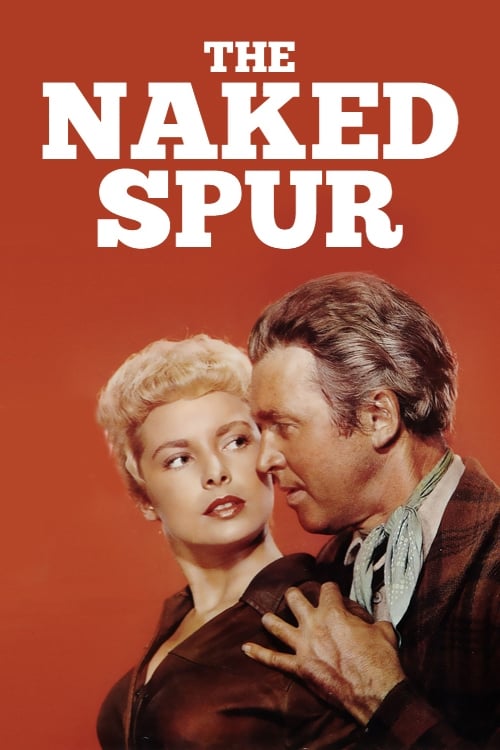
The Naked Spur
1953 · Anthony Mann
For when you want something tight and gripping you can finish in one sitting — a thriller in Western clothes that rewards your full attention.
What it's about
Bounty hunter Howard Kemp has finally caught Ben Vandergroat, the killer worth $5,000, deep in the Colorado mountains — but two strangers, a broke old prospector and a disgraced cavalry lieutenant, force themselves in as partners, and Ben travels with Lina, the loyal daughter of his dead partner. Tied to a saddle with nothing left but his tongue, Ben spends the journey talking, patiently prying at every crack in the alliance dragging him to the gallows.
The experience
Ninety-one lean minutes of pure pressure — no town, no saloon, just five people and money working on them like acid. It's tense, psychologically raw, and surprisingly bruising for a studio Western.
Performances
James Stewart plays furiously against his nice-guy image — Kemp is wounded, obsessive, and close to coming apart — while Robert Ryan makes the captive killer the most charming man on screen, which is exactly the problem. Janet Leigh holds her own in the middle of it.
The craft
Anthony Mann shoots on real Rocky Mountain locations in Technicolor and uses the terrain — rapids, cliffs, rockfalls — as an active participant, with the landscape doing the work a supporting cast normally would. The whole film runs on five credited actors, and the discipline shows in every scene.
Why it matters
The tightest of the celebrated run of Westerns Mann and Stewart made together, it helped push the genre toward darker, more psychologically damaged heroes and remains a model of stripped-down storytelling.
Snapshot
Five people, one mountain range, ninety-one minutes, and $5,000 in reward money that functions like a solvent on every human bond it touches. The Naked Spur is the third and tightest of the five Westerns Anthony Mann made with James Stewart, and the most formally radical: no town, no saloon, no posse, virtually no interiors, and a credited cast of exactly five actors. Howard Kemp (Stewart) is hunting Ben Vandergroat (Robert Ryan) for the bounty on his head, and picks up two accidental partners — a failed old prospector, Jesse Tate (Millard Mitchell), and Roy Anderson (Ralph Meeker), a cavalry lieutenant lately discharged in disgrace. Ben, tied to a saddle for most of the picture and traveling with Lina Patch (Janet Leigh), the daughter of his dead partner, spends the film doing the only thing left to him: talking. He finds the fracture line in each captor and works it.
What results is a Western reduced to its load-bearing elements — money, terrain, and character under pressure — and a study of a hero whose sickness is the film's actual subject. It received a single Academy Award nomination, for Sam Rolfe and Harold Jack Bloom's original story and screenplay, and was selected for the National Film Registry in 1997.
Industry & production
The film was made at MGM under Dore Schary, who had displaced Louis B. Mayer in 1951 and was steering the studio toward leaner, more topical, more cheaply mounted pictures. A five-character Western shot almost entirely outdoors was, in that context, an economically legible proposition: no crowd scenes, no standing sets to dress, no supporting roster on salary. It was produced by William H. Wright, and the production went on location into the Colorado Rockies — the specific sites are reported variously in secondary sources, generally in and around the San Juan range and Colorado's national forest and park land — where the company worked at altitude in real weather with real water.
The industrial timing matters. 1953 is the year the studios panicked about television and answered with size: 3-D, stereophonic sound, and, from September, CinemaScope. MGM's own first CinemaScope feature, Knights of the Round Table, arrived at the end of the year. The Naked Spur, released in the spring, belongs to the last cohort of major-studio Westerns composed for the Academy frame — and it is a film that could not have been composed the same way in 2.55:1, because its dominant axis is vertical.
The other industrial fact is Stewart. His postwar reinvention — begun with Universal's Winchester '73 (1950), the picture around which Lew Wasserman built the profit-participation deal that helped unmake the old contract system — had made him a star with unusual leverage and an unusual appetite for playing damaged men. By 1953 the Mann–Stewart Western was a reliable commercial property. Reliable contemporary box-office figures for this title are not something the public record supports with any precision, and I won't invent them; what is clear is that the cycle continued profitably through The Far Country (1954) and The Man from Laramie (1955).
Technology
Photographed in Technicolor and released in the Academy ratio, roughly 1.37:1, with monaural optical sound. 1953 sits precisely on the hinge between Technicolor's three-strip camera era and the industry's rapid conversion to Eastman single-strip color negative, and secondary sources are not consistent about which capture path this particular production took; the release prints carry the saturated, dye-transfer Technicolor look either way.
The relevant technological point is subtractive rather than additive: the film declines almost every 1953 novelty. No widescreen, no depth gimmick, no stereo. Its wager is that a hard, bright, high-altitude color image of real granite and real whitewater, at a ratio tall enough to hold a cliff face top to bottom, is spectacle enough. Location shooting at that scale — heavy Technicolor camera bodies, generators, and a full crew hauled into mountain terrain — was itself the expensive technology on display.
Technique
Cinematography
William C. Mellor, an MGM-and-Paramount veteran who had shot A Place in the Sun (1951) and would later shoot Giant and The Diary of Anne Frank, gives the film a deliberately unpicturesque Technicolor: hot, flat daylight, hard shadows, greens that read as scrub rather than pastoral. There is very little of the postcard sublime. Where John Ford used Monument Valley as a moral cathedral, Mann and Mellor use the Rockies as an obstacle course — surfaces to be climbed, crossed, fallen from.
The signature is verticality and low camera placement. Characters are repeatedly staged above and below one another on scree slopes, ledges, and riverbanks, so that the frame's y-axis carries the power relations: who is up, who is exposed, who is scrambling. Mann favors compositions that press a face into the lower corner with rock filling the rest of the frame, converting landscape from setting into pressure. In the film's set-pieces — the rockslide assault on Ben's ambush position early on, the horseback flight from the Blackfoot war party, the climactic ambush at the rapids — the camera is often at ground level, in the dust and water with the bodies.
Editing
The cutting, credited to George White (the documentary record on his working method is thin, as it is for most studio-staff cutters of the period), is classically economical and unshowy: long-held two- and three-shots during the campfire scenes, where the drama is verbal and the tension is in who is listening to whom, and a sharp acceleration into fragmented, kinetic cutting during physical crisis. The film's rhythm is a systole–diastole of talk and violence, and the editing enforces it. Crucially, the talk scenes are not over-covered; Mann lets Ryan work on his listeners inside sustained framings, so that the audience watches persuasion happen in real time rather than in shot-reverse-shot shorthand.
Mise-en-scène / staging
This is the film's greatest strength and the reason it rewards rewatching. With five bodies and no sets, every campsite becomes a blocking problem with dramatic consequences: who sleeps where, who holds the rifle, who sits between Ben and the horses, who can hear the whispering. Ben is tied and often prone, physically the most helpless figure in the frame — and Mann stages him so that his low position becomes a vantage, letting him address each man privately, in sequence, like a confessor working a line. The reward money is never seen; the group is staged around its absence.
The terrain does the plot's work. The film's dramatic turns are almost all topographic: a slope that must be climbed under fire, a wound taken on that slope, a river that can't be recrossed, a body caught in white water. Mann's frequent method — get the actor onto real, unstable ground and let the strain register — means the performances are partly a record of physical labor.
Sound
Mono, and unusually attentive to natural sound for a 1953 studio Western: wind, hooves on loose rock, and above all water. The final sequence stages its moral crisis against rapids loud enough to fight the dialogue, so that Lina's pleading has to be shouted over the river — the natural world drowning out the argument about money. Bronisław Kaper's score is agitated and brass-forward, deployed in bursts rather than as continuous underscoring; long passages of the film play with no music at all, which is why the campfire scenes feel so exposed.
Performance
Stewart gives one of the two or three most extreme performances of his career: sweating, feverish from an untreated leg wound, snapping at his partners, his famous hesitant drawl weaponized into something curdled and querulous. The moment near the end when he weeps — openly, unbeautifully, over a corpse he has just hauled out of a river for money — is one of the frankest breakdowns any major American star of that era permitted himself.
Robert Ryan's Ben is the engine. Ryan plays him as genuinely likable, jocular, almost affectionate toward his captors, which is precisely what makes him lethal: he doesn't need a gun because he has an accurate read on greed. Ralph Meeker — who had taken over Stanley Kowalski from Marlon Brando on Broadway and would soon play Mike Hammer in Kiss Me Deadly (1955) — brings a swaggering postwar physicality and casual amorality that the Western hadn't much accommodated before. Millard Mitchell, who had also appeared with Stewart in Winchester '73 and who died later that same year, gives the old prospector a pathos that makes his fate genuinely upsetting. Janet Leigh, cast against her MGM ingénue grain, is dirty, hard, and watchful.
Narrative & dramatic mode
The structure is a chamber play on horseback: a fixed small group, a linear journey, and escalating pressure with no possibility of exit. It is closer to Greek tragedy or to a wartime patrol picture than to the standard Western's town-and-frontier dialectic. There is no community to defend, no settlement to found, no institution to appeal to — the law exists only as the abstract fact that a man in Abilene will pay $5,000.
The plot's inciting deception is that Kemp lets the others believe he is a sheriff; Ben's first strategic act is to expose him, which instantly converts a lawman's authority into a three-way partnership and puts the bounty into contention. From there the drama is arithmetic: every death reduces the number of shares. Ben simply narrates that arithmetic to whoever will listen, and the film's most horrifying stretch — the old prospector lured away by talk of a gold claim — is a demonstration that he doesn't have to lie so much as name what people already want.
Genre & cycle
The Naked Spur is a central text of the 1950s "adult" or psychological Western — the cycle in which the genre turned inward and the hero acquired a pathology. Its immediate neighbors are Fritz Lang's Rancho Notorious (1952), Nicholas Ray's Johnny Guitar (1954), Robert Aldrich's Vera Cruz (1954), Ford's The Searchers (1956), and Budd Boetticher's Randolph Scott "Ranown" films (1956–60), whose small-group-in-open-country structure and charming, philosophizing antagonist are strikingly close kin — close enough that critics have long treated Boetticher and Mann as parallel poles of the decade's Western, without any need to posit direct debt.
Within the Mann–Stewart cycle itself — Winchester '73 (1950), Bend of the River (1952), this film, The Far Country (1954), The Man from Laramie (1955) — The Naked Spur is the outlier in one instructive respect: it is not written by Borden Chase. Rolfe and Bloom's original screenplay dispenses with the wagon trains, boom towns, and secondary casts Chase liked, and the result is the cycle's purest distillation.
Authorship & method
Mann came to the Western from film noir, and the transfer is legible in every frame. His late-1940s crime pictures — T-Men (1947), Raw Deal (1948), Border Incident (1949), most shot by John Alton — taught him to treat physical environment as an expressive agent and to build sequences around entrapment. In the Westerns he swapped Alton's black expressionism for Technicolor daylight while keeping the entrapment: the mountain replaces the alley. His constant motif is the hero's body as the site of the film's violence — Stewart is shot in the leg here, has his hand crushed in Winchester '73, is shot through the palm at point-blank range in The Man from Laramie. Mann's heroes are not invulnerable; they are wounded, and they limp toward whatever grace is available.
Key collaborators: Mellor's camera; Kaper, MGM's Polish-born composer, who won an Academy Award the same year for Lili and whose idiom here is nervous rather than folkloric; George White's editing; and Cedric Gibbons's nominal supervising art-direction credit, which MGM appended to nearly everything and which means comparatively little on a picture shot on rock. Sam Rolfe would go on to create Have Gun — Will Travel and co-create The Man from U.N.C.L.E.; his gift for compressed moral situations is fully visible here.
Movement / national cinema
This is Hollywood studio filmmaking at the end of the classical period — genre production of great formal sophistication made inside an industrial system by a director with no public profile as an artist. Mann's elevation to authorship came from elsewhere: French criticism took his Westerns seriously in the 1950s, and Anglo-American auteurism followed in the 1960s, notably Andrew Sarris's The American Cinema (1968) and, decisively, Jim Kitses's Horizons West (1969), whose Mann chapter established the terms — landscape as psychology, the neurotic hero, the quest as therapy — in which the films are still discussed. Jeanine Basinger's Anthony Mann (1979) consolidated the case.
Era / period
The film is set after the Civil War, and the war is the wound behind the wound: Kemp lost his ranch because he went to fight and the woman he left behind sold it. But its more urgent period is 1953. This is a postwar American picture about a veteran who came home to find his life sold out from under him, about a discharged soldier with an ugly record, about men who cannot re-enter civil society and have converted survival into transaction. Stewart himself had flown bombing missions over Europe; the darkening of his screen persona through the late 1940s and 1950s — It's a Wonderful Life, Rope, the Mann cycle, and on to Hitchcock's Rear Window and Vertigo — is one of the most legible cases of a star metabolizing a war.
Themes
Money as corrosion. The reward is never seen and never spent; it exists purely as a number that reorganizes everyone's behavior. The film's cruelest irony is reserved for the man who dies in the rapids trying to lay hands on a corpse worth $5,000 — value and body in the same current.
The wound. Kemp's festering leg is his soul made visible; his fever and his obsession advance together, and both break at once.
Persuasion as violence. Ben, bound and unarmed, kills more people than anyone else in the film, using only speech. The picture takes seriously the idea that the deadliest weapon on the trail is an accurate understanding of what a man wants.
Renunciation. The ending — hauling the body out, then breaking down and burying it — is redemption purchased at the price of the entire journey's purpose. Kemp gets his life back only by throwing away everything the film has been about.
It is worth stating a limit plainly: the Blackfoot war party pursuing Roy Anderson exists as an external hazard with no interiority, dialogue, or perspective. The film uses Anderson's offense against a Native woman to characterize him, and the pursuit to raise the tempo. That is standard for the period and it is still a real deficiency in a film otherwise so attentive to motive.
Reception, canon & influence
Contemporary American reviews were broadly favorable — the picture was received as a strong, tough Western with an unusually good Stewart performance — and the Academy nomination for original story and screenplay (lost to Titanic) registered the industry's sense that its construction was the achievement. But its canonical position was built later, by auteurist criticism, and it has since become the film most often named when the Mann–Stewart cycle is discussed, with The Man from Laramie its nearest rival. The 1997 National Film Registry listing formalized the status.
Backward. The most direct ancestor is John Huston's The Treasure of the Sierra Madre (1948): a small party in punishing terrain, dissolved by suspicion over money. Howard Hawks's Red River (1948) had already licensed the pathological Western protagonist, and Raoul Walsh's Pursued (1947) had imported psychoanalytic machinery into the genre. Behind all of it sits Mann's own noir apprenticeship, and a theatrical training — Mann worked in New York theater before Hollywood — that shows in his willingness to let five people in a clearing carry ninety minutes.
Forward. The film's structure — a compromised group, a contested body or bounty, a journey that becomes a moral siege — recurs across the Western's subsequent history. Sam Peckinpah's Ride the High Country (1962) and The Wild Bunch (1969) inherit the wounded, obsolete professional; the Italian Western's bounty-hunter economy (Leone's For a Few Dollars More, 1965) descends from this line of American pictures even where direct acknowledgment isn't documented; Clint Eastwood's Unforgiven (1992) is, among other things, a feature-length examination of what it costs to collect a reward. The confined-party-and-a-bounty scenario resurfaces in Quentin Tarantino's The Hateful Eight (2015), and the landscape-as-antagonist strain runs through Kelly Reichardt's Meek's Cutoff (2010) and the body-punishing wilderness of The Revenant (2015). Mann's Westerns are a standing reference point for filmmakers of the New Hollywood generation and after; the specific claims of debt vary in how well they are documented, and where they are inference rather than record I've marked them as resonance rather than lineage.
What endures most concretely is the demonstration: that the Western needs almost nothing — five people, a mountain, and a sum of money — to become a tragedy.
A Deleuzian reading
A man's face is jammed into the bottom corner of the frame and rock fills everything above it.
The full Deleuzian reading of The Naked Spur →
Reception
A solid hit in 1953, it's since climbed to the top of the Mann–Stewart pile — now routinely called the best of their five westerns and a founding text of the 'psychological western,' with a National Film Registry spot (1997) to prove it.
How The Naked Spur was received, from release to now →
How to watch The Naked Spur: what to notice on a first viewing
- Watch who stands above and who stands below at each campsite. Mann repeatedly places these five people on slopes, ledges, and riverbanks, so height in the frame marks who has power and who is exposed. Landscape stops being scenery and starts doing the work of a plot, deciding who can act.
- Notice that you never actually see the reward money. The $5,000 bounty is talked about constantly but never appears on screen; every campsite is staged and blocked around its absence instead. An amount nobody sees still manages to organize where everyone sits and who trusts whom.
- Watch how Robert Ryan talks to each captor differently. Ben, tied up and unarmed for most of the film, works each man's private weakness in turn, friendly and patient, like a confessor down a line. He never needs a weapon because he understands exactly what each man wants.
- Notice the camera staying low, near the dirt and water. Mellor's camera repeatedly shoots from ground level during the film's set pieces, putting you in the dust and the rapids alongside the bodies. You experience the terrain as something physically dangerous, not as a pretty backdrop.
- Watch Stewart sweat and favor his wounded leg all film. Stewart plays Kemp with an untreated leg wound that worsens steadily, his fever visibly rising in how he moves and snaps at the others. His body breaking down on screen tells you something is wrong with him that words never quite name.
The whole guide to watching The Naked Spur, with the keys for a rewatch →
Influences: the films it descends from and the films it influenced
- T-Men (1947) — Mann and John Alton established the working method the Western inherits wholesale — the frame as a trap built from foreground obstruction and extreme low camera, so that architecture (later, rock) does the dramatic work of a line of dialogue.
- Border Incident (1949) — The first Mann picture to move Alton's entrapment geometry outdoors onto real terrain, staging killings so the ground itself is the murder weapon — the direct rehearsal for the mountain that kills in the seed film.
- Pursued (1947) — Imported psychoanalytic machinery — repressed trauma driving the protagonist rather than a villain — into Western dramaturgy, licensing a hero whose antagonist is his own history, which is the only plot Kemp has.
- Red River (1948) — Cast a beloved star (Wayne) as an escalating obsessive and let the journey itself function as the pressure vessel, which is the precise permission Stewart's screaming, weeping bounty hunter exercises five years later.
- The Treasure of the Sierra Madre (1948) — The template of a small party in punishing location-shot terrain dissolved by arithmetic over money, with campsite blocking — who sits where, who sleeps facing whom — carrying the suspense instead of action.
- The Ox-Bow Incident (1943) — Proved a Western could run on a compressed cast conducting a moral trial in near-real time, the chamber-play compression that lets five people in a clearing sustain ninety minutes without a town, a saloon, or a posse.
- Winchester '73 (1950) — Founded the Mann–Stewart contract — star wounded in the body (hand crushed here, leg shot in the seed film) and finished off in a bare rock climax where the men scramble on vertical stone rather than face off on flat ground.
- Bend of the River (1952) — Perfected the Technicolor location shoot as a moral instrument — Mount Hood photographed in daylight with no process work — plus the systole-diastole rhythm of long trudging traverses punctured by sudden brutal eruptions.
- The Man from Laramie (1955) — The clearest sibling in the wounding motif: Stewart shot through the palm at point-blank range, extending the seed film's insistence that the hero's body, not a symbolic object, is where the picture's violence is registered.
- Ride the High Country (1962) — Takes the wounded, obsolete professional escorting valuable cargo through high country, and repeats Mann's casting trick — Scott and McCrea's screen personas used against themselves — with location shooting standing in for a lost world.
- For a Few Dollars More (1965) — Builds an entire economy on the bounty as a contested sum between partners who cannot trust each other, the transactional structure Mann and Rolfe stripped down to five people and a price.
- The Wild Bunch (1969) — Extends the compromised-party structure into a group whose only cohesion is a payday, and inherits Mann's rhythm of long dusty passages detonating into disproportionate violence — plus the bodies-take-the-damage ethic.
- Unforgiven (1992) — A feature-length audit of what collecting a reward costs the collector, staged largely in campsites and interiors with sparse scoring, reversing the Mann arc — the wound is moral, and the man does not limp toward grace.
- Meek's Cutoff (2010) — Returns to the Academy ratio precisely to squeeze the party and make the landscape a pressure rather than a vista, with the drama carried by sustained wide two-shots at the wagons and diegetic sound — water, wheels — instead of score.
- The Hateful Eight (2015) — The confined-party-and-a-bounty scenario made explicit: a contested body worth money, a fixed set of suspicious characters, and blocking that tracks who is seated where relative to the door and the stove.
- The Revenant (2015) — Carries the Mann principle that the terrain does the violence to its logical extreme — real-location shooting in punishing conditions with the hero's mutilated body as the film's primary text and the score reduced to atmospheric drone.
- 3:10 to Yuma (2007) — Mann's two-hander establishes the prototype Mangold inherits: a bounty hunter transporting a captured criminal across hostile terrain while the prisoner psychologically manipulates his captor's self-image, using the journey's spatial confinement as the primary pressure mechanism.
- The Outlaw Josey Wales (1976) — Model for the morally troubled, revenge-corroded hero whose psychology is externalized through punishing wilderness pursuit, the template for Josey's vengeance curdling into exhaustion rather than catharsis.
- El Cid (1961) — Mann's method of externalizing moral conflict as terrain — every reversal of loyalty staged on a specific gradient, ledge, or river crossing that the camera keeps geographically legible — is the exact procedure transposed to Castile, where Rodrigo's choices are always sited on a bridge, a gate, or a slope.
- Man of the West (1958) — Strips the cast down further to a handful of people in a shack and a gully, pushing the chamber-play Western to its limit and confirming that Mann's unit of construction is the confined group, not the frontier panorama.
- The Searchers (1956) — Parallel solution to the same problem — a star's likability weaponized as racial-sexual obsession, and a journey structured as a series of camp scenes where landscape scale mocks the party's moral smallness.
- 3:10 to Yuma (1957) — Psychological captor/captive western whose bound prisoner manipulates and corrodes his keepers through proximity — the moral-erosion duel Yuma chambers indoors.
Similar films
- Winchester '73 (1950) — influence & lineage
- The Man from Laramie (1955) — influence & lineage
- The Treasure of the Sierra Madre (1948) — influence & lineage
- The Ox-Bow Incident (1943) — influence & lineage
- The Searchers (1956) — influence & lineage
- The Hateful Eight (2015) — influence & lineage
- Pursued (1947) — influence & lineage
- Unforgiven (1992) — influence & lineage