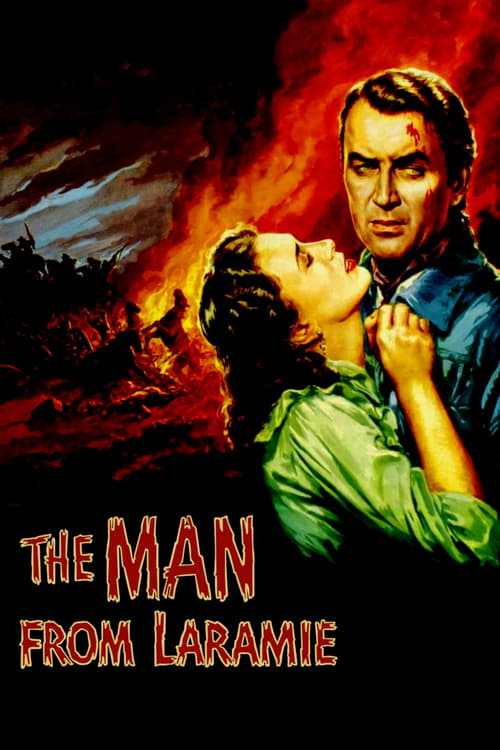
The Man from Laramie
1955 · Anthony Mann
When you want a Western with teeth — a lean, dark story of obsession and family rot rather than white hats and easy justice.
What it's about
A stranger arrives in an isolated New Mexico town hauling freight, but he's really hunting the man who sold repeating rifles to the Apache band that wiped out his brother's cavalry patrol. The trail leads into a powerful ranching dynasty — an aging, half-blind patriarch, his volatile son, and an ambitious foreman raised almost as family — where everyone seems to be hiding something.
The experience
A revenge Western pitched at the temperature of tragedy: tense, surprisingly brutal for its era, and streaked with real anguish. The violence lands hard because the film makes you feel its cost.
Performances
James Stewart, in his final Western with Anthony Mann, digs into the raw, obsessive side of his persona — a decent man worn down to bare nerve and rage, a world away from his folksy image.
The craft
Anthony Mann shoots the New Mexico landscape in widescreen not as scenery but as pressure — harsh, exposed country that mirrors the cruelty of what happens in it. The direction gives a pulp revenge plot the shape and weight of tragedy.
Why it matters
The culmination of the Mann–Stewart run of Westerns, one of the defining director-star partnerships of the 1950s, and a key step in the genre's turn toward darker, psychologically wounded heroes.
Snapshot
The Man from Laramie is the fifth and final Western that Anthony Mann and James Stewart made together, and it functions as both a culmination and a coda to one of the most consequential director-star partnerships of the American 1950s. Stewart plays Will Lockhart, a freight hauler and former cavalry captain who arrives in the isolated New Mexico town of Coronado nominally to deliver goods but actually to find whoever sold the repeating rifles that armed the Apache band that massacred his younger brother's patrol. His search entangles him with the Waggoman ranching dynasty — the aging, half-blind patriarch Alec, his volatile son Dave, and the ambitious foreman Vic Hansbro who has been raised almost as a second son. The film is a revenge Western pitched at the temperature of tragedy: brutal, elegiac, structured around a patriarch's ruin and a stranger's refusal, finally, to become an instrument of vengeance. It is also Mann's first film in CinemaScope, and among the most formally assured widescreen Westerns of its moment.
Industry & production
The film was produced and released by Columbia Pictures in 1955, part of Hollywood's mid-decade effort to lure audiences back from television with color, spectacle, and the anamorphic width of CinemaScope (which Twentieth Century-Fox had introduced in 1953 and quickly licensed across the industry). It was photographed in Technicolor and shot substantially on location in New Mexico, in the high country around Santa Fe — real terrain rather than backlot, consistent with Mann's conviction that landscape should carry dramatic weight rather than serve as backdrop.
The screenplay was written by Philip Yordan and Frank Burt, adapting a story by Thomas T. Flynn that had appeared as a serial in The Saturday Evening Post before publication as a novel. Yordan was a prolific and much-discussed figure of the period — a screenwriter whose credits are sometimes complicated by his known practice of fronting for blacklisted writers, so attributions from these years should be read with some caution; the exact division of labor on this particular script is not something the historical record settles cleanly. Stewart by this point was not merely the hired lead but a central creative and commercial engine of the Mann Westerns, having pioneered profit-participation deals earlier in the decade (most famously on Winchester '73, 1950) that reshaped how top stars were compensated. Precise budget and box-office figures for The Man from Laramie are not reliably documented in the sources available to me, and I will not invent them; the film is generally understood to have been a solid performer within the successful Mann-Stewart cycle rather than an outlier hit or flop.
One production footnote with unusual reach: the title song, "The Man from Laramie" (music and lyric credited to Lester Lee and Ned Washington), became a genuine popular hit in Britain, where Jimmy Young's recording topped the UK chart in 1955 — a rare case of a Western's theme achieving a cultural life well beyond the picture itself.
Technology
The defining technical fact of the film is CinemaScope. This was Mann's first encounter with the anamorphic widescreen process, and the format's demands — a roughly 2.55:1 frame, the "letterbox" width that early directors often distrusted as better suited to snakes and funerals than to intimate drama — forced a rethinking of composition. The Technicolor cinematography, whether via three-strip or the increasingly common Eastmancolor-based Technicolor process of the mid-1950s, gave Mann's New Mexico exteriors a saturated, weathered palette. The technological interest of the film lies precisely in the tension between an emphatically horizontal format and Mann's instinct for depth, verticality, and the compression of figures within hostile space — a problem he solves rather than surrenders to.
Technique
Cinematography
The cinematographer was Charles Lang, one of the most accomplished camera artists in Hollywood, and the film's images are among the reasons it endures. Lang and Mann use the CinemaScope width to isolate Lockhart against enormous stretches of land and sky, so that the human figure reads as small, exposed, and precarious. Rather than filling the wide frame with incident, they frequently empty it, letting negative space become an expressive value — the loneliness and vulnerability of the outsider made literal by scale. Interiors and confrontations are staged in strong depth, with foreground and background planes held in tension. Mann's recurring visual idea — the placement of characters in relation to rock, ridge, and drop — organizes the film's moral geography: elevation and descent, exposure and cover, become the grammar of danger.
Editing
The film was cut by William A. Lyon, a veteran Columbia editor. The editing serves Mann's characteristic rhythm, which alternates long stretches of tense, deliberate observation with sudden eruptions of violence. The most notorious instance — the scene in which Dave Waggoman has Lockhart's men hold him down and shoots him through the hand at point-blank range — is built for maximum shock precisely because the surrounding cutting is patient; the abruptness of the act lands harder against the film's otherwise measured tempo. The action set pieces (the burning of Lockhart's wagons and the slaughter of his mules, the mountain confrontations) are constructed for clarity of geography, so that the viewer always understands who stands where on the terrain.
Mise-en-scène / staging
Mann's staging is the film's signature. He blocks scenes to express hierarchy, obligation, and threat spatially — the patriarch above, the sons contending below; the stranger hemmed in by men and rock. The salt flats where Lockhart hauls his wagons, the Waggoman ranch, the mountain passes, and the town of Coronado each carry a distinct dramatic charge. The recurring motif of Alec Waggoman's failing eyesight is staged as much as spoken: a man who cannot see what is happening within his own household, groping toward a truth the audience already dreads. Violence in Mann is rarely clean or heroic; it is staged as something that damages the body of the protagonist and degrades everyone it touches.
Sound
George Duning composed the score, and its most memorable element is the title theme, whose melody recurs through the film as a lyrical counterweight to the harshness of the action — the sound of the lone rider, romanticized even as the images refuse romance. Beyond the score, the film's sound design leans on the concrete textures of the Western: gunfire made shockingly loud in the assault scenes, the ambient emptiness of the exteriors. Detailed technical documentation of the sound work is thin in the standard literature, and I won't overstate what the record supports.
Performance
Stewart gives one of the definitive performances of his Mann period. The persona he built with Mann — decisively distinct from the gentle everyman of his Capra and pre-war roles — is a man of barely governed rage, capable of cruelty, driven by grief and a hunger for retribution that curdles toward obsession. Lockhart is courteous on the surface and volcanic beneath, and Stewart lets the neurosis show. Arthur Kennedy, as Vic Hansbro, delivers the film's other great performance: a man whose ambition and thwarted belonging drive him to betrayal, played with a wounded, resentful humanity that keeps him from being a mere villain. Donald Crisp brings Old Testament weight to Alec Waggoman, the failing patriarch. Alex Nicol plays Dave as pure spoiled menace; Aline MacMahon, as the rival rancher Kate Canaday, and Cathy O'Donnell, as Barbara Waggoman, anchor the film's counter-currents of loyalty and tenderness. Wallace Ford appears in support.
Narrative & dramatic mode
The dramatic mode is tragedy grafted onto the revenge Western. The narrative advances on two tracks that converge: Lockhart's investigation into the rifle-runner, and the internal disintegration of the Waggoman family. What distinguishes the film from a conventional revenge plot is its ending. Having pursued his brother's killers across the whole picture, Lockhart arrives at a position where he could take blood vengeance — and declines it. He forces the guilty man to destroy the cache of repeating rifles rather than gunning him down, and the desert and the Apaches, not Lockhart's pistol, deliver the final reckoning. The hero renounces the very drive the genre exists to satisfy, and rides away rather than kill. This makes the film a meditation on the cost of vengeance as much as an enactment of it — the revenge Western turned, at the last moment, against its own machinery.
Genre & cycle
The Man from Laramie belongs to the "psychological" or "adult" Western that flourished in the 1950s, and specifically to the Mann-Stewart cycle: Winchester '73 (1950), Bend of the River (1952), The Naked Spur (1953), The Far Country (1954), and this film. Across that cycle Mann and Stewart rebuilt the Western hero as a figure of trauma, compulsion, and moral instability, and used the genre to stage Oedipal and fraternal conflict, greed, and the wounds of the past. Laramie is the cycle's terminus and, many argue, its most explicitly tragic entry — the one that most nakedly borrows the architecture of classical and Shakespearean tragedy. It sits alongside the decade's other revisionist Westerns (the work of Budd Boetticher, the darker films of the era) in dismantling the genre's innocence from within.
Authorship & method
Anthony Mann is the film's decisive author, and it distills his method: landscape as psychology, violence as damage, the hero as a man at war with himself. Mann's control of figures in real terrain — his sense that a mountain or a salt flat could externalize an inner state — is the through-line of his Westerns, and here it meets, for the first time, the challenge of the wide frame. His key collaborators shape the result: cinematographer Charles Lang, whose widescreen compositions give the film its scale and loneliness; composer George Duning, whose theme became the film's most portable legacy; editor William A. Lyon, whose cutting sets the alternation of patience and shock; and writers Philip Yordan and Frank Burt, adapting Thomas T. Flynn. Stewart, again, must be counted among the authors: the persona he and Mann developed together — the pleasant man with fury underneath — is inseparable from the films' meaning. This was the last of their Westerns; they did not reunite on the genre again, and accounts of the partnership's cooling vary, so I'll refrain from asserting a single cause.
Movement / national cinema
This is thoroughly American studio cinema — a Columbia production made inside the classical Hollywood system during its widescreen, anti-television phase of the mid-1950s. It is not part of a self-conscious movement in the European sense, but it belongs to the broad current of the mature American Western at its artistic peak, and to the specific auteurist achievement later critics (particularly the French, and Anglophone writers after them) would identify in Mann. Its national character is inseparable from its subject: the mythology of the American West interrogated rather than celebrated, the frontier community rendered as a place of hidden guilt and dynastic rot.
Era / period
The Man from Laramie is a product of 1955 Hollywood — the moment when CinemaScope and color had become standard weapons in the studios' defense against television, and when the Western was simultaneously ubiquitous and being pushed toward greater psychological and moral complexity. Its themes of familial disintegration, buried violence, and a hero's tormented interiority resonate with the wider American culture of the mid-1950s, an era increasingly preoccupied (in its melodramas and in emerging Method-influenced performance) with generational conflict and the fault lines beneath domestic authority. The film's diegetic period is the post-Civil War Southwest, with the rifle-running plot rooted in the historical reality of arms trafficking to Native nations during the Apache conflicts — though the film treats the Apache largely as an offscreen threat rather than as characters, a limitation typical of the genre in this period.
Themes
The governing theme is vengeance and its renunciation: the film builds an entire revenge structure only to have its hero step back from the kill. Braided with it is the theme of the family as a site of tragedy — the aging patriarch, the unworthy heir, the loyal outsider consumed by resentment at never truly belonging. Blindness, literal and moral, recurs throughout: Alec Waggoman's failing sight is the emblem of a man who cannot see the ruin growing under his roof, and the film extends the metaphor to the ways obsession and pride blind everyone. Belonging and exclusion drive the tragedy — Vic Hansbro's betrayal is the act of a man who was promised a place he was never truly given. And running beneath it all is the Mann preoccupation with the body in pain, the cost of violence written on flesh rather than glorified.
Reception, canon & influence
Critically, The Man from Laramie has ascended over the decades from well-regarded genre picture to acknowledged classic, and it is now routinely treated as one of the finest of the Mann-Stewart Westerns and among the key Westerns of the 1950s. The recurring critical touchstone — advanced by serious writers on Mann, including scholars such as Jeanine Basinger — is the film's kinship with Shakespeare's King Lear: the blind and failing patriarch, the two contending "sons," the household torn apart by the question of inheritance and loyalty. That reading has become inseparable from the film's reputation and marks the high point of the claim that the 1950s Western could carry the weight of classical tragedy.
Looking backward, the film draws on the deep well of Western mythology, on the tragic architecture of Shakespeare, and above all on the accumulated grammar of the four preceding Mann-Stewart films, whose portrait of the wounded, vengeful hero it perfects. Its literary source in Thomas T. Flynn's story anchors it in the mid-century popular-fiction Western.
Looking forward, its influence runs through the subsequent revisionist Western and, more broadly, through the reputation of Anthony Mann as an auteur whose command of landscape and psychology helped legitimize the genre for later critics and filmmakers. The Mann-Stewart model of the compromised, obsessive protagonist can be felt in the darker Westerns that followed across the late 1950s and 1960s. And in its own strange way the film left a mark on popular music: the title theme's chart success in Britain gave The Man from Laramie a second, unexpected afterlife as a song, decoupled from the picture that produced it. Where the documentary record on specific figures — budgets, grosses, the precise authorship of the script — is genuinely thin, the enduring critical consensus is not: this is Mann and Stewart's Western reaching for tragedy, and, in the judgment of most who have written on it, reaching it.
A Deleuzian reading
Men hold him down and Dave Waggoman shoots him through the hand at point-blank range.
The full Deleuzian reading of The Man from Laramie →
Reception
A solid hit in 1955 that was treated as just another sturdy Stewart western; the French auteurists' championing of Anthony Mann and decades of reappraisal have since elevated it into the capstone of one of Hollywood's great actor-director runs.
How The Man from Laramie was received, from release to now →
Influences: the films it descends from and the films it influenced
- Raw Deal (1948) — Mann's noir apprenticeship with cinematographer John Alton, where trapped figures are pinned by expressionist light and violence registers as bodily damage — the visual grammar he later transposed onto Western terrain.
- Devil's Doorway (1950) — Mann's first Western establishes his signature staging of a lone, doomed protagonist against oppressive landscape, treating exterior geography as the externalized pressure of an inner tragedy.
- Winchester '73 (1950) — Launches the Mann-Stewart persona — the affable man whose fury erupts into disproportionate, obsessive violence — the neurotic-hero template that Laramie perfects.
- The Furies (1950) — Mann's earlier study of a ranching patriarch and contested inheritance rehearses the King Lear architecture — the failing father and warring heirs — that structures Laramie's household.
- The Naked Spur (1953) — Perfects Mann's use of real mountain terrain as psychological arena, with Stewart's revenge-crazed bounty hunter scaling rock faces that literalize his moral degradation.
- The Far Country (1954) — The immediately preceding Mann-Stewart film refines the alternation of long, patient observation and sudden brutal shock that editor William Lyon deploys again in Laramie.
- Pursued (1947) — An early psychological Western that imports noir's traumatized, memory-haunted protagonist into the genre, prefiguring Mann's damaged, war-with-himself hero.
- The Gunfighter (1950) — Reframes the Western hero as a doomed, tragic figure imprisoned by his own reputation, legitimizing the genre's reach toward classical tragedy that Laramie extends.
- Duel in the Sun (1946) — Deploys saturated Technicolor and operatic landscape to render sexual and familial psychosis, an early model for the Western as color-drenched psychological melodrama.
- Ride the High Country (1962) — Inherits Mann's aging, morally compromised protagonists and elegiac tragedy, carrying the wounded-hero ethos into the elegy for the West.
- The Wild Bunch (1969) — Radicalizes Mann's insistence that screen violence be felt as physical damage, turning the sudden-shock rhythm into visceral, bloody spectacle.
- Once Upon a Time in the West (1968) — Builds an entire film around a revenge quest and a recurring musical theme fused to landscape, monumentalizing Mann's landscape-as-psychology and title-motif into operatic form.
- Ran (1985) — Transposes King Lear — the blind failing patriarch and warring heirs that critics read into Laramie — onto epic terrain where landscape carries the tragedy's moral weight.
- Unforgiven (1992) — Consummates the 'revenge renounced' strand and the theme of violence as irreversible damage, its reformed killer dragged back to brutality descending directly from Mann's compromised, self-warring hero.
- El Cid (1961) — Mann's first CinemaScope film worked out the deep lateral composition El Cid runs on: antagonists pinned at opposite frame edges with usable depth between them, and humiliation (the dragging through fire, the hand shot) staged in one wide unbroken take rather than cut into.
- One-Eyed Jacks (1961) — Direct precedent for the film's central atrocity — the hero's gun hand deliberately destroyed at point-blank range as a ritual of humiliation — and shot by Charles Lang, whose wide-screen placement of small figures against punishing terrain Brando hired him to repeat in VistaVision.
- Johnny Guitar (1954) — A contemporary Trucolor Western that pushes psychology and neurosis to expressionist extremes, sharing Laramie's conviction that the genre could carry operatic emotional derangement.
- The Searchers (1956) — Ford's VistaVision epic centers an obsessive, racially poisoned avenger whose fury dwarfs his cause, staging Monument Valley as the mirror of a psyche — the landscape-as-psychology and revenge-driven hero running parallel to Mann.
- Man of the West (1958) — Mann's late CinemaScope Western pushes violence-as-damage and a reformed man dragged back into brutality even further, the direct continuation of Laramie's method with Gary Cooper in the Stewart role.
- The Big Country (1958) — Mann's CinemaScope psychological Western that embeds neurotic conflict in punishing, depth-composed terrain, a parallel effort to make widescreen landscape express interior moral pressure.
Similar films
- Winchester '73 (1950) — influence & lineage
- The Naked Spur (1953) — influence & lineage
- The Searchers (1956) — influence & lineage
- Unforgiven (1992) — influence & lineage
- The Gunfighter (1950) — influence & lineage
- Pursued (1947) — influence & lineage
- The Man Who Shot Liberty Valance (1962) — shared sensibility
- Shane (1953) — shared sensibility