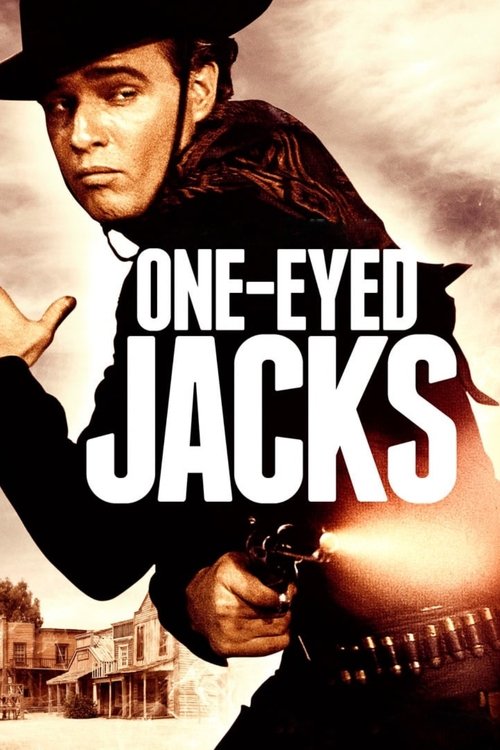
One-Eyed Jacks
1961 · Marlon Brando
For a long evening when you want a classic western with psychological rot under the surface — something to sink into slowly rather than a quick-draw crowd-pleaser.
What it's about
After a bank robbery in Mexico goes wrong, the outlaw Rio is abandoned by his partner Dad Longworth, who rides off with the gold and leaves him to five years in prison. When Rio finally escapes, he tracks Dad to a California coastal town where the old thief has reinvented himself as a respectable sheriff with a family. Rio's revenge starts as a patient game of charm and insinuation — aimed partly at Dad's stepdaughter — and becomes something he can't steer.
The experience
Unhurried, brooding, and strange for a western — it lingers on humiliation and wounded pride where other films would cut to the gunfight. The pace is luxuriant, the cruelty personal, and the seaside setting gives the whole thing an odd, dreamlike beauty.
Performances
Marlon Brando directs himself as a smoldering, resentful Rio, and Karl Malden matches him as Dad — genial, guilty, and quietly vicious. Katy Jurado and Pina Pellicer bring real tenderness to a film otherwise built on betrayal.
The craft
The only film Brando ever directed, shot in VistaVision and Technicolor against the surf at Monterey — almost no western before it looked like this, with the Pacific crashing behind the standoffs. The framing is patient and painterly, and it genuinely rewards the biggest screen you can find.
Why it matters
A notorious, over-budget production that ended Brando's directing career before it started, later re-evaluated as a genuinely personal, ahead-of-its-time western whose themes of betrayal and revenge echo through decades of the genre.
Snapshot
One-Eyed Jacks is the only film Marlon Brando directed, and it carries the marks of that singularity everywhere: a Western of luxuriant length and unhurried cruelty, photographed in VistaVision and Technicolor against the Pacific surf at Monterey, in which the genre's usual arithmetic of revenge is slowed almost to a standstill so that humiliation can be examined at leisure. Rio (Brando) is betrayed by his partner Dad Longworth (Karl Malden) after a bank robbery in Sonora, serves five years in a Mexican prison, escapes, and finds Dad installed as the respectable sheriff of Monterey with a Mexican wife, Maria (Katy Jurado), and a stepdaughter, Louisa (Pina Pellicer). Rio's revenge begins as seduction-by-proxy — he courts Louisa to wound her stepfather — and curdles into something he cannot control when he falls in love with her.
The film's title supplies its thesis. In a deck of cards, the jacks of spades and hearts are drawn in profile, showing one side of the face only; Rio's taunt to Dad — that he is a one-eyed jack in this town, but that Rio has seen the other side of his face — states the film's obsession with respectability as a mask worn over predation. Made by Brando's own Pennebaker Productions for Paramount, it ran catastrophically over schedule and budget, was taken from him and re-cut, failed commercially, and then spent decades circulating in degraded public-domain prints before a 2016 restoration returned it to view. It is now generally read as a hinge object: the last gasp of the studio-era prestige Western and an early, unstable specimen of the revisionist one.
Industry & production
The production is a textbook case of the post-Paramount-decree Hollywood in which stars, not studios, initiated pictures. Pennebaker Productions — named for Brando's mother, Dorothy Pennebaker Brando — was one of a cluster of star-owned companies (Kirk Douglas's Bryna, Hecht-Hill-Lancaster, later Newman's ventures) that took creative control in exchange for absorbing risk. Paramount financed and distributed; Frank P. Rosenberg produced.
The source was Charles Neider's 1956 novel The Authentic Death of Hendry Jones, a spare, elegiac transposition of the Billy the Kid–Pat Garrett legend to the Monterey coast, narrated retrospectively by a member of the outlaw's band. The adaptation history is unusually crowded. Sam Peckinpah, then a television writer moving toward features, produced early screenplay work and was let go; the final credited screenplay is by Guy Trosper (Jailhouse Rock, later The Spy Who Came in from the Cold) and Calder Willingham (co-writer of Kubrick's Paths of Glory, later The Graduate and Little Big Man). Stanley Kubrick was engaged to direct and departed in 1958 amid disagreements with Brando over script and casting; he moved almost immediately to replace Anthony Mann on Spartacus. Brando then took the chair himself — by most accounts less out of long-held ambition than because the project had consumed too much of him to hand off again.
What followed is the part of the film's history that everyone knows. Shooting ran roughly six months against a schedule of about two, largely on location around Monterey, the Big Sur coast, and desert exteriors, with Paramount interiors. The budget, initially set in the region of $1.8 million, is generally reported to have reached about $6 million. Brando shot enormously — figures approaching a million feet of exposed film are commonly cited — and worked slowly, notoriously waiting on weather, light, and the sea itself. Editing stretched across many months; the widely repeated account holds that Brando's assembly ran somewhere near five hours, that he then delivered a cut of roughly half that, and that Paramount ultimately took the picture from him, trimming it to the released 141 minutes and altering the ending, including material that in Brando's conception was considerably bleaker for Louisa. The specifics of what was shot, what was reshot, and by whom have never been fully documented, and the long cuts do not survive in circulation; that gap should be stated plainly rather than filled in.
The film underperformed badly relative to its cost. Brando never directed again. A later lapse in copyright renewal pushed the title into the American public domain, which meant that for decades it was available chiefly in muddy, cropped, unauthorized video editions — a material fact that shaped its reputation as much as any review. A 4K restoration, presented by Martin Scorsese and Steven Spielberg and issued by the Criterion Collection in 2016, restored the VistaVision image and effectively reopened the critical case.
Technology
One-Eyed Jacks was photographed in VistaVision, Paramount's large-negative process in which 35mm stock runs horizontally through the camera across eight perforations, yielding a negative roughly twice the area of standard 35mm. Introduced in 1954 as the studio's answer to CinemaScope, VistaVision bought resolution and tonal smoothness rather than extra width: release prints were normally reduction-printed to conventional 35mm and masked for projection at about 1.85:1. The result is a widescreen image of exceptional fineness of grain and depth — precisely the qualities that survive best in landscape and in skin, and precisely what the public-domain dupes destroyed.
By 1961 the format was being retired; One-Eyed Jacks stands among the last American features photographed in it. VistaVision's afterlife was technical rather than dramatic: the large negative made it the preferred format for optical effects compositing, and it was revived for that purpose in the late 1970s at Industrial Light & Magic. Color was by Technicolor. The heavy VistaVision camera was a poor fit for the improvisatory, weather-dependent coastal shooting Brando insisted on, and much of the production's slowness is inseparable from the apparatus.
Technique
Cinematography
Charles Lang — one of the most nominated cinematographers in Academy history, and the eye behind Gunfight at the O.K. Corral and The Magnificent Seven — received the film's sole Oscar nomination, for Best Cinematography, Color. His work here is the strongest argument for the picture. The controlling idea is geographic: this is a Western played out at the continent's edge, and Lang repeatedly stages against surf, wet sand, fog, and the pale wash of coastal light. The ocean does what mesas and buttes do in Ford — supplies scale and indifference — but with an added finality. There is no further west.
Interiors and the Mexican sequences run darker and more sculptural, with strong sidelight and deep blacks that isolate faces within the wide frame. Lang exploits VistaVision's tonal range in the transitions between hard exterior daylight and the smoky, lamp-lit rooms where the film's talking and lying get done. The compositions favour long-held wide and medium-wide setups over aggressive coverage, which gives performers room to hang in the frame — a director's-of-actors instinct showing up as a photographic strategy.
Editing
Archie Marshek, a Paramount veteran with credits reaching back to the early sound era, is the credited editor, but the released cut is unavoidably a studio artifact: the shape we watch is the product of the picture being taken away from its director. The rhythm is slow by 1961 commercial standards and slower still by genre standards — scenes are allowed to idle, dialogue exchanges run past their informational purpose, and the revenge plot is repeatedly suspended for long stretches of courtship, drinking, and waiting. Read charitably, this is the film's method: revenge deferred until it rots. Read unsympathetically, it is indulgence. Both readings were available to contemporary critics and both were taken.
The one place the cutting turns hard and percussive is violence — the flogging on the hitching rail, the shootings — where the film abruptly shortens its shots and lands the blow.
Mise-en-scène / staging
Brando's staging is essentially theatrical in the Actors Studio sense: he blocks for the actor's body and lets the camera accommodate. Business is dense and specific — hands, food, hats, cards, whiskey — and lines are often delivered while the speaker is turned away or occupied, so that meaning arrives obliquely. The Monterey scenes build a whole social architecture of respectability (the sheriff's office, the fiesta, the family table) that exists to be exposed as a set.
The most famous sequence is the public whipping: Dad ties Rio to a hitching rail, flogs him before the town, and then smashes his gun hand with a rifle butt. It is staged as a civic ritual with the community watching — the punishment of an outlaw by a lawman who is the same man — and it functions as the film's structural center, the wound around which everything else organizes.
Sound
Hugo Friedhofer, Oscar winner for The Best Years of Our Lives and composer for The Young Lions, supplies a score that leans on Mexican and Californio idiom — guitar and brass coloring, dance material for the fiesta — set against a broader romantic line for Rio and Louisa. It is a late-studio symphonic score used with more restraint than the era's norm; long passages of the coastal scenes carry surf and wind rather than music. The soundscape's Mexican textures do real thematic work, marking the world Rio moves easily within and Dad has married into without belonging to.
Performance
The film is a compendium of playing styles held in productive tension. Brando's Rio is the Method star at full stretch — mumbled charm, sudden stillness, an eroticized capacity for being hurt that runs through his career from On the Waterfront onward. Karl Malden's Dad Longworth is the performance that keeps the film honest: not a sneering villain but a man who has genuinely persuaded himself that his betrayal was reasonable, and whose bonhomie is only ever a half-inch from violence. That Brando and Malden had played opposite each other in A Streetcar Named Desire and On the Waterfront gives their scenes a used, biographical friction.
Katy Jurado (High Noon) brings weight and moral clarity to Maria. Pina Pellicer, the Mexican stage actress making her American debut as Louisa, gives a raw, unpolished, interior performance quite unlike Hollywood ingénue playing; she made only a few further films and died in 1964. Around them Brando assembles genre faces — Ben Johnson from the Ford stock company, Slim Pickens as a sadistic deputy, Elisha Cook Jr., and Timothy Carey, whose grotesque energy carries over from Kubrick's The Killing and Paths of Glory.
Narrative & dramatic mode
The armature is classical revenge tragedy, but the film systematically frustrates its own momentum. Rio has one goal and 141 minutes in which not to accomplish it; the plot's real subject is what waiting does to him. The seduction of Louisa converts revenge into a moral trap: the instrument of his vengeance becomes the one person whose good opinion he wants, and the lie he tells her poisons any victory he might win over Dad.
Structurally the film is a diptych — Sonora and Monterey, freedom and settlement, the outlaw's world and the civic one — joined by the ellipsis of five prison years. Dramatically it operates less through incident than through repeated confrontations in which two men who know exactly what the other has done perform cordiality. The mode is closer to chamber drama than to action Western; the violence, when it comes, is punctuation rather than syntax.
The released ending is the film's most contested feature. As it stands, the resolution grants a survival and a future that the preceding two hours have not obviously earned, and the reported existence of a darker authorial version has encouraged critics to read the finale as an imposition. That reading is plausible but not verifiable from the surviving materials.
Genre & cycle
The film sits inside the late-1950s adult or psychological Western, the cycle in which the form turned inward: Ford's The Searchers (1956), Mann's Man of the West (1958), Arthur Penn's The Left Handed Gun (1958). Penn's film is the closest sibling — another Method-inflected, psychoanalytic reworking of the Billy the Kid legend, with Paul Newman playing the Kid as an inarticulate adolescent. Neider's novel and hence Brando's film draw on the same legend, but rename and relocate everyone, converting myth into a private story about a father who sells a son.
Its immediate context is a genre under pressure. By 1961 the Western had migrated en masse to television, where Gunsmoke and Bonanza served the mass audience; feature Westerns responded by getting longer, darker, more sexually frank, and more skeptical about law. One-Eyed Jacks belongs with Ride the High Country, Lonely Are the Brave, and The Man Who Shot Liberty Valance — all 1962 — in registering the closing of the frontier as an ethical rather than merely historical event. Its Pacific setting literalizes that closure.
Two further generic features mark it as transitional: the sympathetic, fully inhabited Mexican world (rather than the genre's usual backdrop of bandits), and the frank sadomasochism of the flogging sequence, which pushes at what the weakening Production Code would tolerate.
Authorship & method
Brando's direction is not the work of a stylist. He shows little interest in montage or in visual signature, delegating the image to Lang, and enormous interest in duration, behavior, and the moment when an actor stops performing. His method — long takes, extensive improvisation, many takes, waiting for conditions — was the same one that made him extraordinary as a performer and unmanageable as a director inside a studio budget. The film is therefore an experiment in whether Actors Studio process can be scaled to industrial production; the honest answer the production gives is no, at least not at Paramount in 1960.
The key collaborators pull in useful directions. Lang supplies classical Hollywood craft at its most refined, which is what keeps the picture legible. Friedhofer supplies emotional continuity across sequences that Brando was content to leave unresolved. Willingham and Trosper bring, respectively, a novelist's taste for cruelty in dialogue and a professional's structural discipline; Peckinpah's uncredited early labor on the material would resurface transformed in his own Pat Garrett and Billy the Kid (1973), which returns to the Kid–Garrett story with the betrayed-partnership theme intact. Marshek's editing credit stands over a cut whose final authority was the studio's.
The result is a genuinely divided authorship — an auteur film whose author was removed before the last decision was made — and criticism of it has to hold that division rather than resolve it.
Movement / national cinema
This is American studio cinema in its terminal phase, and specifically the moment when the New York theater and the Actors Studio finished colonizing Hollywood. Brando is the vector; One-Eyed Jacks is what happens when the Method takes the megaphone. It belongs to a small tradition of one-off films by actors — Charles Laughton's The Night of the Hunter (1955) is the standing comparison, another commercially punished, visually ravishing single directorial credit later canonized — and to the broader shift of production power from studios to star-run independents.
It is also, unusually for a Hollywood Western, a film with a substantial and non-condescending Mexican dimension: Jurado and Pellicer are given interiority, the Sonora sequences are played partly on Mexican terms, and the border between Anglo law and Mexican life is drawn as a moral rather than merely scenic frontier.
Era / period
1961 is the Western's late prestige moment and Hollywood's structural crisis point: shrinking audiences, collapsing contract systems, the Production Code fraying, roadshow lengths and widescreen formats deployed against television. One-Eyed Jacks exhibits every symptom — large-format photography, star-producer control, runaway costs, adult content, and a running time that presumes the audience will sit still. Within two years the Western's center of gravity would begin shifting to Italy, and within a decade the American Western would be openly elegiac. The film reads now as a document of the interval before both.
Themes
The false father. Dad Longworth is named for what he is. The film's deepest wound is not robbery but paternal betrayal — a man who left a boy to be taken — and its revenge plot is really a demand for acknowledgement that Dad is constitutionally unable to give.
Respectability as disguise. The one-eyed jack shows one face. Dad's badge, his marriage, and his standing are not a reform but a better hiding place; the film's most unsettling suggestion is that civic order is where predators go to be safe.
Humiliation and the male body. The flogging places Brando's body in the position his career kept returning to: beaten, exposed, publicly broken. The film treats male pain as spectacle and as erotics with a directness rare for 1961.
Revenge as self-consumption. Rio's vengeance ruins the one relationship it passes through. The seduction-as-weapon device makes vengeance and love the same act, which is why the film cannot end cleanly.
The end of the West. Set at the continental edge, the film stages the frontier's exhaustion geographically. There is nowhere further to run, which is why everyone must finally deal with each other.
Reception, canon & influence
Influences on the film (backward). Neider's novel is the direct source, and behind it the whole Billy the Kid literature, including Walter Noble Burns's romantic Saga of Billy the Kid. Generically, the film inherits from Ford the landscape-as-moral-space and from Anthony Mann the Western as psychological torment. Penn's The Left Handed Gun had already proved that the Kid legend could carry Method interiority. Brando's own filmography is the other precursor: the beaten hero of On the Waterfront, the Mexican-set Viva Zapata!, and the Kazan-derived belief that behavior outranks plot.
Contemporary reception. American reviews divided sharply, praising Lang's photography and the Brando–Malden scenes while objecting to the length, the pacing, and what many took as self-indulgence — the picture's production legend arrived at the reviews ahead of the picture. Its only Academy recognition was Lang's cinematography nomination, in a year dominated by West Side Story. It did not recover its costs. European critics were, by most accounts, notably warmer, treating it as a serious authorial Western rather than a star's folly; that transatlantic split is itself part of the film's history.
Legacy (forward). Three lines run out of it. First, the revisionist Western: the corrupt lawman, the sympathetic outlaw, the frank cruelty, and the elegiac coastal setting anticipate the 1960s and 70s reckoning with the genre, and Peckinpah's return to this exact legend in Pat Garrett and Billy the Kid closes a circle that began with his dismissal from this project. Second, the international Western: the film's slow, ritualized confrontations and its taste for humiliation and delayed retribution belong to the same sensibility the Italian Western would industrialize from 1964 onward, though direct lines of transmission are asserted more often than they are documented, and the safest claim is convergence rather than causation. Third, its long rehabilitation by directors — most visibly Scorsese and Spielberg, who presented the 2016 restoration — has moved it from cautionary tale to canonical oddity.
Its critical fortunes are inseparable from its material history. Decades of public-domain prints made it look like a shabby film; restored to VistaVision, it looks like what it is — one of the most beautiful American Westerns of its decade, made by a great actor who never got to finish it, and unfinished in a way that has come to seem part of the subject.
A Deleuzian reading
Dad Longworth ties his old partner to a hitching rail, whips him in front of the whole town, and then, with Rio still hanging there, brings a rifle butt down on his gun hand.
The full Deleuzian reading of One-Eyed Jacks →
Reception
In 1961 it was written off as a bloated vanity project — wildly over budget, taken away from Brando and recut by Paramount — and it then rotted for decades in murky public-domain prints. The 2016 Film Foundation restoration (championed by Scorsese) and a Criterion release flipped it into a rediscovered near-masterpiece.
How One-Eyed Jacks was received, from release to now →
How to watch One-Eyed Jacks: what to notice on a first viewing
- Watch how often the ocean fills the frame. Charles Lang keeps staging scenes against surf, wet sand, and fog at the continent's edge, giving the land the same scale and indifference Ford gets from his deserts. This landscape says there is nowhere further west left to run to.
- Watch actors' hands more than their faces in dialogue scenes. Brando blocks for the actor's body, loading scenes with cards, whiskey, hats, and food, and often has a speaker turned away or occupied while talking, so meaning arrives sideways. What a character is actually doing with his hands often tells you more than what he is saying.
- Notice how long the film lets a scene just sit. Conversations between Rio and Dad run well past the point of delivering information, into drinking, courtship, and cordiality between two men who each know exactly what the other has done. The film is making you feel how long revenge can be put off, not just telling you that it is.
- Notice how much darker the interior rooms feel. Lang lights the Mexican sequences and interiors with strong sidelight and deep blacks, a sharp contrast to the hard daylight of the coastal exteriors where the story began. The light itself marks the difference between the open world Rio came from and the closed rooms where lying happens.
- Look at how respectable Dad's whole life looks now. Brando builds a whole social world around Dad, the sheriff's office, the fiesta, the family table, presenting it as settled and civic before anything in the story exposes it. The film builds the mask in careful detail before it ever tries to look underneath it.
The whole guide to watching One-Eyed Jacks, with the keys for a rewatch →
Influences: the films it descends from and the films it influenced
- The Left Handed Gun (1958) — Established the template Brando works from — Actors Studio behavioral business (Newman's mumbling, fidgeting, sensory play) allowed to displace narrative event inside the Billy the Kid legend, with the Kid's revenge staged as inarticulate psychological damage rather than plot mechanics.
- On the Waterfront (1954) — Supplies the beaten-hero body Brando restages as Rio: the climactic offscreen-then-revealed pulping of Terry Malloy, and Kazan's method of shooting behavior in long coverage until an actor stops performing, which Brando converts into his directorial procedure of many takes and improvised runs.
- Viva Zapata! (1952) — Gives Brando the betrayed-comrade armature and the Mexican-border milieu played through physical transformation rather than star framing — the compañero who takes the respectable office while the other stays outlaw, which One-Eyed Jacks reduces to the two-man Rio/Dad diptych.
- The Man from Laramie (1955) — Direct precedent for the film's central atrocity — the hero's gun hand deliberately destroyed at point-blank range as a ritual of humiliation — and shot by Charles Lang, whose wide-screen placement of small figures against punishing terrain Brando hired him to repeat in VistaVision.
- Gunfight at the O.K. Corral (1957) — Lang's prior VistaVision/Technicolor Western: the same lacquered dusk palette and static wide two-shots that hold two men in one frame across a whole scene, letting the lawman/outlaw friendship curdle without a cut to underline it.
- The Searchers (1956) — The VistaVision landscape-as-moral-verdict — deep-focus horizon compositions where the frame's emptiness indicts the man riding through it — which Brando transposes from Monument Valley to the Monterey surf, substituting tide and fog for buttes.
- Shane (1953) — Source of the percussive violence grammar: a gunshot cut as a single shocking impact with amplified concussive report and the body thrown, rather than absorbed into a duel montage — the editorial shock Brando applies to the flogging and the final draw.
- The Night of the Hunter (1955) — The other great actor's-sole-film: direction organized around performance and tableau rather than montage, with respectability worn as costume (the preacher's collar, Dad's sheriff's star) and a composer carrying emotional continuity across scenes the director leaves unresolved.
- A Fistful of Dollars (1964) — Industrializes the beating-and-convalescence structure — the hero systematically pulped by the family he provoked, hidden away to heal, then returning with the wounded hand concealed — the same deferred-retribution shape and taste for prolonged humiliation Brando built the second half around.
- Django (1966) — Takes the maimed gun hand literally: Django's hands crushed by rifle butts before the finale, forcing a duel won by contrivance rather than skill — the Italian Western's most explicit inheritance of Rio's smashed trigger hand as the precondition of revenge.
- Once Upon a Time in the West (1968) — Extends the long-held wide setup past comfort into the ritual of waiting — ambient wind, insects, and creaking wood carrying whole scenes with no score, the confrontation delayed until duration itself becomes the dramatic content, exactly the register of Brando's surf-and-wind interludes.
- The Wild Bunch (1969) — Escalates the percussive cutting of violence into multi-camera, multi-speed montage, and opens on the same device Brando used — a public spectacle (the temperance parade, the flogging) staged as civic ritual before it detonates.
- Pat Garrett and Billy the Kid (1973) — Closes the circle Peckinpah began as the fired writer here: the identical Kid/lawman betrayed partnership, the lawman's badge as respectable cover for the same trade, and an elegiac, becalmed pacing — plus a studio recut that repeats One-Eyed Jacks' authorship wound.
- The Missouri Breaks (1976) — Brando as actor-author again dictating the film's rhythm from inside the frame — improvised accents, costume changes and behavioral detours the director accommodates — the Actors Studio-scaled-to-a-Western experiment run once more, this time with someone else absorbing the budget.
- Unforgiven (1992) — Rebuilds the seed's engine wholesale: a sheriff whose civic respectability licenses him to publicly beat men in the street, the protagonist flogged and left to heal in hiding, and revenge deferred so long that when it arrives it plays as squalor rather than catharsis.
- The Proposition (2005) — Stages the public flogging as the film's structural center exactly as Brando does — the lash counted aloud before a forced-witness town, the camera holding wide on the crowd's complicity rather than cutting to the wounds — with harsh coastal/outback light doing the moral work Lang's Pacific surf did.
- Pat Garrett & Billy the Kid (1973) — A former-partners betrayal between lawman and outlaw shot in dusk lyricism — and a project Peckinpah scripted early, feeding directly into the Garrett/Billy intimacy-turned-hunt.
- Mutiny on the Bounty (1962) — Shot immediately after, with Brando again seizing de facto authorship on location and again building the picture around a public flogging staged at length as the moral fulcrum — the lash as institutional ritual, the crowd forced to watch, the victim's endurance timed rather than cut around.
- Ride the High Country (1962) — Peckinpah's own first full statement of the material he had worked on here in uncredited form: two partners split by one going respectable, the moral argument played in long, unhurried two-shots between aging faces, with the betrayal deferred almost to the last reel.
Similar films
- On the Waterfront (1954) — influence & lineage
- Ride the High Country (1962) — influence & lineage
- Django (1966) — influence & lineage
- Unforgiven (1992) — influence & lineage
- The Searchers (1956) — influence & lineage
- The Wild Bunch (1969) — influence & lineage
- A Fistful of Dollars (1964) — influence & lineage
- El Dorado (1966) — shared sensibility