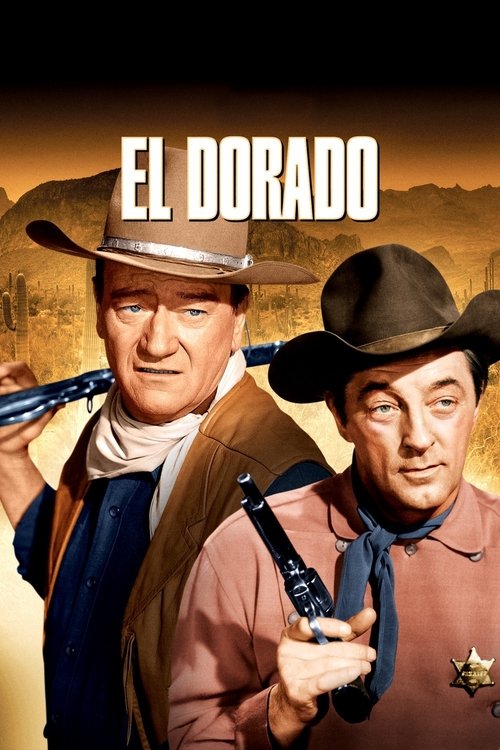
El Dorado
1966 · Howard Hawks
For a Sunday-afternoon comfort watch when you want good company more than suspense — old pros, easy humor, and a story where friendship is the whole point.
What it's about
Cole Thornton, a gunfighter for hire, turns down a dirty job running a ranching family off their water, then rides back into the town of El Dorado to stand with his old friend Sheriff J.P. Harrah — who has meanwhile collapsed into the bottle. With a crotchety old deputy and a young gambler who's deadly with a knife but can't shoot straight, they hold the town against a rich cattleman's hired guns.
The experience
Relaxed, funny, and quietly moving — a hangout Western where the gunfights matter less than the banter, the loyalty, and the sight of aging men refusing to quit. It ambles on purpose, and the warmth sneaks up on you.
Performances
John Wayne and Robert Mitchum play off each other beautifully — Mitchum finding real pathos and comedy in a proud lawman gone to drink — while a very young James Caan brings live-wire energy as the gambler Mississippi.
The craft
Howard Hawks reworks his own favorite premise with the confidence of a master telling a story he loves twice: Leigh Brackett's script keeps the dialogue crackling, and the film's craft is all in rhythm — scenes built around professionals doing their jobs and needling each other. It's classical Hollywood storytelling at its most effortless.
Why it matters
A beloved late statement from one of Hollywood's defining directors, it cemented the 'small band of professionals holding the line' as a template countless action films still follow. It's also cherished as an elegy for the classical Western made by the men who built it.
Snapshot
El Dorado is Howard Hawks's late-career Western, a warm, comic, and elegiac reworking of the premise he had already filmed as Rio Bravo (1959): a small band of flawed professionals holding a town against a moneyed cattleman. Cole Thornton (John Wayne), a gunfighter for hire, declines a job trying to run the MacDonald family off their water rights, then returns to the town of El Dorado to help his old friend Sheriff J.P. Harrah (Robert Mitchum), who has collapsed into drink. Around them gather the aging deputy Bull Harris (Arthur Hunnicutt) and the young knife-wielding gambler "Mississippi" (James Caan), who cannot shoot straight. Produced by Hawks for Paramount and adapted by Leigh Brackett from Harry Brown's novel The Stars in Their Courses, the film is at once a genre entertainment and a meditation on professionalism, friendship, and physical decline — Thornton carries a bullet near his spine that periodically paralyzes his gun hand. It stands, with Rio Bravo and Rio Lobo (1970), as the middle panel of an informal trilogy and is widely regarded as one of the strongest films of Wayne's and Hawks's later years.
Industry & production
El Dorado was made near the end of the classical studio era, produced by Hawks's own production arrangement and released through Paramount Pictures. By the mid-1960s Hawks was one of the last major directors still working comfortably inside the old system while operating as his own producer, controlling casting, script development, and shooting on the ground. Principal photography took place largely at Old Tucson Studios in Arizona — a standing Western location — with interior and additional work on the Paramount lot. The picture was photographed in Technicolor. It carries a 1966 copyright, but Paramount held it back and gave it its wide United States release in 1967; the precise commercial reasoning for the delay is not something the public record settles cleanly, and I won't invent a figure or motive for it. Reliable, verified box-office totals for the film are likewise not something I can state with confidence, so I leave them unclaimed rather than fabricate numbers. What is well established is that the production reunited Hawks with collaborators he trusted — screenwriter Leigh Brackett and star John Wayne foremost among them — and paired Wayne, for the only time, with Robert Mitchum, drawing on the audience goodwill both men carried as durable, unfussy screen presences.
Technology
The film was shot on 35mm and finished in Technicolor, and — consistent with Hawks's long-standing preference — it was composed in the flat widescreen ratio rather than in anamorphic CinemaScope or the wide scope frames then fashionable in the Western. Hawks distrusted the very wide frame, which he felt scattered attention and undercut the intimacy of the two-shot and the group; the standard-width frame let him keep faces, hands, and gun rigs legible and close. The tools here are entirely those of mature studio filmmaking rather than any technical novelty: sound-stage interiors, location exteriors, practical Western effects, and Technicolor's saturated, dependable palette. El Dorado is not a film that advertises technology; its craft lies in the disciplined, transparent use of established resources.
Technique
Cinematography
The cinematography is by Harold Rosson, a Hollywood veteran whose career reached back to the silent era and included The Wizard of Oz and Singin' in the Rain; El Dorado is generally cited as his final feature. Rosson's work here is unshowy and functional in the best Hawksian sense — clean, frontal, evenly lit setups that serve action and performance rather than calling attention to themselves. Interiors, especially the jailhouse and saloon that anchor so much of the film, are staged for clarity of space and sightline, so the audience always knows who stands where in relation to doors, windows, and the street. The climactic movements through the darkened town are handled for legibility over expressionist effect. It is a style that rewards attention to blocking rather than to lighting flourishes.
Editing
Cut by John Woodcock, El Dorado is edited in the classical continuity manner: shots are held long enough to let performance and gesture register, coverage is economical, and the rhythm favors clarity over acceleration. Hawks's action is built around cause and consequence you can follow — a wounded man's stumble, a hand that will not close, a shotgun leveled at close range. The cutting supports the film's alternation between comic ensemble byplay and sudden violence, letting scenes breathe in the former and tightening only as much as needed in the latter.
Mise-en-scène / staging
Staging is where Hawks's authorship is most visible. The film is organized around a handful of enclosed, repeatedly used spaces — the jail, the saloon, the doctor's office, the street — and around the physical facts of the men who move through them: Thornton's periodically dead gun hand, Harrah's shakes and hangovers, Bull's age, Mississippi's uselessness with a pistol. Hawks choreographs the group as a working unit, distributing tasks and jokes so that each man's competence (and incompetence) is dramatized through action rather than dialogue. The recurring two-shot keeps friendship at the center of the frame; entrances and exits through doorways structure the suspense. Bodies and their limitations are the real subject of the blocking.
Sound
The score is by Nelson Riddle, the celebrated arranger, whose music supports the film's mixture of tension and good humor without overwhelming it. A title ballad drawn from the film's Poe-derived name frames the picture. (I'll flag honestly that fine-grained credits for the song's vocal and lyric attribution are the kind of detail I won't assert precisely from memory.) Within the drama, sound is used pointedly and literally: the recitation of Edgar Allan Poe's poem "Eldorado" by Mississippi becomes a running motif, and a piece of music — a mournful trumpet dirge that the antagonists play to signal a killing — is deployed as a diegetic instrument of psychological pressure, one that Harrah eventually turns back on his enemies. Gunfire, silence, and the creak of a besieged town do the rest of the work.
Performance
Performance is the film's great pleasure. Wayne plays Thornton with the settled authority of his late persona, but Hawks complicates it with vulnerability — a hero who literally cannot always trust his own hand. Mitchum's Harrah is the film's emotional engine, moving from degraded, comic drunkenness to painful recovery with an ease that reads as effortless; the sweat-out sequences are played for both humor and pathos. James Caan, early in his career, gives Mississippi a nervy, ingratiating energy, his hat and knife substituting for the marksmanship he lacks. Arthur Hunnicutt's Bull supplies cracker-barrel comedy, and Michele Carey's Joey MacDonald embodies the tough, forward Hawksian woman. Christopher George's cold professional gunman Nelse McLeod provides the antagonist's mirror to Thornton — respect between men who may have to kill each other. The ensemble interplay, not any single turn, is the point.
Narrative & dramatic mode
The dramatic mode is the group-under-siege structure Hawks had perfected: a confined situation, a fixed set of characters, and a plot advanced less by incident than by how these people behave under pressure. The narrative braids two arcs — Thornton's arrival and physical jeopardy, and Harrah's fall and redemption — against the external threat of rancher Bart Jason's war on the MacDonalds' water. Tonally the film moves fluidly between comedy and menace, often within a single scene, a hallmark of Hawks's late style. It is episodic and relaxed by design, privileging camaraderie, banter, and the ethics of the professional over conventional suspense mechanics; the climax resolves the personal stakes (friendship restored, self-respect regained) as much as the plot ones.
Genre & cycle
El Dorado is a classical Western operating squarely within the town-tamer / hired-gun tradition, but its most important generic context is intramural: it is Hawks reworking his own Rio Bravo, retaining the sheriff-and-friends-hold-the-jail premise while redistributing the flaws (the drunk is now the sheriff himself, not the deputy). Together with Rio Lobo, the three constitute a self-referential cycle of Hawksian Westerns about aging professionals. The film also belongs to a mid-1960s moment when the traditional American Western was being pressured from outside — by Sergio Leone's Italian Westerns and by the more violent, revisionist strain soon to arrive — making El Dorado's genial classicism feel, in retrospect, both confident and valedictory.
Authorship & method
This is a Hawks film through and through, and it rewards reading as such. Hawks's lifelong preoccupations — the self-sufficient group, professional competence as a moral value, the comedy that coexists with danger, the woman who meets men on their own terms — are all present and foregrounded. His method of building scenes around behavior and letting trusted collaborators improvise within firm structure is on full display. His central creative partner here is screenwriter Leigh Brackett, the science-fiction novelist and Hollywood screenwriter who had co-written The Big Sleep for Hawks and would later write The Long Goodbye and an early draft of The Empire Strikes Back; her adaptation reshapes Harry Brown's more somber source novel into the loose, character-driven Hawksian mold. Cinematographer Harold Rosson brings decades of studio craft to what is generally regarded as his final picture. Composer Nelson Riddle supplies the score, and editor John Woodcock cuts in the transparent classical style the material demands. The opening credits are illustrated with paintings by the Western artist Olaf Wieghorst, who also appears in the film as a gunsmith — a small, distinctive authorial touch.
Movement / national cinema
The film is a product of late classical Hollywood — the American studio Western at the tail end of its dominance. It is not part of any avant-garde or new-wave movement; if anything it is a deliberate holdout, made by a director whose sensibility had been formed in the 1930s and '40s and who saw no reason to abandon craft principles that still worked. Its national-cinema significance is precisely as a distillation of the classical American mode: economy, transparency, star iconography, and genre confidence, arriving just as European art cinema and a coming American new wave were redefining what movies could look like.
Era / period
El Dorado sits at a hinge in film history. Copyrighted 1966 and released to wide American audiences in 1967, it appeared as the studio system was fracturing, the Production Code was giving way, and the Western itself was being reinvented — Leone abroad, and revisionist and "end-of-the-West" pictures at home soon after. In that context Hawks's film reads as consciously old-fashioned in the honorable sense: a master working in a mode he helped define, unhurried by fashion. Its relaxed classicism is inseparable from its lateness; part of its resonance comes from being made by, and about, men aware that a certain era is ending.
Themes
The governing themes are professionalism and self-respect, friendship and loyalty, aging and physical decline, and redemption. Thornton's paralyzing wound literalizes the idea that even the most competent man is subject to failing powers; Harrah's alcoholism and recovery dramatize the loss and hard reclamation of dignity. The film insists that worth is proven through how one does the job and stands by one's friends, not through invulnerability — indeed its heroes are conspicuously damaged. Poe's "Eldorado," recited within the story, threads an ironic literary counterpoint through the action: the poem's knight rides on in doomed pursuit of a golden dream, lending the film's title a note of mortality and futility beneath its comic surface. Community, water rights, and rough justice supply the external moral frame, but the emotional core is the mutual care among aging men.
Reception, canon & influence
El Dorado was generally well received and has aged into one of the more admired films of Hawks's and John Wayne's late careers; many critics find it warmer, funnier, and more humane than the tauter Rio Bravo, even as others prefer the earlier film's greater tension. It became a touchstone in the serious critical reappraisal of Hawks as an auteur — the British critic Robin Wood, whose study of Hawks was central to that reappraisal, treated the Western trilogy as key evidence of Hawks's thematic consistency and moral seriousness. Looking backward, the film's chief influences are Hawks's own Rio Bravo (which it openly reworks), the classical town-tamer Western, Harry Brown's source novel, and Edgar Allan Poe's poem, from which it takes its title and one of its motifs. Looking forward, its legacy runs along two lines. Within Hawks's work it led directly to Rio Lobo (1970), completing the trilogy. More broadly, the "professionals under siege" structure Hawks refined across these films became a template for later filmmakers who revered him — most famously John Carpenter, whose Assault on Precinct 13 (1976) transplants the Hawksian siege into an urban register, and whose admiration for Hawks he made no secret of. The image of the aging, physically compromised gunfighter, played with self-aware iconicity, also fed the wider late-'60s and '70s current of Westerns about heroes past their prime. El Dorado endures as both a supremely enjoyable studio Western and a considered meditation, by an old master, on doing the work well while the light lasts.
A Deleuzian reading
A hand that will not close.
The full Deleuzian reading of El Dorado →
Reception
Critics in 1967 shrugged at it as a Rio Bravo rehash even as audiences made it a hit; decades later that 'self-remake' is the whole charm, and it's now treasured as one of the great late-period Hawks hangout movies.
How El Dorado was received, from release to now →
Influences: the films it descends from and the films it influenced
- Rio Bravo (1959) — El Dorado is Hawks's beat-for-beat self-remake of it, retaining the jailhouse-siege blueprint, the drunk-deputy-redeemed subplot, and the small-band-of-specialists-hold-the-fort structure that Leigh Brackett simply reshaped for looser comedy.
- Only Angels Have Wings (1939) — Establishes the Hawksian creed El Dorado dramatizes — the self-sufficient professional group in a confined outpost where competence is the sole moral currency and a woman is admitted only by meeting the men on their terms.
- Red River (1948) — Pioneers Hawks's use of John Wayne as a physically weathered authority figure and the two-shot staging of paired men bickering through danger, the performance register El Dorado pushes toward self-aware aging.
- The Big Sleep (1946) — Leigh Brackett's first collaboration with Hawks, where she perfected the method she reused here: dissolving a somber source novel into a character- and behavior-driven string of scenes prized over plot coherence.
- High Noon (1952) — The lone-lawman-begging-for-help town-tamer Western that Hawks explicitly rejected; Rio Bravo and El Dorado are built as the inverse — professionals who refuse civilian help and defend the jail as a closed unit.
- Stagecoach (1939) — Fixes the Wayne iconography and the ensemble-in-a-besieged-enclosure grammar of classical continuity cutting between a group under threat that El Dorado inherits wholesale.
- Rio Lobo (1970) — Hawks's third and final iteration of the same siege template with Wayne, completing the trilogy by recycling the wounded-hero, drunk-sidekick, and hold-the-building architecture one more time.
- Assault on Precinct 13 (1976) — Carpenter openly transplants Rio Bravo/El Dorado's jailhouse siege into an urban police station, keeping the trapped-professionals-and-a-redeemed-prisoner structure (he even edited it under a Hawksian pseudonym, John T. Chance).
- The Thing (1982) — Extends the Hawksian group-under-siege into paranoid horror — an isolated crew of specialists defending a perimeter where survival hinges on professional competence and mutual trust, the ethos Carpenter absorbed from El Dorado's lineage.
- The Shootist (1976) — Takes El Dorado's motif of the compromised, physically failing gunfighter to its endpoint, using Wayne's own aging body and star mythology as explicit subject — the meta-iconicity El Dorado pioneered for him.
- Escape from New York (1981) — Carpenter's terse anti-hero, laconic professional competence, and synth-scored siege atmosphere are direct outgrowths of his stated Hawks worship, translating the El Dorado ethos into dystopian action.
- The Long Goodbye (1973) — Written by Leigh Brackett, who applies the same loose, digressive, character-first adaptation approach she used for Hawks, dissolving Chandler's plot into behavioral drift just as she loosened Harry Brown's novel.
- The Empire Strikes Back (1980) — Brackett wrote the first draft, carrying forward her Hawksian instinct for wry professional banter between bickering partners under pressure that defines El Dorado's two-shot exchanges.
- The Wild Bunch (1969) — Shares the late-'60s current of the aging professional gunfighter — men defined by doing the job well while their bodies and their era fail them — that El Dorado meditates on through Wayne's stiffening trigger hand.
- Ride the High Country (1962) — Casts iconic screen veterans as past-their-prime gunmen trading on their own weathered stardom, the self-aware-iconicity performance mode El Dorado builds around Wayne and Mitchum's physical decline.
- True Grit (1969) — Leans into the same knowingly self-parodic, aging Wayne persona — the paunchy, one-eyed, professionally proud gunman — that El Dorado had just established as the actor's late-career register.
Similar films
- Rio Bravo (1959) — influence & lineage · same viewing thread
- Stagecoach (1939) — influence & lineage · same viewing thread
- Ride the High Country (1962) — influence & lineage · often watched together
- Red River (1948) — influence & lineage
- Only Angels Have Wings (1939) — influence & lineage
- The Big Sleep (1946) — influence & lineage
- The Wild Bunch (1969) — influence & lineage
- High Noon (1952) — influence & lineage
All the films related to El Dorado →
Watch it with: curated runs of related films
- The Classical Hollywood Frontier — Watch these to see the American Western at its studio-era height — from Ford's frontier poetry to the tight one-room standoff — the bedrock that Leone and everyone after would later inherit and invert.