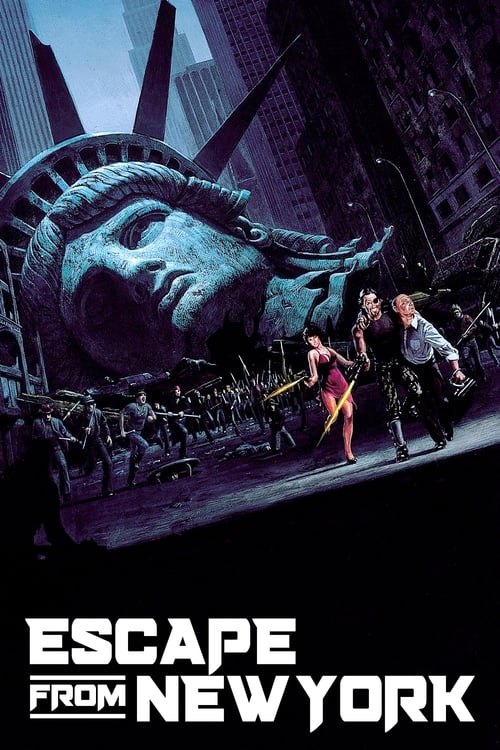
Escape from New York
1981 · John Carpenter
For when you want pure genre pleasure: a badass anti-hero, a ticking clock, and a world gone to hell — a Friday-night comfort watch with real style and a nasty streak.
What it's about
It's the near future, crime has swallowed America, and the entire island of Manhattan has been walled off as a maximum-security prison where the inmates run free. When the President's plane goes down inside, the government makes a deal with Snake Plissken — a one-eyed war hero turned convict — to go in and pull him out. He has twenty-four hours, and explosive charges in his neck to keep him honest.
The experience
Lean, mean, and dripping with midnight-movie atmosphere — a night-crawl through a ruined city set to a pulsing synth score. It's tense but sardonic, the kind of film that grins through gritted teeth and never wastes a minute.
Performances
Kurt Russell's Snake Plissken is an all-timer of screen cool — a raspy, contemptuous anti-hero who became the template for decades of imitators.
The craft
John Carpenter squeezes a whole dystopia out of a modest budget: fog, shadow, matte paintings, and burning trash cans turn a few streets into a dead city, and his own synthesizer score does half the storytelling. Watch it loud and in the dark — the widescreen night photography and that pulsing electronic soundtrack are the whole mood.
Why it matters
Its premise, look, and hero were endlessly borrowed by action films, video games, and dystopias that followed, and it cemented the Carpenter–Russell partnership as one of genre cinema's great teams.
Snapshot
Escape from New York is John Carpenter's lean, sardonic dystopian action film, set in a near-future 1997 in which the whole of Manhattan has been sealed off as a maximum-security penal colony. When Air Force One is hijacked and the President's escape pod lands inside the prison, the authorities give the disgraced war hero and convict Snake Plissken twenty-four hours to extract him, motivating his compliance with explosive charges implanted in his neck. Produced on a modest budget, the film distilled Carpenter's career-long preoccupations — the anti-authoritarian loner, the besieged enclave, the night as a hostile country — into one of the most enduring B-movie premises of the decade. Its iconography (the eyepatch, the snarl, the ruined city) and its terse, world-weary anti-hero, embodied by Kurt Russell, became touchstones of post-punk genre cinema and seeded a lineage of dystopian action that runs from cyberpunk through the modern blockbuster. It is at once a cynical Vietnam- and Watergate-era political fable and a piece of pulp myth-making executed with remarkable economy.
Industry & production
Carpenter has said in interviews that he wrote the original screenplay in the mid-1970s, in the wake of the Watergate scandal, when its mood of disillusionment with American institutions felt unsellable; studios reportedly found the premise too dark and too violent. The commercial success of Halloween (1978) and his television work gave him the leverage to revive the project. The film was made for the independent producer Debra Hill — Carpenter's longtime creative and producing partner — and financed through Avco Embassy Pictures, the company that had backed Carpenter's The Fog (1980) and that specialized in genre product positioned between the studios and exploitation cinema. The screenplay credit is shared by Carpenter and Nick Castle, the latter a frequent collaborator (and the man behind the Halloween mask) who Carpenter has credited with helping shape the plot, including, by Carpenter's account, the idea that Snake might be presumed dead and then reappear.
The budget was small by Hollywood standards — figures in the low-single-digit millions are commonly cited, and I'd treat any precise number with caution given how unreliable such reporting is. The production made resourceful use of locations: much of the burned-out Manhattan was shot not in New York but in St. Louis, Missouri, where a large 1976 fire in the Gateway district had left blocks of derelict buildings that doubled convincingly for a ruined Manhattan, supplemented by Los Angeles locations and sets. The casting drew on Carpenter's preference for veteran character actors and personal loyalties: Lee Van Cleef as the hardened police commissioner Hauk, Ernest Borgnine as the irrepressible cabbie, Donald Pleasence (a Halloween alumnus) as the President, Isaac Hayes as the Duke of New York, Harry Dean Stanton as Brain, and Adrienne Barbeau, then Carpenter's wife, as Maggie. The decision to cast Kurt Russell — known to audiences chiefly as a wholesome Disney star — against type as the laconic, menacing Snake was a deliberate gamble that reset Russell's career and inaugurated one of the great director-actor partnerships of the era.
Technology
Escape from New York is notable as an early showcase for an emerging effects technology. Carpenter has recounted that the budget could not accommodate elaborate optical work, and the now-famous sequence in which Snake guides a glider toward the rooftops of Manhattan was realized using early computer-generated imagery only obliquely. The production built physical models of the city skyline, then, for the pilot's-eye wireframe display, used a representation of the buildings rendered as glowing green vector outlines. By many accounts the "computer" graphics audiences see were in fact achieved by photographing scale models whose edges had been outlined in reflective tape and lit so that only the lines registered against black — a low-tech simulation of a computer display. Among the technicians who worked on this period of the production's visual effects was a young James Cameron, who served on the special effects unit, a frequently noted footnote in his early career. The larger point is characteristic of Carpenter: the film achieves the impression of advanced technology through ingenuity and craft rather than expenditure, a synthetic-future look conjured from models, miniatures, matte work, and carefully controlled lighting.
Technique
Cinematography
The film was shot by Dean Cundey, Carpenter's principal cinematographer of the period, in anamorphic Panavision — the wide 2.35:1 frame that Carpenter favored throughout his classical run and that lends even modest material a sense of scope. Cundey's work here is built around darkness: the prison-Manhattan is a nocturnal world lit by fires, headlights, sodium pools, and the cold blue of moonlight, with vast tracts of the frame left in shadow. The widescreen composition is used to isolate Snake within hostile, depopulated space and to stage the architecture of ruin as a continuous threat. Cundey's command of low-light exposure — making blacks legible without flattening them — gives the film its distinctive texture of grime and menace, and the anamorphic lenses contribute the soft flares and shallow planes that read, then and now, as a deliberately desolate futurism.
Editing
The film was cut by Todd Ramsay. Its construction is economical and forward-driving: a brisk prologue establishes the premise and the ticking-clock device, after which the narrative proceeds as a near-real-time descent through successive zones of the prison. Carpenter's editorial sensibility favors clarity and momentum over flash; set-pieces are staged and cut for legibility, and the pacing modulates between tense, quiet stalking and sudden bursts of violence. The countdown — the explosive charges in Snake's neck — supplies a structural metronome that the editing exploits to maintain pressure across an episodic journey.
Mise-en-scène / staging
The film's design is among its most influential achievements. The conceit of Manhattan-as-prison is realized through a layered production design that mixes recognizable ruin with theatrical menace: graffiti, bonfires, scavenged vehicles, the "crazies" who surge up from the subways, and the gladiatorial spectacle staged by the Duke. The world is built through accumulation of grimy, specific detail rather than exposition. Snake himself is a triumph of costume and staging — the sleeveless look, the eyepatch, the snake tattoo, the perpetual squint — a silhouette designed to be read instantly. Carpenter stages the film as a series of bounded encounters within the larger enclosure, each location a small theater of threat, consistent with his abiding fascination with the siege and the trespass into forbidden ground.
Sound
The score, composed and performed by Carpenter with Alan Howarth, is one of the film's defining elements. Built from brooding analog synthesizers, it pairs a propulsive, minor-key main theme with washes of cold electronic atmosphere — music that is simultaneously driving and desolate, and that became central to the film's identity and to Carpenter's reputation as a composer-director. The synthesizer score does double duty as world-building, its machine textures evoking a decayed-future America without a single line of dialogue. The sound design more broadly favors a stripped, ominous quietness punctuated by gunfire, distant screams, and the mechanical ticking of the countdown.
Performance
Kurt Russell's Snake Plissken is a study in subtraction. Russell has spoken of modeling the character's gravelly, clipped delivery and minimal affect partly on Clint Eastwood's Western anti-heroes, and the performance works almost entirely through withholding — Snake speaks little, reacts less, and projects contempt for every authority that tries to use him. It is a star turn built on iconography and attitude rather than psychological exposition, and its restraint is precisely what made the character durable. Around him, Carpenter's ensemble supplies color: Borgnine's exuberant cabbie, Stanton's weaselly Brain, Hayes's regal Duke, Pleasence's querulous President, and Van Cleef's flinty Hauk. The contrast between Russell's stillness and the gallery of vivid grotesques gives the film its tonal balance of dread and dark comedy.
Narrative & dramatic mode
The film operates in the mode of the mission-thriller crossed with the dystopian fable: a hard deadline, a reluctant agent, a forbidden territory, and a descent-and-return structure that recalls both the war film and the mythic journey to the underworld. Its dramatic engine is coercion rather than heroism — Snake acts not from idealism but because he is collared, literally, by the state. This sourness is the film's signature. The narrative withholds the conventional payoff of patriotic uplift; the rescued President proves contemptible, indifferent to the lives spent saving him, and the film's celebrated final gesture turns Snake's cynicism into an act of quiet sabotage against power itself. The dramatic mode is thus ironic and anti-heroic throughout, using genre machinery to deliver a fundamentally disenchanted view of authority.
Genre & cycle
Escape from New York sits at the confluence of several genre cycles. It belongs to the dystopian science-fiction wave of the 1970s and early 1980s — films extrapolating urban decay, crime panic, and institutional collapse into near-future nightmares, a lineage that includes Soylent Green, Death Race 2000, The Warriors, and the prison and vigilante pictures of the period. It is equally an action-exploitation film, drawing on the urban-decay anxieties that also fueled the crime cinema of New York in the 1970s. And it is a key early text of what would soon crystallize as cyberpunk: its vision of a privatized, lawless near-future city, its outlaw protagonist, and its synthesizer-scored neon-and-shadow aesthetic prefigure the genre's iconography. The film both summarizes the dystopian cycle of its moment and feeds forward into the one that followed.
Authorship & method
The dossier's collaborators recur across Carpenter's filmography, and the film is best understood as the product of a tight repertory company. As director, co-writer, and co-composer, Carpenter is the dominant authorial presence, and Escape concentrates his signatures: the anti-authoritarian loner, the besieged space, anamorphic widescreen, nocturnal lighting, and a self-composed synth score. Co-writer Nick Castle contributed to the screenplay's structure. Producer Debra Hill was an essential collaborator across Carpenter's most important films of this period, shaping the productions creatively as well as logistically. Cinematographer Dean Cundey supplied the visual grammar — the wide, dark, blue-shadowed look — that defines Carpenter's classic run. Editor Todd Ramsay gave the film its forward drive. Composer-collaborator Alan Howarth co-created the score with Carpenter, part of a partnership that extended across several subsequent films. And actor Kurt Russell, in the first of their collaborations, became the era's definitive Carpenter avatar, returning for The Thing, Big Trouble in Little China, and the later sequel. Carpenter's method here is the independent genre artisan's: small budget, trusted collaborators, practical solutions, and a refusal of studio gloss in favor of mood, craft, and attitude.
Movement / national cinema
The film belongs to the American independent-genre tradition of the 1970s and 1980s — the strand of filmmaking, exemplified by Carpenter, that carried the formal lessons of classical Hollywood (especially the Westerns of Howard Hawks, whom Carpenter openly revered) into low-budget horror and science fiction made outside the major studios. It reflects the post-Halloween moment when a generation of "movie brat"–adjacent directors built distinctive authorial bodies of work within exploitation and genre economics. Nationally, it is a deeply American film: its dystopia is a fantasy of American urban collapse, its politics a reaction to Vietnam and Watergate, and its anti-hero a sour inversion of American myths of frontier individualism and patriotic duty.
Era / period
Made at the turn of the 1980s, Escape from New York is saturated with the anxieties of its moment: the fiscal crisis and crime panic that had made New York a national symbol of urban breakdown, the lingering disillusionment of the Vietnam and Watergate years, and a Cold War dread that the film glances at in its geopolitical backdrop. Its imagined 1997 is the 1970s' worst fears extrapolated. Aesthetically it is a creature of the early-1980s genre landscape — the analog-synth sound, the practical-effects futurism, the move from the slasher boom toward science-fiction and action hybrids — released into a marketplace being reshaped by the rise of the blockbuster and, soon, home video, which would do much to cement the film's cult standing.
Themes
At its core the film is about power and the individual's refusal of it. The state is depicted as authoritarian and instrumentalizing — it solves the problem of crime by walling off and abandoning an entire population, and it secures Snake's service through bodily coercion. Against this, Snake embodies a thoroughgoing anti-authoritarianism: he serves no flag and trusts no institution, and his final act expresses a contempt that spares neither captor nor captive. The film meditates on the carceral imagination — the fantasy of disposal, of making the unwanted invisible behind a wall — and on the hollowness of official authority, dramatized in a President who is cowardly, callous, and ultimately exposed. Beneath the pulp surface runs a persistent strain of disenchantment: the heroism of the war-hero past is a wreckage, patriotism is a con, and the only authentic gesture available is refusal. These themes — distrust of the state, the loner against the system, the city as a space of abandonment — recur across Carpenter's work and give this film its lasting political charge.
Reception, canon & influence
On release the film was a commercial success relative to its cost and helped consolidate Carpenter's standing as a genre auteur, though contemporary critical opinion was mixed, with some reviewers prizing its atmosphere and wit and others dismissing it as crude or thin. Over the following decades its reputation rose substantially; it is now widely regarded as one of Carpenter's essential works and a touchstone of 1980s cult cinema, with Snake Plissken among the era's most recognizable screen anti-heroes.
Looking backward, the film draws on a dense web of influences. Carpenter's debts to Howard Hawks — the professional under pressure, the terse masculine code — are explicit across his career. The anti-heroic withholding of Russell's performance descends from the spaghetti-Western man-with-no-name, and the casting of Lee Van Cleef nods directly to that tradition. The dystopian premise sits within the urban-collapse science fiction of the 1970s and the vigilante and prison cycles of the same decade; The Warriors (1979) is frequently cited as a kindred text. The mood of post-Watergate political disenchantment is the film's deepest source.
Looking forward, its legacy is large. The Manhattan-as-prison concept and Snake's iconography fed directly into the cyberpunk imagination, and the film is routinely named as a touchstone for later dystopian action and for video-game franchises built around infiltration and lawless future cities — most famously the Metal Gear series, whose creator has acknowledged Snake Plissken's influence on his protagonist. Carpenter and Russell reunited for the 1996 sequel Escape from L.A., which reprised the formula on a larger scale to a more divided reception. The character, the look, and the sour anti-authoritarian stance have been endlessly echoed in subsequent action and science-fiction cinema, and the synthesizer score helped legitimize the composer-director as a model and prefigured the broad revival of analog-synth film music decades later. As with many cult films, periodic remakes have been announced over the years; given how often such projects stall, the durable legacy remains the original's, not its successors'.
A Deleuzian reading
The first thing the future looks like, in Carpenter's hands, is a line drawing.
The full Deleuzian reading of Escape from New York →
Reception
A solid hit in the summer of 1981, it was often filed under scrappy B-movie territory before decades of cult devotion — and the general Carpenter reappraisal — lifted it into the sci-fi action pantheon.
How Escape from New York was received, from release to now →
Influences: the films it descends from and the films it influenced
- Rio Bravo (1959) — Supplies the Hawksian besieged-space ethic Carpenter cites throughout his career — a small band of professionals defending a fixed perimeter, bound by a terse, unsentimental masculine code rather than heroic motive.
- For a Few Dollars More (1965) — Models the withholding man-with-no-name performance Russell adopts as Snake, and Carpenter casts Leone veteran Lee Van Cleef as Hauk in a direct lineage nod.
- Assault on Precinct 13 (1976) — Carpenter's own prototype: the anti-authoritarian loner conscripted into defending/escaping a sealed urban zone, scored by his own minimalist analog-synth pulse — the template Escape scales up.
- Dark Star (1974) — Establishes Carpenter's independent-artisan method — micro-budget genre filmmaking with a self-composed electronic score and practical, attitude-over-gloss effects.
- The Warriors (1979) — Lays down the nocturnal journey-across-a-hostile-city structure, with territory carved into stylized gang fiefdoms the protagonist must traverse to survive — the spatial logic Escape inherits.
- Death Wish (1974) — Anchors the 1970s urban-collapse vigilante cycle and the post-Watergate civic despair that makes Escape's lawless Manhattan legible as political fable rather than mere spectacle.
- THX 1138 (1971) — Pioneers the low-key dystopian-SF grammar of sparse production design and sound-as-oppression that Carpenter and Cundey translate into blue-shadowed nocturnal widescreen.
- Forbidden Planet (1956) — The Barrons' all-electronic 'tonalities' establish score-as-worldbuilding — synthesized sound defining an environment rather than underscoring emotion — which Carpenter/Howarth's synth work extends.
- El Dorado (1966) — Carpenter's terse anti-hero, laconic professional competence, and synth-scored siege atmosphere are direct outgrowths of his stated Hawks worship, translating the El Dorado ethos into dystopian action.
- Escape from L.A. (1996) — Direct sequel that reprises Snake's iconic costume silhouette, ticking-clock descent-and-return structure, and Carpenter/Howarth synth idiom on a larger canvas.
- The Terminator (1984) — Carries forward the propulsive analog-synth score and grimy, low-budget dystopian-noir texture as engine of dread and forward drive.
- Doomsday (2008) — Explicit homage that reconstructs the quarantined-city premise, the disposable-anti-hero-sent-in mission, and the iconic-costume loner lifted straight from Snake Plissken.
- Lockout (2012) — Transposes Escape's exact armature — a wisecracking convict coerced into infiltrating a sealed prison-zone against a clock to extract a VIP — into orbital SF.
- Drive (2011) — Centerpiece of the analog-synth film-music revival Carpenter prefigured, pairing a near-silent anti-heroic loner with neon low-key night photography and a score-as-mood aesthetic.
- I Am Legend (2007) — Carpenter established the grammar of post-apocalyptic Manhattan as a sealed, lawless geography — familiar architecture made alien by institutional collapse — that I Am Legend inherits for its New York disaster subgenre staging, including the convention of the lone competent figure navigating hostile urban ruins by vehicle through a city retaken by hostile forces.
- Johnny Mnemonic (1995) — Template of the synth-scored dystopian B-genre picture built around a laconic, affectless antihero navigating a lawless urban grid.
- Death Proof (2007) — Codified the Kurt Russell action-icon persona that Death Proof casts as commentary, exploiting audience memory of Russell-as-badass to stage his humiliating collapse.
- Maze Runner: The Death Cure (2018) — Template for the infiltration of a sealed quarantine-zone city to extract a captive, shot in high-contrast night imagery of engineered structures gone to ruin.
- Good Luck, Have Fun, Don't Die (2026) — The economic model as much as the look: a night city constructed from silhouette, pools of practical source light and empty real locations because sets were unaffordable, with the entire mission's rules and countdown delivered in a single briefing monologue before the first frame of action.
- The Thing (1982) — Immediate reunion of the same repertory company (Russell, Cundey, the synth-score method) reapplying the besieged-perimeter structure and anti-heroic loner to a single isolated outpost.
- Big Trouble in Little China (1986) — Extends the Carpenter–Russell collaboration's cast-against-type swagger and anamorphic, practical-effects genre play born of the Snake Plissken partnership.
- Blade Runner (1982) — Parallel founding text of cinematic cyberpunk: a decaying near-future metropolis rendered in low-key night and rain, scored by an analog synth (Vangelis) used as immersive worldbuilding.
- Mad Max 2: The Road Warrior (1981) — Same-year sibling building dystopian action around a laconic, morally compromised loner coerced into a mission across lawless wasteland territory.
- Mad Max 2 (1981) — Contemporary sibling deploying the same laconic, morally ambivalent antihero in a decayed-society dystopia, scored by a driving synth-and-brass pulse that similarly weaponizes rhythm as tension.
Similar films
- Blade Runner (1982) — influence & lineage · often watched together
- The Thing (1982) — influence & lineage · often watched together
- The Terminator (1984) — influence & lineage
- The Warriors (1979) — influence & lineage
- For a Few Dollars More (1965) — influence & lineage · often watched together
- Dark City (1998) — often watched together
- Die Hard (1988) — shared sensibility
- The Rock (1996) — shared sensibility