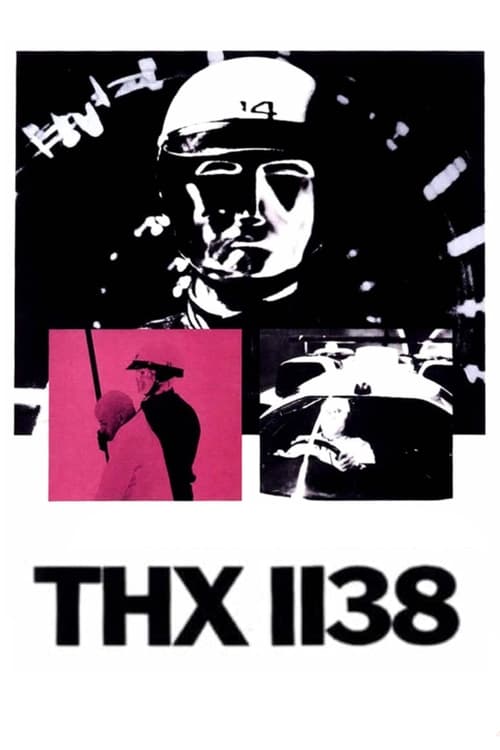
THX 1138
1971 · George Lucas
For when you want your sci-fi austere and strange rather than fun — a late-night, lights-off watch to sink into and feel a little alienated by. This is a challenge, not a comfort; reach for it when you're in an art-film frame of mind.
What it's about
In an underground city of white corridors and constant surveillance, workers are kept docile with mandatory drugs, monitored confessions, and round-the-clock consumerism. When a technician's chemical regimen lapses, he starts to feel — desire, love, fear — and begins a forbidden relationship that puts him on a collision course with the chrome-faced android police who run the place.
The experience
Cold, hypnotic, and deliberately disorienting — more a tone poem than a thriller, all antiseptic whiteness and murmuring, overlapping sound. It's unsettling in a slow-drip way, then breaks into one of the era's starkest chase sequences.
Performances
Robert Duvall carries the film almost wordlessly, playing a man waking up from sedation with a shaved head and a face that does all the talking.
The craft
George Lucas's debut is a design triumph on a shoestring: blinding white voids with no walls in sight, shaved-head crowds, and a legendary sound collage of whispers, static, and announcements by Walter Murch that's half the movie. Good speakers or headphones are practically mandatory.
Why it matters
A commercial flop that was cut by its studio, it's since been reclaimed as a key 1970s dystopia — the flint-hard art film Lucas made before Star Wars, and proof of where his obsessions started.
Snapshot
THX 1138 is George Lucas's feature debut: a cold, elliptical dystopia about a drugged-pacified worker (Robert Duvall) who, when his chemical regimen lapses, awakens to desire, love, and the impulse to flee an underground consumer-state. Expanded from Lucas's award-winning USC student short Electronic Labyrinth: THX 1138 4EB (1967), it was the first feature produced under Francis Ford Coppola's American Zoetrope and released by Warner Bros. in March 1971. More tone poem than thriller, it trades plot for texture — antiseptic white voids, shaved heads, chrome-faced android police, layered murmuring sound — and announces nearly every preoccupation of Lucas's later career in inverted, austere form. Commercially it failed and was trimmed by its distributor against the director's wishes; critically and historically it has been reassessed as a landmark of American science-fiction minimalism and a foundational text for the craft of modern sound design.
Industry & production
The film sits at the hinge of "New Hollywood." Coppola, fresh from Finian's Rainbow, had founded American Zoetrope in San Francisco in 1969 as a deliberate alternative to the studio system — a young, geographically independent collective of "movie brats." Lucas, his protégé, was the first to deliver a feature, and THX 1138 effectively functioned as the company's calling card to Warner Bros., which had agreed to finance and distribute a development slate. The production was made cheaply — reported budgets cluster around three-quarters of a million dollars, though precise figures should be treated cautiously — and shot largely on location in and around San Francisco rather than on sets, a necessity that became an aesthetic.
The picture's reception inside the studio is itself a famous episode in industry lore. Warner executives, unhappy with the finished film, cut roughly four to five minutes and shelved enthusiasm for the broader Zoetrope deal; the episode (sometimes recalled as a "Black Thursday" for the company) helped collapse Warner's relationship with Zoetrope and contributed to Coppola's mounting financial pressures going into The Godfather. Lucas, stung by having his cut altered, drew a career-long lesson about creative control that shaped his subsequent insistence on independence. The film's commercial underperformance is well established; specific box-office tallies are not something I will assign numbers to here.
Technology
THX 1138 is, in production terms, a film about turning constraint into method. Lucas could not afford to build a future, so he photographed an existing, half-finished one: the under-construction tunnels of the Bay Area Rapid Transit (BART) system supplied the sleek, raw concrete corridors and the climactic high-speed roadway, while the blinding white "limbo" of the prison sequences was achieved through bright, evenly lit cycloramas and white-on-white staging rather than expensive set construction. The result reads as advanced production design but is closer to documentary opportunism.
The technology within the fiction is equally pointed: a society regulated by mandatory mood- and libido-suppressing drugs, omnipresent surveillance monitors, automated confession booths dispensing a recorded deity (OMM), and a police force of identical chrome-masked androids whose pursuit is governed less by zeal than by budget — they abandon the chase when its cost exceeds an allotted figure, one of the film's sharpest satirical strokes. Lucas's later 2004 "director's cut" reintroduced digital effects, creatures, and altered backgrounds; that revision is a separate technological artifact and a contested one, and the 1971 release remains the historically primary text.
Technique
Cinematography
Photographed by Albert Hall and David Myers, the film's visual scheme is built on two opposed registers: the overexposed, depthless white of the detention sequences, where figures float in a space with no discernible floor or horizon, and the cool, hard geometry of the underground city, full of fluorescent corridors, monitor banks, and reflective surfaces. Telephoto compositions flatten and isolate bodies against institutional backdrops; the framing repeatedly subordinates the human figure to architecture and signage, visualizing the citizen as a unit within a system. The white-void aesthetic — radical for its emptiness — became the film's signature image and one of its most imitated.
Editing
Lucas, who cut the film himself, structures it by fragmentation and ellipsis rather than continuity. Scenes are introduced mid-action, exposition is withheld, and the narrative advances through accumulation of detail. The opening in particular collages overlapping audio and disorienting imagery before the viewer has any foothold in the story. This montage sensibility owes an acknowledged debt to the Canadian experimental filmmaker Arthur Lipsett, whose collage short 21-87 Lucas has repeatedly cited as formative — and from which, by most accounts, the very numerical naming scheme derives.
Mise-en-scène / staging
The world is rendered through subtraction. Citizens wear identical white tunics with shaved heads; color is nearly purged; props and signage are functional and corporate. The famous staging of the white prison — actors in an apparently infinite field of light — is a mise-en-scène of pure ideology, a society that has abolished privacy by abolishing place itself. Against this, small human gestures (a touch, a glance, the growing of hair) carry disproportionate dramatic weight. The android police, blank and gleaming, are staged as the perfect visual antithesis of the vulnerable, exposed human body.
Sound
The film's most influential single dimension is its sound. Walter Murch — credited for sound montage and re-recording, and Lucas's co-writer — treated the soundtrack as a composed, layered field rather than mere accompaniment: overlapping bureaucratic chatter, electronic tones, public-address murmur, and the disembodied, soothing voice of the state. Dialogue is frequently buried, fragmented, or made to compete with ambient noise, so that the citizen's world is experienced as an undifferentiated wash of mediated speech. This work is widely regarded as a seminal precursor to the discipline Murch would later help name "sound design," and it remains the film's clearest technical legacy. Lalo Schifrin's score is used sparingly, ceding much of the sonic foreground to Murch's montage.
Performance
Performance is deliberately flattened to match the world. Robert Duvall plays THX with held-in opacity, a man whose interior life surfaces only in micro-gradations as the drugs wear off; the arc is one of barely perceptible awakening rather than overt transformation. Maggie McOmie as LUH 3417 gives the film its fragile emotional center. Donald Pleasence, as the manipulative SEN 5241, supplies its closest thing to flamboyance — needy, scheming, verbose — while Don Pedro Colley appears as a hologram (SRT) who escapes into the "real." The general performance mode is muted and affectless by design, the better to make small flickers of feeling register as transgression.
Narrative & dramatic mode
THX 1138 is anti-conventional in its dramaturgy. It largely refuses the explanatory scaffolding of genre screenwriting — there is little backstory, no expository guide, and a deliberately withheld sense of geography and stakes. The dramatic mode is immersive and experiential: the viewer is disoriented alongside, and slightly ahead of, the protagonist. Its three broad movements — pacified routine, illicit awakening and arrest, and escape through the white limbo and the tunnels toward the surface — are organized as a gradual emergence from numbness into sensation. The ending, in which THX climbs into open air against a setting sun as the android pursuit is called off on grounds of cost, is ambiguous in tone: a liberation that is also an abandonment, escape granted less by triumph than by accountancy. The film prizes mood, irony, and image over psychology and resolution.
Genre & cycle
The film belongs to a dense cluster of late-1960s and early-1970s American dystopian science fiction that used the future to interrogate the present: Planet of the Apes (1968), 2001: A Space Odyssey (1968), and, contemporaneously, A Clockwork Orange (1971), The Omega Man (1971), Silent Running (1972), Soylent Green (1973), and Logan's Run (1976). Within that cycle THX 1138 is the most formally austere and least action-driven — closer to European art cinema than to studio spectacle. It updates the literary anti-utopian tradition (Orwell, Huxley, and the "machine-state" imagination) into a specifically consumerist, pharmaceutical, surveillance-saturated key, satirizing advertising, mandated shopping, and state-administered religion as much as overt tyranny.
Authorship & method
The dossier's authorship is genuinely collaborative within a tight Zoetrope circle. George Lucas is the controlling sensibility — director, co-writer, and editor — translating his student short into a feature while preserving its experimental, collage-driven instincts; the film is the purest expression of the "abstract," montage-minded Lucas before American Graffiti and Star Wars redirected him toward populist storytelling. Walter Murch, co-writer and sound architect, is the indispensable second author, shaping both the screenplay and the radical soundtrack. Francis Ford Coppola served as producer and patron, providing the institutional shelter that made the film possible. The cinematography of Albert Hall and David Myers realized the white-void and tunnel aesthetics, and Lalo Schifrin contributed the restrained score. The method throughout was low-budget ingenuity: real locations standing in for the future, constraint converted into style, and an unusual trust in image and sound to carry meaning that dialogue withholds.
Movement / national cinema
The film is a product of American independent cinema's film-school generation, but its sensibility is markedly transnational. Its formal vocabulary — elliptical editing, alienated affect, location-shot futurism, philosophical chill — aligns it with European modernism, and the obvious comparison is Jean-Luc Godard's Alphaville (1965), which similarly built a dystopia from unadorned contemporary cityscapes. Geographically it is a San Francisco film, embodying Zoetrope's deliberate distance from Los Angeles and its ambition to forge a regional, auteur-driven alternative to Hollywood. In that sense it is both quintessentially American — a New Hollywood origin story — and consciously continental in its art-cinema affiliations.
Era / period
Released in 1971, THX 1138 is legible as a document of its anxieties: the regimentation and conformity critiques of the late counterculture, suspicion of advertising and consumer society, unease about pharmaceutical pacification ("better living through chemistry" turned sinister), and a nascent dread of computerized surveillance and bureaucratic control. Its vision of mandated consumption and automated religion reads as a satirical extrapolation of affluent, technocratic America. It is equally a period marker for the industry — arriving at the precise moment the studio system was ceding ground to younger filmmakers, and standing as the test case (and partial cautionary tale) for the independence those filmmakers sought.
Themes
Its central theme is dehumanization by system: the suppression of desire, individuality, and feeling in the name of order, productivity, and "happiness." Surveillance and the abolition of privacy run throughout, as does the satirical treatment of consumerism and state religion — the OMM confessional, with its soothing, content-free reassurances, fuses church, advertising, and bureaucracy into a single pacifying mechanism. Love and sexuality figure as subversive forces, the awakening of the body as the first act of resistance. The film is pointedly cynical about institutional motive: the climactic decision to halt the manhunt because it has grown too expensive reframes oppression as cost management, suggesting that the system's deepest value is not control for its own sake but the balance sheet. Escape, finally, is rendered as emergence into uncertain light — freedom defined by leaving the machine rather than defeating it.
Reception, canon & influence
On release the film was a commercial disappointment and met a divided critical response, admired in places for its formal daring and faulted elsewhere for coldness and opacity; the studio's trimming did it no favors. Its reputation has risen substantially in retrospect, helped immeasurably by Lucas's subsequent fame, and it is now treated as a serious, influential debut and a touchstone of minimalist science fiction.
Looking backward, the film synthesizes the literary anti-utopian tradition (Orwell's 1984, Huxley's Brave New World, and the broader "machine-stops" imagination), the location-built futurism and intellectual chill of Godard's Alphaville, the experimental montage of Arthur Lipsett, and the contemporaneous example of 2001 in its willingness to subordinate plot to atmosphere. Looking forward, its influence runs along two tracks. Aesthetically, its white-void minimalism and surveillance-state iconography echo through later dystopian cinema and design, while Murch's layered soundtrack is routinely cited as foundational to the modern art of sound design. Institutionally and within Lucas's own mythology, the film is a seed-bed: the figure "1138" recurs across his later work (notably American Graffiti and Star Wars), and the "THX" name was later attached to the cinema-sound certification standard developed under Lucasfilm — an apt afterlife for a film whose most lasting contribution was to the way movies are heard. The 2004 director's cut, with its added digital effects, extended the work's life while sparking debate about revision and authorial second-guessing, keeping THX 1138 in active critical conversation decades after its quiet original release.
A Deleuzian reading
Start with the white.
The full Deleuzian reading of THX 1138 →
Reception
A box-office flop in 1971 that Warner Bros. recut against Lucas's wishes — it's since been reclaimed as one of the boldest studio debuts of the New Hollywood era, and the proof that Lucas was an experimental filmmaker before he was an empire.
How THX 1138 was received, from release to now →
Influences: the films it descends from and the films it influenced
- Electronic Labyrinth: THX 1138 4EB (1967) — Lucas's own USC student short is the direct prototype: the chase-through-corridors structure, telephoto-flattened tunnels, and disembodied surveillance-voice soundtrack are expanded wholesale into the feature.
- 21-87 (1964) — Lipsett's collage of found footage cut against scavenged overheard audio is the literal model for the film's montage passages and its technique of letting layered fragments of speech, not scenes, carry the sense of a controlling system.
- Alphaville (1965) — Godard built the future by shooting contemporary architecture deadpan with no sets — the same found-location futurism Lucas uses, turning real garages, tunnels and unfinished BART stations into a dystopia.
- 2001: A Space Odyssey (1968) — Subordinates plot to atmosphere and duration, and supplies the template of pristine, brightly-lit white interiors as the visual language of a sterile technological order.
- Playtime (1967) — Tati's telephoto-flattened wide shots reduce humans to small interchangeable figures inside depersonalizing modern architecture — the same compositional flattening Lucas uses to dissolve the individual into the grid.
- Fahrenheit 451 (1966) — Establishes the affectless, drugged-flat performance register and the brightly sterile consumer dystopia, where conformity is staged as blandness rather than menace.
- The Trial (1962) — Welles's vast emptied bureaucratic spaces — the individual dwarfed and processed by institutional architecture — prefigure the subtractive mise-en-scène of THX's white void and endless corridors.
- La Jetée (1962) — Builds an SF narrative through elliptical fragmentation and a voice/image track that withholds conventional drama, trusting montage and sound to deliver meaning dialogue refuses — the same anti-conventional dramaturgy.
- Metropolis (1927) — Lucas's white-city underground surveillance dystopia — identical-costumed citizens moving through featureless corridors as interchangeable units, laboring in a state-controlled economy — adapts Metropolis's worker-underground visual logic and spatial grammar while extending its capital-labor displacement theme into a behaviorist-control register stripped of the expressionist architectural excess.
- Forbidden Planet (1956) — Walter Murch's sound montage, in which processed voice, machine noise and musical tone form one continuous fabric with no seam between score and effect, is the doctrine Forbidden Planet arrived at first when the Barrons' circuits played both the Id monster's roar and its theme.
- The Conversation (1974) — Walter Murch carries his THX method directly forward, building the entire film around layered, manipulated surveillance audio — buried, distorted and rebuilt speech — as the narrative's primary substance.
- Eraserhead (1977) — Alan Splet's continuous industrial sound-design drone follows Murch's lead in treating ambient machine noise as a sustained authored bed that carries dread and meaning independent of dialogue.
- Star Wars (1977) — Ben Burtt's found-object sound design extends Murch's THX practice into a new mythology, and Lucas literally transplants the cell-block tag '1138' as a self-citation.
- Apocalypse Now (1979) — Murch's spatialized, multi-layered sound montage — the maturation of the THX soundtrack — became the canonical reference point for modern theatrical sound design (and the lineage of the THX certification standard).
- Gattaca (1997) — Revives the white, clinical, subtractive minimalism of THX — futurism built from clean real locations and restrained design rather than spectacle — to stage a system that sorts and discards human bodies.
- The Island (2005) — Inherits THX's premise of human life administered as cost/asset management, dressing its clones in identical white uniforms within a sterile surveilled facility that quotes the original's institutional iconography.
- WALL-E (2008) — Ben Burtt's near-wordless, sound-design-driven storytelling and the depiction of consumer-corporate dehumanization carry the Murch/Lucas principle that image and engineered sound, not dialogue, should bear the meaning.
- Escape from New York (1981) — Pioneers the low-key dystopian-SF grammar of sparse production design and sound-as-oppression that Carpenter and Cundey translate into blue-shadowed nocturnal widescreen.
- I, Robot (2004) — Pioneers the sterile, over-lit white dystopia of enforced conformity and android police that informs the film's clean consumer-friendly robot design and uniformity staging.
- A Clockwork Orange (1971) — Released the same year, it shares the white-void interior as designed dystopian iconography and the cool, distanced framing of state coercion as clinical procedure.
- Solaris (1972) — Contemporary art-SF that likewise privileges atmosphere, silence and texture over expository plot, refusing the genre's action conventions.
- Silent Running (1972) — A contemporaneous New Hollywood SF parable that converts budget limits into a spare, design-driven aesthetic built around a single alienated protagonist resisting an indifferent system.
- 1984 (1956) — Lucas pushes the facet of aural saturation of surveillance to its limit, building the totalitarian state largely through omnipresent monitoring sound and disembodied control voices.
- Sleeper (1973) — A near-contemporary sterile white high-key future of enforced conformity; Sleeper shares the blank-modernist daylight aesthetic and uses it for laughs instead of dread.
Similar films
- 2001: A Space Odyssey (1968) — influence & lineage
- A Clockwork Orange (1971) — influence & lineage
- Eraserhead (1977) — influence & lineage
- Alphaville (1965) — influence & lineage
- Star Wars (1977) — influence & lineage
- The Trial (1962) — influence & lineage
- Solaris (1972) — influence & lineage
- The Conversation (1974) — influence & lineage
All the films related to THX 1138 →