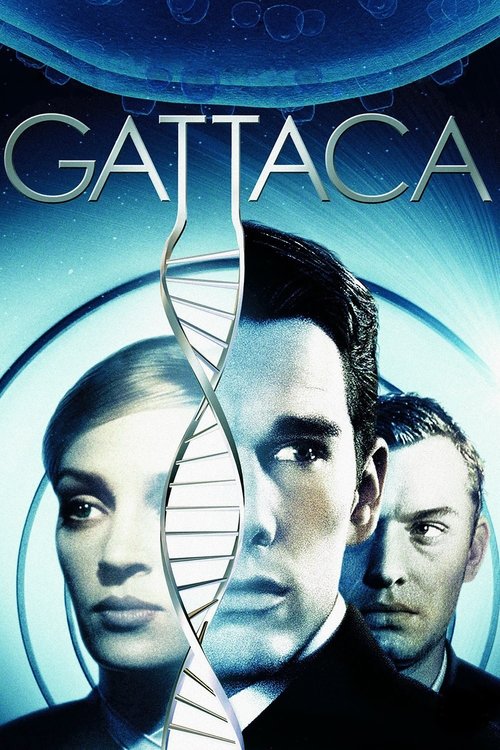
Gattaca
1997 · Andrew Niccol
For when you want smart, soulful sci-fi to chew on — a film about willpower and identity that doubles as an underdog story. Contemplative rather than comforting, but it ends up strangely rousing.
What it's about
In a near future where your DNA is read at birth and treated as your résumé, Vincent was conceived the old-fashioned way — flagged for heart trouble, filed as an 'In-Valid,' and locked out of everything he wants. So he borrows the identity of a genetically perfect man whose body has failed him, and bluffs his way into an elite aerospace program with his eyes on a launch to Titan. Every stray hair and skin flake threatens to expose him, and an investigation is closing in.
The experience
Elegant, hushed, and quietly suspenseful — more slow-burn tension and longing than action, wrapped in a cool retro-futurist glow. It's the rare science fiction film that leaves you feeling stirred rather than dazzled, and it lingers.
Performances
Ethan Hawke carries the film's yearning, Jude Law is magnetic and bitter as the man selling his own perfection, and Uma Thurman brings a guarded chill to the romance.
The craft
Andrew Niccol's debut is a triumph of production design and restraint: a future built from mid-century modern architecture, sharp suits, and amber light instead of gadgets, scored with an aching Michael Nyman-style swell. Every frame is composed like the sterile world it depicts — beautiful, and deliberately airless.
Why it matters
A commercial disappointment on release, it grew into one of the canonical science fiction films of its era — a fixture of bioethics classrooms and the standard reference point for any debate about genetic engineering.
Snapshot
A near-future parable about genetic determinism and the will to exceed one's biological script, Gattaca follows Vincent Freeman — born without genetic enhancement in a society that reads DNA as destiny — as he assumes the identity of Jerome Morrow, a genetically superior but physically broken swimming champion, in order to earn a place on a mission to Titan. The film is simultaneously a heist narrative, a noir-inflected romance, and a sustained philosophical argument: that the self cannot be reduced to its chemistry. On release it found only a modest audience; in the decades since it has become one of the canonical science-fiction films of its era, regularly cited in bioethics syllabi and filmmaking curricula alike.
Industry & production
Gattaca was the directorial debut of New Zealand-born writer-director Andrew Niccol, though he had already completed the screenplay for The Truman Show (Barry Levinson was attached to direct it at the time; Peter Weir would eventually make it the following year). Jersey Films — Danny DeVito, Michael Shamberg, and Stacey Sher's production company — produced, with Columbia Pictures distributing. The budget was in the mid-range for a prestige genre picture of the period. The film underperformed at the domestic box office relative to its cost and marketing spend, a disappointment that did not, however, prevent it from attracting sustained critical attention and eventually a stable home-video afterlife. The relative commercial failure paradoxically contributed to its cult standing: it was positioned as intelligent adult science fiction in a marketplace increasingly oriented toward effects spectacle, and its audience found it gradually rather than on opening weekend.
Niccol retained final-cut creative control over the visual and thematic register in ways unusual for a first-time director at a major studio, a circumstance that accounts for the film's uncompromising pacing and refusal to explain its world through exposition.
Technology
Gattaca is notable for what it withholds technologically. Niccol and production designer Jan Roelfs made a foundational decision early in preproduction: the film would use no computer-generated imagery for its environments. The world of Gattaca Aerospace Corporation is rendered entirely through real locations, practical sets, and production design. This was partly philosophical — a film about the dangers of technological overreach should not itself rely on technological overreach — and partly aesthetic, a commitment to a tangible, photographic materiality that CGI of the period could not have supplied convincingly.
The genetic testing apparatus depicted in the film — the rapid blood and urine analysis at security checkpoints, the DNA sequencing equipment — was designed to be recognizable as extrapolation from late-1990s laboratory practice rather than as science-fantasy invention. The film's central dread depends on the audience accepting these procedures as plausible near-future bureaucracy, and the production design sustains that credibility through restraint.
Technique
Cinematography
The film's visual identity is inseparable from the work of Polish cinematographer Slawomir Idziak, whose collaboration with Krzysztof Kieślowski on The Double Life of Véronique (1991) and Three Colors: Blue (1993) had established him as one of world cinema's most technically inventive DPs. For Gattaca, Idziak shot anamorphic and applied a warm amber-sepia filtration scheme — achieved through a combination of camera filters, lighting choices, and the warm-toned palette Roelfs built into the production design — to code the world of the genetic elite in the color register of old photographs and faded grandeur. The irony is precise: the most supposedly advanced human environment looks like the past.
Idziak worked closely with Niccol on compositions that emphasize the body as a surveilled, measured object. Extreme close-ups of biological material — an eyelash scraped from a desk, a fingernail clipping, a single hair — recur as visual motifs that literalize the film's argument about reduction: in this world, the body is legible as data before it is legible as person. Longer shots frequently place figures within architectural geometries that dwarf them, emphasizing the institutional scale against which individual will must contend.
Editing
Lisa Zeno Churgin edited the film with a controlled deliberateness that mirrors the screenplay's emphasis on routine and procedure. Vincent's daily rituals of disguise — scrubbing, sanding, applying Jerome's biological material, calibrating his performance — are rendered in sequences of methodical exactitude that function as both character study and dramatic suspense. The editing rarely rushes. The murder mystery subplot, which provides the film's plot scaffolding, is cut with conventional thriller economy, but the sequences of Vincent at the swimming pool, or gazing at the star field, or moving through the Gattaca corridors, are given room to breathe in ways that signal the film's true priorities.
Mise-en-scène / staging
The production design by Jan Roelfs — who had previously worked with director Sally Potter on Orlando (1992), a film similarly preoccupied with the performance of identity — is the film's most consistently celebrated technical achievement, earning an Academy Award nomination. Roelfs built the Gattaca facility around real locations, primarily the Marin County Civic Center in San Rafael, California, designed by Frank Lloyd Wright and completed in 1962. The building's long colonnaded corridors, its rounded government modernism, its suggestion of utopian technocracy calcified into bureaucratic routine, provide the film's dominant spatial register. Additional locations included the Vandenberg Air Force Base launch facilities and several Southern California modernist residential buildings.
Crucially, Niccol and Roelfs populated this world with automobiles from the 1950s through the late 1970s, and costumed the cast in silhouettes drawn from mid-century tailoring. The effect is a temporal displacement that reads simultaneously as retro-futurist and as period piece — a future imagined through the design language of the Kennedy-era space program, which is precisely the cultural moment Gattaca is mourning and interrogating. By making the future look like the past, the film avoids the datedness that besets science-fiction production design that attempts to look contemporary-futuristic, and it deepens the thematic resonance: the technocratic dream that produced this genetic hierarchy has the same aesthetic DNA as mid-century American optimism.
Sound
Michael Nyman's score is a defining element of the film's emotional texture. Nyman, whose long collaboration with Peter Greenaway had made him synonymous with a certain brand of minimalist repetitive structure, composed a score that leans heavily on solo and small-ensemble piano, with orchestral swells reserved for moments of genuine release or tragedy. The central theme — associated with Vincent's aspiration and Jerome's immolation — returns in variations throughout, its repeated ascending figures encoding the film's governing metaphor: the attempt to transcend a given condition through willed iteration. The score is integrated with the film's editing rhythms in ways that give the more meditative sequences a musicological underpinning; Nyman's music does not punctuate scenes so much as inhabit them.
The sound design for the laboratory and institutional spaces emphasizes quiet and regulated ambience — the hum of climate control, the soft electronic signatures of biometric readers — creating an environment in which every audible sound feels monitored.
Performance
Ethan Hawke carries the film's center of gravity with deliberate interior restraint. Vincent's voiceover frames the narrative retrospectively, and Hawke's performance sustains the quality of a man who has spent years suppressing spontaneous self-expression in favor of a sustained, vigilant performance of someone else. The physical discipline Hawke brought to the role — his posture, his gait, the controlled quality of his affect in institutional settings — is the film's primary performance argument against determinism: the body, shaped by will and practice, can become something other than what it was born into.
Jude Law's Jerome is the film's most layered characterization: a man who possesses everything the genetic order promised and finds it has delivered nothing of value. Law calibrates Jerome's bitterness and eventual generosity with precision, making Jerome's final act of self-immolation legible as both sacrifice and self-determination. Uma Thurman's Irene is more constrained by the screenplay's allocations, though she brings a quality of melancholy to a character whose genetic "flaw" — a heart condition that bars her from deep-space missions — positions her as a mirror for Vincent's predicament. The supporting cast includes Gore Vidal in a rare acting role, underscoring the film's investment in its own cultural seriousness.
Narrative & dramatic mode
The narrative architecture is a layered imposition of genre forms. At its surface the film is a procedural thriller: a murder has been committed at the Gattaca facility, and Vincent's borrowed identity comes under threat from the investigation. This thriller armature is, in practice, a MacGuffin — the murder mystery is resolved without great narrative fanfare, and the film's real dramatic engine is the sustained question of whether Vincent will reach the launch date before his biological identity is exposed.
Beneath the thriller structure lies a mode closer to literary naturalism's inversion: where Zola or Dreiser chart the deterministic forces that crush individual aspiration, Gattaca asks whether those forces can be defeated through an act of sustained, methodical will. The film answers in the affirmative, but not cheaply — Jerome's death shadows Vincent's triumph and suggests the systemic cost of the individual escape.
The voiceover narration is retrospective and elegiac, giving the film a quality of fable or testimony, and aligning its narrative mode with the confessional science fiction of the mid-century tradition.
Genre & cycle
Gattaca belongs to a strain of literary science fiction that takes genetic technology as its central dystopian mechanism, a cycle that includes — in antecedent form — Aldous Huxley's Brave New World (1932) and extends forward to include a range of biotech anxieties that intensified in the 1990s alongside the Human Genome Project, which was in active progress during the film's production and release. The film is closer to Brave New World than to the more action-oriented or horror-inflected genetic thrillers of its era; it is interested in discrimination and aspiration rather than in monsters or runaway science.
It also participates in a cycle of 1990s prestige science fiction that attempted to rehabilitate the genre's literary seriousness after the blockbuster spectacle of the preceding decade — films such as Twelve Monkeys (1995), Contact (1997), and Dark City (1998) that prioritized thematic and philosophical coherence over action. Within this cycle, Gattaca is distinguished by its austerity and its refusal of irony.
Authorship & method
Andrew Niccol wrote the screenplay before any attachment to production, and the film bears the marks of a writer-director with unusually precise control over his material's architecture. The double structure — Vincent's story and Jerome's story — is coordinated with careful economy, and Niccol's thematic concerns (the constructed self, institutional surveillance, the costs of identity performance) appear in consistent form across his subsequent work, including The Truman Show screenplay and his later directorial projects.
Slawomir Idziak's contribution to the film's visual language cannot be overstated. His calibration of the amber-sepia palette, his compositional emphasis on bodily material, and his architectural framing brought to the film a visual grammar that is immediately recognizable and deeply coherent with the screenplay's concerns. The collaboration between Niccol's conceptual precision and Idziak's cinematographic intelligence produced a film that looks unlike anything else in American science fiction of the period.
Jan Roelfs' production design provides the film's third essential authorial layer. His decision to ground the future in real modernist architecture — to use Wright's Marin County Civic Center as the face of genetic governance — gives the film a spatial credibility and historical resonance that no constructed set could have achieved. The choice to costume and vehicle the world in mid-century idiom was, by all accounts, a collaborative decision between Niccol and Roelfs, and it remains one of the most consequential aesthetic judgments in the film's production history.
Movement / national cinema
Gattaca is an American studio production, but its director is New Zealand-born, its cinematographer Polish, and its production designer Dutch. The film's visual sensibility owes more to European art cinema — specifically the Kieślowski school of color-coded, philosophically inflected cinema — than to Hollywood genre convention. This cosmopolitan authorial composite gives the film a quality of displaced national identity that arguably suits its subject: a man performing a nationality of genetic origin that is not his own.
Era / period
The film was produced and released in the immediate context of the Human Genome Project's active phase — the complete sequencing of the human genome would not be announced until 2000, but the cultural anticipation of that achievement was already reshaping public discourse about genetics, identity, and biological determinism. Gattaca is one of the most fully realized artistic responses to that cultural moment, and its anxiety about the social uses of genetic information has become, if anything, more rather than less prescient in the years since its release.
Themes
The film's governing theme is the contest between biological determinism and individual will — or, more precisely, between institutional determinism (the use of genetic data to allocate social position) and the refusal of that allocation. Vincent's famous declaration that there is no gene for the human spirit is the film's thesis statement, and the narrative is constructed to make that claim experientially convincing rather than merely rhetorical.
Closely related is the theme of performed identity — the sustained, daily labor of becoming someone else, and the question of where performance ends and self begins. Jerome's gradual investment in Vincent's success, and his eventual sacrifice, suggest that identity can be transferred and shared in ways the genetic order cannot account for.
The film also meditates on surveillance, the body as legible text, and the bureaucratic reduction of personhood to measurable data — concerns that have grown more rather than less relevant in the decades since its release.
Reception, canon & influence
Influences on the film (backward): Huxley's Brave New World is the most direct literary precursor, providing the template of genetic stratification as social order. Fritz Lang's Metropolis (1927) informs the film's architecture of labor hierarchy and the two-tier society it spatializes. The film's noir inflections — the identity theft, the murder, the femme fatale figure, the retrospective voiceover — draw on a generic tradition from Chandler through to mid-century Hollywood. The mid-century modernist aesthetic references both the actual Space Age and the utopian design movements of that period, particularly as filtered through the corporate modernism of the Kennedy-era American space program. Idziak's own prior work with Kieślowski, especially Blue's deployment of color as emotional and philosophical coding, is a direct cinematographic influence.
Critical reception: Reviews on initial release were mixed to positive. Critics frequently praised the production design and visual ambition while noting the screenplay's occasional schematism — the film's allegory is legible almost to a fault, and some reviewers found its symbolic architecture too neat. Roger Ebert was among those who received it positively, recognizing its seriousness and visual intelligence. The film's reputation has grown considerably in the twenty-five years since release; it is now routinely listed among the significant science-fiction films of the 1990s and among the most thoughtful treatments of bioethical themes in cinema.
Legacy and forward influence: Gattaca has had a substantial afterlife in academic bioethics, where it is used as a teaching text for discussions of genetic discrimination, the ethics of genetic enhancement, and the social implications of genomic technology. In filmmaking culture, its production design approach — the use of modernist architecture to construct a credible future without CGI — influenced subsequent science-fiction production design. Its amber-sepia visual palette has been widely imitated. More broadly, the film established a template for scientifically engaged dystopian drama that operates in a literary register, a template drawn on by later films including Never Let Me Go (2010), Ex Machina (2014), and various streaming-era biotech narratives. The title itself has entered the English language as a shorthand for genetic discrimination — "Gattaca scenario" appears in bioethics and policy literature as a recognized formulation — which is among the more unusual forms of cultural canonization available to a work of speculative fiction.
A Deleuzian reading
Start with the eyelash.
The full Deleuzian reading of Gattaca →
Reception
A box-office flop in 1997 that critics found chilly and audiences skipped, Gattaca has since been fully rehabilitated as one of the smartest sci-fi films of the decade — its stock rising with every real-world advance in gene editing.
How Gattaca was received, from release to now →
Influences: the films it descends from and the films it influenced
- The Double Life of Véronique (1991) — Slawomir Idziak's amber-green optical filtration — glass filters placed before the lens rather than in post — is the direct technical precedent for Gattaca's warm sepia palette; Niccol hired Idziak specifically to repurpose this method for a different ideological end, coding the genetic elite's world in the register of faded photographs.
- Three Colors: Blue (1993) — Idziak's second Kieślowski collaboration refines the extreme macro close-up of physical debris as evidence of interior states — shattered car glass, a dropped medication — which Niccol and Idziak directly transpose into Gattaca's recurring shots of eyelashes, fingernail clippings, and hair as surveillance objects that reduce personhood to data.
- Blade Runner (1982) — The Voight-Kampff biological authenticity test — a procedural at which the protagonist may or may not be exposed — is the structural ancestor of Gattaca's DNA checkpoints; both films organize their thriller mechanics around the fear of biological exposure, and both frame the genre material through retrospective noir voiceover as elegy rather than suspense.
- THX 1138 (1971) — The production design conceit of long white institutional corridors — shot in the unfinished BART Transbay Tube — as dystopian surveillance space, with identity reduced to an alphanumeric designation, is the precise staging grammar Niccol and Jan Roelfs reactivate at the Marin County Civic Center, where the individual is legible only as a genetic sequence.
- Alphaville (1965) — Godard's foundational decision to shoot contemporary Paris modernist structures — Orly Airport, the Maison de la Radio — as a sci-fi city without constructed sets is the direct methodological precedent for Niccol's use of Frank Lloyd Wright's Marin County Civic Center as built retro-futurism that requires no dressing to read as dystopian technocracy.
- Seconds (1966) — The narrative conceit of a protagonist who physically assumes another man's identity within a corporate-institutional system that validates the biological replacement — shot by James Wong Howe in anamorphic widescreen with bodies placed inside institutional corridors — is the direct structural and formal ancestor of Gattaca's identity-theft plot and its anamorphic compositions of figures dwarfed by architecture.
- The Piano (1993) — Michael Nyman's score — solo piano motifs that accrue emotional weight through repetition and small melodic variation rather than conventional dramatic swelling — is the compositional template Nyman extends directly into Gattaca, where the piano functions as an institutional heartbeat underscoring routine rather than event.
- Orlando (1992) — Jan Roelfs's production design for Potter's film — rendering identity performance through material surface, costume, and architecturally coded space — develops the specific design methodology Roelfs brings to Gattaca, where the amber-toned interiors of the genetic elite's world similarly encode the film's argument about the body as a legible, changeable costume.
- Brazil (1985) — The retro-futurist production design principle — making the dystopian future look like a degraded version of modernist optimism, so that the future reads iconographically as the past — and the institutional apparatus that reduces citizens to file numbers are the aesthetic grammar Niccol absorbs and reskins in DNA sequence rather than paperwork.
- A Short Film About Killing (1988) — DP Idziak transplants the poisoned green-amber filtration and inward-rotting vignette wholesale into science fiction — a direct transfer of the cinematographer's optical method.
- Decalogue V (1989) — Idziak carried his green-gold in-camera filtration internationally, tinting the entire world a diseased, filtered hue so that palette itself encodes a moral condition — the Dekalog V method transplanted to sci-fi.
- Code 46 (2003) — The most direct heir to Gattaca's genetic checkpoint grammar: PCR biological identity verification at institutional transit boundaries, near-future dystopia shot entirely on real locations in Shanghai and Dubai without constructed environments, and a fugitive-couple plot driven by genetic incompatibility — the couple share too much DNA to be legally permitted to reproduce — rather than social transgression.
- Minority Report (2002) — Extends Gattaca's biological surveillance infrastructure into a running-man thriller: the retinal scan as identity checkpoint replaces the DNA screen, and the plot turns on a protagonist who must evade a system that reads his biology as his destiny — here predictive criminal identification rather than genetic caste assignment.
- Never Let Me Go (2010) — Romanek adopts Gattaca's structural formula of biological determinism rendered through retrospective first-person voiceover and amber-warm cinematography (Adam Kimmel), using the same thriller-as-MacGuffin device: the organ-donation conspiracy is consistently subordinated to a philosophical argument about whether biological origin forecloses the full range of human experience.
- Ex Machina (2014) — Garland shoots the Juvet Landscape Hotel in Norway as a sci-fi research facility without constructed sets or CGI environments, directly continuing Gattaca's method of finding modernist architecture whose existing geometry produces institutional alienation; the question of whether an artificial body constitutes authentic personhood is Gattaca's genetic identity argument transposed from DNA to robotics.
- Divergent (2014) — Renders a caste-sorted dystopia through immaculate color-graded production design that codes social rank chromatically — the direct precedent for Divergent's faction-color-coding.
- I Origins (2014) — Idziak again, applying the same amber-filtered monochromatic light to a genetics fable; more specifically it invents the dramaturgy of biometric gates (retinal and blood scanners) as the machinery that adjudicates who you are — which I Origins simply inverts, using the scanner to certify a soul instead of exposing a fraud.
- The Truman Show (1998) — Niccol's own screenplay, written before Gattaca and produced simultaneously: both films share the structural conceit of a protagonist performing an identity not biologically or institutionally assigned to him within a totalizing surveillance architecture, with clean modernist production design used to aestheticize institutional control rather than to make it menacing.
- Dark City (1998) — A contemporaneous neo-noir in which biological identity — memory, physical form — is implanted and reassigned nightly by an institutional apparatus; production designer George Liddle builds the entire retro-futurist city from practical sets and miniatures without CGI environments, sharing Gattaca's commitment to photographic materiality as the aesthetic precondition for philosophical credibility.
- Contact (1997) — Niccol's sibling hard-SF film deploys minimal spectacle and institutional-dwarfing wide compositions to stage a philosophical argument about determinism in the same release year as Contact, sharing its strategy of making architectural geometry — the glass-and-steel eugenics bureau echoing the VLA's Y-pattern — the visual register of institutional opposition to individual transcendence.
- Lord of War (2005) — Niccol's own authorial signature: a cool, measured voiceover narrator embedded inside an engineered system, photographed with seductive high-gloss surface that masks the human cost beneath.
Similar films
- Blade Runner (1982) — influence & lineage
- Code 46 (2003) — influence & lineage
- Minority Report (2002) — influence & lineage
- Alphaville (1965) — influence & lineage
- Brazil (1985) — influence & lineage
- Ex Machina (2015) — shared sensibility
- Blade Runner 2049 (2017) — shared sensibility
- The Aviator (2004) — shared sensibility