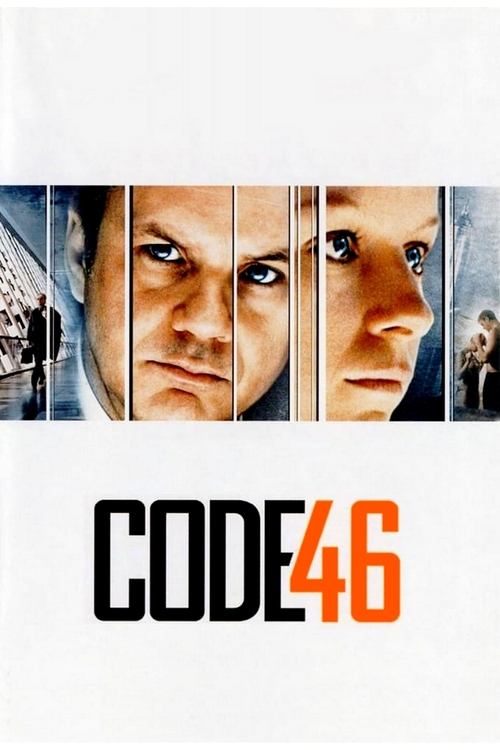
Code 46
2003 · Michael Winterbottom
For when you want your science fiction sad and atmospheric — a late-night watch to sink into rather than an action fix. It rewards patience and a reflective frame of mind.
What it's about
In a near future where travel, work, and even having children are governed by genetic permits, an insurance investigator flies to Shanghai to expose a forger of 'papelles' — the documents that let people move and live. He identifies the culprit almost immediately: a young woman he promptly falls for instead of turning in. Their affair puts them both on the wrong side of a law that regulates who is allowed to love whom.
The experience
Dreamy, melancholy, and slow-burning — more a mood piece than a thriller, drifting between neon cities and empty desert. It gets under your skin quietly and leaves a lingering ache rather than a jolt.
Performances
Tim Robbins plays the investigator with a weary, rumpled tenderness, and Samantha Morton is quietly magnetic — she makes an enigmatic character feel wounded and real with very little dialogue.
The craft
The boldest choice is building the future out of the present: no sets or effects, just the real architecture of Shanghai, Dubai, and the desert, shot so that our own world looks alien. The film also invents a plausible global creole — characters pepper their English with Spanish, French, and Mandarin — and the whole thing has a hushed, jet-lagged texture that suits headphones and a dark room.
Why it matters
A cult touchstone for low-budget, idea-driven science fiction, proving a convincing future could be conjured from location shooting and imagination rather than production design.
Snapshot
Code 46 is a near-future science-fiction romance built almost entirely from the present world. Michael Winterbottom and screenwriter Frank Cottrell Boyce imagine a globalized society in which travel, work, and reproduction are governed by genetic and biometric permissions, and then stage that future not through production design but through the existing architecture of Shanghai, Dubai, and the desert beyond. The premise is at once bureaucratic and mythic: insurance investigator William Geld (Tim Robbins) — note the freighted surname, Geld meaning money in German and carrying the sense of "to geld" — travels to Shanghai to expose a forger of "papelles," the permit documents that authorize movement and life, and falls for Maria Gonzalez (Samantha Morton), the forger herself. Their affair collides with "Code 46," a statute forbidding reproduction between the genetically too-similar in a world saturated with IVF and cloning. The revelation that Maria is a genetic relation of William's mother turns a noir investigation into an Oedipal tragedy of memory, consent, and erasure. It is one of Winterbottom's most formally controlled films and among the purest examples of "mundane" or austere science fiction — speculation rendered through restraint rather than spectacle.
Industry & production
The film was produced by Revolution Films, the company Winterbottom runs with his longtime producing partner Andrew Eaton, with backing from BBC Films and the UK Film Council — the institutional ecosystem that sustained much of British auteur cinema in the period. It is a characteristic Revolution project: internationally ambitious in setting but modest in budget, shot quickly and lightly with a small crew that could move through real, working locations rather than soundstages. Winterbottom's house method — fast, cheap, documentary-inflected shooting — is what made a film spanning Shanghai, Dubai, the Rajasthan/Indian desert, and London economically feasible at all. The picture premiered in competition at the Venice Film Festival in 2003. Commercially it was among Winterbottom's weaker performers, a cool and difficult art film that found a limited theatrical audience before settling into a durable cult reputation; precise box-office figures are not something I can responsibly reconstruct here, but the record is consistent that it under-returned relative to its profile. Its afterlife has been on disc and streaming and in the syllabi of film and media courses rather than at the box office.
Technology
Code 46 is unusually rich as a thought-experiment about biotechnology and governance, and its speculative apparatus is integrated into plot rather than exposition. The central technology is genetic surveillance: a society in which cloning and assisted reproduction have so multiplied shared genetic material that the state must legislate against inadvertent incest, hence "Code 46." Papelles function as combined passport, visa, work permit, and health clearance — life is permissioned, and to live "al fuera" (outside, beyond the covered cities, in the irradiated desert) is to live without papers and without protection. The film also imagines biological viruses engineered to deliver behaviors and knowledge: William is dosed with an "empathy virus" that grants him an intuitive, near-telepathic ability to read people, the very faculty that lets him find the forger and also makes him susceptible to love. Most devastating is the technology of memory: the state can excise specific memories, and the film's ending turns on selective erasure as both mercy and punishment. What distinguishes the film is that none of this is visualized as gadgetry. The technology is administrative, biological, and linguistic — felt as policy and consequence rather than seen as hardware.
Technique
Cinematography
The film was shot by Marcel Zyskind — Winterbottom's regular collaborator of the period — together with Alwin H. Küchler, working largely handheld and with available light. The governing idea is to photograph the contemporary world as the future: the glass towers and elevated motorways of Shanghai, the airports and atria, the seamless international architecture of late capitalism, all stand in for a coming order without a single matte painting. Interiors are clean, bright, and slightly clinical; the covered city reads as perpetual, regulated daylight. The crucial visual opposition is inside versus al fuera — the controlled, illuminated city against the blown-out, sun-scorched desert of the dispossessed, where the image itself seems to lose definition. Long-lens street footage and a semi-documentary attention to crowds and transit give the world density and plausibility; the camera treats the future as already inhabited.
Editing
Cut by Peter Christelis, the film uses an elliptical, associative structure that mirrors its themes of partial and edited memory. The narration is retrospective and fractured — Maria's voice frames events as recollection, and the cutting often withholds and rearranges, so that the audience experiences the story the way the characters experience their own minds: in pieces, with gaps that may have been engineered. This editorial reticence is essential to the film's tragic mechanism, since the plot itself concerns memories that have been removed.
Mise-en-scène / staging
Production design works by selection rather than fabrication. The future is built from what the world already offers — uniform corporate interiors, transit hubs, the anonymous luxury of the global business traveler — so that the speculative element is carried by language, behavior, and rule rather than by props. The "Sphinx" corporation that employs William is itself a piece of staging: the name invokes the riddling monster of the Oedipus myth, signposting the incest plot in plain sight. Costume and behavior emphasize a sleek, deracinated cosmopolitanism, against which the desert exiles register as raw, exposed life.
Sound
The film's most inventive design choice is linguistic. Its characters speak a near-future creole — English laced with Spanish, French, Arabic, Italian, and Mandarin loanwords ("papelle" for papers, "al fuera" for outside, and similar coinages) — a sonic shorthand for a fully globalized world in which languages have interpenetrated. This invented vernacular does more world-building than any set could. The music is by The Free Association, the band associated with producer-DJ David Holmes (a frequent Winterbottom collaborator), and the film leans on a recurring pop motif — Coldplay's "Warning Sign," whose lyric of recognizing a love arriving as a warning is woven into the texture and into Maria's own act of singing a "cover version." The cover-song idea rhymes with the film's preoccupation with copies, clones, and genetic repetition.
Performance
Tim Robbins plays William as a muffled, decent, somewhat passive man whose empathy is both gift and affliction; the performance is deliberately interiorized, a bureaucrat undone by feeling. Samantha Morton, one of the most expressive screen actors of her generation, gives Maria a fragile luminosity and supplies much of the film's emotional gravity — particularly in the closing movement, where she must register a love she is no longer permitted to remember. The pairing's restraint is intentional: this is a romance of muted affect, melancholy rather than heat, closer to grief than to passion.
Narrative & dramatic mode
Structurally the film is a detective story that mutates into a doomed romance and finally into myth. It opens in the investigative register of noir — an outsider sent to a strange city to uncover a crime — then abandons the case almost casually when William, smitten, frames an innocent and protects Maria. The dramatic mode is elegiac and fatalistic: from early on, the retrospective narration signals that this love is already lost, so that suspense gives way to dread. The Oedipal substructure governs everything; the revelation that the lovers are genetically akin transforms transgression into tragedy, and the climax — a car crash, an erasure, an exile — distributes its punishments with mythic asymmetry. William, the man, is returned to his family with his memory of Maria wiped clean; Maria, the woman, is cast out into the desert but allowed to keep her memories, condemned to remember a love the world has unmade. The ending's gendered cruelty is the film's bleakest and most pointed stroke.
Genre & cycle
Code 46 belongs to the lineage of intellectual, austere science fiction that treats the genre as a vehicle for ideas about identity, memory, and social control rather than for action or effects. It sits with the strain of dystopia descended from Huxley's Brave New World — reproduction as state matter, pleasure and mobility as licensed privileges — and with the cinematic tradition of futures shot in the present. Its most important generic kin is the science-fiction romance of irrecoverable love, and within early-2000s cinema it anticipates the wave of quiet, humane, low-spectacle SF that would gather force later in the decade. It is emphatically not a film of the blockbuster cycle; its dystopia is administrative and intimate.
Authorship & method
The film is a definitive Winterbottom production in its method: shot fast and light, internationally and on real locations, with a recurring company of collaborators. Frank Cottrell Boyce, Winterbottom's most important screenwriting partner — their work together includes Welcome to Sarajevo, The Claim, 24 Hour Party People, and In This World — supplies the literate, idea-driven script, including the invented creole and the Oedipal architecture; the writing is the film's intellectual engine. Marcel Zyskind, the cinematographer Winterbottom used repeatedly in this era, executes the documentary-grade handheld aesthetic, alongside Alwin Küchler. David Holmes and The Free Association provide the score, continuing a music partnership central to Winterbottom's sound. Editor Peter Christelis shapes the elliptical, memory-like structure. What makes the film authorially coherent is the alignment of method and meaning: the same lightweight, world-as-found approach that lets Winterbottom shoot a global future cheaply also produces the film's central thesis — that the future is already here, distributed unevenly across the cities and deserts of the present.
Movement / national cinema
The film is a product of British art cinema of the late 1990s and 2000s, specifically the Revolution Films / BBC Films axis that gave Winterbottom unusual freedom to move between genres and continents. It is internationalist by temperament — a British film with an American lead, a Shanghai setting, and a polyglot language — which is itself an expression of its theme. Within Winterbottom's restless, genre-hopping body of work, it stands as the science-fiction entry, but it shares with his realist films (In This World, The Road to Guantánamo) a deep preoccupation with borders, papers, migration, and who is permitted to move — concerns that make Code 46 legible as speculative fiction grown directly from the politics of its moment.
Era / period
Made and released in 2003, the film is steeped in early-twenty-first-century anxieties: the post-9/11 security state, the hardening of borders and the bureaucratization of travel, the genomic optimism and dread following the Human Genome Project, and the visible architecture of globalization in the boomtowns of Asia and the Gulf. Its dystopia is recognizably an extrapolation of that instant — surveillance, biometrics, and permissioned mobility imagined as the logical end of trends already underway. Shooting in the then-emergent skylines of Shanghai and Dubai grounds the film firmly in its period even as it projects forward.
Themes
The film's master theme is determinism — genetic, social, and emotional — against the human wish to choose. Code 46 itself dramatizes the collision between biological fact and desire; the empathy virus literalizes the loss of emotional autonomy; the memory erasures pose the question of whether a self persists when its formative experiences are deleted. Incest and the Oedipal return run beneath everything, figured openly through the Sphinx and the riddle of identity. Borders and belonging — inside versus al fuera, the papered versus the paperless — give the love story a political dimension, making the personal tragedy inseparable from a regime of exclusion. Finally there is repetition and the copy: clones, genetic likeness, cover versions of songs, a world of duplicates in which true singularity, including the singularity of one beloved person, is what the system cannot tolerate.
Reception, canon & influence
Critical reception was respectfully divided. Admirers praised the film's intelligence, its melancholy beauty, the boldness of its world-building-through-restraint, and Samantha Morton's performance; skeptics found it cold, slow, and emotionally remote, faulting a romance that keeps the viewer at arm's length. It was a commercial disappointment and was not a major awards presence, but it has aged into a genuine cult object, increasingly cited as a model of low-budget, idea-led science fiction.
Its backward lines of influence are clear and deep. The film is unthinkable without Chris Marker's La Jetée — the doomed love story bound to memory and to a controlled future, science fiction conjured without spectacle. It draws on Jean-Luc Godard's Alphaville, which similarly used a contemporary city as dystopia and a noir investigator as its hero, and on the literary dystopia of Brave New World. The Oedipus myth is its deepest structural source. In tone and its imagery of muted, doomed longing, it shows affinities with the mood cinema of directors like Wong Kar-wai. Its forward influence is harder to document with confidence, and honesty requires saying that the record of direct, traceable lineage is thin: Code 46 is more often invoked as a touchstone or predecessor for the subsequent cycle of quiet, humane, low-spectacle science fiction — near-future films that build worlds from real locations and ideas rather than effects — than credited as a demonstrable source for any single later work. Its surest legacy is exemplary: proof that ambitious science fiction can be made intimately, cheaply, and intelligently, by photographing the present as if it were already the future.
A Deleuzian reading
She sings someone else's song.
The full Deleuzian reading of Code 46 →
Reception
It landed with a shrug in 2003 — mixed Venice reviews, a tiny box-office footprint, and 'minor Winterbottom' status. Two decades of biometric borders, travel permits, and gig-economy megacities later, it keeps getting rediscovered as one of the most quietly prescient sci-fi films of its era.
How Code 46 was received, from release to now →
Influences: the films it descends from and the films it influenced
- La Jetée (1962) — Conjures a controlled-future, time-bound love story almost entirely from elliptical fragments and memory rather than spectacle — the foundational proof that idea-led SF can be built from withheld images, which Code 46's memory-keyed romance directly inherits.
- Alphaville (1965) — Photographs contemporary Paris as a future dystopia with no built sets and fronts it with a noir investigator-protagonist — the exact 'shoot the present as the already-arrived future' + detective-hero strategy Code 46 reuses.
- Gattaca (1997) — Stages a near-future of genetic determinism and DNA-gated belonging inside real modernist architecture instead of effects, the direct precedent for Code 46's gene-screened 'papelles' surveillance world.
- Until the End of the World (1991) — Organizes a globe-trotting near-future around a memory-recording/playback technology shot across real international cities — the model for distributing the future unevenly across actual locations.
- Solaris (1972) — Subordinates its speculative premise to an interiorized, memory-haunted love and a muted, melancholic register, prioritizing inward longing over genre incident.
- Chungking Express (1994) — Shoots handheld, available-light urban romance fast and loose in found city spaces, the documentary-grade intimacy Zyskind's camera echoes.
- Welcome to Sarajevo (1997) — Establishes the Cottrell Boyce screenwriting partnership and the documentary-location, shot-fast-and-light production method that Code 46 applies to speculative material.
- Children of Men (2006) — Assembles its near-future from the degraded real present with documentary handheld camerawork and minimal effects, extending the 'future built from found locations' approach Code 46 modeled.
- Moon (2009) — Low-budget, idea-led humane SF that foregrounds identity, cloning and loneliness over spectacle — the exemplary 'intimate, cheap, intelligent' lineage Code 46 anticipated.
- Never Let Me Go (2010) — Quiet, muted-performance SF of biological/genetic determinism shot in real English locations, dramatizing predetermined fate through restraint rather than action.
- Monsters (2010) — Micro-budget SF built by photographing real Central American locations as the future with effects kept minimal — the 'selection not fabrication' world-building Code 46 pioneered at scale.
- Her (2013) — Renders the near-future as a lightly tweaked, warmly lit present and routes its speculation through an intimate, melancholic romance instead of hardware spectacle.
- Under the Skin (2013) — Shoots SF in found reality with available light and non-actors in real public spaces, treating the world as selected rather than fabricated — the documentary-SF method Code 46 prefigures.
- In the Mood for Love (2000) — Builds doomed romance from restraint and withheld emotion, the muted-interiorized tonal template that keeps Code 46's lovers — and the viewer — at an aching arm's length.
- In This World (2002) — Code 46's immediate methodological twin — same Marcel Zyskind handheld 'world-as-found' shooting, lightweight crew, and a borders-and-belonging subject traced across real transit routes.
- Eternal Sunshine of the Spotless Mind (2004) — Fuses a memory-erasure technology with a fractured, retrospectively scrambled romance edited as subjective recollection — the same memory-wipe-meets-love structure Code 46 runs the year before.
Similar films
- Gattaca (1997) — influence & lineage
- Children of Men (2006) — influence & lineage
- In the Mood for Love (2000) — influence & lineage
- Alphaville (1965) — influence & lineage
- Moon (2009) — influence & lineage
- Her (2013) — influence & lineage
- 2046 (2004) — shared sensibility
- Black Bag (2025) — shared sensibility