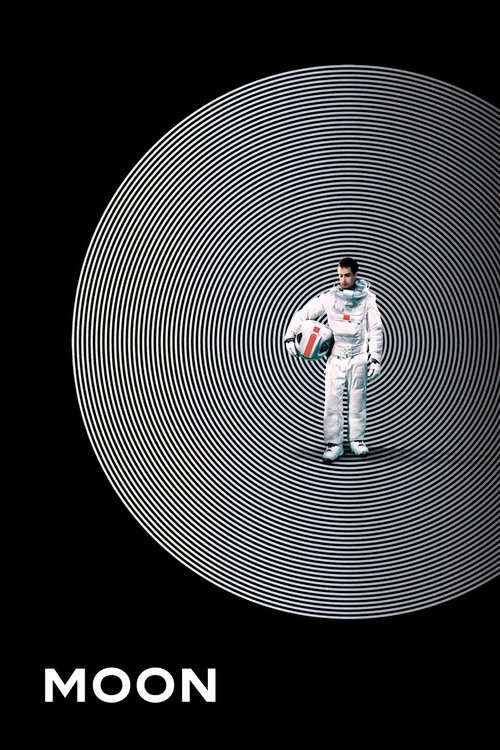
Moon
2009 · Duncan Jones
For when you want smart, sad science fiction to chew on for days — a film about identity and what a company owes a person, not lasers. Contemplative rather than comforting, but strangely moving by the end.
What it's about
Sam Bell has spent three years alone on a lunar mining base with only GERTY, the station's soothing computer assistant, for company — and he's two weeks from going home to his wife and daughter. Then an accident out on the moon's surface sets off a chain of discoveries that make him question everything about the station, his employer, and himself.
The experience
Quiet, melancholy, and slowly unnerving — less a thriller than a lonely hum that gets under your skin. It makes you feel the isolation in your bones, then keeps tightening the screws of one very personal mystery.
Performances
Sam Rockwell carries virtually the entire film alone and it's a marvel — funny, frayed, and devastating, doing things with a solo performance that few actors are ever asked to attempt.
The craft
Made for around five million dollars, it looks like ten times that: tactile model-work lunar exteriors, a lived-in station that feels sweated in, and a mournful score that does a lot of the emotional lifting. Duncan Jones directs it as a chamber piece — small rooms, big questions.
Why it matters
An instant landmark of low-budget, idea-driven science fiction that launched Duncan Jones's career and became the template pointed to whenever someone argues sci-fi doesn't need a blockbuster budget.
Snapshot
Duncan Jones's debut feature is a chamber piece set almost entirely inside a single lunar mining installation, following a lone contractor named Sam Bell through the final weeks of a three-year rotation as he discovers that his sense of selfhood—and perhaps his humanity—is a company-managed fiction. Shot quickly on a modest British budget, the film accomplished something its makers could not have guaranteed: it arrived as a genuine landmark in post-millennial science fiction, measuring the cost of isolation and corporate instrumentalisation in the quiet register of a man talking to his reflection.
Industry & production
Moon was produced by Liberty Films UK, with Trudie Styler and Stuart Fenegan among its producers, on a budget reported at approximately five million US dollars. For a film whose ambitions included credible lunar exteriors and convincing dual-performance compositing, the financial constraints were severe; they also proved generative, forcing Jones and his collaborators toward practical ingenuity rather than digital largesse.
Jones developed the story from a long-standing personal concept, then hired Nathan Parker to write the screenplay — Parker's feature debut. The script went through development at a pace that kept the project small and under the radar of studio interference, which was by design. Jones had trained at the National Film and Television School in the UK and had worked in advertising and music video direction; he wanted his first feature to be uncompromised. Pre-production centered on building full-scale interior sets at Shepperton Studios, where the cramped corridors, recreation room, and medical bay of Sarang Station were constructed to allow continuous shooting and to give Sam Rockwell a genuinely physical environment to inhabit.
The film premiered at the Sundance Film Festival in January 2009 in the World Dramatic Competition, then received a UK release and was distributed in North America by Sony Pictures Classics. Its theatrical run was limited but its critical profile was immediate and strong; it found a larger audience through ancillary release and became something of a cornerstone film for the early streaming era.
Technology
The signature technological decision of Moon — and the one that most visibly locates it in a particular lineage — was the choice to build the lunar-surface sequences around practical miniature effects rather than computer-generated imagery. The moon rovers, the exteriors of Sarang Station, and the wide shots of the lunar regolith were realized using physical scale models, photographed against matte backgrounds and integrated through optical and digital compositing. This was not a budget workaround so much as a deliberate aesthetic allegiance to the tradition of British effects cinematography: the model work of 2001: A Space Odyssey, Silent Running, and Alien.
The more technically demanding challenge was staging scenes in which two incarnations of Sam Bell occupy the same frame simultaneously. This was achieved through a combination of split-screen photography, a body double, and careful post-production compositing. The approach required precise blocking and a consistent spatial logic from Gary Shaw (director of photography), Nicolas Gaster (editor), and Jones — in every shared two-shot, the audience needed to forget the seam and attend only to Rockwell's doubling act. On the budgetary and pipeline evidence available, the effects house Cinesite handled much of the compositing work, though the project was notable for the modest scale of its digital-effects pipeline relative to its ambition.
GERTY, the station's AI assistant, was rendered as a screen-mounted robotic arm with an emoticon display — a practical on-set prop that gave Rockwell something tactile to interact with, and whose design deliberately recalled the HAL 9000 interface unit while inverting its connotations.
Technique
Cinematography
Gary Shaw shot Moon in a palette of cool whites, institutional grays, and artificial fluorescence that makes Sarang feel less like a futuristic outpost than like a particularly remote oil rig or Antarctic research station. The interiors are deliberately prosaic — the cinematography refuses glamour, favouring the overhead fluorescent logic of workspaces and the shallow depth of field that comes from lensing tight corridors. When Sam walks the station's hamster-wheel exercise track, the composition holds him small against the centrifugal curvature, suggesting perpetual containment.
Exterior shots on the lunar surface are photographed with a wider dynamic range: the harsh sunlight bleaching the regolith white, the shadows absolute. Shaw and Jones used these exterior compositions economically, making each venture outside feel like a deliberate departure from the film's claustrophobic grammar. The two cinematographic registers — compressed interior and exposed exterior — map cleanly onto the film's psychological logic.
Editing
Nicolas Gaster's editing is patient and architectural. The film's early reels establish a rhythmic routine — Sam performs tasks, tends his plants, plays ping-pong alone, records video messages — and the cutting honors that repetition without underlining its pathos. When the film's central revelation arrives, the editing accelerates only slightly; Moon is not a thriller and does not cut like one. The dual-Sam sequences required particular precision: continuity of eyeline, matching of Rockwell's physical rhythms across plates, and the suppression of any optical tell that might break the illusion of two bodies sharing space.
Mise-en-scène / staging
Tony Noble's production design is meticulous in the logic of the everyday. Sarang Station has the accumulated texture of a place actually lived in for three years: personal mementos, a half-finished scale model of a town, fitness equipment, a cafeteria with institutional furniture. Noble and Jones understood that the horror of Sam's situation is not alien but domestic — the props of a normal life transplanted into an abnormal isolation. The emotional charge of the design comes from recognition: this could be any workplace, any site of contracted labor.
Jones stages the dual-Sam encounters with an attention to small behavioral differentiation — one Sam carries more physical damage, one is more emotionally volatile — and the blocking consistently places them in shallow opposition, the frame barely large enough to hold both. The decision to shoot on physical sets rather than green-screen gave Rockwell continuous peripheral grounding and contributes to the naturalness of performance.
Sound
Clint Mansell's score is one of his most restrained and characteristic. Primarily piano, sparse strings, and long tones, the music occupies the register of suppressed emotion rather than underscored sentiment. Mansell had built his reputation through louder, more percussive work with Darren Aronofsky (Requiem for a Dream, The Fountain); Moon asked him for something smaller, closer to chamber music, and he delivered a score that functions almost as internal monologue — what Sam feels but cannot articulate.
The sound design uses silence and ambient drone to emphasize the acoustic poverty of the station. Outside, on the moon's airless surface, the film commits to near-silence interrupted only by the sound transmitted through Sam's suit and rover — a choice that underscores physical vulnerability without melodrama. The engineering of quiet is as important here as any musical element.
Performance
Sam Rockwell's performance is the film's central technical and emotional achievement. He plays multiple instantiations of the same person, differentiated by physical decay, psychological state, and accumulated experience, while maintaining recognizable continuity of identity across all of them. The performance required Rockwell to supply all the relational energy that would normally be distributed across an ensemble — to be, simultaneously, protagonist and antagonist, the known and the strange. By all accounts the shoot demanded he play scenes against stand-ins and then against himself in composited plates, with Jones providing the through-line of intention.
Kevin Spacey voices GERTY with a deliberate flatness that recalls HAL 9000 without replicating it: where HAL's menace accretes through false warmth, GERTY's affect is genuinely ambiguous, its emoticon display cycling through approximations of feeling that the film eventually reveals to be something closer to real loyalty than to performance. The casting invites the audience to misread the character along familiar lines, and the subversion carries weight.
Narrative & dramatic mode
Moon is structured as a slow disclosure. The opening establishes Sam's routine and his deteriorating psychological state before introducing, about a third of the way through, a second Sam — physically fresher, emotionally reactive, not yet worn down. The film withholds full exposition of what this means and allows the two Sams to arrive at understanding in parallel with the audience.
The dominant mode is intimate science fiction: the speculative premise (corporate cloning of a single worker, deployed in rotation) functions as a lens for examining questions about identity, the authenticity of memory, the legal and ethical status of persons who were manufactured rather than born. These are Philip K. Dick's questions, and the film inhabits them with the sobriety Dick often sacrificed for pace. The story is Aristotelian in the specificity of its setting — almost entirely one location, a compressed duration — and Greek in its concern with what constitutes a human soul and who has the standing to claim one.
Genre & cycle
Moon belongs to the revival of contemplative, philosophically oriented science fiction that emerged in the middle years of the 2000s as a counterweight to the franchise-spectacle mode then consolidating its dominance. This cycle includes Danny Boyle's Sunshine (2007), Shane Carruth's Primer (2004), Andrew Niccol's earlier Gattaca (1997, a precursor rather than a contemporary), and the quieter strands of Alfonso Cuarón's Children of Men (2006). These films share a preference for practical or restrained production values, a focus on individual psychology rather than civilisational stakes, and a return to the literary premises of 1960s and 1970s speculative fiction.
Moon sits most comfortably in the tradition of British space-isolation drama — a line that runs from Nigel Kneale's Quatermass serials through the studio-era science fiction of the BBC, and finds its nearest cinematic antecedents in the single-set, performance-centred works of the 1970s industrial-science-fiction moment.
Authorship & method
Duncan Jones came to features from advertising and music video direction, where he had developed facility with the tightly controlled image — economy of means in service of maximum emotional impact within a short duration. Moon extended that economy to feature length, and the pressure it puts on each scene to carry weight is characteristic. Jones is also, publicly and unmistakably, the son of David Bowie, who starred in Nicolas Roeg's The Man Who Fell to Earth (1976) — a film about an alien stranded on Earth by corporate and human exploitation that is one of Moon's most obvious emotional ancestors. Jones has acknowledged the personal resonance of that lineage without overclaiming it, and the film's treatment of alienation and estrangement from home carries the shadow of that inheritance without becoming allegory.
Gary Shaw's cinematographic contribution was to bring an almost documentary sobriety to material that could have been stylized into unreality; he worked with Jones to ensure that the film looked like a workplace rather than a dreamscape. Clint Mansell's score, as noted, provided the film's emotional undertow without prescribing response. Nicolas Gaster's editing built the structure that the film's slow revelation required. Nathan Parker's screenplay translated Jones's conceptual story into a functional dramatic architecture with a care for dialogue that resists exposition while still delivering information — the voices of the two Sams are subtly distinct in register and rhythm.
Movement / national cinema
Moon is a British production working explicitly within a British science fiction tradition. The UK had, by the late 2000s, developed a small but significant strand of genre filmmaking that combined modest production values with literary seriousness: 28 Days Later (Boyle, 2002), Children of Men (Cuarón, 2006), Sunshine (Boyle, 2007), and, slightly later, Ex Machina (Garland, 2014) form a recognizable formation around Moon. These films share a tendency to use genre as a vehicle for social or philosophical inquiry, are often produced through the alliance of British talent and modest international co-production funding, and maintain a healthy skepticism toward the commercial genre conventions they employ.
The film also sits within the broader tradition of British studio filmmaking — Shepperton Studios, where Moon was shot, has housed British science fiction production since the postwar period — and inherits something of the tight-budget ingenuity that characterized British genre production throughout the 1970s.
Era / period
Moon was released in 2009, a year that also saw the release of District 9, Avatar, and Star Trek (J.J. Abrams) — three films that in different ways defined the commercial and technological possibilities of the moment. In that context, Moon was a deliberate anachronism: a film that looked backward to 1970s science fiction aesthetics and inward to single-performance chamber drama at a moment when the blockbuster was doubling down on scale. Its critical success was partly a response to that anachronism — the film arrived as relief for audiences who felt the genre had lost its capacity for the intimate and the uncertain.
The film was also a product of the post-Iraq, post-financial-crisis atmosphere of 2009: its concern with corporate exploitation of isolated workers, with the contract as a mechanism of dehumanization, and with the gap between what institutions tell workers about their situation and what is actually the case, read clearly against the decade's political context without being in any way topical or polemical.
Themes
The film's central preoccupation is identity under conditions of manufacturing and amnesia: what makes a person continuous with their past self, and what remains when memory is revealed to be an implant. These questions are Dickian in origin and connect Moon to Blade Runner, Total Recall, and the larger tradition of constructed-memory science fiction. Where that tradition is often resolved into action — the protagonist fights to assert their identity — Moon refuses resolution, ending instead with a sense of the problem's persistence and the system's indifference to it.
Closely related is the theme of contract labor and corporate abuse: Lunar Industries maintains its operation not through automation but through the systematic exploitation of a single person's entire life, cloned and deployed in rotation. The film does not labor this point but does not let it disappear either. The three-year contract, the video messages home, the physiological deterioration — these are the texture of a working life, and the film treats them with the seriousness that texture deserves.
GERTY's subversive loyalty introduces a secondary theme about the nature of feeling and the capacity for ethical relation in non-human entities. The film inverts the HAL-9000 template: where the AI of 2001 is warm in manner and murderous in function, GERTY is functionally cold and genuinely compassionate. This is not a naive humanization of technology but a more precise observation — that loyalty may not require personhood, and that the institutional setting that dehumanizes Sam has not succeeded in dehumanizing his machine.
Reception, canon & influence
Critical reception on release was enthusiastic across major outlets, with reviewers noting particularly the economy of means, the intelligence of the premise, and the authority of Rockwell's performance. The film accumulated strong notices and developed a dedicated festival-circuit and home-video audience; it is frequently cited as one of the outstanding science fiction films of its decade.
Moon received several industry nominations, including nominations at the BAFTAs; the film's record at awards bodies was respectable for a low-budget debut without generating the sweep that some critics felt it deserved. Sam Rockwell received substantial critics' circle recognition for his performance.
Influences on the film (backward): The direct lineage is principally Stanley Kubrick's 2001: A Space Odyssey (1968) — the AI companion, the deep-space isolation, the slow institutional horror — and Douglas Trumbull's Silent Running (1972), with its single-figure ecological parable and its robot companions. Ridley Scott's Alien (1979) is present in the film's corporate-horror dimension and its institutional set design logic. Andrei Tarkovsky's Solaris (1972) and, closer to hand, Steven Soderbergh's Solaris (2002) contribute the double and the question of whether a duplicate is owed the same standing as an original. The Man Who Fell to Earth (Roeg, 1976) is a biographical ghost haunting the film's treatment of alien estrangement. Philip K. Dick's prose fiction — particularly the novels and stories concerned with constructed memory, ersatz persons, and corporate control of identity — is the conceptual ground the film stands on, even though no Dick property is adapted.
Legacy (forward): Moon established Duncan Jones as a filmmaker worth sustained attention; his follow-up Source Code (2011) extended his interest in loop structures and identity, though in a more conventionally commercial register. More broadly, the film confirmed the viability of the cerebral, low-budget British science fiction mode and contributed to the critical environment that later welcomed Alex Garland's Ex Machina (2014) and Annihilation (2018). Its model-effects approach and its rigorous commitment to a single performance as structural load-bearer have been cited by subsequent filmmakers working at the intersection of genre and limited resource. The film sits securely in the contemporary science fiction canon and is taught in film programs as both a production-model case study and a work of philosophical fiction in the tradition it self-consciously extends.
A Deleuzian reading
There is a half-finished scale model of a town on the rec-room table at Sarang Station.
The full Deleuzian reading of Moon →
Reception
A tiny $5M Sundance debut that critics adored in 2009 but awards bodies barely touched — Sam Rockwell's shut-out became an instant cause célèbre. It's since climbed into the modern sci-fi canon, the film everyone points to when arguing small-scale, idea-driven sci-fi can beat blockbusters.
How Moon was received, from release to now →
Influences: the films it descends from and the films it influenced
- 2001: A Space Odyssey (1968) — GERTY's single dispassionate voice, calm institutional interface and screen-mounted emoticon directly rewrites HAL, and the slow architecturally-patient cutting tempo is borrowed wholesale.
- Silent Running (1972) — A single caretaker bonded to small service robots aboard an isolated craft, sustained through practical model work — GERTY and the lunar harvesters descend from Huey, Dewey and Louie.
- Solaris (1972) — Supplies the materialized double and the ethical question of whether a duplicate is owed the moral standing of the original.
- Solaris (2002) — Models the chamber-scaled, score-led reduction of cosmic sci-fi to a few rooms and faces, applied to the duplicate problem.
- Alien (1979) — Source of 'the Company' expendable-employee logic and the lived-in functional industrial set-design grammar — Moon's miniatures were even built by Alien model veteran Bill Pearson.
- The Man Who Fell to Earth (1976) — Alien estrangement under corporate exploitation; the Bowie/Roeg inheritance Jones folds into Sam's homesick longing for Earth.
- Blade Runner (1982) — Establishes the Philip K. Dick problem of implanted memory and whether manufactured persons deserve standing — the conceptual ground Sam's identity crisis stands on.
- Dead Ringers (1988) — Pioneers motion-control split-screen compositing that lets one actor convincingly share the frame as two selves — the exact technical lineage for Rockwell's dual-role staging.
- Outland (1981) — The corporate-instrumentalisation workspace thriller: a lone man against the Company on an isolated off-world industrial mining outpost.
- Woman in the Moon (1929) — Jones stages Sam Bell as a lone figure moving through SARANG Base's spare white geometric interiors and across the high-contrast blankness of the lunar surface — human body as small element against a light-flooded, geometrically reduced field — directly inheriting the visual grammar Woman in the Moon established for lunar-environment staging: maximum tonal contrast between figure and blank, bright, architecturally minimal ground.
- I Am Legend (2007) — Sam Rockwell's sustained solitary performance — behavioral accumulation of an isolation-distorted daily routine, psychological deterioration registered through small physical and procedural details — descends from the performance template I Am Legend established for single-star survival drama in a sealed environment, extending it into a clone-identity science fiction context.
- Code 46 (2003) — Low-budget, idea-led humane SF that foregrounds identity, cloning and loneliness over spectacle — the exemplary 'intimate, cheap, intelligent' lineage Code 46 anticipated.
- Source Code (2011) — Jones's own follow-up extending his loop structure and identity-instability into a more conventionally commercial register.
- Ex Machina (2014) — Single-location, few-character cerebral chamber sci-fi about manufactured personhood made on limited resource — the production mode Moon helped re-legitimise.
- Annihilation (2018) — Continues the cerebral British-adjacent sci-fi Moon licensed, reprising the duplicated/copied-self motif as its central horror.
- Oblivion (2013) — A lone technician maintaining infrastructure for a remote corporate authority discovers he is one of many identical clones — the Moon reveal scaled to blockbuster size.
- I Am Mother (2019) — Single-location confinement structured around a benevolent-seeming institutional AI caretaker whose true agenda drives a slow disclosure.
- Mickey 17 (2025) — Jones built Sam Rockwell's dual clone performance entirely through motion-control compositing and physical differentiation between instances — the technical and conceptual direct precedent for Mickey 17's dual-Pattinson architecture and its treatment of clone disposability as corporate labor logic.
- Sunshine (2007) — Contemporaneous British contemplative-space film built on crew isolation, a single vessel and an electronic chamber score as emotional undertow.
- Another Earth (2011) — Low-budget indie sci-fi carried by a single speculative premise and the figure of the double rather than spectacle, in Moon's economy-of-means mode.
- The Martian (2015) — Builds load-bearing drama from a lone worker's procedural problem-solving inside a single off-world habitat, extending Moon's inhabited-workspace realism.
- Twinless (2025) — Sam Rockwell's dual-role compositing dramatizes profound isolation, using the one-actor-as-two technology specifically as an instrument of male loneliness.
- Gravity (2013) — Sam Rockwell's solo-performer space film shares Gravity's bottle-film architecture and uses psychological doubling as its interiority device where Gravity uses hallucination, but commits to dialogue-driven exposition and conventional cutting, placing it in the same genus while marking the formal fork: Moon trusts narrative; Gravity trusts duration.
- Ad Astra (2019) — Builds psychological drama from enclosed near-future spacecraft interiors and isolation, using the confined station as a pressure chamber for a lone man's identity, a staging Ad Astra echoes.
- Mars Express (2023) — A worker meets his own clone and discovers corporate ownership of duplicated life — the labor-and-ownership plus grief-of-copies knot that drives the seed's backup-brain plot.
- Ikarie XB 1 (1963) — Revives the clean high-key modernist station interior and the study of solitary psychological endurance under isolation that Ikarie prototyped.
Similar films
- The Martian (2015) — influence & lineage · same viewing thread
- 2001: A Space Odyssey (1968) — influence & lineage · same viewing thread
- Sunshine (2007) — influence & lineage · same viewing thread
- Source Code (2011) — influence & lineage
- Silent Running (1972) — influence & lineage
- Alien (1979) — influence & lineage
- Solaris (1972) — influence & lineage
- The Man Who Fell to Earth (1976) — influence & lineage
All the films related to Moon →
Watch it with: curated runs of related films
- Alone in the Void — A run of films about a single mind pitted against the vastness — rationing air, doing the math, reaching across impossible distance — best watched together for how survival keeps tipping into awe.