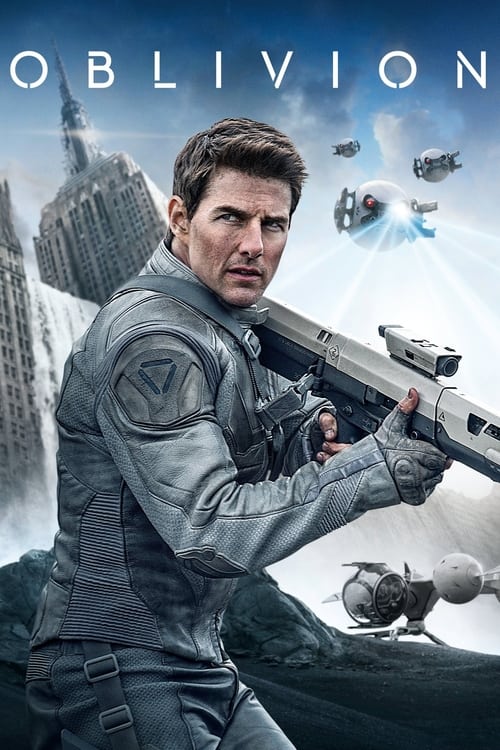
Oblivion
2013 · Joseph Kosinski
For when you want gorgeous big-canvas sci-fi you can sink into on a lazy evening — a puzzle to turn over, but a smooth, comfortable watch rather than a demanding one.
What it's about
Earth, 2077: decades after a war with an alien invader left the planet ruined, Jack Harper works as one of the last repairmen on the surface, fixing the armed drones that guard giant machines harvesting the oceans. He and his partner Victoria live in a gleaming tower above the clouds, counting the days until they join the rest of humanity off-world. Then Jack pulls a mysterious woman from a crashed spacecraft — a stranger who somehow matches the dreams he shouldn't be having — and everything he's been told about his mission starts to feel wrong.
The experience
Cool, sleek, and quietly melancholy — more a slow-burning mystery than a shoot-em-up, punctuated by bursts of drone-versus-human action. It's a film of vast empty landscapes and gnawing questions, and the M83-driven score gives even the quiet stretches a swelling, emotional pull.
Performances
Tom Cruise carries it almost single-handedly, dialing his usual intensity down into something lonelier and more wistful; Andrea Riseborough is quietly excellent as Victoria, radiating brittle devotion and unease in equal measure.
The craft
The production design is the star: a bubble-white sky tower, sleek ships, and a drowned, half-buried New York, all shot against stark Icelandic vistas in crystal-clear digital photography. Joseph Kosinski designs frames like an architect, and the electronic score by M83 is genuinely stirring. This one rewards the biggest screen and best speakers you can find.
Why it matters
It cemented Kosinski's reputation as one of Hollywood's premier visual stylists — a design-first director who would go on to bigger things — and its look and score have been widely imitated in glossy sci-fi since.
Snapshot
Oblivion is Joseph Kosinski's second feature, a glossy, melancholy, and conspicuously derivative science-fiction vehicle built around Tom Cruise and a singular production-design idea: a future of clean, white, depopulated beauty perched above a ruined Earth. The film is set in 2077, sixty years after a war with an alien force called the Scavs left the Moon destroyed and the planet devastated. Jack Harper (Cruise) and his partner Victoria (Andrea Riseborough) are a two-person maintenance team servicing the armed drones that protect enormous machines harvesting Earth's seawater, awaiting their reassignment to a human colony on Titan. Jack is haunted by memories of a woman and a pre-war New York he could not have lived in; when he rescues the survivor of a crashed craft (Olga Kurylenko) — the woman from his dreams — the film unspools its central deception, revealing that nearly everything Jack believes about the war, the Scavs, his employers, and himself is a fabrication. Oblivion is best understood as a film of surfaces in the most literal and most thematic sense: it is about a manufactured man living inside a beautiful lie, and it is itself a beautifully manufactured object assembled, openly, from the parts of earlier science-fiction cinema. That tension — exquisite craft in service of a familiar story — is the through-line of its reception and its place in the record.
Industry & production
Oblivion originated not as a conventional screenplay but as an unpublished graphic-novel concept developed by Kosinski with Radical Comics/Publishing in the late 2000s. The project was shopped as a multimedia pitch and changed hands at the studio level before Universal Pictures ultimately produced and distributed it; the graphic novel itself was never fully published, which is unusual for a property of this profile and worth flagging as a point where the public record is thin on specifics. Kosinski came to the film off Tron: Legacy (2010), his debut, and Oblivion extended both his industrial standing and his recognizable design sensibility.
The decisive industrial fact about the film is its star. Tom Cruise's participation moved the project into the budget tier of a major studio tentpole — reported in the vicinity of $120 million — and shaped its marketing and its tone as a star vehicle in a contemplative key. The screenplay is credited to Karl Gajdusek and Michael Arndt (the latter under the pseudonym "Michael deBruyn"), with the story credited to Kosinski; several writers passed through the project across its development, a normal pattern for a concept-first studio production. Released in April 2013, the film grossed roughly $286 million worldwide, a solid if unspectacular result that made it a modest commercial success rather than a franchise launch — a relevant outcome given how clearly the world-building was engineered to support more.
Technology
Oblivion is, technically, a landmark in the use of front-projected real skyscapes in place of green screen. The film's signature location — the "Sky Tower," Jack and Victoria's glass habitat suspended in the clouds — was built as a practical set against an enormous projection screen onto which the production played back actual high-altitude cloud and sky footage. That footage was photographed from a Hawaiian volcanic summit (the production used the high, cloud-piercing vantage of Haleakalā on Maui), so that the light falling on the actors and the white sets was motivated, natural, and continuous rather than composited after the fact. The result is one of the film's most distinctive achievements: the actors are genuinely lit by the environment behind them, and the imagery reads with a clarity and integration that conventional green-screen work of the period frequently lacked. It is a notable instance of a digital-era blockbuster reaching for an in-camera, photographic solution to a problem usually solved in post.
The film was shot digitally in high resolution on Sony's CineAlta F65 system, a then-new 4K-class camera, consistent with Kosinski and his cinematographer's commitment to a pristine, high-resolution image. The hardware design — the "Bubbleship" with its insectile glass canopy, the spherical hunter-killer drones, the towering harvesting rigs — was rendered through a blend of practical builds and visual effects, and is among the most admired aspects of the production. The drone designs in particular, with their blank, swiveling sensor faces and abrupt lethality, are a strong piece of speculative industrial design.
Technique
Cinematography
Claudio Miranda, who had shot Tron: Legacy for Kosinski and won an Academy Award for Life of Pi (released the prior year), photographs Oblivion with a cool, luminous precision. The film's visual identity is built on a dialectic of brightness: the antiseptic white interiors and sunlit cloud-decks of Jack's sanctioned life set against the gray, scoured, overcast surfaces of the ruined Earth below. Miranda exploits the front-projection setup for soft, enveloping natural light in the tower, and turns to the volcanic landscapes of Iceland — lava fields, glacial runoff, ash plains — for the desolate ground sequences, lending the post-apocalyptic Earth a real, mineral bleakness rather than a digitally invented one. The compositions favor clean lines, vast negative space, and the small human figure dwarfed by sky, ruin, and machine, reinforcing the film's themes of isolation and scale.
Editing
The film was cut by Richard Francis-Bruce, a veteran editor (an Oscar nominee for Se7en, The Shawshank Redemption, and Air Force One). The editorial strategy is patient by blockbuster standards: long, unhurried passages of Jack alone in the landscape, the rhythm built to sustain mood and mystery rather than continuous propulsion. The structure is organized around the gradual revelation of its central twist, so the cutting must manage information carefully — withholding, then re-contextualizing earlier images once the deception is exposed. The action set pieces (drone attacks, the Bubbleship chases) are intercut with these contemplative stretches, and the film's measured pace is among the qualities that divided viewers expecting a more conventional Cruise action tempo.
Mise-en-scène / staging
Production design is arguably the film's true authorial signature, continuous with the Apple-clean, minimalist futurism Kosinski established in Tron: Legacy. The Sky Tower is a fantasy of frictionless modern design — glass, white surfaces, a transparent swimming pool cantilevered into the clouds — explicitly coded as aspirational and, ultimately, as a gilded cage. Against it, the staging of the Earth's surface returns repeatedly to ruins half-buried in dust: the most famous image is the partially submerged structure of a destroyed landmark, a composition in the direct lineage of the buried Statue of Liberty from Planet of the Apes. The deliberate contrast between the curated cleanliness above and the entombed civilization below carries the film's meaning in purely spatial terms.
Sound
The score, by the French electronic group M83 (led by Anthony Gonzalez) in collaboration with Joseph Trapanese, is one of the film's most lauded and lasting elements. It marries lush, widescreen synthesizer textures to orchestral swell, situating Oblivion alongside Daft Punk's Tron: Legacy score as part of a brief, influential moment when major studio science fiction embraced electronic composers for an emotive, retro-futurist sound. The end-credits song, "Oblivion," featured the vocalist Susanne Sundfør. The sound design itself foregrounds the mechanical menace of the drones — their servo-whine and target-acquisition tones — as recurring sonic signatures of threat within an otherwise serene aural world.
Performance
Cruise plays Jack Harper in a register of wounded curiosity rather than action-hero bravado, a man nagged by memories that should not be his; it is a star performance calibrated to carry long solo stretches and to register the slow dawning of doubt. Andrea Riseborough's Victoria is the film's most quietly complex performance — loyal, anxious, invested in the comforting fiction the two of them inhabit, and tragic in her refusal to question it. Olga Kurylenko serves more as a catalyst and an emblem of Jack's lost past than as a fully developed character, a limitation that lies in the script rather than the playing. Morgan Freeman, as the Scav leader Beech, anchors the film's expository turn with gravitas, and Nikolaj Coster-Waldau appears among the human resistance. Melissa Leo, as the disembodied mission-control voice "Sally," supplies a deceptively folksy menace that the plot later weaponizes.
Narrative & dramatic mode
Oblivion operates in the mode of the science-fiction mystery built on an unreliable reality — a film whose first act is constructed to be reinterpreted once its secret is known. Its dramatic spine is a question of identity and authenticity: what Jack is, whether his memories and his love are his own, and whether a manufactured being can possess a genuine self. The revelation that Jack is one of many identical copies, that the "alien" Scavs are surviving humans, and that the orbital "Tet" he serves is the real enemy reframes the entire preceding narrative as a story told to him by his oppressor. The film's emotional resolution rests on the discovery of selfhood through memory and sacrifice — the idea that love and free will assert themselves even in an engineered consciousness. It is a serious thematic ambition pursued through a fundamentally familiar twist structure.
Genre & cycle
The film belongs to the early-2010s wave of design-forward, idea-driven studio science fiction — a cycle that includes Duncan Jones's Moon (2009), Source Code (2011), Prometheus (2012), and Elysium (2013), films that paired spectacle with metaphysical or dystopian premises. Within that cycle Oblivion sits at the glossier, more commercial end, a star vehicle dressed in art-cinema restraint. It also extends the post-apocalyptic "last man on a ruined Earth" tradition and the clone/identity subgenre, and its critical conversation was dominated by how openly it recombines those traditions.
Authorship & method
Oblivion is a strong example of director-as-designer authorship. Kosinski, trained in architecture and visual effects, conceives his films first as worlds and surfaces, and Oblivion — like Tron: Legacy before it and Top Gun: Maverick (2022) after — foregrounds a polished, photographically grounded image and a fascination with vehicles, hardware, and clean geometry. His key collaborators reinforce this method: cinematographer Claudio Miranda, with whom he built the front-projection approach; the production-design and visual-effects teams responsible for the Bubbleship and drones; and the composers M83 and Joseph Trapanese, who give his cool visual world its emotional warmth. The writing, credited to Karl Gajdusek and Michael Arndt (as "Michael deBruyn") from Kosinski's story, is generally regarded as the film's weaker dimension relative to its craft. The Cruise–Kosinski partnership begun here would prove durable, culminating in their later, far more successful collaboration on Top Gun: Maverick.
Movement / national cinema
This is mainstream American studio filmmaking at large scale, with no allegiance to a national or aesthetic movement beyond the design-driven Hollywood science fiction of its moment. Its most meaningful "movement" affiliation is stylistic and institutional: the strain of architect-and-effects-trained directors producing high-gloss speculative spectacle, and the early-2010s practice of recruiting electronic musicians for blockbuster scores. Its international texture comes chiefly from its Icelandic locations, which supply the film's ravaged Earth.
Era / period
Oblivion is a document of the early-2010s blockbuster: 4K digital acquisition entering wide use, a renewed appetite for spectacular but "thoughtful" original science fiction between franchise installments, and an environmental anxiety legible in its central image of an Earth drained of its seawater. Its post-catastrophe melancholy, its surveillance-drone iconography, and its theme of an authority that manufactures both its enemies and its servants are recognizably of the post-9/11, drone-warfare era, even where the film handles those resonances obliquely.
Themes
The film's governing themes are identity and authenticity — whether a self can be genuine if it is manufactured and supplied with false memories — and the manipulation of belief by power. Jack's arc is a movement from contented ignorance inside a curated lie toward painful knowledge and self-determination, achieved through the assertion of love and memory against his programming. Surrounding this are themes of memory as the seat of the self, environmental despoliation (the literal harvesting of the planet), and the difference between the comforting illusion (the Sky Tower, the promised colony on Titan) and the harsh truth on the ground. Sacrifice as the proof of authentic selfhood supplies the resolution.
Reception, canon & influence
Critically, Oblivion was received as a film of remarkable craft and derivative substance — widely praised for its production design, cinematography, and M83 score, and just as widely faulted for assembling its story from recognizable sources. Reviewers repeatedly cataloged its debts, and that catalog is the heart of its reception history. Commercially it performed respectably worldwide without becoming a phenomenon.
Backward, its influences are unusually visible and frequently named: Duncan Jones's Moon (the lone worker, the clone revelation, the corporate deception) is the most cited; WALL·E (2008) supplies the lonely cleanup-of-a-ruined-Earth premise; 2001: A Space Odyssey and Tarkovsky's and Soderbergh's Solaris inform its contemplative, memory-haunted tone; The Matrix underlies its "reality is a constructed lie" structure; Independence Day its orbital-superweapon scale; and Planet of the Apes its buried-landmark image of a lost civilization. Cruise's own Top Gun and Minority Report hover at the edges of his star persona here. The film wears these lineages openly enough that its originality lies almost entirely in execution rather than concept.
Forward, Oblivion's most concrete legacy is technical and collaborative. Its front-projection methodology contributed to a broader industry re-engagement with in-camera environmental lighting that would culminate, by the end of the decade, in LED-volume virtual production. Its M83/Trapanese score helped cement the early-2010s vogue for electronic-composer film music. And it consolidated the Kosinski–Cruise partnership that would later produce one of the highest-grossing films of Cruise's career. As a piece of storytelling it is rarely held up as canonical; as a piece of craft, design, and sound, it remains a frequently cited example of how fully a science-fiction film can be made out of beautiful surfaces.
A Deleuzian reading
Start with the pool.
The full Deleuzian reading of Oblivion →
Reception
In 2013 it landed as 'gorgeous but derivative' — critics shrugged, it made decent money, and everyone praised the visuals while docking points for familiarity. Post–Top Gun: Maverick, Kosinski's stock shot up and Oblivion got the full 'actually, this one was underrated' rewatch treatment.
How Oblivion was received, from release to now →
Influences: the films it descends from and the films it influenced
- 2001: A Space Odyssey (1968) — Establishes the front-projection-for-in-camera-environments technique Kosinski revived, paired with a contemplative, near-wordless minimalist-futurist design grammar of clean white interiors.
- Solaris (1972) — Models the memory-haunted, slow-burn SF register in which a protagonist's intimacy with a recreated dead lover destabilizes his sense of identity and reality.
- Silent Running (1972) — Supplies the lone caretaker tending a despoiled ecology with small robot/drone companions, a template for Jack Harper's solitary stewardship and his drone antagonists.
- Planet of the Apes (1968) — Provides the buried-landmark final reveal — a recognizable monument half-destroyed — that recontextualizes the whole story as Earth's own ruined future.
- Moon (2009) — Furnishes the core architecture of the lone orbital worker who discovers he is an expendable clone serving a deceptive corporate system, executed with restrained practical sets.
- WALL·E (2008) — Originates the lonely-cleanup-of-a-ruined-Earth premise, with a dutiful solitary machine-minder amid the abandoned debris of a vanished humanity.
- The Matrix (1999) — Provides the reality-is-a-constructed-lie withheld-revelation structure in which the hero's perceived world and even his memories are an engineered deception.
- Minority Report (2002) — Shapes Cruise's clean-future-tech star persona — gestural transparent interfaces and sleek hardware — that Oblivion leans on for the Sky Tower's control surfaces.
- Tron: Legacy (2010) — Kosinski's own director-as-designer debut establishes the polished minimalist-futurist surfaces, vehicle fetishism, and electronic-score-as-emotional-warmth method he carries directly into Oblivion.
- Solaris (2002) — Demonstrates the quiet, score-driven, glossy-yet-melancholy contemplative-SF tone built around a returned lover, a direct stylistic precedent for Oblivion's mood.
- Top Gun: Maverick (2022) — Extends the Kosinski–Cruise–Miranda partnership begun here, reusing the in-camera, photographically-grounded capture of vehicles and hardware around a restrained Cruise performance.
- Blade Runner 2049 (2017) — Carries forward the negative-space minimalist-futurism and natural-motivated-light compositions, framing solitary figures against vast empty environments in a ruined Earth.
- Interstellar (2014) — Continues the memory-haunted, contemplative-blockbuster mode with in-camera practical environments and a synth-organ score deployed as emotional ballast against cosmic scale.
- The Mandalorian (2019) — Realizes the technological endpoint of Oblivion's front-projection experiment — the StageCraft LED volume that projects lit environments in-camera for true reflections and motivated light.
- Drive (2011) — Shares the early-2010s synth-score vogue (Cliff Martinez) that M83 and Trapanese extend, using pulsing electronic music to lend cool, surface-driven images emotional weight.
- Prometheus (2012) — A contemporaneous big-budget SF film built on 4K-digital photography and immaculate industrial-design hardware, prioritizing world-as-surface spectacle over narrative coherence.
- Ex Machina (2014) — Pairs minimalist-futurist architectural surfaces with an identity-and-authenticity puzzle, using clean negative-space staging to interrogate what is real about a manufactured being.
- F1 (2025) — Kosinski and Claudio Miranda's collaboration on natural-light capture using real environments and front-projected skies, establishing the Miranda naturalistic-light method reused across F1's on-location shooting.
Similar films
- Blade Runner 2049 (2017) — influence & lineage · often watched together
- Top Gun: Maverick (2022) — influence & lineage · often watched together
- TRON: Legacy (2010) — influence & lineage
- Interstellar (2014) — influence & lineage
- Solaris (1972) — influence & lineage
- Minority Report (2002) — influence & lineage · often watched together
- Edge of Tomorrow (2014) — often watched together
- Jack Reacher (2012) — often watched together
All the films related to Oblivion →
Watch it with: curated runs of related films
- Worlds Worth Getting Lost In — A run of maximalist, effects-driven pictures that each conjure a whole world from scratch — watch them when you want to be swept somewhere on the biggest screen you can find.