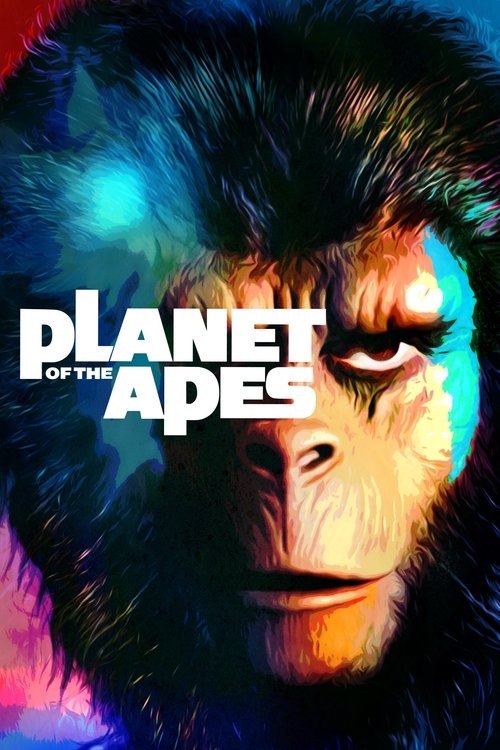
Planet of the Apes
1968 · Franklin J. Schaffner
For when you want big-canvas classic sci-fi that's genuinely about something — an entertaining watch that leaves you arguing at the credits. Great for a first-timer's night of essential movies.
What it's about
An astronaut crash-lands on a strange planet centuries from home and finds the natural order upside down: intelligent apes rule, and humans are mute animals kept for labor and experiment. Captured and caged, he becomes a specimen, a curiosity, and finally a threat to the ape society's most sacred beliefs — with a sympathetic chimpanzee scientist as his only ally.
The experience
A pulpy adventure with a philosophical sting — it moves like an action picture but keeps needling you with questions about civilization, faith, and what we do to creatures we consider beneath us. The ending lands hard and stays with you.
Performances
Charlton Heston plays the astronaut with a snarling, wounded fury that anchors the whole premise, and Roddy McDowall and Kim Hunter manage to give full, expressive performances through heavy ape prosthetics — a small miracle of acting under makeup.
The craft
John Chambers's revolutionary prosthetic makeup made talking apes credible for the first time and changed what movie makeup could do. Jerry Goldsmith's jagged, percussive score and stark desert widescreen photography give it an alien edge that still looks striking, and the script — reworked from Pierre Boulle's novel by Rod Serling and Michael Wilson — smuggles real satire into a studio spectacle. It rewards a big screen.
Why it matters
It proved intelligent science fiction could be a mass-audience blockbuster, spawned one of Hollywood's first true multimedia franchises, and its final image entered the culture whole — endlessly quoted, parodied, and imitated.
Snapshot
Planet of the Apes is the film that proved intelligent science fiction could be a mass-audience event, translating a slim French satirical novel into a widescreen studio spectacle with a philosophical charge and a final image that entered the culture whole. Directed by Franklin J. Schaffner for producer Arthur P. Jacobs and released by 20th Century-Fox, it fuses adventure-picture momentum with allegory: an astronaut, thrown forward in time to a world where apes rule and humans are mute beasts, becomes a specimen and a heretic before discovering the truth beneath his feet. Anchored by Charlton Heston's snarling, wounded performance and by John Chambers's revolutionary prosthetic makeup, it married technical innovation to a script — reworked from Pierre Boulle by Rod Serling and the blacklisted Michael Wilson — that used its premise to interrogate race, faith, nuclear self-destruction, and human vanity. It launched a franchise, won an honorary Academy Award for its makeup, and remains a touchstone for the idea that genre entertainment can carry serious ideas without apology.
Industry & production
The film's long gestation is central to its identity. Producer Arthur P. Jacobs, a former publicist turned independent producer working through his APJAC company, optioned Pierre Boulle's 1963 novel La Planète des singes and spent years attempting to convince a studio that a picture full of talking apes would not be laughable. The persistent obstacle was credibility: executives feared audiences would giggle at actors in monkey suits. Jacobs's solution was to commission a screen test — a short scene of made-up actors playing a dialogue scene — that demonstrated the makeup could sustain dramatic seriousness. That test is widely credited with securing the greenlight from 20th Century-Fox, then under Richard Zanuck's production leadership.
Rod Serling, of The Twilight Zone, wrote many of the earliest drafts and is generally credited with steering the story toward its ironic twist structure. His conception, however, imagined a technologically advanced ape society that would have been prohibitively expensive to build. Michael Wilson — an Oscar-winning writer who had been blacklisted during the HUAC era — was brought in to rework the material, and it is Wilson who is usually credited with recasting ape civilization as a more primitive, quasi-agrarian and theocratic order, which was both cheaper to realize and richer as satire. The final screenplay carries both Serling's and Wilson's names. This layered authorship is worth flagging honestly: the precise apportioning of credit between the two writers has been debated by historians, and the surviving accounts do not always agree on who authored which specific element.
Charlton Heston's commitment as star lent the project the marquee weight studios wanted, and Heston in turn helped recruit Franklin J. Schaffner, with whom he had worked on The War Lord (1965). The budget was substantial for the period — figures in the mid-single-digit millions are commonly cited — with a significant portion consumed by the makeup, which required a large team of makeup artists working long daily hours on the principal ape performers. Production drew on dramatic American Southwest locations, including the Lake Powell area and other Arizona and Utah desert and river landscapes, with additional California coastal shooting; the alien-yet-terrestrial geography was essential to the film's concealed premise.
Technology
The defining technological achievement of Planet of the Apes is prosthetic makeup. John Chambers, who had a background in medical prosthetics for wounded servicemen, developed foam-latex appliances that allowed the ape performers to emote — to move brows, lips, and cheeks — rather than simply wear rigid masks. This articulated flexibility is what made the ape characters readable as characters with interiority rather than as costumes, and it is the single reason the film escapes the ridicule its producers feared. The Academy recognized the breakthrough with an honorary Oscar to Chambers, as the competitive makeup category did not yet exist; his work is routinely cited as a catalyst for that category's eventual creation. The production also devised a tiered system of appliances, with more elaborate work reserved for close-up principals and simpler makeup for background players, an economical division of labor that made a large ape population affordable to depict.
Technique
Cinematography
Leon Shamroy, one of the most decorated cinematographers in Hollywood history, shot the film in Panavision anamorphic widescreen and color. His compositions exploit the desert vistas to establish scale, isolation, and the deceptive strangeness of the landscape, while the early sequences of the astronauts crossing barren terrain evoke a genuinely otherworldly emptiness. Shamroy uses low angles and canted framings during the ape hunt and Taylor's captivity to convey disorientation and subjugation, and the film's tonal shift from bright exteriors to the harder, institutional spaces of the ape city and courtroom mirrors Taylor's movement from open peril to caged interrogation.
Editing
Hugh S. Fowler's cutting is most celebrated in the ape hunt sequence, a kinetic set piece in which mounted gorillas drive fleeing humans through cornfields and netting. The montage builds terror through rapid, disorienting cuts and freeze-like trophy imagery, inverting the conventional human-hunter dynamic with brutal economy. Fowler also manages the film's crucial withholding: information is paced so that the audience, like Taylor, is kept from the full truth until the ending, and the final revelation is timed for maximum shock rather than gradual dawning.
Mise-en-scène / staging
The ape society is realized through production and costume design that stratifies the species into a rigid caste order — chimpanzees as intellectuals, orangutans as political and religious authorities, gorillas as military and labor — legible instantly through costume color and staging. Interiors evoke a theocratic, pseudo-classical culture, and the tribunal sequence is staged with deliberate courtroom formality that lets the film satirize institutional dogma directly. The famous "see no evil, hear no evil, speak no evil" gesture by the three orangutan judges is a piece of pointed visual wit embedded in the staging. Morton Haack's costume design earned an Academy Award nomination.
Sound
Jerry Goldsmith's score is one of the landmark achievements of film music and, arguably, the film's most influential technical element after the makeup. Rejecting conventional melody, Goldsmith wrote a percussive, atonal, avant-garde score employing unusual techniques and instruments — extended, dissonant orchestral effects and unconventional sound production — to render the ape world alien and threatening. The music refuses reassurance, keeping the audience destabilized. It received an Academy Award nomination and is frequently studied as a turning point in what mainstream film scoring could sound like. The sound design more broadly withholds and reveals — notably in the moment Taylor's voice returns, and in the silence and surf of the closing beach.
Performance
Heston plays Taylor as a misanthrope whose contempt for humanity is his defining trait, which sharpens the irony of his fate; his physical performance — hunted, captured, muzzled, denied speech — carries much of the film's meaning through the body. His hoarse cry, "Take your stinking paws off me, you damned dirty ape," and the closing anguish on the beach are among the most quoted moments in American film. The ape performers work under the constraint of heavy prosthetics: Roddy McDowall (Cornelius) and Kim Hunter (Zira) generate warmth and moral seriousness through eyes and voice, while Maurice Evans lends Dr. Zaius a stentorian, theatrical gravity as the reactionary guardian of orthodoxy. Linda Harrison plays the mute Nova, and James Whitmore and James Daly fill out the ape hierarchy.
Narrative & dramatic mode
The film operates as ironic tragedy wearing the clothes of an adventure serial. Its dramatic engine is dramatic irony sustained to a final reversal: the audience gradually suspects, and Taylor eventually confirms, that the "planet" is Earth after nuclear apocalypse, and that the human race authored its own downfall. The structure is a descent — from exploration, to hunt, to captivity, to trial, to revelation — with Taylor moving from arrogant survivor to horrified witness. The twist ending is a canonical example of the reversal that retroactively reorganizes everything preceding it, converting a fantasy about an alien world into an indictment of our own.
Genre & cycle
Planet of the Apes sits at the intersection of the space-travel adventure, the social-satire tradition of speculative fiction, and the emerging strain of pessimistic 1960s science fiction. It stands apart from the utopian gadgetry of much earlier genre cinema and belongs instead to a wave — alongside works like 2001: A Space Odyssey, released the same year — that took science fiction seriously as a vehicle for ideas, though the two films could hardly be more different in style. It also inaugurated its own cycle: a franchise of four theatrical sequels through the early 1970s, two television series, and, decades later, a critically embraced reboot trilogy, making "Apes" one of the durable science-fiction properties in Hollywood history.
Authorship & method
The film is best understood as a producer's vision realized by a coalition of major craftsmen. Arthur P. Jacobs supplied the years-long persistence and the promotional instinct that got an "unmakeable" project made. Franklin J. Schaffner, who would go on to direct Patton (1970), brought a controlled, muscular classicism and a feel for large-scale physical staging that kept the fantastical premise grounded. Screenwriters Rod Serling and Michael Wilson translated Boulle's satire into a leaner, more allegorically pointed American shape, with Serling associated with the twist architecture and Wilson with the primitivized, politicized ape society. Leon Shamroy's veteran cinematography, Jerry Goldsmith's radical score, Hugh S. Fowler's editing, and John Chambers's makeup each contributed an indispensable authorial layer. This is a film whose "authorship" is genuinely distributed, and honest accounts acknowledge that no single figure — not even Schaffner — dominates it the way an auteur model would suggest.
Movement / national cinema
The film is a product of the American studio system in transition. Made at 20th Century-Fox at the close of the 1960s, it belongs to the moment just before the New Hollywood upheaval fully took hold — a big-studio genre production that nonetheless absorbed the era's darkening mood, its distrust of institutions, and its willingness to end on despair rather than triumph. It is not part of any formal movement, but its pessimism, its social allegory, and its readiness to turn a popular form against its audience's complacency align it with the questioning temper of late-1960s American culture.
Era / period
Released in 1968 — a year of assassinations, escalating war in Vietnam, and civil-rights turmoil in the United States — the film reads inescapably as a work of its moment. Its anxieties about nuclear annihilation, racial hierarchy and dehumanization, and the conflict between scientific inquiry and religious dogma were live national preoccupations. The blacklist history of co-writer Michael Wilson adds another period resonance: a film about a society that persecutes truth-tellers, written in part by a man who had himself been professionally persecuted for his politics. Reading these connections requires some care — the film never states them explicitly — but the alignment between its themes and its historical instant is one reason it landed so hard.
Themes
The film's central theme is human self-destruction and the vanity that precedes it: the "planet" is a mirror, and Taylor's misanthropy is vindicated in the cruelest possible way. Around this core cluster several others. Race and caste are dramatized through the rigidly stratified ape order and the enslavement of a despised underclass, an allegory frequently read in relation to American racial history. The conflict between science and faith runs through the figures of the inquiring chimpanzee scientists and the orthodoxy-defending orangutans, with the tribunal staging the suppression of inconvenient truth. Evolution and the reversal of the "great chain of being" underwrite the whole conceit, turning human supremacy into a temporary and forfeitable condition. And nuclear apocalypse haunts the narrative as the unseen catastrophe that produced this world — made literal in the closing image.
Reception, canon & influence
Planet of the Apes was a major commercial success on release and drew serious critical attention for treating a fantastical premise with intelligence, though contemporary reviews were not uniformly reverent; some critics admired the concept and makeup while finding the allegory heavy-handed. Over time its reputation has only grown, and it is now firmly canonized — preserved in the United States National Film Registry and routinely cited among the most important science-fiction films.
Its influences flowing backward are clear: Pierre Boulle's satirical novel supplied the premise, though the film significantly altered the book's more sophisticated ape civilization and, crucially, invented its own ending; Jonathan Swift's tradition of using inverted or animal societies to satirize human folly stands behind it; and the broader speculative-fiction culture of the Twilight Zone era — with which Serling was synonymous — shaped its taste for the moral reversal.
Its influence flowing forward is immense. It established the modern science-fiction franchise model, spawning four sequels, television adaptations, and the acclaimed 2010s reboot series. Its makeup breakthrough is credited with advancing the entire field of prosthetic character work and helping bring about the Academy's competitive makeup award. Jerry Goldsmith's score reshaped expectations for what film music could do. Above all, its final image — Taylor collapsing before the ruined Statue of Liberty — became one of the most parodied, homaged, and instantly recognizable endings in cinema, a piece of shorthand for the twist revelation and for civilizational self-ruin that far outlived the film's own release and secured its place in the popular imagination.
A Deleuzian reading
Three orangutans sit on a high bench.
The full Deleuzian reading of Planet of the Apes →
Reception
A genuine hit in 1968 — critics and audiences both went for it — so no rescue arc needed; instead it's climbed from 'smart sci-fi blockbuster' to bona fide classic, its ending now more famous than most entire films.
How Planet of the Apes was received, from release to now →
How to watch Planet of the Apes: what to notice on a first viewing
- Notice the color-coding: chimpanzee robes, orangutan formal wear, gorilla uniforms. Costume design by Morton Haack sorts ape society into a fixed caste order the moment a character appears on screen, before they speak a word. The hierarchy is visual and instant, so you read power and rank before any dialogue explains it.
- Listen for the absence of a normal film score during tense scenes. Jerry Goldsmith replaces melody with percussive, dissonant orchestral effects that never resolve or comfort you. The music refuses to tell you the ape world is safe, so your unease never settles.
- Watch Heston's body when Taylor is caged, hosed, and muzzled. Denied speech for long stretches, Heston carries meaning through posture, straining, and eyes rather than lines. His physical humiliation makes Taylor's fight to be recognized as a person visible before he can argue it in words.
- Count how fast the cuts come during the ape hunt through the cornfield. Hugh Fowler's editing speeds up into rapid, disorienting cuts and trophy-like freeze images as mounted gorillas run down fleeing humans. The rhythm itself inverts the usual hunter and hunted roles, putting you on the terrified side of the chase.
- Notice the low, tilted camera angles once Taylor is captured. Leon Shamroy shoots the desert wide and level but switches to canted, low angles during the hunt and captivity scenes. The tilted frame makes subjugation something you feel physically, not just a plot event.
The whole guide to watching Planet of the Apes, with the keys for a rewatch →
Influences: the films it descends from and the films it influenced
- King Kong (1933) — Established the technique of making audiences read pathos and interiority on a non-human ape face, the emotional grammar that lets Apes stage a courtroom drama among simians rather than monsters.
- Forbidden Planet (1956) — The Barrons' all-electronic 'tonalities' legitimized dissonant, melody-free sound as science fiction's sonic language, the atonal soundscape Goldsmith extends with serial percussion, mixing bowls, and ram's horns.
- Freud: The Secret Passion (1962) — Jerry Goldsmith's early twelve-tone-influenced, atonal orchestral writing here is the same avant-garde vocabulary he weaponizes into the ape score's clanging, arrhythmic dread.
- The Bridge on the River Kwai (1957) — Adapts the same Pierre Boulle satirical source-novel via the (then-secretly blacklisted) Michael Wilson, the exact author/adapter craft pairing that produced Apes's screenplay.
- Salt of the Earth (1954) — Michael Wilson's blacklisted screenwriting turning social stratification into pointed political allegory, the direct craft ancestor of Apes's primitivized, caste-politicized ape society.
- Cleopatra (1963) — Leon Shamroy's Oscar-winning anamorphic-widescreen composition of vast physical sets and crowds, the same veteran-cinematographer craft he brings to the Forbidden Zone and ape city vistas.
- The Twilight Zone (1959) — Serling's signature moral twist-reversal architecture and ironic final-image punchline is the narrative engine he ports directly into the Statue of Liberty revelation.
- Battleship Potemkin (1925) — The rhythmic collision-montage of armed pursuers against a fleeing crowd is the editing lineage behind the ape-hunt sequence's kinetic cross-cutting of horsemen, nets, and running humans.
- The Day the Earth Stood Still (1951) — Codified the cautionary 'humanity may destroy itself' mode that treats genre spectacle as moral parable rather than pulp, the pessimistic-allegory template Apes inherits.
- Patton (1970) — Schaffner reapplies his controlled, muscular classicism and command of large-scale physical staging, again scored by Goldsmith, proving the director-composer craft partnership forged on Apes.
- Papillon (1973) — A second Schaffner/Goldsmith reunion staging bodily captivity and endurance with the same grounded, unstylized physical realism that anchored the ape premise.
- Soylent Green (1973) — A Heston-led ecological dystopia engineered entirely to detonate a final horrifying revelation ('Soylent Green is people'), a direct rework of the withheld-twist architecture.
- Alien (1979) — Pairs Jerry Goldsmith's atonal, disorienting orchestral score with a creature grounded by suited-performer physicality, both craft methods pioneered on Apes.
- Star Wars (1977) — Cemented the franchise sci-fi model Apes launched and populated its cantina with full-face appliance-makeup creatures descending from John Chambers's prosthetic-ensemble approach.
- Rise of the Planet of the Apes (2011) — Translates Chambers's prosthetic-constrained ape acting into Andy Serkis's performance-capture, preserving the emotion-through-simian-face craft as digital rather than latex.
- Oblivion (2013) — Provides the buried-landmark final reveal — a recognizable monument half-destroyed — that recontextualizes the whole story as Earth's own ruined future.
- Kingdom of the Planet of the Apes (2024) — Supplies the buried-civilization archaeology reveal and the recovered name Nova, while Goldsmith's atonal 1968 cues are literally quoted inside Paesano's score so the music performs the same inheritance the plot dramatizes.
- Dawn of the Planet of the Apes (2014) — John Chambers's foam-latex ape makeup and the mime-trained physical ape performance it demanded establish the actor-embodies-ape convention that Weta's performance capture digitally supersedes.
- War for the Planet of the Apes (2017) — Supplies the franchise's core device of inverting the human/ape hierarchy as dramatic engine, and the mute-human motif that War literalizes in Nova and the soldiers who lose speech.
- The Omega Man (1971) — Reprises Heston's misanthrope-among-ruins persona, the isolated modern man raging against a self-destructed civilization, extending his Taylor archetype.
- Snowpiercer (2013) — Stages a rigidly caste-stratified society as escalating class allegory that culminates in a systemic revelation, extending Apes's tribunal-and-hierarchy satirical staging.
Similar films
- Star Wars (1977) — influence & lineage · same viewing thread
- Rise of the Planet of the Apes (2011) — influence & lineage
- Forbidden Planet (1956) — influence & lineage
- King Kong (1933) — influence & lineage
- Alien (1979) — influence & lineage
- The Day the Earth Stood Still (1951) — influence & lineage
- War for the Planet of the Apes (2017) — same viewing thread
- Kingdom of the Planet of the Apes (2024) — same viewing thread
All the films related to Planet of the Apes →
Watch it with: curated runs of related films
- The Blockbuster Sci-Fi Canon — A run of the effects-driven epics that taught modern audiences what a movie could feel like — from the desert planets of Star Wars to the rain of Blade Runner and the sands of Arrakis.