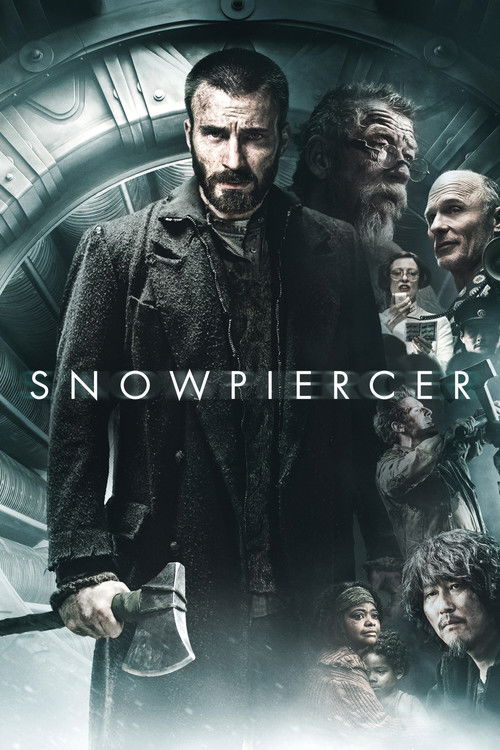
Snowpiercer
2013 · Bong Joon Ho
For when you want an action movie with teeth — big set pieces that double as an argument about class you'll be chewing on for days. Exciting on the surface, bleak underneath.
What it's about
A climate-engineering experiment gone wrong has frozen the Earth, and the last of humanity circles the globe aboard a single perpetually running train, sorted by carriage into a brutal caste system. In the squalid tail section, a revolt ignites — and the rebels fight their way forward car by car toward the engine, discovering with each door what the people up front have been enjoying at their expense.
The experience
A propulsive, side-scrolling ride that keeps shifting register — savage axe-fight one car, absurdist black comedy the next — while the allegory tightens like a vise. It's thrilling and grimly funny, and it means every bit of its politics.
Performances
Chris Evans works against his heroic image with a haunted, guilt-ridden turn, and Tilda Swinton is unforgettable as a grotesque, toothy mouthpiece for the ruling order — a comic monster you can't look away from.
The craft
Bong Joon Ho turns the train's confinement into the film's engine: each new carriage is a self-contained world with its own look, and the strictly linear geography makes the class structure physical — forward literally means up. The action is staged with brutal clarity, including a tunnel battle that plays out in near-total darkness.
Why it matters
Bong's first English-language film, it carried his blend of genre thrills and class allegory to international audiences and prefigured the themes that would later win him the Oscar; it also spawned a TV series.
Snapshot
Snowpiercer is a closed-system parable: after a botched climate-engineering effort freezes the Earth, the last of humanity survives aboard a perpetually circling train, sorted by car into a rigid caste order. Bong Joon Ho's first English-language feature adapts the French graphic novel Le Transperceneige into a horizontal odyssey in which an underclass revolt fights its way carriage by carriage from the tail toward the sacred engine at the front. The film fuses the kineticism of an action picture with the schematic clarity of allegory, and it closes not with a seizure of power but with a refusal of the entire machine. It is at once Bong's most overtly political work and one of his most formally controlled—a side-scrolling fable about whether a broken system can be reformed from within or must simply be blown open.
Industry & production
The project originated in Bong's own reading: he encountered Jacques Lob and Jean-Marc Rochette's bande dessinée in a Seoul comic shop in the mid-2000s and reportedly read it standing in the store. It became his most ambitious production to date, with a budget in the rough range of $40 million—large by Korean-cinema standards and at the time among the most expensive films financed primarily through Korean capital, led by CJ Entertainment. Park Chan-wook's company Moho Film produced, lending the film the imprimatur of Korea's auteur-driven studio ecosystem.
Principal photography took place at Barrandov Studios in Prague, where the train's interconnected cars were built as practical sets on gimbals to generate motion. The international cast—Chris Evans, Tilda Swinton, John Hurt, Ed Harris, Octavia Spencer, Jamie Bell, Alison Pill, Ewen Bremner—was anchored by Bong's longtime collaborator Song Kang-ho and Ko Asung, the father-daughter pair from The Host, who perform largely in Korean with in-world translation devices.
The film's release history is inseparable from its meaning. Snowpiercer opened in South Korea in 2013 to major commercial success, drawing well over nine million admissions and ranking among the year's biggest domestic releases. Its English-language distribution, however, became a notorious case of auteur-versus-distributor conflict: The Weinstein Company, holding North American and other rights, pushed for cuts of roughly twenty minutes and the addition of explanatory voiceover. Bong refused to deliver a recut. The standoff delayed and constrained the U.S. release, which finally arrived in 2014 through the boutique label RADiUS-TWC on a limited theatrical and video-on-demand basis rather than a wide rollout. The episode became a touchstone in critical debates about the treatment of foreign-language and auteur cinema in the American market—and, in retrospect, a prelude to the unmediated international embrace Bong would receive six years later with Parasite.
Technology
The production leaned on a hybrid of practical and digital craft characteristic of mid-2010s effects filmmaking. The carriages were physical builds—self-contained environments (the dim tail, a greenhouse, an aquarium car, a classroom, a nightclub) constructed to be shot in sequence—mounted to convey the lurch and sway of a moving train. The frozen world outside, glimpsed through windows and in the rare exterior beats, was extended through CGI: snowbound ruins, the buckled trestle of the Yekaterina Bridge, and the engine's exterior. The film's most cited visual conceit, a long arcing tunnel of darkness traversed by axe-wielding masked guards, exploits the train's geometry and the technology of night-vision goggles as both plot device and lighting strategy. The overall approach favors tactile, in-camera staging punctuated by digital extension rather than a fully synthetic environment, which keeps the violence and the cramped social order grounded in physical space.
Technique
Cinematography
Shot by Hong Kyung-pyo—who would go on to lens Mother, Burning, and Parasite—the film makes a virtue of confinement. The train dictates a strong horizontal axis: the camera tracks forward and back along the cars, so that progress through the social hierarchy is rendered as literal lateral movement. Hong differentiates each carriage by a distinct palette and quality of light, moving from the steel murk of the tail section to saturated, almost hallucinatory color in the privileged forward cars, so the journey reads as a visual ascent through registers of luxury. The single-axis blocking turns the film's spaces into a kind of cross-section diagram, making the metaphor visible without dialogue having to state it.
Editing
Cut by Steve M. Choe and Changju Kim, the film alternates between sustained set-piece carnage and abrupt tonal pivots—a hallmark of Bong's rhythm. The night-vision battle is staged and cut for maximal disorientation, while quieter cars are allowed to breathe. The editing also manages a tricky structural task: the narrative is essentially a series of thresholds, each door opening onto a new world and a new piece of exposition, and the cutting has to make that episodic progression feel propulsive rather than schematic.
Mise-en-scène / staging
Production designer Ondrej Nekvasil's carriages are the film's central authorial achievement, each a self-contained ecosystem expressing a rung of the order: the squalid bunk-stacked tail, the verdant greenhouse, the luminous aquarium, the pastel classroom where children are indoctrinated with a hymn to the engine, the decadent sauna and rave cars. Bong stages within these boxes with theatrical precision, often arranging characters along the lateral plane so that power relations are spatialized. The recurring "protein block"—a gelatinous bar later revealed to be made from ground insects—and Tilda Swinton's grotesque schoolmarm-bureaucrat Mason (false teeth, oversized glasses, a parodic Yorkshire-inflected officiousness) exemplify the film's satirical design sensibility, in which costume and prop carry argument.
Sound
Marco Beltrami's score moves between propulsive percussion for the action and a colder, more elegiac mode for the film's revelations and its bleak exterior vistas. The sound design exploits the train itself—the relentless mechanical rhythm, the rumble that underlies every scene—as an inescapable sonic environment, reinforcing the sense of a world with no acoustic exit. Language is also a deliberate texture: the polyglot exchange between Evans's Curtis and Song's Namgoong, mediated by a translation device, foregrounds communication across difference as part of the film's fabric.
Performance
Chris Evans plays against his heroic register as Curtis, the reluctant leader whose climactic confession—about the depths to which the tail's early survivors sank—undercuts any clean image of revolutionary virtue; it is among his strongest dramatic work. Song Kang-ho, as the addicted security specialist who opened the train's doors, supplies the film's pivot from rebellion-within to escape-from. Tilda Swinton's Mason is a bravura comic-grotesque turn, John Hurt lends gravity as the mentor Gilliam, and Ed Harris's Wilford embodies the chilly rationality of the engine's keeper. The performances are pitched to coexist with caricature without collapsing into it—a balance characteristic of Bong's tonal control.
Narrative & dramatic mode
The film's structure is its argument: a linear, threshold-by-threshold advance that maps revolutionary momentum onto physical geography. Each car functions as a station of revelation, escalating both the spectacle and the moral stakes until Curtis reaches Wilford and learns the system's secret—that the periodic uprisings are not threats to the order but instruments of it, engineered population-management staged by the front and the tail alike. This twist reframes the entire forward drive as a closed loop, the rebellion as part of the machine's homeostasis. Against this, the film offers a counter-logic embodied by Namgoong, who has been hoarding the industrial drug Kronole not to get high but as an explosive, because his goal was never the engine but the side door—not to rule the train but to leave it. The dramatic mode is allegory operating at full transparency, yet Bong complicates the parable with genuine moral ambiguity and a refusal of triumphalism.
Genre & cycle
Snowpiercer sits within the 2010s wave of class-conscious dystopian science fiction—a cycle that includes films using speculative premises to literalize economic stratification. It shares DNA with the post-apocalyptic survival film and the prison-break/corridor-crawl action structure, and critics frequently noted its resemblance to the spatial logic of side-scrolling video games, in which the hero advances rightward through escalating levels toward a final boss. But it inverts the genre's usual reformist arc: where many such narratives end with the righteous remaking the system, Snowpiercer concludes that the system must be destroyed and abandoned, placing it closer to a tradition of apocalyptic rather than restorative SF.
Authorship & method
The film is unmistakably Bong's, bearing the signatures evident across Memories of Murder, The Host, and Mother: abrupt tonal shifts that fold slapstick into horror into pathos; structural metaphors built into the architecture of the story; and a sympathy for the underclass twined with skepticism about heroic redemption. The mentor figure Gilliam is named in homage to Terry Gilliam, whose dystopian satire is an acknowledged touchstone. Bong's method here, as elsewhere, is meticulous pre-visualization—he is known for storyboarding extensively—paired with collaborators who recur across his filmography. Cinematographer Hong Kyung-pyo and, above all, actor Song Kang-ho are central to that authorial continuity; production designer Ondrej Nekvasil and composer Marco Beltrami were the key new collaborators the international production brought in. The screenplay, credited to Bong with Kelly Masterson, translates Lob and Rochette's comic into Bong's idiom while departing substantially from its plot, retaining the premise of the segregated train and the journey forward while inventing much of the specific incident and the engineered-rebellion revelation.
Movement / national cinema
Snowpiercer is a product of the post-millennial Korean New Wave's globalization. By 2013 the generation of directors that included Bong, Park Chan-wook, and Kim Jee-woon had achieved both domestic commercial dominance and international festival prestige, and several were making first forays into English-language production. The film thus occupies a hinge position: financed and produced largely within the Korean industry, shot in Europe with a multinational cast, and aimed at a global audience. It demonstrates how Korean auteur cinema exported not just talent but a sensibility—genre fluency married to social critique—into the international market, and its distribution battle exposed the frictions in that crossover. In hindsight it reads as a crucial step on the path that culminated in Parasite's 2019–2020 awards sweep.
Era / period
The film belongs squarely to the early-2010s moment of post-financial-crisis anxiety, when income inequality and ecological dread had become dominant cultural subjects. Its allegory of a tiny elite hoarding resources at the front while a brutalized mass subsists at the back resonated with the rhetoric of that period, and its climate-catastrophe framing—a geoengineering "fix" (the dispersal agent CW-7) that overshoots into apocalypse—spoke to mounting fears about both warming and the hubris of techno-solutions. It is a film very much of its decade's preoccupations, rendered with enough formal stylization to outlast the immediate moment.
Themes
The governing theme is the architecture of class itself: the train materializes hierarchy as a fixed, engineered order in which one's worth is determined by where in the chain one was born. Bong layers onto this a meditation on the necessity of inequality to systems that claim to require it—Wilford's defense of the order as a balanced ecosystem is the film's most chilling idea, presenting oppression as homeostatic rather than incidental. Sacrifice and complicity run throughout: Curtis's confession denies the rebellion a pure origin, and the revelation that the engine's "eternal" function depends on child labor—small bodies fitted into machinery—exposes the literal human cost beneath the ideology of the perpetual engine. Against the closed, self-justifying world of the train, the film sets the possibility of stepping outside the system entirely, even at catastrophic risk. The final image—two children, a Korean girl and a Black boy, emerging into the snow to see a polar bear, a sign of survivable life beyond the rails—stakes the film's hope not on inheriting the machine but on escaping it.
Reception, canon & influence
Critical reception was strongly positive in both Korea and, when it finally arrived, the West, where reviewers praised its imagination, its political nerve, and Bong's tonal control, frequently singling out the production design and Swinton's performance. The Weinstein distribution dispute became a cause célèbre, with many critics framing their enthusiasm partly as a defense of the director's cut against the threatened studio recut; the film's eventual success on VOD was also noted as an early sign of shifting distribution models for specialty releases.
Looking backward, the film draws on the French graphic-novel source, on the dystopian satire associated with Terry Gilliam, on the corridor-advance logic of video games, and on the broader lineage of class-allegory science fiction. Looking forward, Snowpiercer consolidated Bong's international standing and helped clear the path for his subsequent English-language and crossover work, including Okja and ultimately Parasite, with which it shares a sustained preoccupation with vertical (or here, horizontal) class structure. Its premise proved durable enough to be expanded into a television series that ran for several seasons beginning in 2020, extending the world well beyond Bong's film. Within the canon of 2010s science fiction, it is widely regarded as one of the decade's defining genre-allegories—a work whose schematic clarity, rather than limiting it, became the source of its lasting force.
A Deleuzian reading
Every few minutes a door slides sideways, and behind it is a new world.
The full Deleuzian reading of Snowpiercer →
Reception
Famously caught in a standoff with Harvey Weinstein, who wanted ~20 minutes cut for US audiences — Bong won, but the 'punishment' was a limited 2014 release that turned it into a VOD word-of-mouth hit. Post-Parasite, it's been fully canonized as the moment the world should have seen Bong coming.
How Snowpiercer was received, from release to now →
Influences: the films it descends from and the films it influenced
- Brazil (1985) — Supplies the retrofitted-industrial dystopian production design and bureaucratic-absurdist tonal register Bong names outright through the engineer character 'Gilliam.'
- 12 Monkeys (1995) — Models the deterministic closed-loop reveal in which the protagonist's whole journey turns out to have been engineered — the template for Snowpiercer's 'the rebellion was planned by Wilford' twist.
- Oldboy (2003) — Its lateral single-take corridor hammer-brawl is the direct staging precedent for Snowpiercer's axe-fight advancing strictly car-to-car along one horizontal axis.
- Memories of Murder (2003) — Establishes Bong's signature abrupt slapstick-to-horror-to-pathos tonal pivots executed within single scenes, carried wholesale into the train.
- The Host (2006) — Pioneers Bong's underclass-family-versus-system structure with grotesque creature staging and comic-tragic whiplash, the dramaturgical engine reused here.
- Mother (2009) — Cements the Bong–Hong Kyung-pyo cinematographic partnership, whose controlled framing and desaturated palette continuity directly precedes Snowpiercer.
- Metropolis (1927) — Literalizes class as architecture — laborers below, masters above — the schematic spatial allegory Bong rotates ninety degrees into the train's front-to-back car stratification.
- Delicatessen (1991) — Furnishes the grotesque enclosed-microsociety model: a sealed building of cannibal economics rendered in sepia clutter-design and dark slapstick.
- Children of Men (2006) — Perfects the immersive forward-thrust camera that drives a protagonist through successive zones of escalating danger — the cinematic grammar of corridor-advance.
- The Lady Vanishes (1938) — Makes the threshold door the film's entire dramatic unit, structuring the narrative as carriage-by-carriage passage, and stages its axe fight as cutting-on-movement within a corridor whose width forbids any escape from frame.
- Okja (2017) — Extends Snowpiercer's English-language crossover idiom: anti-corporate satire fusing tonal whiplash, grotesque caricature (again via Swinton), and underdog sympathy.
- Parasite (2019) — Converts the horizontal class-train into vertical domestic architecture as a built-in structural metaphor, shot again by Hong Kyung-pyo with staircase-as-hierarchy blocking.
- The Platform (2019) — Reprises the level-by-level spatial-class schema in which advancing through the structure exposes engineered scarcity as deliberate systemic homeostasis.
- Mickey 17 (2025) — Bong's hierarchy-as-spatial-geography grammar — train cars encoding class strata through low-angle staging and axial blocking — is the direct architectural precedent for the colony ship's power geography in Mickey 17, produced through the same storyboard-driven preproduction method.
- Kill (2024) — Modular carriage sets built as discrete, rearrangeable chambers turn a train into a level-based escalation engine — each car a new lighting scheme, new weapon class, new antagonist tier — which is precisely how Kill's production designed and shot its Rajdhani.
- High-Rise (2015) — Stages class stratification within a single sealed structure that erupts floor-by-floor into revolt, treating the building's level-design as the allegory itself.
- Mad Max: Fury Road (2015) — Shares the single-vector forward-momentum action built on practical gimbal-mounted moving sets, with water/citadel resource control as its class mechanism.
- Train to Busan (2016) — Restages the Korean train-set as a car-by-car forward advance whose passenger compartments form a moving class microcosm under siege.
- Elysium (2013) — Same-year class-allegory SF that divides haves from have-nots by a hard spatial boundary the hero must physically breach zone by zone.
- The Hunger Games (2012) — Renders the same class-exploitation allegory through literal production design — train cars escalating from squalor to decadence — that the film stages as Districts versus Capitol.
- The Hunger Games: Catching Fire (2013) — A same-year dystopia using costume and production design as explicit class taxonomy — each car/district legible by wardrobe and palette — sharing the design-as-politics expressive strategy.
- Planet of the Apes (1968) — Stages a rigidly caste-stratified society as escalating class allegory that culminates in a systemic revelation, extending Apes's tribunal-and-hierarchy satirical staging.
Similar films
- Okja (2017) — influence & lineage
- Train to Busan (2016) — influence & lineage
- Parasite (2019) — influence & lineage
- Oldboy (2003) — influence & lineage
- Mad Max: Fury Road (2015) — influence & lineage
- Elysium (2013) — influence & lineage
- The Host (2006) — influence & lineage
- Society of the Snow (2023) — shared sensibility
All the films related to Snowpiercer →