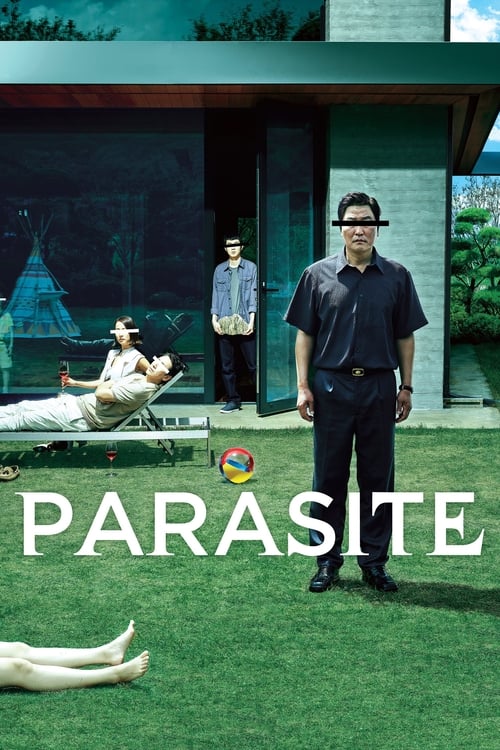
Parasite
2019 · Bong Joon Ho
The inciting incident of the era: the first non-English Best Picture winner, "overcome the one-inch barrier of subtitles," and the moment international cinema became the mainstream conversation rather than a sidebar.
For when you want to be completely gripped and surprised — ideally knowing as little as possible going in. It's a crowd-pleaser with teeth: perfect for a watch-with-friends night that turns into a long conversation after.
What it's about
The Kims — father, mother, son, daughter, all unemployed, living in a cramped semi-basement in Seoul — talk their way into jobs with the wealthy Park family one by one, each posing as an unrelated, highly qualified professional. The scheme works beautifully, the two households fold into each other, and then something surfaces that neither family saw coming. It's a con-artist comedy that keeps turning into something else.
The experience
Wickedly funny, then tense, then genuinely shocking — it shifts gears so smoothly you don't notice the ground moving until it's gone. Few films are this entertaining and this pointed at once; it plays like a thriller and stings like satire.
Performances
Song Kang-ho anchors the film as the Kim patriarch, warm and wily with something unreadable underneath, and the whole ensemble plays the family's schemes with delicious comic timing.
The craft
Bong Joon Ho's direction is watchmaker-precise: the screenplay is a machine where every setup pays off, and the production design — the sunlit modernist mansion above, the flood-prone semi-basement below — turns architecture itself into the story of inequality. Every camera move and cut is doing quiet narrative work; it's a masterclass in visual storytelling that rewards rewatching.
Why it matters
The first Korean film to win the Palme d'Or and the first non-English-language film ever to win Best Picture at the Oscars — a watershed that cracked open global audiences for international cinema and crowned Bong Joon Ho's career.
Snapshot
A masterwork of genre hybridization and social satire, Parasite follows the Kim family — unemployed, scraping by in a semi-basement apartment in Seoul — as they infiltrate the household of the wealthy Park family one by one, each member assuming a false professional identity. The film pivots from dark comedy to thriller to something approaching Greek tragedy, and its pivot-point is a revelation hidden beneath the Parks' modernist home. Upon its Cannes premiere it became the first Korean film to win the Palme d'Or; at the 92nd Academy Awards it became the first non-English-language film in the ceremony's ninety-two-year history to win Best Picture. It also took Best Director, Best Original Screenplay, and Best International Feature Film — a sweep without precedent. The film simultaneously crowns Bong Joon Ho's career and stands as the most globally visible artifact of the Korean New Wave that had been building for two decades.
Industry & production
Parasite was produced by Barunson E&A and CJ ENM, the South Korean entertainment conglomerate that had long been the financial backbone of prestige Korean cinema. CJ ENM had already backed Bong's Memories of Murder and Mother; its commitment here extended to the construction of an entirely bespoke set — the Park family mansion — on a backlot in Seoul rather than location-scouting for an existing house that could satisfy the film's precise spatial requirements. Production designer Lee Ha-jun worked in close collaboration with Bong on the geography of that house for over a year of pre-production, the architecture functioning not merely as backdrop but as dramaturgical argument.
The film's North American distribution rights were acquired by Neon, which pursued an unusual rollout: a limited prestige release expanding week over week, building on Cannes momentum and critical praise rather than front-loading on the traditional wide-release model. The strategy proved remarkably effective at sustaining the film's theatrical life through award season. The budget has been reported at roughly eleven million US dollars, modest by the standards of any prestige international production, though CJ ENM's marketing investment amplified its global profile considerably.
Technology
Parasite was shot digitally on the ARRI Alexa, consistent with Bong's practice since at least Snowpiercer and the standard of the contemporary Korean industry. Hong Kyung-pyo, the cinematographer, leveraged the camera's latitude for low-light work in the film's subterranean and semi-basement sequences, where the contrast between shadow and the tungsten warmth of practical sources carries significant expressive weight. The film does not employ visual effects in any substantial way; its sense of uncanny architecture is achieved entirely through practical construction and compositional control. The production's commitment to a fully built set — rather than location work supplemented by CGI — allowed for a degree of camera choreography and spatial consistency that would have been difficult to achieve otherwise.
Technique
Cinematography
Hong Kyung-pyo, who had previously shot Bong's Mother and later collaborated with him across the decade, constructs Parasite's visual grammar around a strict vertical axis. The Kim semi-basement apartment is shot in cramped, slightly low-angled frames that emphasize walls closing in; the Parks' house sits at the top of a long climbing staircase whose ascent and descent the camera performs with unhurried deliberateness. The film's most distinctive single shot — the Kim family descending flooded stairs into their submerging apartment during the torrential rain sequence — is composed from an elevated angle that renders them as figures in a drainage diagram, the camera's height implicating the viewer in the indifference of the world above. Hong's palette shifts perceptibly between spaces: cool ambient light and natural Seoul gray outdoors, warm tungsten in the Kim basement, the diffused, high-key architectural light of the Park house suggesting a world where the sun itself seems cleaner.
Editing
Yang Jin-mo's editing orchestrates Parasite's tonal modulations with surgical precision. The first act is cut with comic timing — beats landing with the snap of a well-constructed farce — while the revelation of the bunker beneath the bunker shifts rhythm entirely: a slow, dread-building extension of holds and silences. Yang and Bong had worked together on Memories of Murder, and the trust between them is evident in his willingness to let sequences breathe when the script calls for it. The climactic garden party sequence is cut at an almost unbearable pace, each line of action — Kim Ki-taek, his son, the figure emerging from below — given its own temporal lane that the editing holds apart until collision becomes inevitable.
Mise-en-scène / staging
The film's spatial logic is its argument. Lee Ha-jun's production design for the Park house encodes class in architecture: the house is set back from the road on elevated ground, accessed through a long staircase, its interior organized around glass, negative space, and expensive furniture that serves as status marker rather than comfort. A critical spatial element is the hidden staircase behind the kitchen pantry descending to a sub-basement shelter — a space that inverts the film's vertical hierarchy and literalizes the idea of something suppressed living below what is visible. Against this, the Kim semi-basement (banjiha) apartment — a real and widespread housing category in Seoul, typically the province of low-income tenants — is staged at half-height to the street, its windows offering a view of ankles and gutter. Bong stages scenes within the Park house as a series of territorial negotiations, characters occupying and vacating rooms in patterns that map power relations.
Sound
Jung Jae-il's score is one of the more distinctive of recent prestige cinema, blending orchestral writing with dissonance and occasional operatic passages that refuse ironic detachment. The string-heavy "Belt of Faith" cue, which accompanies the first descent into the sub-basement, moves from curiosity to dread without a clear seam. Jung had scored Bong's Okja and brings to Parasite an ability to navigate tonal whiplash — the score can be faintly comic and then genuinely terrifying within the same scene. Sound design privileges ambient texture: rain in the flood sequence is mixed not as dramatic effect but as overwhelming, indifferent mass.
Performance
Song Kang-ho, Bong's longtime collaborator (present in Memories of Murder, The Host, Mother, and Snowpiercer), plays Kim Ki-taek with a weariness beneath the comedic surface — his face capable of registering the specific humiliation of a man who is neither angry nor resigned but suspended between both. Choi Woo-shik as his son Ki-woo and Park So-dam as his daughter Ki-jung are sharper, more predatory; their performance register shifts fluidly with genre. Lee Sun-kyun as the Parks' father brings a studied obliviousness to the role — not cruelty but the unconscious ease of inherited comfort. Cho Yeo-jeong as Mrs. Park is performed on a knife's edge between parody and pathos. Lee Jung-eun as the previous housekeeper carries the film's most violent content with a performance that doesn't signal what is coming.
Narrative & dramatic mode
Parasite operates in three discernible modes. The first act is a comedy of infiltration — a caper in which each Kim family member insinuates themselves into the Park household by a different ruse, the audience given complicit delight in watching the scheme extend itself. The second act pivots on the discovery that the Kims are not the first family to colonize the Parks' space; the sub-basement reveal introduces a structural double to their situation and a new layer of desperation beneath the veneer of comedy. The third act is tragic: not in the classical sense of downfall earned by hubris, but in the modern sense of catastrophe arriving through systemic pressure and contingency. The film's final image — a letter, a staircase, an impossible aspiration — forecloses optimism without making an argument for despair. It is structurally closer to naturalist drama than to either comedy or thriller, even as it borrows the machinery of both.
Genre & cycle
Bong has described Parasite as a "thriller about class," and the formula is accurate without being reductive. The film belongs to a recognizable cycle of class-anxiety films that crested in the late 2010s — including Ruben Östlund's The Square (2017), Jordan Peele's Us (2019), and Todd Phillips's Joker (2019) — but Parasite is more narratively precise and less allegorically schematic than its contemporaries. It draws on the long tradition of the infiltration comedy (reaching back through The Servant [1963] and class inversion farces of European cinema) and the domestic thriller, while the sub-basement material borrows from gothic and horror modes. The genre switching is itself thematic: the film's formal instability mirrors its social argument.
Authorship & method
Bong Joon Ho co-wrote Parasite with Han Jin-won, who receives screenplay credit alongside him. Bong is an unusually controlling auteur in the sense of storyboarding extensively and rarely deviating from pre-visualization on set; his shot lists are documented as exceptionally detailed. The collaboration with Hong Kyung-pyo is foundational — Hong's understanding of Bong's preference for camera movement that tracks character displacement rather than simply covering action is evident throughout. Yang Jin-mo's editorial sensibility functions as a kind of quality control on tonal register. Lee Ha-jun's production design is arguably as authorial as any collaborator's contribution; the architecture is so tightly integrated with the script's meaning that it is difficult to discuss one without the other.
Movement / national cinema
Parasite sits at the apex of the Korean New Wave — the term used to describe the generation of directors who emerged in the late 1990s and 2000s following South Korea's relaxation of censorship and the restructuring of its film industry. Park Chan-wook, Lee Chang-dong, Hong Sang-soo, and Kim Jee-woon were contemporaries and interlocutors. The Korean industry developed a hybrid mode in this period — genre filmmaking inflected with art cinema ambitions and a persistent engagement with Korean social history — and Parasite is its most globally recognized expression. The film's specific social content (the banjiha apartment, the architecture of Seoul's class geography, the particular precarity of educated youth unemployment in contemporary Korea) is grounded in local conditions even as its structural argument about class resentment is internationally legible.
Era / period
The film is unmistakably of the late 2010s: its class anxieties reflect a global moment in which income inequality had become a dominant axis of political discourse, in which precarious labor and credentialed unemployment were common experiences in advanced economies, and in which the prestige film festival circuit had begun to genuinely grapple with non-Anglophone cinema as a mainstream proposition rather than a specialty market. The Academy Award win was both a recognition of the film's quality and a symbol of an industry renegotiating its own geography.
Themes
Class is the film's explicit subject, but Bong is precise about which aspect of class he is interrogating. Parasite is not primarily about poverty versus wealth but about the internalization of subordination — the way the Kim family's scheme requires them to reproduce the ideological framework that subordinates them. Ki-taek's final act is not revolution but eruption: untheorized, self-destructive, relieving nothing. The film is equally interested in smell as a class marker — the recurring motif of the "smell" of the Kims, registered by the Parks as an ambient fact rather than an individual attribute, is a precise account of how class distinction is naturalized as sensory fact. Space and verticality — above ground, below ground, underground — organize the film's moral geography. Aspiration is treated neither with sentimentality nor with cynicism but with a kind of diagnostic attention: the closing letter-sequence acknowledges desire without validating its achievability.
Reception, canon & influence
Critical reception at Cannes was close to unanimous; the Palme d'Or jury, presided over by Alejandro González Iñárritu, awarded the film without a reported dissent. Western critical consensus — from the major Anglo-American press outlets — was equally enthusiastic, and the film's English-subtitle success in markets not typically receptive to subtitled features was widely noted as a cultural event. The Academy Award sweep generated substantial secondary discourse about the historical exclusion of non-English-language cinema from the Best Picture category.
Influences on the film (backward): Bong has acknowledged the influence of The Servant (Joseph Losey, 1963) and its examination of class inversion and domestic space. Kim Ki-duk and the earlier Korean directors of the 1990s form an implicit context. The Korean thriller tradition — particularly the procedural intensity of Memories of Murder — is an obvious formal ancestor. The structural use of a secret space beneath a house has precedents in gothic literature and horror cinema that Bong has discussed without specifying particular titles.
Legacy (forward): Parasite's global success measurably accelerated the international distribution of Korean cinema and contributed to a broader willingness among streaming platforms to invest in non-Anglophone prestige production. It is credited by some distributors and producers with shifting industry assumptions about subtitle tolerance in American theatrical audiences. Bong adapted the film into a limited television series produced by HBO in collaboration with Adam McKay, which premiered in 2024; the series expands the narrative scope while retaining the original's spatial and class logic. The film has entered university syllabi in film studies, sociology, and Korean studies courses rapidly; its canonical status, as of the mid-2020s, appears durable.
A Deleuzian reading
Start with the shot Bong shoots from above: the Kim family hurrying home through the storm, down and down a staircase that has become a spillway, the camera hung high enough that they read less like people than like water finding its level.
The full Deleuzian reading of Parasite →
Reception
No reappraisal needed — Parasite won the Palme d'Or unanimously, then swept to a historic Best Picture win, going from festival darling to global phenomenon in under a year. If anything, the arc since has been fans defending it against inevitable 'was it overhyped?' backlash — which mostly hasn't stuck.
How Parasite was received, from release to now →
Influences: the films it descends from and the films it influenced
- The Servant (1963) — Losey and Pinter stage the English townhouse staircase as a precision instrument of power inversion — who descends into whose territory, who occupies which floor — establishing domestic vertical architecture as a class dramaturgy that Lee Ha-jun's production design literalizes in the Park/Kim household's sub-basement, ground, and garden tiers.
- Metropolis (1927) — Lang's foundational spatial grammar — workers confined in underground machine rooms while the elite inhabit sky-towers above — is the originary cinematic text for vertical geography as class hierarchy, which Bong's vertical-axis framing and production design systematically invoke and subvert.
- The Discreet Charm of the Bourgeoisie (1972) — Buñuel's satirical mise-en-scène uses the repeated staging of bourgeois dinner rituals in architecturally coded interiors to establish the grammar of elite domestic space and its behavioral protocols as an arena for class-satire that Bong's Park household sequences directly inherit.
- Gosford Park (2001) — Altman maps social hierarchy onto a country house's upstairs/downstairs architecture — servants' below-stairs kitchen versus family's above-stairs reception rooms — with characters' physical position encoding their social rank without exposition, the spatial logic Bong reconfigures into the sub-basement/ground floor/garden tiers.
- Barking Dogs Never Bite (2000) — Bong's debut uses a Seoul apartment complex — its elevators, stairwells, and underground maintenance rooms — as a vertical map of economic precarity, establishing his vocabulary of Korean residential architecture as a class-geography system that the semi-basement setting and vertical framing of Parasite directly extends.
- Memories of Murder (2003) — Song Kang-ho's performance method — comic bluster collapsing into sudden, unguarded pathos — and Bong's three-register tonal architecture (procedural black comedy → thriller → tragedy) are the formal prototype for Parasite's tonal modulation system, developed across the same director-actor collaboration.
- Caché (2005) — Haneke uses hidden surveillance recordings sent to a bourgeois Parisian household to force the family to confront the violence sustaining their comfort, establishing the model of the bourgeois home as a space where what is concealed reveals class guilt — a logic Bong literalizes spatially in the sub-basement and its hidden inhabitant.
- There Will Be Blood (2007) — Jonny Greenwood's score — Brahms-adjacent string writing undercut by atonal clusters and percussion — established orchestral dissonance as a tonal-modulation device in prestige cinema; Jung Jae-il's Parasite score adopts the identical strategy of deploying classically-coded 'wrong' music to accelerate the audience's generic disorientation during tonal pivots.
- Mother (2009) — The first collaboration between Bong, cinematographer Hong Kyung-pyo, and editor Yang Jin-mo established their shared grammar: Hong's tracking shots that map spatial displacement onto emotional register, and Yang's editorial control of tonal-register shift velocity — the working vocabulary both bring fully-formed to Parasite.
- Oldboy (2003) — Jo Yeong-wook's score deploys orchestral dissonance — classical string figures undercut by atonal ruptures — to amplify tonal pivots within Park's genre-hybridization framework, while Park's staging of architectural confinement as psychological state operates within the same Korean New Wave formal vocabulary as Bong's sub-basement dramaturgy.
- Burning (2018) — Lee Chang-dong uses smell as an explicit class marker — the working-class protagonist consciously registers the 'clean' scent of the wealthy man's apartment against his own home's odor — and deploys the spatial contrast between cramped family dwelling and sterile luxury apartment as class geography, making this the closest contemporary parallel to Parasite's smell/space/class grammar in Korean cinema.
- The Host (2006) — Perfects the tonal-switching and satiric-institutional mise-en-scène first mastered in The Host, again using Song Kang-ho's humiliation-into-pathos performance as the hinge between comedy and catastrophe.
- Triangle of Sadness (2022) — Östlund extends Parasite's class-inversion structural model — the hierarchy of a luxury yacht collapses in a grotesque set piece that inverts the social order — and adopts the same three-act tonal pivot (satirical social comedy → body horror → survival drama) and genre-hybridization template that Bong systematized.
- The Menu (2022) — Mylod deploys an exclusive restaurant's architecture — its controlled sightlines, restricted access, and concealed kitchen operations — as a precision trap for wealthy patrons, extending Bong's model of elite architectural space as dramaturgy, with the film's tonal modulation from gastro-tourism satire to psychological horror following Parasite's three-register pivot formula.
- Twinless (2025) — Shares composer Jung Jae-il, whose tonal scoring lets a film whiplash from comedy into devastation without rupture — the exact tonal control Twinless borrows from the collaboration.
- Mickey 17 (2025) — Parasite's spatial encoding of class hierarchy — the Parks' architecturally elevated sightlines versus the Kims' semi-basement — is the most immediate formal precedent for Mickey 17's vertical colony-ship power geography, using the same low-angle/high-angle shot grammar to map social position without dialogue.
- The Housemaid (2025) — Enacts class intrusion via domestic staff infiltrating the wealthy household, staging architecture — stairs, service thresholds — as the boundary the servant transgresses.
- The Wailing (2016) — Na Hong-jin's three-register tonal architecture — village procedural comedy → rural thriller → folk-horror climax — and his ambient texture design (rain, forest sounds, and ritual percussion deployed as modulators between generic registers) directly parallel Bong's sound-design-as-genre-pivot strategy within the Korean New Wave's genre-hybridization tradition.
- Get Out (2017) — Peele deploys the infiltration-caper structure — a working-class outsider enters a wealthy household under a constructed social identity, with the house's spatial layout gradually revealed as a trap — and a tonal pivot from social comedy to body horror that mirrors Bong's three-mode generic shift, adapted to American race-class dynamics.
- Shoplifters (2018) — Koreeda's staging within a cramped, over-occupied interior — where spatial compression is a direct index of poverty, contrasted against the wealthy grandmother's house — and his deployment of performed family identity as a survival strategy constitute a Japanese parallel to Parasite's class-anxiety dramaturgical architecture.
- No Other Choice (2025) — Weaponizes domestic architecture and tonal whiplash for internationally legible Korean class satire — the post-Parasite template this film consolidates rather than imitates.
- Knives Out (2019) — Uses genre scaffolding (thriller, then horror) to stage a social argument about class stratification, with a bourgeois home whose architecture physically encodes the hierarchical structure — the sub-basement as hidden underclass — in exactly the way the Thrombey estate's layout maps inherited entitlement onto spatial arrangement.
- Beasts Clawing at Straws (2020) — Immediate sibling in the Korean dark social comedy cycle: both films stage economic precarity through architectural liminal spaces and use ensemble naturalism to distribute moral culpability across class positions, refusing the genre convention of a clean criminal-victim divide.
- Anora (2024) — Generic triptych as formal argument: sequential genre shifts (social comedy → domestic thriller → horror) used as the structural mechanism of class critique, with threshold spaces — the staircase, the basement — carrying the spatial logic of economic stratification in a direct formal parallel to Anora's three-act genre migration.
- The Handmaiden (2016) — Descendant in New Korean Cinema's con-on-the-rich within a single charged house, using estate architecture and tonal whiplash to stage class predation.
- Saltburn (2023) — Class-interloper thriller in which an outsider studies, imitates and infiltrates a wealthy household until eat-the-rich satire tips into violence and supplanting.
- Microhabitat (2018) — Renders class and housing hierarchy through the concrete staging of domestic space — who occupies which home — making architecture the vehicle of social critique, a spatial-craft sibling to Microhabitat's household-by-household map of Seoul's economic strata.
- Ready or Not (2019) — The 2019 eat-the-rich touchstone that treats a single wealthy home as class-war architecture, its rooms and hidden passages becoming the battleground between the moneyed and those they consume.
- Blink Twice (2024) — Uses architectural staging and repeated visual rhymes to dramatize class predation, the formal blueprint for encoding wealth-power hierarchy directly into blocking and space.
Similar films
- Mother (2009) — influence & lineage · same viewing thread
- No Other Choice (2025) — influence & lineage · same viewing thread
- Memories of Murder (2003) — influence & lineage · same viewing thread
- Oldboy (2003) — influence & lineage · same viewing thread
- Shoplifters (2018) — influence & lineage
- Get Out (2017) — influence & lineage
- Burning (2018) — influence & lineage
- The Host (2006) — same viewing thread
All the films related to Parasite →
Watch it with: curated runs of related films
- New Korean Cinema — Watch these in a run and you feel one national cinema flip between monster movie, revenge thriller, gothic horror, and slow-burn procedural without ever loosening its grip on class, history, and family.
Film essays and courses that include it
- After the Multiplex: Auteurs and the Streaming Disruption
- The Comedy of Catastrophe: How Dark Cinema Learned to Laugh at the Abyss
- Rage and Form: The Korean New Wave
- The Hidden Frame: A Century of the Cinematic Twist
- Nothing to Lose: A Century of Cinema at the Margins
- The Machinery of Greed: Cinema's Anatomy of Capital
- The Body Will Not Behave: Appetite, Transformation and Excess in Recent Cinema
- No One Leaves: The Satirical Class-Horror Cycle
- The Long Crossing: International Films That Made the World Watch
- The Architecture of Above and Below
- The Master of the Tonal Swerve