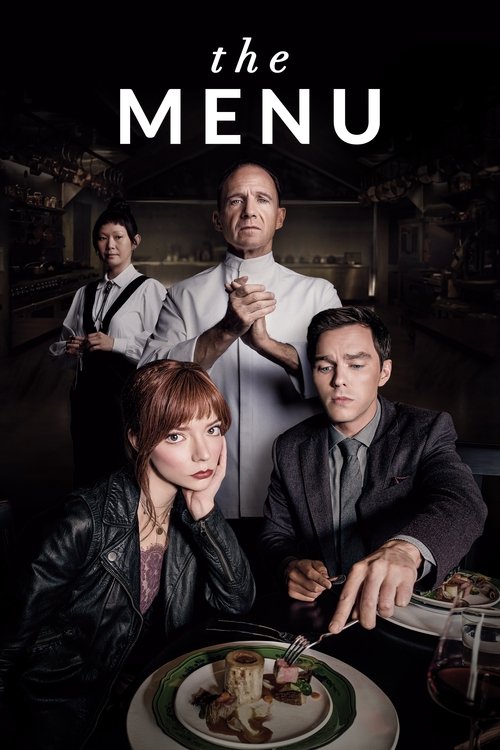
The Menu
2022 · Mark Mylod
For when you're in the mood for something wicked — a sharp, nasty crowd-pleaser that's best with friends and a strong opinion about rich people. Challenging in tone, easy to devour.
What it's about
A young couple joins a handful of ultra-wealthy guests on a boat to a remote island restaurant, where a celebrity chef serves a once-in-a-lifetime tasting menu. Course by course, the evening curdles: the chef has designed the night around his guests — the critics, the regulars, the money men — and one woman at the table doesn't fit his plan. Dinner becomes a trap, and the menu becomes the mechanism.
The experience
Deliciously tense and very funny in a mean way — each new course ratchets the dread while the satire keeps landing jabs at everyone at the table. It's a horror film that makes you laugh, then makes you feel slightly guilty for laughing.
Performances
Ralph Fiennes is chilling and weirdly sad as the chef, running his kitchen like a cult leader, while Anya Taylor-Joy gives the film its pulse as the one guest who refuses to play along — their scenes together are a duel.
The craft
The food is shot like fine-art photography, complete with deadpan menu title cards that become a running joke, and the single-location staging turns the dining room into a pressure cooker. Precise, controlled filmmaking where every plate and camera move is part of the satire.
Why it matters
A signature entry in the wave of eat-the-rich satires that dominated early-2020s cinema, and a film that made fine-dining culture itself a horror setting.
Snapshot
A satire of luxury, artistic purity, and class performance, The Menu follows a group of ultra-wealthy guests to Hawthorn, a remote island restaurant run by the visionary and increasingly unhinged Chef Julian Slowik (Ralph Fiennes). What begins as a dinner of performative gastronomy escalates into a theater of ritual humiliation, psychological coercion, and murder. The film belongs to a pointed wave of post-Parasite class-horror comedies, but distinguishes itself through its specific target: not merely the rich, but the entire apparatus of cultural consumption — critics, collectors, hangers-on, and the artists who mistake the validation of elites for genuine meaning. Anya Taylor-Joy's Margot Mills, the lone guest who refuses to perform the expected reverence, becomes the film's moral compass and finally its only survivor, on the basis of an act of unpretentious desire: she orders a cheeseburger.
Industry & production
The Menu was produced under Searchlight Pictures — the Fox specialty label absorbed into the Disney portfolio — with production companies including Gary Sanchez Productions and Hyperobject Industries, the company associated with producer Adam McKay. The project was shepherded through development during the COVID-19 pandemic, a period that arguably sharpened its satirical edge: the film's setting — a destination restaurant of near-impossible exclusivity — resonated acutely in an era when the restaurant industry was collapsing around such concepts. Principal photography took place in 2021, primarily in coastal Georgia, with the Isles of Hope and surrounding marshland providing the film's remote island exterior; the sterile interior of the Hawthorn dining room was a constructed set. The film was released in North America on 18 November 2022 by Searchlight, competing in a crowded autumn awards season alongside other class-oriented satires. It performed solidly at the specialty box office while generating substantial streaming longevity on HBO Max (subsequently Max). Specific budget and gross figures are in circulation but are not reproduced here to avoid inaccuracy.
Technology
The Menu was shot digitally, consistent with contemporary Searchlight productions. The film's visual grammar — cold, composed, clinical — benefits from digital's latitude for controlled color grading. The production design required the construction of a purpose-built kitchen and dining room set that could be lit with exceptional precision, effectively functioning as a stage whose every angle was calculated. No significant process innovation or special-effects infrastructure defines the film's technical profile; its technology is in service of control rather than spectacle. The decision to use title cards between courses — stark white text on black, naming each dish — borrows from literary and theatrical chapter structure and gives the editing rhythm a formally predetermined quality, as if the film itself were a tasting menu.
Technique
Cinematography
The film's visual approach is deliberately institutional: wide, symmetrical framings; a cool, desaturated palette of gray, off-white, and polished steel; shallow focus deployed to isolate figures against blurred backgrounds that read less like environments than voids. The camera is mostly observational — it does not anticipate action so much as survey it, mimicking the detached competence of a restaurant critic making notes. Close-ups on food are handled with the same clinical precision used for close-ups on distressed faces, a deliberate equivalence. The island exterior is gray-skied and tidal, shot in natural and near-natural light to contrast with the artificial, stage-managed interior. This aesthetic was developed in close collaboration with director Mylod and serves the film's central argument: Hawthorn is a performance space, and every visual choice underscores its theatrical artificiality. The specific cinematographer's contributions are not independently verified in detail beyond what can be inferred from the finished film; the project is typically attributed in interviews to the collaborative decisions of Mylod's team.
Editing
The editing, structured around the course-by-course progression, gives the film an unusual rhythm — deliberate, almost metronomic in its early passages, then accelerating through the mid-section as the violence escalates, before slowing again for the film's climax and coda. The inter-title cards function as chapter breaks, preventing the accumulation of traditional thriller momentum and instead producing an experience closer to revue or performance: each act is discrete, self-contained, formally introduced. This structure is both a satirical device (it mocks the restaurant's self-seriousness) and a genre mechanism (it prolongs and delays dread by withholding narrative resolution). The intercutting between kitchen and dining room — between command and submission — is handled with precision, establishing the spatial logic of control that Slowik exercises.
Mise-en-scène / staging
Mylod, whose television background includes prestige ensembles such as Succession and Game of Thrones, brings to The Menu a strong command of group staging — the ability to work with large casts in bounded spaces and make their social geometry legible. The dining room is staged with the precision of Brechtian theater: characters are seated in configurations that externalize their social relationships, and Slowik moves among them with the blocking vocabulary of a director addressing his cast. The kitchen is staged as its mirror image — a military operation, the brigade in white, each station obsessively tidy. The gap between the two rooms, and the ritual of service across that threshold, maps the film's power diagram. A key staging choice that became widely discussed is the breaking of the fourth wall — Slowik's direct addresses to the dining room, which function as a director's notes, a preacher's sermon, and a chef's preamble simultaneously, and which Fiennes delivers as if performing for an audience beyond the frame.
Sound
The sound design uses the ambient sounds of fine dining — clinking crystal, the scrape of ceramic, the soft percussion of the kitchen — to construct an atmosphere of controlled anxiety. Sound is precise, never cluttered. The score, whose specific composer the available record does not confidently confirm at the level of detail required here, deploys tonal drones and percussive elements that gradually increase in frequency and dissonance as the courses progress, underlining the shift from anticipation to dread without announcing it. The silence around Slowik's speeches is carefully managed — the ambient sound drops almost completely when he addresses the room, conferring on his words the quality of absolute authority.
Performance
Ralph Fiennes's performance is the film's structural pillar. He plays Slowik as a man of perfect surface and radical emptiness — charismatic, terrifying, faintly ridiculous, and genuinely pathetic, often within the same sentence. Fiennes brings to the role the classical theater training that defines his stage career, and his control of register — the capacity to shift from warmth to menace in a sustained gaze — anchors the film's tonal instability. Anya Taylor-Joy's Margot operates as a deliberately opaque foil: she is the only character in the room not performing a role she chose, and Taylor-Joy plays her as watchful and self-contained, refusing the histrionics the situation seems to demand. Nicholas Hoult's Tyler — the food obsessive, the true believer, Slowik's most abject admirer — is played as a portrait of parasocial capture: Hoult calibrates the character's self-satisfaction, fragility, and final destruction with uncomfortable specificity. Hong Chau's Elsa, the maître d', is a study in institutional loyalty taken to psychopathic extreme; her physical precision and affectless delivery constitute a performance mode distinct from the rest of the cast and all the more unsettling for it. The supporting ensemble — John Leguizamo as a faded film actor, Janet McTeer as a food critic, Judith Light and Reed Birney as a long-married couple whose corrosive accommodation of each other forms the film's most quietly devastating subplot — is uniformly calibrated to the satirical register without tipping into caricature.
Narrative & dramatic mode
The film operates as a sustained dramatic irony: the audience understands, before the characters fully do, that the dinner will not end conventionally. The dramatic mode is closer to stage farce than conventional thriller — the situation is enclosed, the exits blocked, the escalation mechanical — but the horror is real and the deaths are not played for laughs. The screenplay, by Seth Reiss and Will Tracy (both writers with backgrounds in comedy — Reiss from Late Night with Seth Meyers, Tracy from The Onion and other satire outlets), is structured as a series of comic revelations, each of which also advances the horror. The film's central narrative argument — that Margot survives because she refuses to engage in Slowik's performance, because her desire is authentic rather than curated — is stated explicitly, which some critics read as a flaw (the film lectures) and others as appropriate to the satirical mode (the lecture is the joke).
Genre & cycle
The Menu is legible within at least three distinct genre frameworks. As class satire, it belongs to the post-Parasite (2019) wave that also includes Triangle of Sadness (2022), Glass Onion: A Knives Out Mystery (2022), Knives Out (2019), and Ready or Not (2019) — films that use generic genre machinery (whodunit, horror, action) to examine economic stratification, specifically the social performance of wealth. As body horror, it belongs to a tradition of films set at the table — the dinner party as the site of bourgeois anxiety and violent revelation — that runs through Buñuel's The Discreet Charm of the Bourgeoisie (1972) and Thomas Vinterberg's Festen (1998). As artist-dissolution narrative, it engages the familiar trope of the perfectionist auteur who destroys himself and others in the service of a vision from which all humanity has been evacuated. The film is unusual in addressing all three simultaneously, with the restaurant as the institution that makes these frameworks collapse into one another.
Authorship & method
Mark Mylod is a British director whose career has been primarily in prestige television. His most significant credit before The Menu was as a recurring director and executive producer on Succession (HBO, 2018–2023), where his command of tonal instability — the show's characteristic oscillation between comedy and devastation — directly informs his approach to The Menu. Succession also trained Mylod in the management of large casts of accomplished actors in enclosed, status-saturated environments, a skill the film required in concentrated form. His earlier film work (Hype!, Ali G Indahouse, Entourage) does not substantially anticipate the control evident in The Menu, and the film is widely understood as representing a step-change in his theatrical ambitions. Screenwriters Reiss and Tracy brought the satirical infrastructure; Mylod and his production collaborators transformed what is, on the page, an extended sketch into a coherent tonal architecture. The film's reliance on physical production design — the restaurant as a character — was a directorial emphasis, with Mylod speaking in promotional materials about the necessity of building a real, functional kitchen to give the actors and the blocking genuine spatial logic.
Movement / national cinema
The Menu is an American studio-adjacent production — Searchlight Pictures was, at the time, the prestige arm of Disney — but its directorial intelligence is distinctly British, shaped by Mylod's formation in British television and theater and by a satirical tradition in which class analysis is conducted with formal precision and mordant wit. It does not belong to a New Hollywood wave or a specific national cinema movement; it is a mid-budget auteur comedy-horror in the Searchlight house style, which has historically accommodated formal and tonal experimentation within commercial parameters.
Era / period
The film is entirely of its post-pandemic, post-Parasite moment. The extreme restaurant — the destination dining experience as secular ritual, the chef as shaman-celebrity — was itself a cultural formation of the 2010s, and The Menu arrives at precisely the moment that formation had fully crystallized in public consciousness and was subject to mockery by mainstream culture. The film captures the sensibility of an era in which the performance of taste had become so elaborate as to be indistinguishable from a species of self-harm, and in which class resentment had moved from the margins to the mainstream of popular entertainment.
Themes
The film's central theme is the corruption of art by approval — the specifically contemporary condition in which the artist produces not for the intrinsic value of the work or even for genuine audience pleasure, but for the validation of a small, wealthy, consecrating class whose approval confers status but is itself empty. Slowik is not a chef who has lost his passion; he is a chef who pursued passion all the way to its annihilation by the machinery of fine dining celebrity. The cheeseburger scene is the film's most deliberate thematic statement: what Margot wants is simple, genuine, pleasurable — food that has no relationship to performance or cultural capital. Her desire is unembarrassed, and it is the one thing that Slowik's system cannot accommodate, and therefore the one thing that disarms him.
Secondary themes include: the complicity of the cultural professional (the food critic as enabler), the toxicity of admiration without understanding (Tyler's worship is more dangerous to Slowik than the indifference of the other guests), and the gendered dynamics of service labor — Elsa and the kitchen brigade's devotion operates as an examination of how labor ideologies are weaponized by charismatic authority figures. The film's conclusion — the island destroyed, every guest consumed — is a fantasy of purification that the film itself refuses to fully endorse; its final image is Margot eating her cheeseburger in a boat, receding from the flames, and it is deliberately, conspicuously unresolved.
Reception, canon & influence
The Menu received broadly positive critical notices, with particular praise directed at Fiennes's performance and the precision of the film's premise. Some critics, notably those inclined toward subtlety in their satire, found the script too explicit in its thesis delivery — the film tells you what it means rather than allowing inference — though this itself became a point of debate, with defenders arguing that explicitness is the appropriate register for Brechtian comedy. The film has not attracted the sustained auteurist scholarly attention granted to its obvious predecessors (The Discreet Charm of the Bourgeoisie, Festen, Funny Games), in part because it is too recent and in part because Mylod's primarily televisual profile places him outside the categories through which film scholarship conventionally distributes prestige.
The backward lines of influence are multiple and visible: Buñuel's repeated interrogation of the bourgeoisie through the rituals of the table; Haneke's cold clinical violence against comfortable people in enclosed spaces (Funny Games, 1997/2007, The Piano Teacher, 2001); Vinterberg's Festen as the model of the dinner party horror that escalates through social revelation to physical catastrophe; Robert Altman's ensemble cinema, in which the satirical subject is a milieu rather than an individual; and the American theatrical tradition of the one-room intensification (Albee's Who's Afraid of Virginia Woolf? is not an implausible reference for the Birney/Light subplot). The film's debt to musical theater — the course-as-act structure, the direct address, the final spectacle — is acknowledged in various readings, particularly the influence of Stephen Sondheim's structural dramaturgy.
Its forward legacy is more difficult to assess at short distance. The film clearly participates in, and perhaps consolidates, the vocabulary of the class-satire horror-comedy that Parasite inaugurated at mass scale, and it contributes a specific refinement: the figure of the artist who becomes an agent of destruction in the service of a vision purged of humanity. Whether it proves formally influential — whether filmmakers cite its chapter-break structure, its spatial logic, its tonal calibration — remains to be established. What is already clear is its cultural resonance: the cheeseburger scene entered widespread discourse as a shorthand for the difference between authentic desire and performed sophistication, which is the surest sign that a film has contributed an image to the common vocabulary.
A Deleuzian reading
Watch how the camera looks at a scallop.
The full Deleuzian reading of The Menu →
Reception
A sleeper hit in late 2022's 'eat the rich' wave (alongside Triangle of Sadness and Glass Onion), it earned Golden Globe nods for Ralph Fiennes and Anya Taylor-Joy — and rather than fading, it found a huge second life on streaming, where it became a compulsively rewatched favorite.
How The Menu was received, from release to now →
Influences: the films it descends from and the films it influenced
- The Discreet Charm of the Bourgeoisie (1972) — Buñuel invented the grammar of the repeatedly thwarted bourgeois dinner as structural engine for class satire — the meal that cannot be completed as a device for exposing the rituals sustaining class identity; The Menu's course-as-chapter architecture is a direct heir to this formal invention.
- Babette's Feast (1987) — Establishes the chef-as-artist who pours self-annihilating devotion into a meal for guests constitutionally incapable of receiving it; The Menu inverts this premise with structural irony, transforming Babette's earnest aesthetic communion into Slowik's vehicle of punitive violence against unreceiving consumers.
- The Cook, the Thief, His Wife and Her Lover (1989) — Greenaway staged the restaurant as a theatrically organized, laterally traversed space with symmetrical frontal compositions and color-coded zones, establishing the visual grammar of the dining room as arena for class violence that The Menu's production design and camera logic directly inherit.
- Festen (1998) — Vinterberg established the genre grammar The Menu follows: the formal dinner party as a sealed container through which private devastation erupts into public catastrophe, with guests unable to exit the social ritual even as it destroys them — the film's spatial confinement and performative-meal escalation are The Menu's direct structural model.
- Funny Games (1997) — Haneke's direct-to-camera addresses — in which the killer acknowledges the audience watching violence-as-entertainment to implicate viewers in their own complicity — are the precise formal precedent for Slowik's audience-confronting monologues; The Menu borrows this fourth-wall device as both Brechtian alienation and instrument of class critique.
- The Piano Teacher (2001) — Haneke's portrait of the perfectionist artist (Erika Kohut) whose aesthetic severity has consumed her capacity for human connection, culminating in self-directed violence, is the precise template for Slowik's dissolution arc — the figure of the artist who has aestheticized himself out of pleasure and into destruction.
- Gosford Park (2001) — Altman's grammar of simultaneous action across class-stratified vertical space — above (dining room) and below (kitchen) stairs counterpointed within a single location, with social status tracked through spatial positioning — is the architectural model for The Menu's kitchen/dining room as separate power zones under continuous intercutting.
- Dogville (2003) — Von Trier literalized Brechtian theatrical devices in cinematic space — chapter-title intertitles dividing the film into named acts, deliberate anti-naturalism replacing illusionism — establishing the specific formal grammar of the intertitle-as-chapter-break that The Menu's course structure directly adopts.
- Whiplash (2014) — Chazelle's autocratic perfectionist whose pedagogy crosses into abuse — the conservatory-as-kitchen where the master's artistic standards systematically destroy the humanity of those beneath him — is the model for Slowik's chef-as-tyrant; The Menu's kitchen hierarchy and the destruction of the line cook descend directly from Whiplash's institutional-abuse grammar.
- The Lobster (2015) — Lanthimos's clinical performance register — actors delivering absurdist social compliance with flat affect, no wink at the audience — is the direct theatrical ancestor of The Menu's service-staff choreography, choral recitations, and the deadpan precision with which the ensemble inhabits a surrealist social system without breaking its internal logic.
- The Square (2017) — Östlund's 'Monkey Man' dinner-party sequence — a performance escalating from conceptual discomfort to physical violence while affluent guests remain paralyzed by social propriety — is the most immediate formal antecedent for The Menu's dining room staging, and the film's grammar of the art world as a site where class performance anxiety and aesthetic value collapse together.
- Parasite (2019) — Bong pioneered the tonal architecture in which a class-comedy of manners pivots without register change into body horror — the genre-hybrid grammar The Menu inherits — and his use of domestic vertical spatial architecture to literalize class hierarchy taught The Menu its grammar of kitchen/dining room as contiguous but politically opposed zones.
- Saltburn (2023) — Fennell adopts The Menu's grammar of class anxiety contained within an architecturally precise enclosed space — the country house as theatrical container for class violence — with a controlled, desaturated palette shifting toward heightened color as violence approaches, and ensemble staging that descends from The Menu's production design logic and tonal modulation between social comedy and body horror.
- The Killing of a Sacred Deer (2017) — Lanthimos's enclosed-fate-acceptance structure — characters submitting to an inexorable social logic of retributive punishment they cannot escape, performed with deadpan precision — directly anticipates The Menu's finale, in which dinner guests accept their deaths within the ritual logic of the meal without breaking the decorum of the occasion.
- Triangle of Sadness (2022) — Östlund's use of labeled chapter intertitles to organize a class-satire narrative, and his pivot from comedy of manners to corporeal abjection (the luxury-yacht vomiting sequence), shares with The Menu both the chapter-break formal device and the class-comedy-to-body-horror escalation arc, the two films crystallizing the same genre grammar simultaneously.
- No Other Choice (2025) — Executes eat-the-rich class satire as a precision-engineered genre-thriller with comic timing and escalating set-piece cruelty, a parallel craft solution to carrying critique through suspense.
- Bugonia (2025) — Written by Will Tracy — Bugonia's screenwriter — deploying class-resentment horror-comedy through service-industry ritual as satirical frame for corporate critique; the deadpan performance register and satirical architecture Tracy brings directly into the Lanthimos collaboration.
- Ready or Not (2019) — Runs the same survive-the-night rules game — an elite host stages a ritualized execution of paying guests with dark comedy — literalizing class predation as a scheduled, escapeless ceremony.
- Fresh (2022) — Turns food styling and culinary foley into instruments of dread, plating class satire as haute cuisine — the same appetizing-image/horrific-content marriage and consumption-as-commodification thesis.
- Blink Twice (2024) — The wealthy lured to a remote, tightly controlled venue governed by ritual and rigid host-versus-guest power dynamics, satire tightening into entrapment.
- Send Help (2026) — Closed-system eat-the-rich satire trading on institutional-power illegibility and the dramatic irony of trapped elites who can't read the rules being run on them.
Similar films
- Triangle of Sadness (2022) — influence & lineage
- Funny Games (1997) — influence & lineage
- Parasite (2019) — influence & lineage
- Babette's Feast (1987) — influence & lineage
- No Other Choice (2025) — influence & lineage
- The Celebration (1998) — influence & lineage
- Saltburn (2023) — influence & lineage
- The Lobster (2015) — influence & lineage
All the films related to The Menu →
Watch it with: curated runs of related films
- Locked In With the Powerful — A run of elegant, twisty chamber pieces where the rich and the powerful gather in one sealed world — an island restaurant, a Greek estate, a gothic mansion, the sealed Vatican — and the social order gets carved up in front of you.