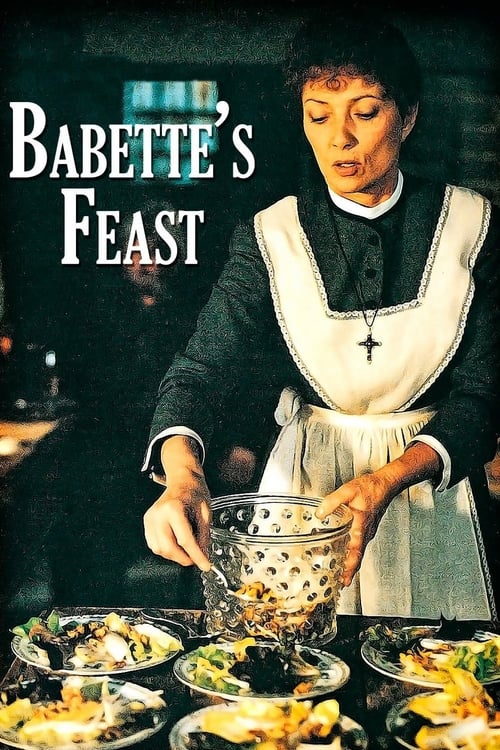
Babette's Feast
1987 · Gabriel Axel
For a quiet night when you need your faith in people restored — comfort cinema of the deepest kind, perfect after a hard week, ideally with something good to eat within reach.
What it's about
On the remote Jutland coast of 19th-century Denmark, two aging sisters lead the remnants of their late father's austere religious sect, their lives narrowed to duty and plain boiled fish. Into their house comes Babette, a French refugee fleeing violence in Paris, who serves them quietly as cook and housekeeper for fourteen years. Then an unexpected windfall lets her ask one favor: to prepare a single, real French dinner for the sisters and their bickering congregation.
The experience
Gentle, wry, and slowly overwhelming — it moves at a candlelit pace, then the feast itself becomes one of cinema's great sequences of pleasure, watching pinched faces thaw course by course. You end it warmed through, possibly weeping, definitely hungry.
Performances
Stéphane Audran plays Babette with magnificent stillness — a woman whose whole hidden life is expressed through work — and the elderly Danish ensemble around her makes every small softening of the heart register.
The craft
Gabriel Axel films the gray coast and dim interiors with such restraint that the feast, when it comes, lands like an explosion of color, candlelight, and texture — the turtle soup and Veuve Clicquot are practically characters. Food has rarely been photographed with this much reverence.
Why it matters
Winner of the Oscar for Best Foreign Language Film, it effectively founded the modern food film and remains the standard by which every meal-as-grace movie is measured — famously beloved by chefs and even cited by Pope Francis.
Snapshot
Babette's Feast (Babettes gæstebud) is a Danish chamber film of extraordinary restraint and warmth, adapted by Gabriel Axel from the 1958 short story by Karen Blixen, who wrote under the pen name Isak Dinesen. In a remote pietist village on the windswept Jutland coast, two aging, devout sisters take in a French refugee, Babette, who has fled the bloody suppression of the Paris Commune in 1871. For fourteen years she serves them as a plain cook and housekeeper. When she unexpectedly wins 10,000 francs in the French lottery, she asks to prepare a single real French dinner for the sisters and their dwindling, quarrelsome congregation — and spends every franc on it, revealing herself to have been the celebrated head chef of the Café Anglais in Paris. The film is at once a parable of grace, a meditation on the cost and vocation of art, and one of cinema's most precise studies of asceticism meeting the sensual world. It became the first Danish film to win the Academy Award for Best Foreign Language Film, and remains a touchstone of the "food film" and of late-twentieth-century literary adaptation.
Industry & production
The film emerged from a long-gestating personal project. Axel, a Dane who had trained and worked extensively in France, was uniquely positioned to mediate Blixen's Franco-Danish material, and he reportedly pursued the adaptation for years before securing financing. It was produced by Panorama Film with producers Just Betzer and Bo Christensen, with support from the Danish Film Institute — the kind of modestly budgeted, state-assisted production typical of Danish art cinema in the 1980s, a period before the Dogme 95 insurgency reshaped the country's international profile. The film's commercial fate was transformed by its awards run: a strong festival and critical reception abroad, and above all the Oscar, turned a small national production into an international arthouse success, particularly in the United States and France. I do not have reliable budget or box-office figures to cite, and will not invent them; the salient industrial fact is the disproportion between the film's small scale and its outsized, durable global reach.
Technology
Technologically the film is deliberately unassuming. It was shot on 35mm color stock in the standard tools of mid-1980s European production, with no recourse to optical spectacle, and its aesthetic ambitions run in the opposite direction from technical novelty — toward natural light, muted palettes, and an almost painterly plainness. The most "technological" dimension of the production is, in a sense, gastronomic rather than cinematic: the climactic feast required real haute cuisine prepared to credible nineteenth-century standards, and the film's authenticity depends on the tangible, photographed reality of the dishes — turtle soup, Blini Demidoff with caviar, Cailles en Sarcophage (quail in puff-pastry sarcophagi) — rather than on any image-making trickery. The camera's job is to record, not to transform.
Technique
Cinematography
The cinematography, by Henning Kristiansen, is foundational to the film's meaning. For the long first movement among the pietists, Kristiansen works in cool, desaturated tones — gray skies, bleached interiors, weathered wood, plain black garments — a visual austerity that embodies the sect's renunciation of the world. The Jutland exteriors are bleak and beautiful, the horizon low and the light Nordic and thin. As the feast approaches, the palette warms: candlelight, the glow of wine and crystal, the deepening reds and golds of the laid table. The film never announces this shift, but the eye registers it as a slow thaw, a chromatic argument that pleasure and grace are not opposed. Compositions favor stillness and frontality, often arranging the congregation like figures in a Dutch genre painting or a Protestant group portrait.
Editing
The cutting is patient and unobtrusive, organized around the story's two-part architecture: a long, expository accumulation of village life and backstory, followed by the sustained set piece of the dinner. (The editing is credited to Finn Henriksen; if I am misremembering that attribution I would rather flag the uncertainty than assert it falsely.) Within the feast, the editing performs its most expressive work, intercutting the diners' faces — the General's dawning astonishment, the congregants' guilty pleasure breaking through their vow to ignore the food — with the dishes and with Babette laboring unseen in the kitchen. The rhythm is unhurried but tightly controlled, building not suspense but a cumulative, almost liturgical transformation.
Mise-en-scène / staging
Mise-en-scène carries the film's argument. The pietist interiors are bare to the point of severity; the congregation's world is one of subtracted objects and suppressed appetites. Against this, the feast is staged as a near-sacramental set piece — the dressed table, the layered courses, the wines arriving in sequence — a visual liturgy that mirrors and gently rivals the religious one. Costume reinforces the scheme: plain dark dress for the sect, the General's resplendent uniform marking the intrusion of the outside world of rank and refinement. Axel stages the dinner so that grace is enacted through gesture and place-setting rather than spoken doctrine.
Sound
Sound is spare and motivated. Music is used sparingly and pointedly: the hymns of the congregation, sung simply and often falteringly, define their world, while the high-cultural counterpoint arrives through the opera singer Achille Papin and allusions to Mozart — a tension between sacred Lutheran song and the worldly art of the operatic stage. The score is credited to the important Danish composer Per Nørgård. Much of the film's most telling sound is diegetic and small: wind, the clink of glass and cutlery, the murmur of the table, the silence of renunciation.
Performance
Performance is where the film's emotional architecture lives. Stéphane Audran, a luminary of the French New Wave and Claude Chabrol's frequent star, plays Babette with magnificent reticence — watchful, dignified, her artistry and grief held almost entirely in reserve until the final revelation. The two sisters are played by distinguished Danish actresses, Birgitte Federspiel as Martine and Bodil Kjer as Philippa, their faces mapping decades of foreclosed desire and faith. Jarl Kulle, as General Lorens Löwenhielm, delivers the film's pivotal spoken aria — the dinner speech on mercy and grace — as a man undone by recognizing, late in life, what he renounced. The ensemble of congregants supplies a fine-grained comedy of repression that keeps the parable from solemnity.
Narrative & dramatic mode
The narrative is structured as a long preparation and a single consummation. The first half is an almost novelistic exposition: the sisters' youth, their two thwarted romances — the cavalry officer Lorens Löwenhielm, who loved Martine, and the Parisian opera singer Achille Papin, who loved Philippa — and the chain of circumstance by which Papin, years later, sends the fugitive Babette to their door. This patient backstory is essential, because the feast can only signify against the full weight of lives lived in renunciation. The dramatic mode is parable, leavened with gentle social comedy: the dramatic engine is not external conflict but an interior reversal, the moment when self-denial is surprised by joy. The film withholds its climax — Babette's confession that she spent the entire fortune, and was the Café Anglais's chef — until the very end, recasting the whole feast retroactively as an act of total, unrepayable self-giving.
Genre & cycle
Babette's Feast is usually shelved as literary-adaptation arthouse drama, but its most consequential generic identity is as a progenitor of the modern "food film." Its central conceit — a meal as the vehicle of transformation, reconciliation, and self-expression — anticipates and arguably catalyzes a cycle that includes Like Water for Chocolate (1992), Big Night (1996), Eat Drink Man Woman (1994), Chocolat (2000), and many later gastronomic narratives. It also belongs to a quieter tradition of the religious or spiritual parable film, and to the costume-drama mode of nineteenth-century period reconstruction. Its hybrid genre billing — drama, history, comedy — accurately reflects a film that braids devotional seriousness with dry social humor.
Authorship & method
The authorship is doubled, literary and cinematic. The originating voice is Karen Blixen / Isak Dinesen, whose story — written in English and collected in Anecdotes of Destiny (1958) — supplies the film's themes, structure, and even much of its narration. Gabriel Axel, who wrote the screenplay as well as directing, is the decisive cinematic author: his bicultural fluency let him honor both the Danish pietist milieu and the French haute-cuisine world the story hinges on, and his directorial method is one of disciplined understatement, trusting image, face, and object over emphasis. The key collaborators reinforce this: cinematographer Henning Kristiansen, whose chromatic restraint and warming are inseparable from the meaning; composer Per Nørgård, anchoring the film in serious Danish music; and the ensemble cast, with Stéphane Audran's casting a small act of authorship in itself, importing a French cinematic aura into a Danish village. Axel's fidelity to Blixen is notable — he preserves her narrational framing and her central paradox of the artist's vocation rather than "opening up" the material into conventional drama.
Movement / national cinema
The film sits within Danish national cinema at a specific hinge moment. It carries forward the country's distinguished tradition of austere, spiritually serious filmmaking associated above all with Carl Th. Dreyer — and indeed Birgitte Federspiel, here playing Martine, had decades earlier starred in Dreyer's Ordet (1955), a near-literal lineage linking Babette's Feast to that ascetic, faith-haunted Danish line. Yet the film also straddles national traditions: its sensibility is as French as it is Danish, and Axel's career bridged the two cinemas. Coming in the late 1980s, it represents Danish cinema's classical, literary, art-film face just before the iconoclastic Dogme 95 movement (Lars von Trier, Thomas Vinterberg) would redefine Denmark's international image in the following decade — making Babette's Feast a kind of culmination of an older mode rather than a harbinger of the new.
Era / period
Set in the late nineteenth century — with a crucial flashback frame in the 1870s — the film reconstructs a vanished world of Lutheran pietist communities on the Jutland coast, small sects organized around a charismatic dean and bound by renunciation. The 1871 Paris Commune is the off-screen historical rupture that delivers Babette to Denmark: she is a Communard widow and refugee, her husband and son killed in the semaine sanglante, her past as an artist of the kitchen erased by exile. The period reconstruction is meticulous but unshowy, and the historical specificity matters thematically — the collision of a defeated French revolutionary's worldly sophistication with a closed Nordic religious community is the film's animating cultural contrast. As a production, the film belongs to the mid-1980s European arthouse moment, when literary adaptation and prestige period drama found strong international markets.
Themes
The film's governing theme is grace — unearned, abundant, and given without expectation of return. Babette's feast is a secular sacrament: she spends her entire fortune to give, once more, the gift of her art, asking nothing, and in doing so dissolves the congregation's petty grudges and reanimates their capacity for joy. Bound to this is the theme of the artist's vocation. The film insists, through both Babette and the singer Papin, that the artist's deepest need is the chance to do her utmost; Babette's tragedy and triumph is that she will never again cook such a meal, yet the act of having done so is its own justification. A third strand is the reconciliation of the sacred and the sensual — the pietists' fear that bodily pleasure is sin, gently overturned by a meal that proves beauty and devotion can meet. The General's dinner speech, drawing on the language of mercy and righteousness embracing, articulates the synthesis the film dramatizes: that "righteousness and bliss shall kiss one another." Themes of exile, memory, renunciation, and the long shadow of roads not taken run beneath all of this.
Reception, canon & influence
Critically, the film was widely and warmly received and quickly entered the canon of beloved arthouse cinema. Its central honor was the Academy Award for Best Foreign Language Film at the 60th ceremony in 1988 — the first such win for a Danish film — and it was also honored by the British Academy as Best Film Not in the English Language; it screened at Cannes in 1987 and drew recognition there, including from the festival's ecumenical jury, though I would not want to overstate specifics I cannot verify precisely. The backward lines of influence are clear: the originating source is Blixen's literary art, and the film's spiritual-aesthetic DNA descends from Dreyer's tradition of Danish religious austerity (literalized by Federspiel's presence) and from a broader European humanist current. The forward influence is substantial and twofold. Aesthetically and thematically, Babette's Feast effectively founded the modern food film, giving later directors a template in which cuisine becomes the medium of grace, memory, and reconciliation — Like Water for Chocolate, Big Night, Eat Drink Man Woman, and Chocolat all work in territory it mapped. Culturally, it became a touchstone in religious and theological circles as a parable of grace and gift — famously cited as a personal favorite by Pope Francis among others — an unusually durable afterlife for a quiet Danish chamber film. Its standing today is that of a modern classic: small in scale, large in resonance, and frequently invoked whenever cinema considers the meeting of art, faith, and the laid table.
A Deleuzian reading
Watch the General's face.
The full Deleuzian reading of Babette's Feast →
Reception
An arthouse hit on arrival — it won the Best Foreign Language Film Oscar, the first Danish film ever to do so — and it has only grown warmer with age, settling in as the ur-'food film' and a perennial comfort-cinema recommendation.
How Babette's Feast was received, from release to now →
Influences: the films it descends from and the films it influenced
- Ordet (1955) — The frontal, slow tableau staging of a Jutland pietist household and the miracle-of-grace finale are the direct model — literalized by casting Birgitte Federspiel (Dreyer's Inger) as one of the spinster sisters.
- Day of Wrath (1943) — Supplies the desaturated, chiaroscuro 'painterly frontality' — faces and dark wool costumes lit like Dutch genre painting against austere interiors — that Kristiansen's photography revives.
- Gertrud (1964) — Origin of the reticent, averted-gaze performance register Audran uses: emotion withheld and registered in stillness rather than expressed in dramatic action.
- The Passion of Joan of Arc (1928) — Establishes the reaction-intercutting grammar — cutting a sacred event through close-ups of upturned, transfigured faces — that the feast sequence deploys on the dining guests.
- Diary of a Country Priest (1951) — The parable-of-grace mode with a withheld spiritual climax and disciplined understatement (image and object over emphasis) prefigures Axel's anti-dramatic fidelity to a religious paradox.
- Winter Light (1963) — Nordic chamber-drama treatment of waning faith staged in a cold rural congregation — the sacred-vs-secular tension and sound restraint Babette inherits and then warms.
- Like Water for Chocolate (1992) — Adopts Babette's template of cuisine as the medium of transmuted feeling and grace, where a meal physically transforms the diners' inner lives.
- Eat Drink Man Woman (1994) — Builds elaborate cooking-sequence montages that carry the narrative and stages family reconciliation at the laid table — the food-film grammar Babette founded.
- Big Night (1996) — Centers a single climactic feast prepared by an uncompromising artist-chef whose vocation is realized in cooking — directly extending Babette's 'artist's gift through cuisine.'
- Chocolat (2000) — Replays the core opposition — a sensual culinary artist arriving among pietist repression to deliver grace through pleasure — as an explicit reworking of Babette's parable.
- Ratatouille (2007) — Stages the transformative meal that disarms a hostile critic via a flashback triggered by taste — a withheld-climax reaction beat lifted straight from the feast's effect on its guests.
- Phantom Thread (2017) — Treats the meal as the arena of an artist's vocation, devotion, and control, with reticent performances and desaturated period interiors — the artist-and-the-table inquiry Babette opened.
- The Menu (2022) — Establishes the chef-as-artist who pours self-annihilating devotion into a meal for guests constitutionally incapable of receiving it; The Menu inverts this premise with structural irony, transforming Babette's earnest aesthetic communion into Slowik's vehicle of punitive violence against unreceiving consumers.
- Girl with a Pearl Earring (2003) — Northern-European still-life framing and tactile diegetic textures of labor and food, with emotion held in restraint rather than dialogue — the diegetic-tactile, withheld-interiority lineage.
- Estômago: A Gastronomic Story (2008) — A literary adaptation in which an unassuming cook's technical mastery becomes quiet authority, staging the meal itself as narrative climax—the template for Raimundo's dishes as instruments of leverage.
- Little Forest (2018) — Extends real-time food preparation into the film's emotional climax, proving a meal's making can carry a narrative's grace — the anti-dramatic, cooking-as-catharsis logic behind Little Forest's dishes.
- Antonia's Line (1995) — Makes the communal table the film's moral and emotional climax within an anti-clerical current where sensual pleasure redeems a pious community, directly informing Antonia's table-motif and anti-church stance.
- The Taste of Things (2023) — Establishes the film's central structural device — a long, quasi-real-time cooking sequence in which the labor of preparing and plating each course carries the entire emotional climax, rather than dialogue or plot resolution.
- Fanny and Alexander (1982) — The lavish communal banquet as a structural set-piece and emotional pivot, photographed with sensuous painterly warmth against austere Lutheran repression — a contemporaneous Nordic version of feast-as-liturgy.
- A Sunday in the Country (1984) — Shares the Impressionist-painting frontality and meal-as-gathering composition, treating a family table in soft natural light as a tableau of memory and reconciliation.
- Tampopo (1985) — Contemporaneous food-film progenitor that, like Babette, ritualizes cooking and eating as a spiritual-artistic discipline filmed with reverent attention to process.
- The Cook, the Thief, His Wife & Her Lover (1989) — Pushes feast-as-moral-allegory into painterly excess — the kitchen-to-dining-room mise-en-scène as a deliberate canvas — an opposite-tempered descendant of the same food-as-meaning conceit.
- Gosford Park (2001) — Its rapt attention to kitchen labor and the dignity of service — the meal assembled below as the event unfolds above — mirrors Gosford Park's foregrounding of invisible labor as the film's true craft subject.
- Barber's Tales (2013) — The purest model of 'liberation through craft' — a woman's silent mastery of a trade becomes the instrument that frees a repressed provincial community, exactly Marilou's barbering.
- The Dead (1987) — A whole feature organized around the preparation, serving and consumption of one meal, with each guest's buried history made legible only through faces at the table.
Similar films
- Eat Drink Man Woman (1994) — influence & lineage
- Big Night (1996) — influence & lineage
- Ratatouille (2007) — influence & lineage
- Fanny and Alexander (1982) — influence & lineage
- Like Water for Chocolate (1992) — influence & lineage
- Ordet (1955) — influence & lineage
- Diary of a Country Priest (1951) — influence & lineage
- The Cook, the Thief, His Wife & Her Lover (1989) — influence & lineage