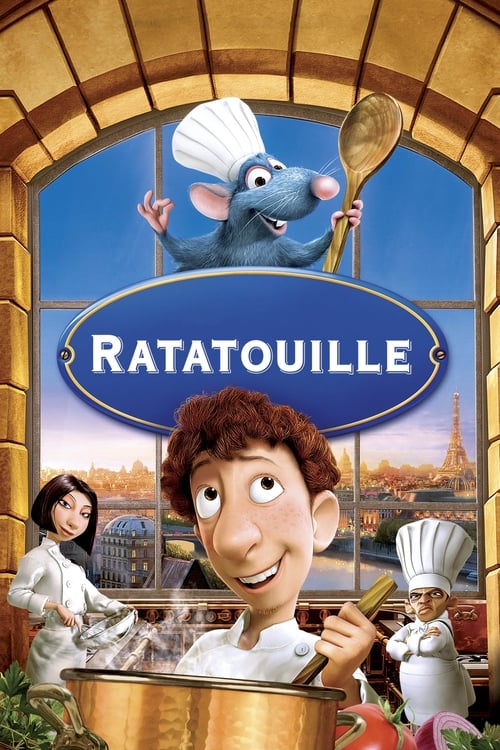
Ratatouille
2007 · Brad Bird
For a cozy night in when you want pure delight — a family film that adults may love even more than kids. Fair warning: you will want good food immediately after.
What it's about
Remy is a rat with a chef's palate, dreaming of creating food rather than scavenging it. When fate drops him into the sewers beneath a fading famous Parisian restaurant, he strikes up a secret alliance with a hapless young kitchen worker — and together they cook their way toward greatness, one near-disaster at a time.
The experience
Warm, witty, and precision-built — kitchen chaos timed like silent comedy, with a streak of genuine feeling about talent and where it comes from. It leaves you happy, hungry, and a little inspired.
Performances
Peter O'Toole voices the vulture-like critic Anton Ego with magnificent, withering gravity — and gets the film's finest monologue, one of the best things ever said about criticism in a Hollywood movie.
The craft
Brad Bird took over a troubled production, rewrote it in eighteen months, and delivered animation that was a leap even by Pixar standards: food so tactile the studio brought in real chefs as consultants, a Paris glowing in burnished evening light, and Michael Giacchino's accordion-flecked score tying it all together. It's a feast for the eyes in the most literal sense.
Why it matters
Widely considered Pixar's most elegant film, it won the Oscar for Best Animated Feature and cemented Bird's run as one of animation's great directors — its 'anyone can cook' credo has become shorthand for democratized genius.
Brad Bird inherited a troubled production mid-stream, rewrote it in eighteen months, and delivered what many consider Pixar's most elegant film: a rat with a refined palate scheming his way through the kitchen of a fading Parisian restaurant. Coming off The Incredibles, Bird again smuggled an auteurist argument into family entertainment — the dead chef's motto 'anyone can cook' is really a claim about where genius comes from, and the climactic review by the vulture-like critic Anton Ego (voiced by Peter O'Toole) is the finest thing ever written about criticism in a Hollywood film. The craft was a leap even by Pixar standards: food rendered so tactilely that the studio brought in chefs as consultants, a Paris of burnished evening light, and kitchen choreography timed like silent comedy. Michael Giacchino's accordion-flecked score won hearts; the film won the animation Oscar. Bird's insistence that a kids' cartoon could hinge on questions of taste, vocation, and artistic gatekeeping made it the Pixar film that cinephiles claim most fiercely as their own.
A Deleuzian reading
Remy shuts his eyes over a scrap of cheese and a piece of strawberry, and the kitchen drops away.
The full Deleuzian reading of Ratatouille →
Reception
A hit and instant critical darling in 2007 (it won the Best Animated Feature Oscar), it has only climbed since — what once sat comfortably among 'great Pixars' is now routinely argued to be THE great Pixar.
How Ratatouille was received, from release to now →
Influences: the films it descends from and the films it influenced
- The Incredibles (2004) — Bird's prior Pixar feature establishes his signature staging of action through densely purposeful blocking, importing live-action camera pacing and wide-lens comic geography into CG animation.
- The Iron Giant (1999) — Bird's directorial method of grounding a fantastical non-verbal protagonist through restrained, appeal-driven character animation and earned sentiment rather than gag-per-second mugging.
- City Lights (1931) — The pantomime-pathos tradition Bird explicitly drew on: Remy, mute to humans, must carry emotion and comic timing entirely through silent-comedy body-acting like the Little Tramp.
- Steamboat Bill, Jr. (1928) — Keaton's architectural physical comedy — a small body navigating and being menaced by hostile mechanical environments — is the blueprint for the kitchen-as-deathtrap choreography.
- Lady and the Tramp (1955) — Disney's precedent for animating eating as a sensual, romantic set-piece; the shared-spaghetti scene prefigures Remy's synesthetic flavor-bursts of color and sound.
- Cinderella (1950) — The Disney conceit of anthropomorphic rodents operating covertly inside a human household, extended into Remy literally puppeteering Linguini by the hair.
- Babette's Feast (1987) — The transcendent-meal structure in which cooking becomes redemptive art and a single dish converts a hardened skeptic — the direct dramatic template for Anton Ego's ratatouille epiphany.
- Tampopo (1985) — Defines the food film as genre through reverent, tactile close-ups of ingredients and technique that treat culinary craft with the seriousness of martial discipline.
- The Red Shoes (1948) — The archetype of vocation-as-tyranny and the exacting maestro (Gusteau, Skinner) demanding total artistic surrender — 'anyone can cook' as the film's rebuttal to that gospel.
- Big Night (1996) — The kitchen-workplace drama built on the friction between commercial survival and uncompromised craft, staged through real cooking labor rather than montage shorthand.
- Vertigo (1958) — Cinematographer Sharon Calahan's burnished, source-motivated evening light and the dolly-zoom vertigo shot on Ego's balcony are lifted as deliberate live-action-cinema quotations.
- A Bug's Life (1998) — Carries forward the small-creature-in-human-scale staging and translucent organic rendering (food, fur, liquids) within a meticulously realized oversized environment.
- WALL·E (2008) — Pixar's immediate extension of Ratatouille's silent-comedy gamble — a near-mute protagonist carrying a first act almost entirely through Chaplinesque pantomime and gesture.
- Coco (2017) — Extends the Pixar auteur-in-a-family-film thesis of artistic calling versus inherited expectation, again resolving vocation through a talent the protagonist's world forbids.
- Soul (2020) — Directly inherits the 'genius, spark, and vocation' theme — interrogating the myth of innate talent and the cost of an all-consuming artistic drive.
- The Menu (2022) — Weaponizes the same chef-versus-critic power dynamic and artistic-gatekeeping theme, inverting Ego's arc into a chef's lethal revenge on the consumers of fine dining.
- Chef (2014) — Carries forward the critic-review-as-inciting-wound and loving food-porn cinematography, staging authentic real-time cooking as the emotional core.
- Mission: Impossible - Ghost Protocol (2011) — Cemented Bird's working partnership with composer Michael Giacchino and a fluid camera that threads through complex three-dimensional architecture, both carried directly into Ghost Protocol.
- Toy Story 5 (2026) — Where Pixar formalized the split of the cinematography credit into director of photography–camera and director of photography–lighting (Sharon Calahan's lighting alongside a separate camera department) — the exact two-headed credit structure, and the Calahan-era lighting school Kalache comes out of.
- Hoppers (2026) — Animated a body driven by an occupant from outside its own nervous system — Remy steering Linguini by tufts of hair — which is Hoppers' premise run in reverse, and the same animation problem of two intentions competing for one set of limbs.
- Inside Out (2015) — Two direct devices: the literal pilot-in-the-hair steering another creature's limbs, and the burst of non-representational shape-and-color animation used to render an interior sensation — the synesthesia riff that Abstract Thought and the emissive memory orbs expand into a whole visual system.
- Amélie (2001) — Giacchino's accordion-and-musette Parisian score shares the whimsical French sound palette Yann Tiersen popularized, scoring a storybook, over-saturated Paris.
- Estômago: A Gastronomic Story (2008) — Same-year parable of class ascent through pure culinary talent, in which a lowly outsider breaches a gated hierarchy solely by the authority of what he can cook.
Similar films
- Amélie (2001) — influence & lineage · same viewing thread
- Babette's Feast (1987) — influence & lineage
- Coco (2017) — influence & lineage
- Fantastic Mr. Fox (2009) — shared sensibility
- The Taste of Things (2023) — shared sensibility
- Ernest & Celestine (2012) — shared sensibility
- Estômago: A Gastronomic Story (2008) — shared sensibility
- The King and the Mockingbird (1980) — shared sensibility
All the films related to Ratatouille →
Watch it with: curated runs of related films
- Storybook France in Full Color — A run of saturated, big-hearted French confections that rhyme on candy-box color, romantic longing, and the magic hiding in an ordinary day.