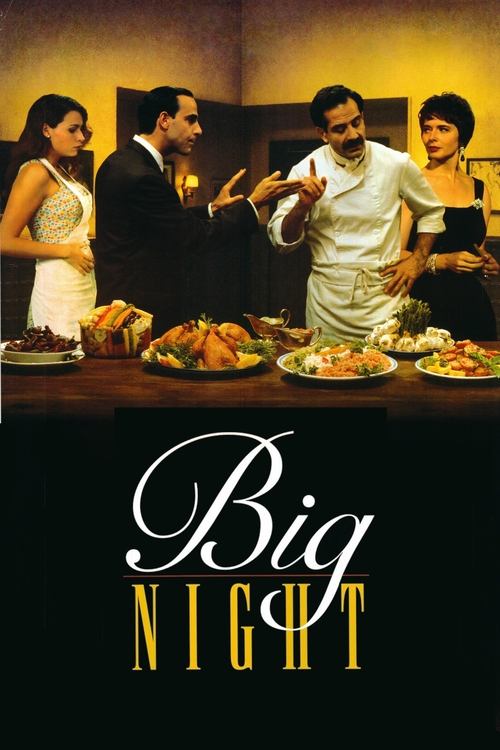
Big Night
1996 · Stanley Tucci
For a cozy night in when you want food, family, and feeling — comfort viewing with a real ache underneath. Perfect with dinner, or better, cooked-for dinner.
What it's about
Two Italian immigrant brothers run a failing restaurant on the 1950s New Jersey shore: Primo, the chef, cooks like an artist for customers who want spaghetti and meatballs; Secondo, the front of house, reads the ledger and knows the end is near. A flashy rival offers a lifeline — he'll bring the bandleader Louis Prima to a banquet at their place, the kind of night that gets you in the newspaper. The brothers bet everything they have on one meal.
The experience
Warm, funny, and quietly heartbreaking — a film that takes its time laying the table and makes the wait delicious. The comedy is gentle and observational, the sadness sneaks up on you, and you will be ravenous by the end.
Performances
Tony Shalhoub and Stanley Tucci make the brothers' bond — all bickering, loyalty, and unspoken love — the film's whole engine, and Ian Holm is gloriously outsized as the rival restaurateur who serves what Americans think Italian food is.
The craft
Tucci co-directs with a patience rare in American comedy, letting scenes play in long, unhurried takes — including a final sequence, done almost without words, that has become legendary among food-movie lovers. The banquet itself, built around a towering baked pasta dish called timpano, is some of the most loving food photography ever put on film.
Why it matters
A defining entry in the food-film canon and the movie that established Tucci as a filmmaker; it's the standard by which restaurant dramas and on-screen feasts still get measured.
Snapshot
Big Night is a two-hander about brothers, a restaurant, and a meal — a film in which almost nothing happens except that dinner is cooked and served, and everything that matters happens anyway. Primo (Tony Shalhoub), the elder brother and the chef, is an artist in a medium the customers of a 1950s New Jersey shore town do not recognize; Secondo (Stanley Tucci), the younger, is the front of house, the one who reads the ledger and knows the restaurant is dying. Their rival Pascal (Ian Holm) runs a loud, successful place down the road that serves what Americans think Italian food is. Pascal offers a lifeline: he claims he can bring the bandleader Louis Prima to a dinner at the brothers' Paradise, an event that would put them in the newspaper and save them. The brothers spend everything they have on the meal.
The film was directed by Tucci and Campbell Scott from a screenplay by Tucci and his cousin Joseph Tropiano, and it arrived in 1996 as a signal instance of the American independent feature at its mid-nineties peak: modest in budget, actor-driven, formally unshowy, distributed by a specialty label (the Samuel Goldwyn Company) into an arthouse market that had, by then, learned how to make such films profitable. It is remembered principally for three things — the timpano, the great baked drum of pasta that anchors its centerpiece meal; the wordless final scene, a single long take of an omelet cooked and eaten; and the quality of its ensemble acting, which is the film's true special effect.
Its afterlife has been unusual. Big Night did not spawn imitators in the ordinary sense, but it became a reference point — for the food film as a genre that could carry adult drama rather than whimsy, for a certain kind of Italian-American story told without gangsters, and, decades later, for the way ambitious restaurant fiction on television talks about the gap between craft and commerce.
Industry & production
Big Night is a product of the specific industrial conditions of American independent film between roughly 1989 and 1999 — the period bracketed by sex, lies, and videotape and the consolidation of the specialty divisions. In that decade a film could be financed outside the studios in the low single-digit millions, premiered at Sundance, acquired by a specialty distributor, and released slowly into a circuit of arthouses that had been trained by My Left Foot, The Crying Game, and Pulp Fiction to show up for a well-reviewed small film. Big Night moved through that pipeline: it premiered at the 1996 Sundance Film Festival and was released by the Samuel Goldwyn Company, a distributor that had built a business precisely on literate, dialogue-forward, often European-inflected pictures.
The production's most distinctive feature is its authorship structure. Tucci co-wrote with Joseph Tropiano and co-directed with Campbell Scott, an actor then better known for Longtime Companion and Dying Young than for directing. The arrangement was practical as much as artistic — Tucci was also playing Secondo, one of the two leads, and a co-director allows a performing director to have an outside eye on the floor. This was, in the nineties, a recognizable pattern: an actor with enough industry standing to attract peers, but not enough to command a studio deal, assembling a picture around the one resource actors reliably have, which is other actors.
The cast reflects that. Shalhoub, Holm, Isabella Rossellini, Minnie Driver, Allison Janney, and Scott himself are performers whose presence in a film of this size is a function of the material rather than the money. Holm in particular — a British classical actor of the first rank playing a Neapolitan restaurateur — is the kind of casting that signals the project's ambitions were literary rather than commercial.
Financially, the film was a modest specialty success rather than a breakout; it played long in urban markets on the strength of reviews and word of mouth, which was the intended business model for a picture of its scale. Precise budget and gross figures circulate in secondary sources with enough variation that they are not worth asserting here as fact. What can be said without qualification is that the film was profitable enough, and prestigious enough, to launch Tucci's directing career — he made The Impostors in 1998 and Joe Gould's Secret in 2000 — and that it won the Waldo Salt Screenwriting Award at Sundance in 1996 and, later, the Independent Spirit Award for Best First Screenplay.
Technology
Big Night is technologically conservative by design, and this is worth stating plainly because the film's virtues are sometimes described as though they were achieved by austerity rather than by choice. It was shot on 35mm color negative and finished photochemically, in the ordinary manner of a mid-nineties independent feature; there is no digital intermediate, no significant optical or visual-effects work, and no formal gimmick. The film's technical achievements are of the pre-digital kind: getting adequate light into small practical interiors, holding focus through long handheld or dollied takes, and recording usable production dialogue in a working kitchen full of hard reflective surfaces and running water.
The one genuinely demanding technical problem the film sets itself is food. Photographing cooking in a way that reads as competence rather than performance requires that the actors actually be able to do the work, that the food be prepared in real time to arrive at camera at the right moment, and that the lighting flatter surfaces — sauce, pastry, oil — that behave very differently from skin. The timpano sequence and the final omelet both depend on this: they are, technically, long unbroken observations of a physical process, and they only work if the process is real. The production employed culinary consultation to that end; the chef Gianni Scappin worked with the film, and Shalhoub's credibility as Primo is in large part the credibility of his hands.
Technique
Cinematography
Ken Kelsch, who had shot Bad Lieutenant for Abel Ferrara, photographed Big Night, and the choice is less incongruous than it looks: Ferrara's films demand exactly the fast, available-light, close-quarters shooting that a restaurant picture needs. Kelsch's work here is warm and unfussy, weighted toward tungsten-inflected interiors — the Paradise's dining room is amber and underpopulated, Pascal's restaurant brighter, busier, and cruder in its light. The palette does an enormous amount of narrative work: the brothers' room looks like a place where a meal is a private matter, Pascal's like a place where it is a show.
The camera is generally patient. Kelsch and the directors favor sustained takes and lateral movement over coverage-and-cut construction, particularly in the kitchen, where the frame tends to follow work rather than dialogue. Two decisions stand out. First, the banquet is shot with increasing intimacy as it proceeds — the film moves in toward faces and plates as the guests surrender to the meal. Second, the closing scene is executed as a single long static-to-slow-moving take, a formal gesture the film has spent ninety minutes earning.
Editing
Suzy Elmiger's cutting is the film's least conspicuous and most consequential craft contribution. Two rhythms are held in tension. In the business scenes — the bank, the arguments over the ledger, the dinner service for the couple who want their risotto with a side of spaghetti — the cutting is conventional and quick, the rhythm of a naturalistic ensemble drama. In the cooking and eating scenes it slows dramatically and lets shots run. The film's structure is essentially two acts of accumulating pressure followed by an extended set piece, and the editing's job is to make the audience feel the shift from anxiety to abundance and then, in the aftermath, back to consequence.
The most discussed cutting decision is the refusal to cut at the end. After the night collapses — after the fight on the beach, after the brothers have said the unsayable things to each other — the film gives its final scene to an unbroken shot of Secondo cooking eggs, Cristiano the busboy eating, and Primo arriving to stand beside his brother. The withheld cut converts a reconciliation that is never spoken into something the audience watches happen in real time.
Mise-en-scène / staging
The film's staging logic is the geography of a restaurant: front of house and back of house, and the swinging door between them, which is also the boundary between Secondo's world and Primo's. Almost every significant scene is blocked around that division. The dining room is a stage where Secondo performs charm and solvency; the kitchen is where Primo makes things that no one out front has asked for. Pascal's restaurant, by contrast, has no such division that the film shows us — it is all front, all performance, which is precisely Primo's objection to it.
Production design and costume place the film securely in the late 1950s without ever making a display of period. The clothes are working clothes; the cars and the shore-town exteriors are handled economically. The film's most famous piece of staging is culinary rather than architectural: the presentation and cutting of the timpano, shot as a ceremony, with the drum carried in, set down, and opened.
Sound
The soundtrack is dominated by period Italian and Italian-American popular music, and above all by Louis Prima, whose recordings function as the film's promise and its absence. Prima is the guest who does not come; his voice is in the room throughout, which is a quietly sophisticated piece of sound design — the film gives us the star in the only form that was ever really available to the brothers, as a record. Gary DeMichele's original score is spare and largely deferential to the source music.
Equally important is the film's use of kitchen sound: knives, pans, boiling water, the scrape of a spoon. In the final scene there is no music at all, only the sounds of eggs and a pan, which is why that scene registers as it does. The film's one great vocal set piece — Primo's kitchen aria of frustration about the customer who wants spaghetti with her risotto — is played almost entirely on Shalhoub's voice.
Performance
Big Night is an actor's film in the specific sense that its meaning is carried by performance rather than by plot or image. Shalhoub's Primo is built out of stubbornness and interiority; his English is effortful, his Italian fluent and voluble, and the film uses the switch between them as a register of how much of himself he can express. Tucci's Secondo is a study in maintained composure — a man who is always calculating, always presenting, and whose collapse when it comes is therefore devastating. Holm's Pascal is the film's most theatrical performance, all appetite and volume, and the film is careful to make him neither a villain nor a fool: his speech about what he understands and Primo does not is delivered with real conviction.
The supporting work is unusually precise. Rossellini and Driver play the two women in Secondo's life with a shared refusal of the standard mistress/fiancée schematic; Janney and Scott each land a fully drawn character in a handful of scenes — Scott's Bob, the car salesman, is a small comic gem of period fatuousness.
Narrative & dramatic mode
Structurally, Big Night is a chamber drama built on the oldest reliable armature in the theater: the family business in crisis, with two siblings representing incompatible answers to the same problem. It is closer to a play than to a conventional screenplay, and it is not defensive about this. The dramatic mode is naturalistic, dialogue-led, and comic in its surface and tragic in its structure — a mixture the film sustains without tonal wobble.
The plot has an unusual shape. The first two-thirds function as rising action toward the banquet; the banquet itself is the film's climax in the sense of spectacle; but the actual dramatic climax comes after, on the beach at dawn, when the brothers finally say what they think of each other. The film then declines to end there, adding the coda that everyone remembers. The effect is to relocate the film's meaning away from success or failure — the restaurant is, we understand, finished — and toward the question of whether the brothers survive each other.
Notably, the film withholds the thing its plot is organized around. Prima never arrives; Pascal's betrayal is revealed obliquely; the audience is denied the payoff the characters have been promised. This is a deliberate refusal of the underdog-triumph structure the setup invites, and it is the single choice that most clearly marks Big Night as a serious drama wearing the clothes of a crowd-pleaser.
Genre & cycle
Big Night belongs to a small but real cycle: the food film as adult drama, which took shape internationally in the late 1980s and early 1990s. Babette's Feast (1987) established the template of the great meal as a spiritual event; Tampopo (1985) demonstrated that cooking could carry a whole film's comic and formal invention; Like Water for Chocolate (1992) and Eat Drink Man Woman (1994) brought food-as-emotion to international arthouse audiences in the years immediately preceding. Big Night enters this cycle and shifts it toward economics — its meal is not magic and does not redeem anyone; it is an expensive gamble that fails.
It belongs equally to the Italian-American cinema of the period, and its significance there is partly negative: it is a film about Italian-Americans with no crime in it. Against the long shadow of Coppola and Scorsese, Big Night proposed immigrant experience as a matter of labor, taste, assimilation, and the gap between what you make and what the market wants. It sits alongside Nancy Savoca's True Love (1989) and Tucci's own later work in this smaller, domestic tradition.
Finally, it is a nineties American independent film in the Sundance mold — ensemble-driven, regionally specific, modest in scale, ending on ambiguity.
Authorship & method
The directing credit is shared between Tucci and Campbell Scott, and the collaboration appears to have divided along practical lines, with Scott handling much of the floor direction in scenes where Tucci was performing. The film's authorial signature is nonetheless Tucci's, and it is legible: an interest in the texture of work, a fondness for ensembles in confined spaces, a comic sensibility built on embarrassment and social performance rather than gags, and a persistent attention to food. These recur across The Impostors (1998) and Joe Gould's Secret (2000), and food specifically has become the through-line of his later public career as a writer and presenter.
The screenplay by Tucci and Joseph Tropiano draws on family history in a general sense — Tucci's Italian-American background and family cooking traditions are well documented in his own accounts — though it is not an adaptation of any specific family story, and it would be a mistake to read Primo and Secondo as portraits of real individuals.
The key collaborators: Ken Kelsch (cinematography) brought a fast, naturalistic method honed on lower-budget New York productions. Suzy Elmiger (editing) had come up in independent film and would go on to a long career in that world; her contribution here is the film's control of tempo. Gary DeMichele wrote the original score, sparse by design and subordinated to the Prima-centered source music. The culinary work, developed with chef Gianni Scappin, is properly a craft department in this film in the way that stunts are in an action picture.
Movement / national cinema
Big Night is an American film with a divided cultural allegiance, and it makes that division its subject. Formally it is an heir to two traditions. The first is American independent naturalism — the observational, performance-centered, low-budget mode running from Cassavetes through the eighties New York independents to the Sundance generation. The second is a European art-cinema patience with duration and meals: the film's willingness to let a dinner run, and to end on an unbroken take of ordinary domestic action, would be unremarkable in a European film of the period and was distinctly unusual in an American one.
Its national-cinema position is best described as diasporic. The film is about Italians in America who are becoming Italian-Americans, and it dramatizes that transition as a question about food: whether to serve what you know to be good or what the customer will buy. Primo's untranslated Italian and his brother's fluent American English map that divide precisely.
Era / period
The film is set in the late 1950s on the New Jersey shore, and the period is doing structural work rather than decorative work. This is the moment of American mass-market abundance — the arrival of the standardized, the branded, the convenient — and Pascal's restaurant is the local expression of it. Louis Prima, whose Las Vegas-era success in the mid-fifties made him a genuine crossover star, is the perfect emblem for what the brothers want: an Italian-American who found a way to be enormously popular without, apparently, ceasing to be himself. That the brothers' hopes attach to Prima specifically, and that Prima does not come, is the film's thesis in compressed form.
As an artifact of 1996, the film reflects a different moment: the beginning of American food culture's transformation into a serious critical and popular subject. Big Night arrives just before the food-media boom of the following decade, and part of its later reputation is that it seems, in retrospect, to have known what was coming.
Themes
The film's governing opposition is art versus commerce, stated in unusually concrete terms because the art in question is dinner and the commerce is a failing small business. Primo's position — that the customer's ignorance is not an argument — is presented sympathetically but not uncritically; the film allows Secondo his rejoinder, which is that principle without solvency is a form of vanity.
Beneath this runs the theme of assimilation. To succeed in America, the film suggests, is to translate yourself into terms the market recognizes, and translation is loss. Pascal has translated completely and prospered; Primo refuses and fails; Secondo is caught between, which is why he is the film's actual protagonist.
Third, and most durably, the film is about brotherhood as a relation of obligation rather than affection. Primo and Secondo are bound by a debt neither can name. The final scene proposes, without dialogue, that this is enough — that after the accusations, the shared meal is the form the bond takes.
There is also a quieter thread about hospitality itself: the film's few moments of grace occur when someone feeds someone else with attention. That is the logic that makes the omelet the correct ending.
Reception, canon & influence
Contemporary reception was strong and led by the film's writing and performances. It won the Waldo Salt Screenwriting Award at Sundance in 1996 and the Independent Spirit Award for Best First Screenplay, and Shalhoub's Primo was widely singled out as a breakthrough — the performance that moved him from reliable character actor to leading man, a shift consolidated by Monk several years later. Reviews consistently identified the same virtues: the ensemble, the food, and the ending. The film's reputation has, unusually, strengthened over time; it now sits securely among the most admired American independent films of its decade.
Backward influences are clear enough. Babette's Feast is the essential precursor for the structure — the extravagant meal as the film's organizing event — and Big Night revises it by removing the redemption. Italian neorealism's attention to work and to the economics of small lives is present in the film's texture, as is the ensemble naturalism of American independent cinema. The Italian-American genre tradition of Coppola and Scorsese is present chiefly as the thing the film declines to be. Louis Prima's recordings are, in a real sense, an influence rather than merely a soundtrack: the film's sense of what Italian-American success sounded like is Prima's.
Forward, the film's legacy is diffuse but substantial. It established a template — the kitchen as a serious dramatic space, cooking shot as skilled labor rather than as montage — that later work has drawn on repeatedly, most visibly in the wave of restaurant fiction on television in the 2020s, where the tension between craft and commerce, and between family members running a struggling establishment, is recognizably the same dramatic engine. It is regularly cited by chefs and food writers as the film that took cooking seriously, and the timpano has had a genuine culinary afterlife, reproduced in cookbooks and restaurants. For Tucci it was foundational: it began a directing career and initiated the food-centered public work that has occupied much of his later life.
The film's most imitated single element remains its ending. The unbroken take of an ordinary meal, offered in place of a resolution, has become a reference point for how to close a film about people who cannot say what they mean — a formal solution that Big Night did not invent but executed with such completeness that it has been difficult to attempt since without invoking it.
Reception
A Sundance darling and modest indie hit in 1996 (it won the festival's Waldo Salt Screenwriting Award), it's since been elevated to comfort-classic status — Tucci's second act as a food icon in the 2020s sent a whole new audience back to it.
How Big Night was received, from release to now →
How to watch Big Night: what to notice on a first viewing
- Compare the warm amber light of the Paradise to Pascal's. Kelsch lights the brothers' dining room amber and underpopulated, while Pascal's restaurant down the road is brighter, busier, and cruder, a contrast the film never explains in dialogue. The color of each room tells you which restaurant treats food as a private matter and which treats it as a show.
- Watch which brother is on which side of the kitchen door. Almost every major scene is blocked around the swinging door between the dining room and the kitchen, Secondo's territory on one side and Primo's on the other. The door marks the line between the brothers' two different ideas of what the restaurant is for.
- Watch the camera follow hands and knives, not conversation. In the kitchen, Kelsch favors sustained takes and lateral movement that track the physical work of cooking rather than cutting for dialogue the way the business scenes do. The patience lets you watch cooking as skilled labor, the same way the film treats performance.
- Listen for Louis Prima's records playing throughout the film. Prima's voice fills the Paradise from records rather than a score, returning again and again as the one form of him the brothers actually have. The recorded voice builds a whole atmosphere out of someone the film keeps just out of reach.
- Notice when Primo switches from English into Italian. Shalhoub plays Primo's English as effortful and his Italian as fluent and voluble, and the film uses the switch to show how much of himself he can express. The language shift becomes a gauge of how comfortable or exposed Primo feels in a given moment.
The whole guide to watching Big Night, with the keys for a rewatch →
Influences: the films it descends from and the films it influenced
- The Rules of the Game (1939) — Renoir's lateral deep-staging that cross-cuts the château's kitchens against its salons — servants' labor and masters' performance as two halves of one continuous geography — is the blueprint for Big Night's front-of-house/back-of-house blocking and its sustained sideways takes through doorways.
- Bicycle Thieves (1948) — Supplies the neorealist procedure of building an entire drama out of one small enterprise's economics and then stopping on failure absorbed rather than reversed — the anti-underdog structure Big Night adopts when the great meal changes nothing and the restaurant closes anyway.
- Marty (1955) — Chayefsky's kitchen-table naturalism established the Italian-American picture built from mundane domestic talk, embarrassment and inarticulacy with no criminal frame anywhere in it — the exact register and milieu Big Night works in forty years later.
- Mean Streets (1973) — Scorsese's method of scoring an Italian-American world with period records treated as the characters' own diegetic music — jukebox, radio, bar — is what licenses Big Night's Louis Prima cues to operate as the sound of a community's aspiration rather than as nostalgic underscore.
- Jeanne Dielman, 23 quai du Commerce, 1080 Bruxelles (1975) — Akerman's fixed, uncut real-time shots of peeling, kneading and frying made domestic kitchen labor into durational cinema, the precedent for filming Primo's preparations — and the final omelet — as unbroken work instead of a cooking montage.
- Tampopo (1985) — Itami shoots cooking as technique to be judged — knife work, broth, apprenticeship in procedural close-up — the grammar Big Night uses for the timpano's assembly and for Primo's connoisseur's contempt for what the customers order.
- Babette's Feast (1987) — The essential structural precursor: one extravagant meal as the film's organizing event, with an extended near-wordless preparation-and-service sequence standing in for a third act — Big Night keeps the architecture and deletes the redemption.
- The Dead (1987) — Huston's chamber staging of a holiday dinner — the carving ceremony, the toasts, an ensemble arranged around a single table, and a closing movement made entirely of what goes unsaid — is the model for Big Night's dinner and its silent coda.
- Moonstruck (1987) — Proved that an Italian-American ensemble comedy could be blocked around the family kitchen and the restaurant table with no crime plot at all, and that food preparation could carry the comic beats rather than decorate them.
- Bad Lieutenant (1992) — Direct collaborator debt: Ken Kelsch's fast, low-budget New York method — shooting to practical tungsten sources with minimal fill and handheld tolerance — is carried intact into Big Night's available-light amber interiors.
- Household Saints (1993) — New York independent Italian-American filmmaking in which sausage-making and Sunday cooking are staged as sustained domestic ritual, rendering the culture through food handling and family economy rather than through violence.
- Eat Drink Man Woman (1994) — Opens with a virtuoso, near-uninterrupted cooking sequence shot as expert manual labor and then structures every family conflict around recurring meals — the same 'craft in the kitchen, negotiation at the table' architecture reached independently and simultaneously.
- The Impostors (1998) — Tucci extends his own signature method — a large ensemble confined to a single working interior, comedy generated by social performance and embarrassment rather than gags, with Shalhoub and Holm carried over from the same stock company.
- Dinner Rush (2000) — The most literal continuation: a single night in an Italian-American restaurant cross-cut between the line and the dining room, with service noise and ticket calls doing the work of a score and restaurant procedure functioning as plot mechanism.
- Ratatouille (2007) — Animates the brigade as choreographed skilled labor and stakes its climax on one plated dish served to a critic — cooking as craft submitted for judgment, with the front-of-house/back-of-house divide built into the architecture of the sets.
- Boiling Point (2021) — Pushes Big Night's two signature devices to their limit by running an entire restaurant service as one continuous Steadicam take that repeatedly traverses pass, kitchen and dining room without a cut.
- The Bear (2022) — Rebuilds the dramatic engine wholesale — a family sandwich shop, one brother's uncompromising cooking against the ledger — using overlapping diegetic kitchen sound as the primary rhythm and near-wordless shared meals where resolution would otherwise go.
- The Taste of Things (2023) — Sustained lateral takes gliding through a working kitchen lit by window and hearth, scored only by pans, fire and knives — the fullest realization of cooking filmed as uncut labor with the emotional payoff withheld to a shared plate.
- Estômago: A Gastronomic Story (2008) — Frames Italian cooking as immigrant self-worth and identity, the kitchen as the one space where a marginal man commands respect—Nonato's Italian-restaurant apprenticeship echoes it.
- Tony (2026) — The founding text for kitchen choreography as staged labor — bodies, knives and pans blocked in sustained takes so the cooking is legible as craft and the brigade's chain of command reads spatially, without cutting to insert-shot food porn.
- Son of the Bride (2001) — Independently develops the restaurant-as-metaphor staging, letting the kitchen and dining room externalize a family's dreams, debts and fractures so that the fate of the business reads as the fate of the men running it.
Similar films
- Tampopo (1985) — influence & lineage
- Babette's Feast (1987) — influence & lineage
- Eat Drink Man Woman (1994) — influence & lineage
- The Taste of Things (2023) — influence & lineage
- Ratatouille (2007) — influence & lineage
- Boiling Point (2021) — influence & lineage
- Tony (2026) — shared sensibility
- Cinema Paradiso (1988) — shared sensibility