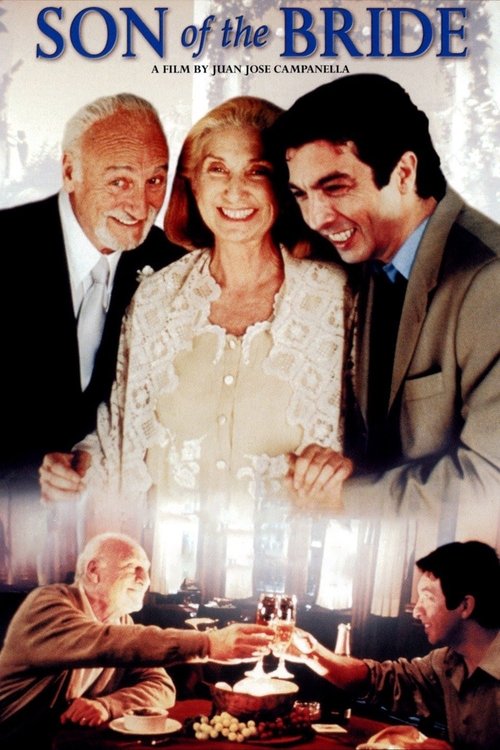
Son of the Bride
2001 · Juan José Campanella
For when you want to laugh and cry in the same evening — a comfort film about second chances that earns its emotion honestly. Reach for it after a hard week, or when family has been on your mind.
What it's about
Rafael Belvedere is 42 and running on fumes: he manages the Buenos Aires restaurant his father built, resents every minute of it, and is failing everyone who loves him — his aging mother, his ex-wife, his young daughter, his girlfriend. A minor heart attack stops him cold, and the reappearance of a childhood friend nudges him toward taking stock of his life. Woven through his crisis is a gentler story: his elderly father's wish to finally give his wife, now living with Alzheimer's, the church wedding she never had.
The experience
Warm and bittersweet in equal measure — it moves easily between restaurant-floor comedy and scenes that sneak up on you and put a lump in your throat. Unhurried, generous, and never cynical about its flawed hero.
Performances
Ricardo Darín is the whole engine here — funny, abrasive, and quietly wounded as a man realizing what he's neglected — while Norma Aleandro and Héctor Alterio give the parents' late-life love story its devastating tenderness.
The craft
Campanella directs with a sitcom veteran's timing and a novelist's patience, letting long dialogue scenes breathe and landing jokes and heartbreaks within the same beat. The bustling restaurant becomes a character in itself, and the film's balance of humor and grief is a masterclass in tonal control.
Why it matters
One of the defining Argentine popular successes of its era, earning an Oscar nomination for Best Foreign Language Film just as the country slid into economic crisis, and cementing the Campanella–Darín partnership that would later produce an Oscar winner.
Snapshot
El hijo de la novia is Juan José Campanella's warm, tear-and-laughter-balanced study of a middle-aged man in freefall, made at the exact moment Argentina itself was sliding into economic catastrophe. Rafael Belvedere (Ricardo Darín) runs the family restaurant his father built, resents it, neglects everyone he loves, and is jolted toward reckoning by a heart attack and the return of a childhood friend. Braided through his crisis is a second, gentler story: his father Nino's wish to give his wife Norma — now living inside Alzheimer's — the church wedding she never had. The film became one of the defining Argentine popular successes of its era and earned a nomination for the Academy Award for Best Foreign Language Film. It stands as the middle panel of the Campanella–Darín collaboration that would culminate, eight years later, in the Oscar-winning El secreto de sus ojos.
Industry & production
The film was produced within Argentina's commercial-auteur sector, a space Campanella had been cultivating with his screenwriting partner Fernando Castets across their previous feature, El mismo amor, la misma lluvia (1999), which had already paired Darín and Eduardo Blanco. El hijo de la novia was an Argentine–Spanish co-production, a structure typical of higher-budget Latin American films of the period that sought Ibero-American theatrical reach and Spanish television/finance participation (Patagonik Film Group and Spanish partners including Tornasol are associated with the production; readers should treat the precise financing breakdown as a matter for the production records rather than firm public knowledge).
The timing is inseparable from the film's meaning and its reception. It opened in 2001 as Argentina hurtled toward the December financial collapse — the corralito, the freezing of bank accounts, the presidential turnover. A story about a man who cannot keep his father's business afloat, who is tempted to sell out to a faceless corporate buyer, landed as something close to national allegory, and audiences responded in large numbers. It became one of the most successful domestic films of its year at the Argentine box office. I would not assign a specific gross figure here without the exhibition data in front of me, but its status as a major popular hit is well established. Internationally it traveled the festival and art-house circuit and secured the country a slot among the year's five Oscar nominees for Best Foreign Language Film, losing to Bosnia's No Man's Land.
Technology
This is a film shot and finished on conventional 35mm photochemical technology, well within the mainstream toolkit of 2001; there is no evidence of the film pursuing formal novelty at the level of capture or post-production. Its technological interest lies less in apparatus than in craft lineage: Campanella had spent the 1990s directing episodic American television, and the film benefits from the efficient, coverage-secure, performance-first shooting discipline that television demands. The result is a polished, unfussy image and a clean, legible cut — a "well-made" film in the classical sense rather than a technically experimental one. Where the specific laboratory, stock, and finishing details are concerned, the public record is thin, and I will not invent them.
Technique
Cinematography
The photography (by Daniel Shulman) serves the drama rather than announcing itself. The register is naturalistic and warm, favoring the crowded, amber interiors of the family restaurant and domestic spaces over any pictorial grandstanding. The camera stays close to faces, trusting the actors, and reserves its more overtly emotional gestures — a held look, a softening of light around Norma — for the film's melodramatic turns. This is a house style built for empathy and clarity, consistent with Campanella's television-honed instinct to keep the viewer oriented and inside the characters' emotional weather. Detailed shot-by-shot analysis of Shulman's scheme is sparse in the critical literature, so specific claims about lens choices or lighting setups should be treated as observation rather than documented fact.
Editing
Cut by Camilo Antolini, the film's editing manages a genuinely difficult tonal problem: it must move between broad comedy, romantic subplot, business-crisis thriller beats, and the near-sacred material of a mother's dementia, without whiplash. The solution is a fluid, rhythm-driven assembly that lets scenes breathe to their emotional conclusion, then pivots on a line or a look. Campanella's TV background shows in the confident scene economy and the willingness to sustain long dialogue exchanges when a performance is carrying them. The interweaving of Rafael's plot with the wedding plot is the editorial spine of the film, and its success is largely a matter of pacing the two so that each lends the other weight.
Mise-en-scène / staging
The restaurant is the film's central set and its governing metaphor — a place of inherited labor, family history, and imminent loss, staged as a warm, cluttered, working space. Domestic interiors and the eventual church furnish the other key locations. Staging is actor-forward: Campanella arranges his ensemble for the maximum legibility of relationship, letting physical proximity and its absence carry the theme of a man who has emotionally left the room he is standing in. The film's Buenos Aires is specific but unglamorized, a middle-class world of obligations rather than a tourist's city.
Sound
Ángel Illarramendi's score is one of the film's most identifiable elements — melodic, restrained, and elegiac, deployed to underline the emotional throughlines (the parents' love story, Rafael's slow thaw) without swamping the comedy. The Basque composer's music leans on a wistful main theme that recurs as an emotional anchor. Otherwise the soundtrack is naturalistic, rooted in the ambient life of restaurant and home and in the texture of porteño speech, which is itself central to the film's humor and authenticity.
Performance
Performance is where the film's reputation genuinely rests. Ricardo Darín's Rafael is the anchor: a study in charm curdling into evasion, self-pity held just this side of sympathy, and a late, hard-won opening of the heart. The role helped consolidate Darín as the defining Argentine screen actor of his generation. Héctor Alterio, as the father Nino, gives the film its moral center — his devotion to his wife, and his plan to marry her again, supplies the title and the emotional climax. Norma Aleandro, one of the towering figures of Argentine cinema (The Official Story), plays Norma's dementia with tenderness and without condescension, refusing easy pathos. Eduardo Blanco as the returning friend Juan Carlos provides comic energy and the catalytic warmth that pulls Rafael back toward life, and Natalia Verbeke as the girlfriend Naty grounds the romantic subplot. The ensemble's chemistry — several of them repeat collaborators with Campanella — is the film's real special effect.
Narrative & dramatic mode
The film operates in the mode of the domestic tragicomedy, or dramedy: a realist family story that earns laughter and tears from the same material. Structurally it is a redemption arc built on a midlife crisis, in which an external shock (the heart attack) forces an internal reckoning. Campanella and Castets braid two engines — Rafael's personal and professional collapse, and Nino's quest to remarry Norma — so that the older couple's fidelity indicts and eventually redeems the son's evasions. The dramaturgy is classical and cause-and-effect clean, with clearly seeded payoffs, and it is unashamed of sentiment; the film courts melodrama deliberately and trusts its performances to keep the sentiment honest. Notably, the film has been described as drawing on personal and real-life inspiration around the idea of a church wedding for a wife with Alzheimer's — a grounding I would attribute to Campanella's own account rather than assert as independently verified detail.
Genre & cycle
Formally it sits at the intersection of comedy, drama, and romance, but its truest category is the mainstream Argentine crowd-pleaser with auteur ambitions — the accessible, emotionally direct, star-driven feature that revitalized domestic commercial cinema at the turn of the millennium. It belongs to a Campanella–Castets cycle of humane, nostalgia-inflected relationship films: preceded by El mismo amor, la misma lluvia (1999) and followed by Luna de Avellaneda (2004), works that share a preoccupation with memory, decline, loyalty, and the Argentine everyman. Against the grittier, more austere films of the concurrent New Argentine Cinema (see below), it represents the popular, feeling-forward alternative.
Authorship & method
Campanella is the film's clear author, but his method is collaborative and consistent across projects. The screenplay is co-written with Fernando Castets, his long-running writing partner, whose contribution to the film's structural braiding and dialogue is central. The cinematography is by Daniel Shulman, the score by the Basque composer Ángel Illarramendi, and the editing by Camilo Antolini — a craft team assembled to serve a performance-and-story-first sensibility. The other half of Campanella's authorship is his repertory company of actors: Darín, Blanco, and others recur across his films, and the trust visible on screen is the product of repeated collaboration. Campanella's formation is distinctive: an Argentine who built a substantial career directing American network television (episodes of series such as Law & Order and, later, House), he brought back to Argentine features a Hollywood-classical command of pacing, clarity, and emotional delivery. That hybrid — porteño material, North American craft discipline — is his signature.
Movement / national cinema
The film emerges from a striking moment in Argentine cinema. The late 1990s and early 2000s saw the rise of the New Argentine Cinema (Nuevo Cine Argentino) — Pablo Trapero, Lucrecia Martel, Adrián Caetano and others — a movement of low-budget, observational, often bleak realism enabled in part by the 1994 cinema law and new film-school talent. Campanella is not properly of that movement; he represents the parallel commercial-auteur tradition, closer to a classical popular cinema. Yet El hijo de la novia is unmistakably a national film, saturated in Buenos Aires middle-class life, porteño idiom, and the specific pressures of the country's economic crisis. Together, the art-cinema and the popular-cinema strands gave Argentine film unusual international visibility in these years, and Campanella's Oscar nominations (here, and the win for El secreto de sus ojos) were a major part of that global profile.
Era / period
Nothing dates and deepens the film more than its 2001 release. It arrived as Argentina's convertibility economy disintegrated; its plot about a small family business squeezed toward sale to a corporate buyer, and a middle-aged man who has lost his sense of what is worth keeping, read directly onto a country losing its savings and its footing. The film's nostalgia — for a mother's memory, a father's constancy, an older, more human way of doing business — is inseparable from a national mood of loss and the desire to hold onto what corporate modernity was erasing. It is very much a film of the crisis, even when it never names it directly.
Themes
The governing themes are memory and its erasure (Norma's Alzheimer's as literal and metaphor), fidelity versus evasion (the parents' lifelong love against the son's chronic absence), inheritance and identity (Rafael living "in the shadow of his father," unsure whether to preserve or sell the family legacy), and the reawakening to one's own life through mortality and friendship. Beneath these runs a meditation on what is worth committing to — a spouse, a child, a business, a past — in a culture and economy pushing toward disposability. The church wedding that gives the film its title crystallizes all of this: a public, sacramental act of remembrance staged precisely because the person it honors can no longer remember it herself.
Reception, canon & influence
Critically and popularly, the film was warmly received. Domestic audiences turned it into one of the signal Argentine hits of its year, and international critics generally praised its emotional generosity and its ensemble, with Darín, Alterio, and Aleandro singled out — while some noted the film's willingness to press its sentimental buttons. Its most durable external marker is the Academy Award nomination for Best Foreign Language Film (for 2001, awarded in 2002), where it represented Argentina among the five finalists. It gathered further honors on the Ibero-American circuit; readers should consult the awards record for the precise slate, which I will not reconstruct from memory.
Influences on the film (backward): it draws on the classical family melodrama and tragicomedy traditions, on the humane bourgeois-crisis dramas of European and Hollywood cinema, and, closer to home, on Campanella's own prior feature with Castets, Darín, and Blanco. Aleandro's presence links it to the prestige lineage of 1980s Argentine cinema (The Official Story). The film has also been discussed as rooted in real-life inspiration around the remarriage premise, per Campanella's own accounts.
Legacy (forward): the film's largest consequence was the consolidation of the Campanella–Darín partnership and of a viable model of emotionally direct, well-crafted popular Argentine cinema that could travel abroad. That trajectory led, via Luna de Avellaneda (2004), to El secreto de sus ojos (2009), which won the Best Foreign Language Film Oscar — a peak that El hijo de la novia had set up both institutionally (Argentina as a repeat Oscar contender) and artistically (the director's mature blend of genre pleasure and feeling). Darín's subsequent standing as the face of Argentine cinema, and the international appetite for accessible Argentine drama in the 2000s, both owe something to this film's success. It remains a touchstone of turn-of-the-millennium Argentine popular cinema and a reliably cited example of how a national film can turn private grief into collective feeling at exactly the moment a country needs it.
Reception
A massive box-office hit in Argentina in 2001 — landing right as the country's economy was collapsing, which made its warmth feel almost medicinal — it rode that wave to a Best Foreign Language Film Oscar nomination; today it reads as the cozy first act of the Campanella–Darín partnership that peaked with The Secret in Their Eyes.
How Son of the Bride was received, from release to now →
How to watch Son of the Bride: what to notice on a first viewing
- Watch how warm and cluttered the restaurant interiors are. Shulman shoots the family restaurant in amber, crowded compositions, favoring lived-in warmth over any postcard version of Buenos Aires. The restaurant is staged as inherited labor and imminent loss before a word of dialogue says so.
- Watch how Rafael's charm slides into avoidance. Darín plays him as a man who's pleasant company and still absent, using charisma to dodge the people who need him. The performance holds you on his side even while showing you exactly how he's failing everyone.
- Notice how the film moves between Rafael's and his parents' story. Antolini's editing braids the two plots so a scene from one lends emotional weight to a scene from the other, rather than cutting between separate stories. Each plot is quietly there to indict or redeem the other, even before you notice the pattern.
- Listen for the same wistful melody returning. Illarramendi's main theme recurs across the film, tied specifically to the parents' love story and to Rafael's slow thaw. The music becomes a throughline connecting two people's decades-long marriage to their son's difficulty committing to anyone.
- Watch how Norma is played in her quieter moments. Aleandro plays her dementia without condescension or spectacle, finding tenderness in small, specific behavior rather than performing a symptom. The performance treats her as a person the film still takes seriously, not a plot device for pathos.
The whole guide to watching Son of the Bride, with the keys for a rewatch →
Influences: the films it descends from and the films it influenced
- The Official Story (1985) — Norma Aleandro's face-first, close-held performance of a woman undergoing a private reckoning is the exact register Campanella recruits for her dementia turn, importing the Argentine prestige tradition of routing national trauma through one household's kitchen-and-dinner-table intimacy.
- Wild Strawberries (1957) — Establishes the structural device Campanella reuses — an aging protagonist's mortality-driven life-review that braids present-day family friction with reconciliation, letting memory and its erasure organize the edit rather than plot.
- Terms of Endearment (1983) — The template for tonal braiding as a craft discipline: cutting between broad character comedy and terminal-illness melodrama within the same ensemble so laughter earns the grief, the mode Campanella and Castets structure their screenplay around.
- Hannah and Her Sisters (1986) — Models the bourgeois family-ensemble dramedy built on a trusted repertory cast and overlapping, naturalistic dialogue scenes staged in warm interiors — the performance-and-writing-first sensibility Campanella cites and rebuilds with his own stock company.
- It's a Wonderful Life (1946) — The classical-Hollywood engine behind Rafael's arc: an exhausted everyman's midlife collapse and redemption delivered with unashamed sentiment that is nonetheless earned through precise pacing — the Capra 'button-pressing done with craft' Campanella learned to control.
- Cinema Paradiso (1988) — Demonstrates the elegiac-score-plus-nostalgic-warm-interiors formula, using a swelling melodic theme over remembered spaces to convert one man's private memory into collective audience feeling — the emotional-delivery machine Illarramendi's score serves here.
- Avalon (1990) — A direct precedent for memory-and-erasure staged around the immigrant family meal, where the recurring dinner table and its dwindling gatherings become the formal measure of generational loss.
- The Same Love, the Same Rain (1999) — Campanella's immediately prior feature with Castets, Darín and Blanco, which set the working method — decades-spanning tragicomic romance anchored by Darín's rueful everyman and cross-cut between comic and melancholic registers — that this film refines.
- We All Loved Each Other So Much (1974) — The commedia all'italiana model of braiding farce with political-personal disillusionment across years, proving comedy and heartbreak can share one continuous tonal weave — the European tragicomic craft feeding Campanella's dramedy.
- Waiting for the Hearse (1985) — Carries forward Doria's warm-but-grotesque Argentine family register and its reliance on beloved comic ensemble performers.
- Martin (Hache) (1997) — Continues the Argentine adult mainstream of performance-driven, dialogue-rich father-and-family drama that privileges character and talk over incident.
- Luna de Avellaneda (2004) — Directly extends the institution-as-metaphor staging — a social club standing in for the restaurant — and the crisis-era ensemble of collective grief, made by the same Campanella–Castets–Darín team in the same emotionally direct register.
- El secreto de sus ojos (2009) — The mature payoff of this film's method: the same Campanella–Castets writing braiding, Darín anchor and Hollywood-classical command of pacing, now fused to genre machinery, carrying the blend of crowd pleasure and feeling to the Best Foreign Language Film Oscar.
- Chinese Take-Away (2011) — Inherits the Darín-anchored tragicomic crowd-pleaser mode — a closed-off man reopened through an unlikely surrogate family, played in Campanella's emotionally direct popular register with comedy shading into tenderness.
- Big Night (1996) — Independently develops the restaurant-as-metaphor staging, letting the kitchen and dining room externalize a family's dreams, debts and fractures so that the fate of the business reads as the fate of the men running it.
- Nine Queens (2000) — The other 2000–01 crisis-era Argentine crowd-pleaser built on Ricardo Darín's anchoring presence and tightly engineered, exportable genre construction, sharing the model of well-crafted popular porteño cinema made to travel abroad.
- Wild Tales (2014) — Carries forward the exportable commercial-auteur Argentine cinema this film helped make viable — polished, genre-savvy, Oscar-contending popular filmmaking drawing on the Darín-era star system as the face of national cinema abroad.
- Away from Her (2006) — Extends the compassionate, performance-first portrait of dementia inside a long marriage that Aleandro pioneers here, staging memory loss through restrained close performance and a partner's devotion rather than clinical spectacle.
Similar films
- The Secret in Their Eyes (2009) — influence & lineage
- Wild Tales (2014) — influence & lineage
- Cinema Paradiso (1988) — influence & lineage
- Nine Queens (2000) — influence & lineage
- Big Night (1996) — influence & lineage
- Waiting for the Hearse (1985) — shared sensibility
- Martin (Hache) (1997) — shared sensibility
- Talk to Her (2002) — shared sensibility