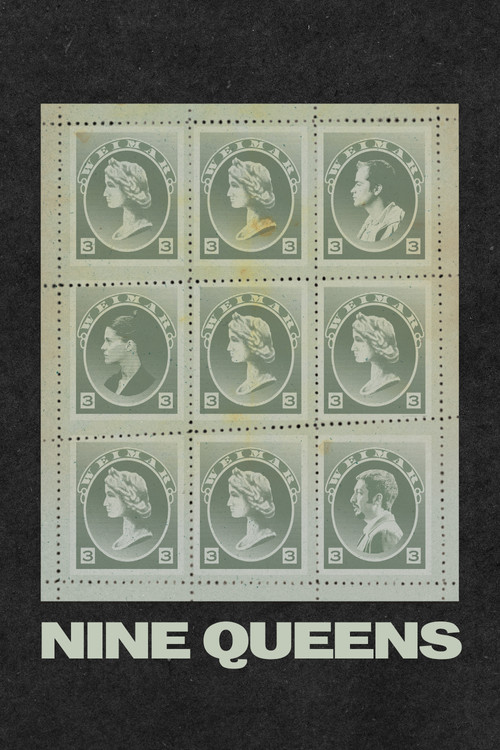
Nine Queens
2000 · Fabián Bielinsky
For when you want to feel clever — a puzzle-box night where you're actively trying to out-think the movie. Pure pleasure viewing with a sharp brain-teaser edge; zero heaviness required.
What it's about
Two Buenos Aires con men — one seasoned and cynical, one younger and seemingly greener — cross paths by chance and team up for the score of a lifetime: selling a sheet of forged rare stamps, the 'nine queens,' to a wealthy collector before the day is out. What follows is a single frantic day of hustles, negotiations, and shifting loyalties in a city where absolutely everyone seems to be running some kind of angle.
The experience
Watching it is like being pickpocketed by an expert — brisk, playful, and quietly sneaky, with a constant low hum of 'wait, who's playing whom?' It keeps you leaning forward, mentally auditing every handshake, and pays off your suspicion in the most satisfying way.
Performances
Ricardo Darín is magnetic as the veteran grifter Marcos — all charm, impatience, and moral rot — and Gastón Pauls's apparent softness as Juan is exactly the counterweight the film needs; the whole movie runs on the friction between them.
The craft
A debut screenplay of watchmaker precision: every throwaway detail earns its keep, and the plotting clicks together without ever feeling mechanical. Director Fabián Bielinsky shoots the streets, hotels, and lobbies of Buenos Aires like a working ecosystem of scams, keeping the camera nimble and the pace tight. It's a film built on dialogue and structure rather than spectacle — great with subtitles and full attention.
Why it matters
A landmark commercial and critical success of Argentine cinema at the turn of the millennium, it announced Bielinsky as a major storyteller, made Ricardo Darín an international face, and inspired an American remake. It remains a touchstone whenever people talk about the perfect con movie.
Snapshot
Nueve reinas is a Buenos Aires con-artist thriller that folds a small-time swindle into a long con whose true architecture is withheld until the final minutes. Two grifters — the seasoned, cynical Marcos (Ricardo Darín) and the younger, seemingly softer Juan (Gastón Pauls) — meet by chance and spend roughly a single day chasing a windfall: the chance to sell a sheet of rare forged stamps, the titular "nine queens," to a wealthy collector. The film is at once a tightly geared genre machine and a portrait of a society in which everyone is running an angle. It was the debut feature of Fabián Bielinsky, a longtime assistant director who arrived fully formed as a storyteller, and it became one of the signal commercial and critical successes of the Argentine cinema of its moment. Its reputation rests on the elegance of its plotting and a closing reversal that reframes everything preceding it — a twist that also, almost accidentally, caught the country on the eve of financial collapse.
Industry & production
The film's origin is unusually well documented on one point: the screenplay won a script competition organized by the Argentine production company Patagonik Film Group, which gave Bielinsky — then in his forties and known chiefly as an assistant director on advertising and features — the opportunity to direct his own script. Patagonik was among the more industrially robust production entities in Argentina at the turn of the millennium, a partnership structure linking local production with larger media and distribution interests, and it positioned Nueve reinas as a piece of accessible, well-crafted commercial cinema rather than an austere art-house work.
That commercial framing matters. Argentine cinema around 2000 was being renewed on two fronts: a critically celebrated wave of naturalist, low-budget auteur films, and a parallel effort by more capitalized producers to make polished genre pictures that could hold their own against Hollywood imports domestically. Nueve reinas belongs to the second stream while sharing personnel sensibilities with the first. It became a substantial domestic hit and traveled widely on the festival and specialty-distribution circuit abroad. I will not cite specific box-office figures, as I cannot verify them, but the qualitative record is clear that it was among the most successful Argentine releases of its year and a breakout for its makers.
Technology
Nueve reinas was produced on 35mm film in the conventional workflow of its era, before digital acquisition had displaced celluloid for mid-budget features. There is nothing in the film that foregrounds technological novelty; its craft is deliberately transparent. The picture relies on real Buenos Aires locations — streets, cafés, a hotel, a currency exchange — and available or lightly augmented light rather than elaborate built sets or effects. If anything, the "technology" of the film is dramaturgical and analog: the plot turns on the material culture of philately (the stamp sheet, its forgery, the loupe-and-tweezers scrutiny of an expert) and on cash, telephones, and face-to-face verbal manipulation. That analog texture is not incidental — the con depends on physical objects and physical presence, and the film's suspense is built from tangible things changing hands.
Technique
Cinematography
The photography, credited to Marcelo Camorino, favors an observational, unshowy realism appropriate to a film that must keep the audience watching hands, faces, and objects. The camera tends to stay close to the two protagonists as they move through the city, using handheld and mobile framing to sustain a documentary immediacy and to keep the viewer inside their transactional present tense. The palette is naturalistic and urban — daylight interiors, glass, concrete, the flat light of offices and lobbies. Crucially, the visual style is engineered to conceal rather than reveal: the camera shows us what the grifters want us to see and withholds the wider frame that would expose the machinery of the con. The restraint is the point; a more expressive or ostentatious style would tip the film's hand.
Editing
The cutting (edited by Sergio Zóttola) is the film's most quietly virtuosic element, because a con narrative is finally an information-management problem solved in the edit as much as the script. The film parcels out its reveals with precise timing, sustaining forward momentum across a nearly real-time day while planting details whose significance only registers retroactively. The closing sequence depends on the editor's discipline: the reversal lands because earlier moments were cut to read one way in the moment and another way in memory. The rhythm is brisk without being frantic, matching the patter of two talkers always improvising the next move.
Mise-en-scène / staging
Bielinsky stages the film as a series of transactions in public and semi-public Buenos Aires spaces — sidewalks, a diner, a hotel lobby and rooms, an exchange house. The staging exploits the choreography of the con: who stands where, who is watching whom, which exits are available, how a mark is steered. Bystanders and incidental figures are deployed so that the audience cannot easily tell accomplices from strangers, which is the whole ethical and formal wager of the movie. The city itself is staged as a landscape of grift, a place where a scam is unfolding in every doorway.
Sound
The score is credited to César Lerner and is used sparingly, in keeping with the film's realist surface; the dominant sonic texture is dialogue and the ambient noise of the city. This is a talk-driven picture, and the sound design privileges the verbal duel — pitches, lies, negotiations, the con's constant patter — over musical underlining. I will not overstate specific mixing choices I cannot verify, but the general approach is one of restraint that keeps attention on speech and on the small diegetic sounds of objects and money.
Performance
Performance is the film's engine. Ricardo Darín, as Marcos, gives the role a weary, predatory charisma — a man whose fluency in deception has hollowed out his relationships, including with his estranged siblings. The part helped cement Darín's stature as the preeminent Argentine screen actor of his generation. Gastón Pauls, as Juan, plays the counterweight: apparently more scrupulous, more sympathetic, a seeming innocent in the older man's orbit. The two performances are calibrated so that the audience's sympathies and suspicions are continually adjusted, and the film's final effect is inseparable from what the actors let us believe about their characters' interior lives.
Narrative & dramatic mode
The film's dramatic mode is the con or "long con" narrative, a form in which the audience is itself a mark. Its pleasures are those of dramatic irony and its inversion: we believe we are ahead of the marks on screen, only to discover the film has been managing our understanding all along. Structurally it compresses to roughly a day and a single escalating scheme, giving it the propulsion of a ticking-clock thriller. Beneath the mechanics runs a more melancholy register — a study of trust and its impossibility, and of a fraternal relationship poisoned by a life of lying. The ending's reversal is not merely a gotcha; it recasts the film's emotional stakes, revealing that what looked like exploitation was, from another angle, something closer to a reckoning. The two-hander design keeps the drama intimate even as the plot widens.
Genre & cycle
Nueve reinas sits in the con-artist / caper tradition, a lineage that runs through American and European cinema and rewards the twist as a structural convention. Within Argentine and Latin American filmmaking it stands out as a confident, export-ready genre picture at a time when the region's most-lauded films were more often naturalist dramas. It participates in a small international cycle of turn-of-the-millennium grifter movies preoccupied with deception as both plot and metaphor. Its genre confidence — clean premise, escalating stakes, decisive reversal — is precisely what let it cross borders where more locally specific films did not.
Authorship & method
Fabián Bielinsky is the film's clear author, and Nueve reinas is a rare case of a debut that already displays complete command of tone, pace, and structure — the fruit of a long apprenticeship as an assistant director rather than of prodigy. He wrote as well as directed, and the screenplay's architecture (its concealed information, its retrospective logic) is the film's foundation. His method, as it reads on screen, is one of control and misdirection practiced without visible strain: the style is legible and unfussy so that the sleight of hand can work.
His key collaborators include cinematographer Marcelo Camorino, editor Sergio Zóttola, and composer César Lerner, each working in a register of realist restraint. The most consequential collaboration, in terms of legacy, is with Ricardo Darín, whom Bielinsky would direct again in his only other feature. Bielinsky's authorship is defined, painfully, by its brevity: he completed just two features before his death, and Nueve reinas is the calling card on which his reputation was founded.
Movement / national cinema
The film belongs to the broad renewal often called Nuevo Cine Argentino (New Argentine Cinema), the flourishing of Argentine filmmaking from the mid-1990s onward, though it occupies a distinctive position within it. Where the movement's most canonized figures pursued observational naturalism and non-professional casts, Nueve reinas pursued genre polish and star performance. It demonstrated that the same national moment could produce internationally viable commercial cinema, and it did much to raise the profile of Argentine film abroad. Its success is frequently cited alongside the movement's arthouse triumphs as evidence of the period's range and vitality.
Era / period
The film is inseparable from its historical moment. Made and released as Argentina slid toward the catastrophic economic crisis that culminated in the 2001 default and the corralito — the freezing of bank accounts — it is threaded with a pervasive atmosphere of distrust, hustle, and institutional decay. Its plot literally hinges on a bank, and its ending has often been read as eerily prescient of the financial collapse that would soon freeze ordinary Argentines out of their own money. Whether or not one reads that resonance as intended, the film captures a society in which scamming has become an ambient condition, and that period texture is a large part of its enduring power.
Themes
The film's governing theme is trust as a scarce, exploitable commodity. Every relationship is potentially a transaction; every kindness is potentially a setup. Around that core it develops a set of linked concerns: fraternity and betrayal (Marcos's ruptured family stands behind the plot's resolution); the moral economy of a corrupt society, where fraud scales from petty street cons up to institutions; performance and identity, since the grifters are always acting and the film asks how one ever knows another person's true face; and complicity, extended to the audience, who are made accomplices to the deception and then confronted with it. The nine queens themselves — counterfeit objects passed off as priceless originals — are the film's central metaphor: value, like trust, is a matter of belief, and belief can be manufactured.
Reception, canon & influence
Critically, Nueve reinas was widely praised on release and remains one of the most admired Argentine films of its era, singled out for the ingenuity of its screenplay, the strength of its lead performances, and Bielinsky's assured direction. It accumulated significant recognition within Argentina and traveled successfully on the international specialty circuit; it is routinely included in surveys of important Argentine cinema. (I am flagging that I cannot verify a precise awards ledger or grosses here, and so decline to enumerate them.)
Its influences run backward to the classical con-artist and caper film — the tradition of the twist-driven grift narrative in world cinema — and to the talk-driven, character-forward thriller. Its forward legacy is threefold. First, it consolidated Ricardo Darín's position as Argentina's leading man and helped open international attention to Argentine genre cinema. Second, it was remade by Hollywood as Criminal (2004), directed by Gregory Jacobs and produced under the Steven Soderbergh–George Clooney banner, with the action transposed to Los Angeles — a clear index of the original's exportable design. Third, and most poignantly, it established Fabián Bielinsky as a major directorial talent whose career was cut short; he made only one further feature, El Aura (2005), again with Darín, before his death in 2006. Nueve reinas thus stands as both a self-contained masterwork of construction and the opening statement of an authorship that history did not allow to complete.
Reception
A sleeper smash in Argentina in 2000, it went global just as the country's economy imploded — and it's since been reappraised as the accidental prophecy of that 2001 collapse, plus the launchpad of Ricardo Darín's international stardom and the New Argentine Cinema boom.
How Nine Queens was received, from release to now →
How to watch Nine Queens: what to notice on a first viewing
- Watch what the camera chooses not to show you. Camorino's handheld camera stays close on hands, faces, and objects as the two men move through the city, but it never widens enough to expose the whole transaction at once. The frame withholds exactly what the grifters would want you not to see.
- Notice who is standing close enough to hear. Bielinsky stages every deal in public spaces, a sidewalk, a diner, a hotel lobby, with bystanders always within earshot. Someone is always watching, so you keep checking the edges of the frame.
- Watch how each man's hands move when he lies. Darín plays Marcos with a weary, predatory ease; Pauls plays Juan as the more scrupulous, more nervous of the two. The film keeps recalibrating which man you trust. Your sympathies are being managed as carefully as any mark's inside the story.
- Listen for how rarely music tells you what to feel. César Lerner's score stays sparse. The dominant sound is dialogue itself, pitches, lies, and negotiation, the con's constant patter carrying the film instead of a soundtrack. Without music cueing you, every line is a claim you have to judge on your own.
- Track the stamp sheet as it changes hands. The nine queens, cash, and telephones move constantly between characters, examined with loupes and tweezers, tactile objects that carry the plot's value from person to person. Follow the object and you follow the deal better than the dialogue alone tells you.
The whole guide to watching Nine Queens, with the keys for a rewatch →
Influences: the films it descends from and the films it influenced
- The Sting (1973) — Supplies the long-con blueprint in which the mechanics are choreographed as spectacle and a final reversal reveals the whole operation was a staged performance run on a mark who—like the audience—never saw the frame.
- House of Games (1987) — Models the con as dialogue-driven verbal performance in near-real-time, with a seasoned grifter tutoring a novice, ending on a reversal that exposes the apparent apprentice/observer as the true mark.
- The Spanish Prisoner (1997) — Perfects the concealing frame that withholds the operation's real architecture—every helpful stranger is placed, every reassurance is bait—until a closing reveal recodes prior scenes as retrospective misdirection.
- Paper Moon (1973) — Establishes the two-hander grifter partnership in which the con technique itself—the short cons, the pigeon drop—is the film's primary staged action rather than a backdrop.
- Pickpocket (1959) — Origin of the observational, tactile documentation of theft's mechanics through tight framing on hands and sleight, the concealing-frame grammar that shows just enough of the technique to make the grift legible and hidden at once.
- The Grifters (1990) — Builds the professional-con milieu around familial betrayal and trust-as-commodity, where intimacy is another mark to be worked and loyalty is priced into the play.
- Sleuth (1972) — The two-hander of escalating one-upmanship played nearly in real time, each reversal re-casting which man is running whom—the gamesmanship structure Bielinsky compresses into Marcos and Juan.
- Criminal (2004) — Direct English-language remake transposing Bielinsky's screenplay architecture—its concealed information and retrospective logic—to Los Angeles, an index of the original's exportable design.
- El Aura (2005) — Bielinsky's own follow-up with Darín, carrying his method of meticulous pre-visualized planning and unfussy observational realism from the grift into the heist form.
- El secreto de sus ojos (2009) — Argentine genre thriller built on retrospective-reveal editing and Darín's everyman-in-over-his-head persona, extending the internationally exportable Nuevo Cine Argentino genre film that Nine Queens opened.
- Focus (2015) — Con-choreography of nested grifts anchored by a mentor-pupil two-hander, with a reveal that the mark's manipulation was pre-planned steps ahead—Nine Queens' final-reversal logic scaled up.
- American Hustle (2013) — Performance-forward con ensemble where the grift is sustained through improvisatory, dialogue-driven two-handers and a closing reversal that reveals loyalties were the real long con.
- Pizza, birra, faso (1998) — Founding text of Nuevo Cine Argentino whose handheld, street-level observational realism and crisis-era naturalism Bielinsky grafts onto a tightly plotted genre machine.
- Ocean's Eleven (2001) — Shares the retrospective-reveal edit that replays the heist to show the con the audience was never shown in real time; the Soderbergh–Clooney banner would go on to produce Nine Queens' remake.
- Confidence (2003) — Extends the nested long-con with a framing device and a terminal reversal that reclassifies who commissioned the grift, in the Mamet-descended talk-and-play register.
- Matchstick Men (2003) — The mentor-apprentice con two-hander whose final reversal turns the veteran grifter into the mark—the very inversion Nine Queens delivers on its expert protagonist.
- On Probation (2005) — The flagship of Argentina's 2000s genre revival, proving domestic audiences would embrace tightly-engineered American-style crime mechanics staged in local settings.
- Wild Tales (2014) — Shares New Argentine Cinema's tightly-machined genre plotting anchored by Ricardo Darín's naturalism, proving Argentine cinema could build precision-engineered crowd-pleasers with a sting.
- Son of the Bride (2001) — The other 2000–01 crisis-era Argentine crowd-pleaser built on Ricardo Darín's anchoring presence and tightly engineered, exportable genre construction, sharing the model of well-crafted popular porteño cinema made to travel abroad.
Similar films
- The Sting (1973) — influence & lineage
- The Secret in Their Eyes (2009) — influence & lineage
- House of Games (1987) — influence & lineage
- The Grifters (1990) — influence & lineage
- Son of the Bride (2001) — shared sensibility
- GoodFellas (1990) — shared sensibility
- Revanche (2008) — shared sensibility
- Casino (1995) — shared sensibility