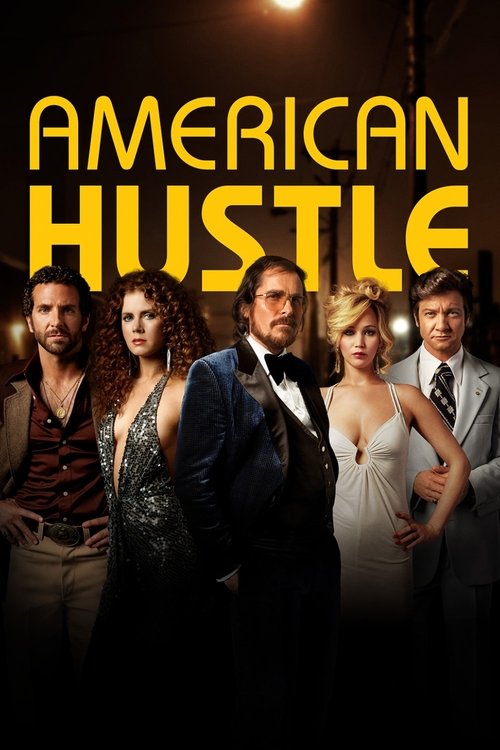
American Hustle
2013 · David O. Russell
For when you want glamour, laughs, and great actors bouncing off each other — dressed-up entertainment that's smart without ever feeling like work.
What it's about
A paunchy, comb-over con man and his sharp, seductive partner get caught by an ambitious FBI agent who forces them into a sting on New Jersey power brokers — a scheme involving a fake sheikh, a decent-hearted mayor, and eventually the Mafia. Loosely spun from the real ABSCAM scandal of the late 1970s, it opens with the wink 'Some of this actually happened.'
The experience
Loose, funny, and a little chaotic by design — a movie that cares more about hair, costumes, and people reinventing themselves than about the mechanics of the con. It plays like a party where everyone's lying and half of them believe their own lies.
Performances
Christian Bale disappears into a bloated, oddly tender con artist; Amy Adams plays a woman running so many personas even she loses count; Jennifer Lawrence steals scenes as a loose-cannon wife; and Bradley Cooper spins into permed, coked-up ambition. It's an ensemble showcase, top to bottom.
The craft
David O. Russell shoots it fast and loose, letting improvisation, swirling camera moves, and a wall-to-wall 70s soundtrack set the rhythm, while the costume and hair design do real storytelling — every perm and plunging neckline is a character choice.
Why it matters
An awards-season juggernaut of 2013 that crystallized Russell's actor-first, controlled-chaos style and helped set the template for the starry, needle-drop period caper.
Snapshot
American Hustle is David O. Russell's exuberant, deliberately disheveled period crime comedy, a fictionalized riff on the FBI's late-1970s ABSCAM sting that snared members of Congress and local New Jersey officials through a fake Arab sheikh and a network of con artists. The film opens with a now-famous title card — "Some of this actually happened" — that announces its loose relationship to fact and its primary subject: the artistry of the con, the survival economics of self-invention, and the porous line between hustling and aspiration. Built around a four-hander of Christian Bale, Amy Adams, Bradley Cooper, and Jennifer Lawrence (with Jeremy Renner as a tragically decent mayor), it is less a procedural than a character carnival, prizing performance, costume, hair, and needle-drop over plot mechanics. Released at the end of 2013, it became a major awards-season presence — nominated across all four acting categories and for Best Picture and Best Director — and stands as the third panel in Russell's loose comeback trilogy with The Fighter (2010) and Silver Linings Playbook (2012).
Industry & production
The project originated as a spec screenplay by Eric Warren Singer titled American Bullshit, which dramatized the ABSCAM operation and the figure of con man Mel Weinberg. It circulated in development before Russell came aboard, rewrote it substantially, and reframed it around his own preoccupations with reinvention, family, and damaged people improvising their way forward. The renamed American Hustle became the screenplay of record, credited to Singer and Russell.
The film was produced by Megan Ellison's Annapurna Pictures — then in its ascendant phase as a backer of director-driven, prestige-adjacent work — together with Charles Roven's Atlas Entertainment and Russell's collaborators, and distributed by Columbia Pictures (Sony). It carried a mid-range budget by studio standards and went on to perform strongly at the box office, becoming one of Russell's most commercially successful films; precise grosses should be checked against trade records, but it was unambiguously a hit relative to its cost. Principal photography took place largely in and around Boston and Worcester, Massachusetts, with locations standing in for late-1970s New Jersey and New York — a practical choice tied to Massachusetts production incentives that Russell had used before.
The casting drew directly on Russell's recent ensemble: Bale and Adams from his orbit, Cooper and Lawrence reunited from Silver Linings Playbook, and Renner rounding out the principals, with Robert De Niro in an uncredited cameo as a Mafia financier. The production was notable for Bale's radical physical transformation — substantial weight gain, a comb-over hairpiece built up in an elaborate opening sequence — reflecting the actor's method tendencies and the film's foregrounding of artifice and disguise.
Technology
American Hustle was shot photochemically on 35mm film, consistent with cinematographer Linus Sandgren's preference for celluloid and the production's desire for authentic late-1970s grain, color, and halation. The choice is integral to the film's texture: film stock lends the wide lapels, sunburst lighting, and saturated browns and golds a period-appropriate softness that digital capture of the era tended to flatten. The film does not foreground any technological novelty in its making — its "technology" is largely the analog craft of period reconstruction. Diegetically, however, the plot turns on the era's surveillance hardware: reel-to-reel wiretaps, hidden recorders, and the FBI's then-novel videotaping of bribes, which the screenplay uses both as plot engine and as thematic mirror — everyone in the film is recording, performing for, or being captured by someone else's apparatus.
Technique
Cinematography
Sandgren's camerawork is restless and frankly Scorsese-derived: gliding push-ins, whip pans, snap zooms, and roving Steadicam that prowls through casinos, hotel rooms, and the gilded interiors of power-brokering. The lighting favors warm, practical-driven sources — table lamps, chandeliers, the amber glow of disco-era nightlife — and frequently throws lens flares and shafts of backlight through cigarette smoke. Sandgren and Russell use long, mobile takes that follow characters in motion to keep the actors loose and the energy combustible, and they punctuate the flow with sudden close-ups that isolate a glance, a hairpiece, a décolletage. The visual scheme is maximalist by design, matching the costume and production design's commitment to excess.
Editing
Cut by Jay Cassidy, Crispin Struthers, and Alan Baumgarten, the film moves with a propulsive, music-driven rhythm and leans heavily on overlapping, sometimes competing voiceovers from multiple characters — a structural conceit that fractures the narration so that no single hustler controls the story. The editing accommodates Russell's improvisational shooting by assembling performance from many takes and angles, prioritizing the most alive line readings over strict continuity. Montage sequences set to period songs compress exposition and tone, and the cutting frequently withholds and then reveals who is conning whom, sustaining the plot's shell-game uncertainty up to the final reversal.
Mise-en-scène / staging
This is the film's most celebrated dimension. Production designer Judy Becker and costume designer Michael Wilkinson construct a densely textured late-1970s world of velour, polyester, plunging necklines, perms, and comb-overs, where surface is character. Russell stages scenes to let costume and hair carry meaning: Irving's elaborate combover ritual that opens the film; Sydney's calculated wardrobe of sophistication; Rosalyn's lacquered domestic chaos; Richie's tight perm-in-progress. Interiors are layered with period bric-a-brac, and the staging favors crowded frames, overlapping bodies, and characters talking over one another. The mise-en-scène treats the late-'70s milieu not as nostalgia but as a thesis: an entire culture remaking itself through artifice.
Sound
The soundtrack is a curated jukebox of period and adjacent recordings — among them Duke Ellington, Electric Light Orchestra, Steely Dan, America's "A Horse with No Name," Donna Summer's "I Feel Love," Tom Jones's "Delilah," and Wings' "Live and Let Die," the last scoring Jennifer Lawrence's volatile lip-synced set piece. Danny Elfman's original score threads through and around these needle-drops. The sound design foregrounds dialogue overlap, ambient nightclub din, and the era's music as an almost continuous emotional commentary, in the Scorsese tradition where pop records function as narration. The result is a wall-of-sound aesthetic that matches the visual maximalism.
Performance
American Hustle is fundamentally an actor's film, and Russell's process — encouraging improvisation, rewriting on set, prizing spontaneity — is visible in every scene. Bale disappears into Irving Rosenfeld's paunch, comb-over, and wounded shrewdness; Adams's Sydney Prosser oscillates between a fabricated British aristocrat and a frightened Midwestern striver, often within a single shot; Cooper's Richie DiMaso is all manic ambition and curlers; and Lawrence's Rosalyn Rosenfeld steals scenes as a live-wire, self-justifying force of chaos. Renner grounds the ensemble with sincerity as Mayor Carmine Polito. The performances are pitched at a heightened, near-screwball register that is the film's signature mode and the engine of its acclaim.
Narrative & dramatic mode
The film operates as a con-artist caper crossed with a character-driven ensemble dramedy. Its dramatic mode is comic but with melancholic undertow: these are desperate people whose schemes are extensions of their need to be seen as more than they are. The plot is a nesting doll of double-crosses — Irving and Sydney coerced into working a sting that grows beyond the FBI's control — but Russell repeatedly subordinates plot clarity to emotional and behavioral texture. Multiple unreliable voiceovers, abrupt tonal shifts from farce to pathos, and a structure organized around set pieces rather than tight causality mark it as character-first storytelling. The recurring motif — "from the feet up," Irving's philosophy of the con — frames deception as empathy: knowing what people want to believe.
Genre & cycle
American Hustle sits at the intersection of the crime film, the period caper, and the dramedy. It belongs visibly to a post-Scorsese cycle of energetic, music-saturated, voiceover-driven crime pictures, and arrived in the same cultural moment as Scorsese's own The Wolf of Wall Street (also late 2013), with which it is frequently paired as a study in American greed, performance, and excess. It also extends a tradition of con-artist movies — The Sting, Dirty Rotten Scoundrels, Catch Me If You Can — while filtering the form through Russell's ensemble-comedy sensibility. Within Russell's own filmography it completes an informal cycle of redemption-through-family dramedies begun with The Fighter and Silver Linings Playbook, sharing actors, tonal volatility, and a fascination with reinvention.
Authorship & method
David O. Russell's authorship here is defined by a actor-centered, improvisational method: he is known for rewriting dialogue on the day, running long takes to keep performers off-balance and alive, and building scenes around behavioral spontaneity rather than locked blocking. The film bears his recurring signatures — chaotic families, characters reinventing themselves out of damage, tonal swings between comedy and raw feeling, and ensembles drawn from a recurring stock company. His key collaborators shape the result decisively: cinematographer Linus Sandgren, whose mobile, film-shot, flare-rich imagery defines the look; composer Danny Elfman, working alongside an extensive licensed soundtrack; the editing trio of Jay Cassidy, Crispin Struthers, and Alan Baumgarten, who translate Russell's coverage-heavy shooting into propulsive rhythm; co-writer Eric Warren Singer, whose ABSCAM-based spec gave the film its skeleton; and the design team of Judy Becker (production) and Michael Wilkinson (costume), whose period world is arguably the film's true author. Russell's method openly courts the risk of incoherence in exchange for vitality, and American Hustle is the fullest, most exuberant expression of that bargain.
Movement / national cinema
The film is a product of American studio-adjacent independent prestige cinema of the early 2010s — financed through Annapurna's auteur-friendly model and released by a major (Sony/Columbia) into the awards corridor. It does not belong to a formal movement, but it exemplifies a particular Hollywood tendency of its moment: mid-budget, star-ensemble, director-branded films aimed at adult audiences and the Oscar season, a category that was already contracting under the pressure of franchise economics. Its aesthetic lineage is thoroughly American, descending from the New Hollywood crime film and especially from Martin Scorsese's body of work.
Era / period
Set principally in 1978, the film reconstructs the late Carter-era American Northeast — a moment of disco, economic anxiety, urban decay, and the early televisual scrutiny of political corruption. The ABSCAM operation it fictionalizes unfolded across 1978–1980 and led to real convictions of a U.S. senator and several representatives, making the film a period piece about a genuine inflection point in public trust. Russell uses the era less for documentary fidelity than as a stylized landscape of striving and surface, where the period's fashions and music become expressions of a national appetite for self-reinvention. The film's "period" is therefore double: the late 1970s it depicts, and the early-2010s prestige moment in which it was made and received.
Themes
At its core the film concerns the American art of self-invention — the idea that identity is a performance, and that the line between the con artist and the legitimate striver is a matter of framing. Survival, reinvention, and the longing to be more than one's origins drive every principal. It is preoccupied with the ethics of deception: Irving's belief that the best cons give people the story they want, and the moral cost when the law itself becomes the most reckless hustler (Richie's ambition causes more damage than the criminals'). Class and aspiration run throughout — Sydney's invented aristocracy, Carmine's genuine civic idealism corrupted by good intentions. Marriage and family chaos, a Russell constant, anchor the comedy in real ache. And finally, the film meditates on artifice and surface — hair, clothes, accents, recordings — as both armor and truth.
Reception, canon & influence
American Hustle was warmly received by most critics on release, praised above all for its ensemble performances, costume and production design, and infectious energy, even as some reviewers faulted it for narrative looseness and for wearing its Scorsese influence on its sleeve. It became one of the season's central awards contenders, earning ten Academy Award nominations — including Best Picture, Best Director, Best Original Screenplay, and acting nominations in all four categories (Bale, Adams, Cooper, Lawrence) — a rare across-the-board acting sweep. It notably won none of those Oscars, a fact that became part of its legacy as the era's most-nominated film to go home empty-handed; it did, however, win Best Motion Picture — Musical or Comedy at the Golden Globes among other honors. (Exact award tallies should be verified against official records.)
Influences on the film (backward): Its most obvious debt is to Martin Scorsese — Goodfellas and Casino above all — for its multi-voice narration, period needle-drops, gliding camera, and morally ambiguous criminal milieu. It draws on the New Hollywood crime tradition and on the con-artist comedy lineage, and its specific events derive from the historical ABSCAM operation and the memoir-adjacent figure of Mel Weinberg as reworked in Singer's screenplay.
Legacy (forward): The film consolidated Russell's early-2010s position as a maker of awards-friendly ensemble dramedies and helped cement the careers of its younger leads, particularly extending the Cooper–Lawrence partnership. It is frequently cited as a high-water mark for 2010s costume and hair design and as a touchstone in discussions of the period's prestige con-artist and "American greed" cinema, often in dialogue with The Wolf of Wall Street. Its longer critical reputation is somewhat contested — admirers prize its vitality and performances, skeptics view it as stylish pastiche — but it remains a durable reference point for the actor-driven, music-saturated period crime film. The honest scholarly assessment is that its place in the canon is secure as a performance and design showcase, while its standing as a fully achieved narrative remains genuinely debated.
A Deleuzian reading
Start with the comb-over.
The full Deleuzian reading of American Hustle →
Reception
In 2013 it was an awards juggernaut — 10 Oscar nominations, Golden Globe wins, 'Russell's Goodfellas' buzz. A decade on it's become film Twitter's go-to example of the acclaimed-then-evaporated Oscar movie, the one people swear nobody has thought about since the ceremony.
How American Hustle was received, from release to now →
Influences: the films it descends from and the films it influenced
- Goodfellas (1990) — Supplies the template Russell copies wholesale: braided first-person voiceover handing narration between criminal partners, wall-to-wall period needle-drops cut to action, and a restlessly gliding camera through smoky rooms.
- Casino (1995) — Models the dual competing narrators and the obsessive period-costume/hair maximalism — coiffures and wide lapels treated as character information — that Wilkinson and Becker's design directly extends.
- Boogie Nights (1997) — Demonstrates the late-70s Scorsese-via-ensemble mode Russell adopts: roaming Steadicam through period interiors, jukebox scoring, and a damaged surrogate family of self-reinventing strivers.
- The Sting (1973) — Establishes the con-artist caper architecture — the long-game sting whose mechanics are withheld until a reveal — that Singer's ABSCAM screenplay reworks.
- Shampoo (1975) — A New Hollywood ensemble of overlapping, semi-improvised behavior set against a precise period-political backdrop, prioritizing actorly spontaneity over locked blocking exactly as Russell does.
- Nashville (1975) — Pioneers the crowded-frame, overlapping-dialogue ensemble where many characters talk at once and the camera roves — the behavioral chaos Russell chases with day-of rewrites and long takes.
- American Graffiti (1973) — Originates the wall-to-wall licensed-pop soundtrack as continuous period-evocation rather than score, the jukebox-as-narration device the film leans on.
- Dog Day Afternoon (1975) — Supplies the sweaty, improvisation-friendly 70s milieu of small-time hustlers and FBI stings, with performances built on Pacino-style behavioral risk over plot mechanics.
- The Fighter (2010) — Russell's own prior film establishes the recurring stock-company method, chaotic-family dynamics, and coverage-heavy shooting of behavioral spontaneity that American Hustle perfects.
- Catch Me If You Can (2002) — Period con-artist ensemble built on costume-as-deception and an FBI sting, extending the inverted procedural in which the impersonator and his pursuer become entangled.
- Nine Queens (2000) — Performance-forward con ensemble where the grift is sustained through improvisatory, dialogue-driven two-handers and a closing reversal that reveals loyalties were the real long con.
- American Made (2017) — Extends the model directly: a true-crime 70s/80s government-sting caper narrated by an unreliable hustler, scored with period pop and shot with restless flare-lit handheld energy.
- War Dogs (2016) — Explicitly apes the Goodfellas-via-Hustle formula — bro-narrator voiceover, freeze-frame chapter beats, needle-drop montages of fast money — as 2010s 'American greed' caper.
- I, Tonya (2017) — Inherits the unreliable-multi-narrator true-crime structure, fourth-wall-adjacent direct address, and meticulous late-70s/80s costume-and-hair tackiness as character, plus a needle-drop spine.
- American Honey (2016) — Carries forward the improvised-ensemble, non-locked-blocking American-striver film, building scenes from behavioral spontaneity and a continuous pop-music bed.
- Hustlers (2019) — A direct heir in the con-artist 'American greed' lineage: female grifters, period needle-drop montages of money and reinvention, and Scorsese-style narration framing the scam.
- Silver Linings Playbook (2012) — Immediate companion piece reusing the Cooper–Lawrence pairing and Russell's tonal swings between comedy and raw feeling, with the same off-balance long-take direction of actors.
- The Wolf of Wall Street (2013) — Released the same season as the era's other 'American greed' showcase, deploying the same Goodfellas toolkit — direct-address narration, propulsive needle-drop montage, amoral hustler energy.
- The Hangover (2009) — Source of Bradley Cooper's improvised-comic motor-mouth register that Russell weaponizes, sharing the manic ensemble-riffing performance culture.
- Pain & Gain (2013) — Parallel true-crime caper of self-inventing American hustlers told through competing unreliable voiceovers and saturated, period-pop-driven montage.
Similar films
- The Wolf of Wall Street (2013) — influence & lineage
- The Sting (1973) — influence & lineage
- The Fighter (2010) — influence & lineage
- Casino (1995) — influence & lineage
- GoodFellas (1990) — influence & lineage
- Dog Day Afternoon (1975) — influence & lineage
- Ocean's Thirteen (2007) — shared sensibility
- The Big Short (2015) — shared sensibility