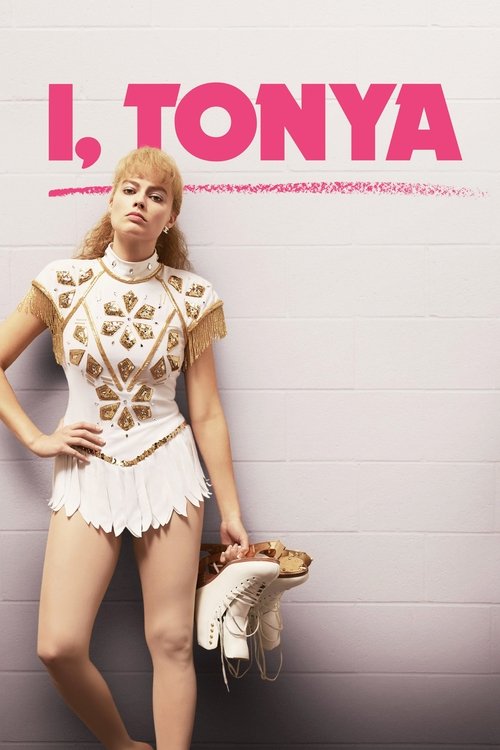
I, Tonya
2017 · Craig Gillespie
For when you want something loud, mean, and morbidly entertaining — a true-story binge with the energy of gossip and an aftertaste that makes you examine your own appetite for it. Not comfort viewing, but compulsive.
What it's about
The rise of figure skater Tonya Harding — a hard-luck, hard-driving athlete from the wrong side of the class line in a sport obsessed with polish — told through the wildly contradictory testimonies of the people who lived it. Her brutal mother, her volatile ex-husband, and Tonya herself all talk straight to camera, each selling their own version, as her career hurtles toward the tabloid 'incident' that made her infamous.
The experience
Fast, abrasive, and blackly funny — it plays domestic violence and slapstick idiocy in the same breath and dares you to figure out how you feel. You laugh, then catch yourself laughing, which is exactly the point.
Performances
Margot Robbie gives Tonya fury, need, and wounded pride all at once, and Allison Janney's LaVona — chain-smoking, parakeet on shoulder, love weaponized into abuse — won her an Academy Award. Together they make the mother-daughter scenes the film's live wire.
The craft
The mockumentary structure — competing direct-to-camera testimonies that openly contradict each other — turns an unreliable story into the film's whole engine. The skating sequences are shot with whip-fast, swirling camerawork that makes the triple axel feel genuinely dangerous, and a jukebox of 70s–80s rock keeps the pace at a sprint.
Why it matters
It reframed one of the 90s' biggest tabloid scandals as a story about class and abuse, kicked off a wave of sympathetic reappraisals of publicly shamed women, and turned Margot Robbie into a producer-star force.
Snapshot
I, Tonya is a biographical black comedy that reconstructs the life of figure skater Tonya Harding and the 1994 assault on her rival Nancy Kerrigan — the "incident," as the film's characters call it — that turned an Olympic sport into tabloid spectacle. Working from contradictory interviews its screenwriter conducted with the real Harding and her ex-husband Jeff Gillooly, the film refuses to adjudicate the truth. Instead it stages competing, self-serving testimonies as direct-to-camera mockumentary, lacing the result with class resentment, domestic violence, and slapstick incompetence. Margot Robbie's Harding and Allison Janney's monstrous stage-mother LaVona anchor a tonally aggressive picture that asks the audience to laugh, wince, and reconsider its own appetite for the story in roughly the same breath. The film's central achievement is formal: it converts the unreliability of memory into structure, and the cruelty of public ridicule into theme.
Industry & production
I, Tonya was an independently financed production, made on a reportedly modest budget in the low-to-mid eight figures, and shot largely in and around Atlanta, Georgia — a low-cost, tax-incentivized production hub standing in for the Pacific Northwest of Harding's biography. Margot Robbie produced through her company LuckyChap Entertainment, the venture she founded to develop female-driven material, making I, Tonya one of LuckyChap's defining early credits and a template for the kind of project (women at the center, prestige-adjacent, commercially shrewd) the company would continue to pursue.
The film premiered at the Toronto International Film Festival in September 2017, where it was acquired and ultimately released in the United States by Neon in partnership with 30West — an early, profile-raising title for Neon, then a young distributor building a reputation for sharp specialty pickups. The picture followed a platform-release pattern, opening in limited theaters in December 2017 to qualify for awards and expanding into early 2018. It earned a substantial multiple of its production cost theatrically, a strong result for a specialty title, though precise grosses should be treated as approximate here. Its commercial life was amplified by an awards campaign that paid off most decisively for Allison Janney, who swept the major supporting-actress prizes, including the Academy Award; Robbie received a Best Actress nomination and the film was also recognized for its editing.
Technology
The most consequential technical problem the production faced was credibility on the ice. Harding's signature feat — she was the first American woman to land a triple axel in competition — is among the hardest jumps in the sport, and no lead actor could be expected to perform it. The filmmakers solved this through a combination of practical skating doubles and extensive digital face replacement, compositing Robbie's performance onto the bodies of professional skaters for the most demanding rotations and using visual effects to extend, stabilize, and stitch together what could be shot live. The seams are deliberately minimized so that the camera can stay close and mobile during routines rather than cutting away at the moment of difficulty, preserving the illusion that we are watching Harding skate.
This is otherwise a technologically conventional contemporary production — digitally captured, finished in a standard color pipeline — and its inventiveness lies less in hardware than in the marriage of period-appropriate texture (the grain and palette of 1980s and early-'90s broadcast and home video) to a modern, restless shooting and cutting style.
Technique
Cinematography
Belgian cinematographer Nicolas Karakatsanis shoots I, Tonya with a roving, handheld-inflected energy that keeps pace with the film's verbal momentum. The camera prowls through cramped domestic interiors and oappresses the trailer-park and rink spaces with a naturalistic, slightly desaturated palette that resists glamour. Long takes and Steadicam-style moves follow characters through rooms and arenas, lending the present-tense scenes a documentary immediacy that plays against the staged artificiality of the talking-head interviews. The skating sequences are the visual showpiece: rather than admiring the routines from a fixed broadcast distance, the camera orbits and tracks the skater, pushing into the body in motion so that the athleticism reads as physical rather than televisual.
Editing
Editor Tatiana S. Riegel's work is arguably the film's signature craft contribution, earning an Academy Award nomination. The cutting is the engine of the film's comedy and its instability: it whips between decades, between the "interview" frame and the dramatized past, and between contradictory versions of the same event, sometimes letting characters break frame mid-scene to dispute what we have just watched. The rhythm is fast and percussive, timed to dialogue and to musical cues, and it is the editing — more than any single performance or line — that sustains the film's argument that there is no settled version of this story, only competing edits of it.
Mise-en-scène / staging
Production and costume design ground the film in the lived texture of Harding's class position: the homemade competition dresses (a recurring sore point in her conflict with the genteel skating establishment), the wood-paneled interiors, the cigarettes and big hair and fluorescent rinks. The staging insists on the ordinariness and the squalor of the milieu, refusing the gloss that sports biopics often apply. The direct-address interview setups are staged with a flatter, more composed framing that visually quarantines "testimony" from "event," so the audience always knows which register it is in.
Sound
I, Tonya is built on a wall-to-wall needle-drop soundtrack of classic and arena rock — the kind of populist, period-evoking catalog songs (Heart, Fleetwood Mac, Supertramp, ZZ Top and their kin) that double as ironic commentary and as the genuine cultural soundscape of Harding's world. The selections function almost as a Greek chorus, undercutting or amplifying the action and locating the film firmly in the late-1970s-through-early-'90s American working class. The original underscore is comparatively unobtrusive and subordinate to the songs; the public record foregrounds the music supervision and licensed tracks far more than any composed score, and I will not overstate a contribution the documentation treats as secondary. The mix also exploits the contrast between the roar of competition crowds, the intimacy of confessional interview audio, and the percussive shock of the film's violence.
Performance
Performance is the film's center of gravity. Margot Robbie plays Harding from teenager to adult without heavy prosthetic disguise, building the character out of defiance, wounded pride, and a flickering, hard-won vulnerability; the celebrated "mirror" beat before Harding takes the ice — wiping her tears, fixing her face, forcing a smile — distills the role's blend of armor and exposure. Allison Janney's LaVona is a study in withering, chain-smoking cruelty, a comic grotesque who never tips fully into caricature because Janney keeps a glint of damaged logic behind the venom. Sebastian Stan plays Gillooly with an unsettling ordinariness, and Paul Walter Hauser's portrayal of the self-deluding "bodyguard" Shawn Eckhardt is a small classic of comic obliviousness. The ensemble is calibrated to the mockumentary conceit: each actor performs both a "real" self and that self's flattering account of itself.
Narrative & dramatic mode
The film's defining choice is its embrace of the unreliable narrator multiplied. Adapted from separate, irreconcilable interviews, it presents Harding, Gillooly, LaVona, Eckhardt and others as competing witnesses whose recollections openly contradict one another and whose accounts the film stages without resolving. Characters narrate in voice-over, address the camera directly, and at times step out of dramatized scenes to object to how they are being depicted. This faux-documentary architecture — interviews intercut with dramatization, fourth wall routinely broken — is borrowed from a lineage of mockumentary and metafictional storytelling and weaponized for both comedy and moral discomfort. The tonal mode is black comedy that lurches, sometimes within a single cut, into domestic horror: a beating is played for the same propulsive rhythm as a punchline, which is precisely the film's provocation. It implicates the viewer's pleasure in the spectacle, then names that implication outright in its later passages about media circus and public scorn.
Genre & cycle
I, Tonya sits at the intersection of the sports biopic, the true-crime tabloid retelling, and the ironic anti-biopic. It belongs to a cycle of 2010s films and series that revisited 1990s American media scandals with revisionist sympathy — reframing women who had been objects of public derision as more complicated, more sinned-against figures. As a sports film it inverts the genre's triumphalist conventions: the underdog does not win clean, the system is rigged by class and decorum as much as by scoring, and victory is poisoned. As biography it openly distrusts the form, using the mockumentary frame to satirize the very idea of a definitive life story.
Authorship & method
Director Craig Gillespie, an Australian filmmaker who came up through commercials, had previously shown a feel for tonally tricky, empathetic material in Lars and the Real Girl (2007) alongside studio work like Fright Night (2011) and Million Dollar Arm. I, Tonya became his breakout as an auteur of tone — the balancing of cruelty and comedy, sympathy and judgment — and led to higher-profile projects including Cruella (2021), the limited series Pam & Tommy, and Dumb Money, all of which extend his interest in tabloid figures and contested public reputations.
Screenwriter Steven Rogers is the project's true origin point. He sought out and interviewed Harding and Gillooly separately, found their stories flatly contradictory, and made that contradiction the screenplay's organizing principle rather than smoothing it away — a method that gives the film both its structure and its ethics. Tatiana S. Riegel (editor) translated that method into form, as discussed above, and Nicolas Karakatsanis (cinematographer) supplied the restless, naturalistic image. Producer-star Margot Robbie, through LuckyChap, was instrumental in shepherding the film to the screen and shaping its point of view. The collaboration is unusually legible: each major craftsperson is working on the same single problem — how to dramatize a story no one tells the same way twice.
Movement / national cinema
The film is a product of American independent cinema operating inside the contemporary specialty-distribution ecosystem, made by a creative team that is internationally sourced (an Australian director and producer-star, a Belgian cinematographer) but telling an emphatically American story. It does not belong to a formal "movement" so much as to a 2010s tendency toward genre-hybrid, fourth-wall-aware prestige indies — films comfortable importing the grammar of reality television and documentary into dramatic features. Its class consciousness, regional specificity, and skepticism toward institutions place it in a recognizably American vein of working-class storytelling.
Era / period
I, Tonya is doubly periodized: it is a late-2010s film about the early 1990s, and it is acutely conscious of the distance between the two. It reconstructs the analog-tabloid moment — network broadcasts, supermarket front pages, the birth of the 24-hour scandal cycle around the O. J. era — while addressing a post-social-media audience newly attentive to how the press manufactures villains, especially female ones. The film's argument about media spectacle and public shaming reads as a deliberate intervention in its own present, reclaiming a 1990s punchline as a 2010s reconsideration.
Themes
The film's governing themes are class and taste — Harding is repeatedly told her skating is "not the right image," punished for a working-class affect the genteel sport will not reward however cleanly she lands her jumps. Around this turns a brutal account of inherited abuse: LaVona's violence shapes Harding, who then cannot recognize Gillooly's violence as anything but normal, a cycle the film traces without excusing. It is also a film about truth and narration — about who gets to tell a story, and the impossibility of a single true version. And it is, finally, a film about the audience: in its closing movements it turns on the viewer, naming "America" as the abuser who built Harding up to tear her down, and indicting the spectacle of public ridicule that the film itself has just performed for laughs.
Reception, canon & influence
Critically, I, Tonya was warmly received, with particular praise for its performances and editing and a recurring critical debate about whether its comic treatment of domestic violence was a bold provocation or a tonal evasion — a disagreement that has become part of the film's identity rather than a footnote to it. The awards record is unambiguous on one point: Allison Janney's supporting performance was honored across the major precursors and at the Academy Awards, while Robbie's lead performance and Riegel's editing drew nominations.
Looking backward, the film's influences are clear: the confessional mockumentary and fourth-wall address of metafictional comedy; the irony and pop-soundtrack maximalism associated with a certain strand of crime cinema; and the long tradition of the sports underdog narrative, which it consciously inverts. Looking forward, I, Tonya helped consolidate a wave of sympathetic 1990s-scandal revisionism that reconsidered the women the tabloids had vilified, a sensibility that recurs across subsequent films and limited series — including Gillespie's own later work. It established LuckyChap as a serious creative force, confirmed Robbie's range beyond ingénue roles, elevated Janney and introduced Paul Walter Hauser, and demonstrated, commercially and critically, that a tonally daring, formally restless anti-biopic could thrive in the specialty market. Its most durable legacy may be methodological: it showed how to build a movie out of the refusal to decide what really happened.
A Deleuzian reading
Before she skates, Tonya looks in the mirror, wipes the tears, fixes her face, and forces out a smile.
The full Deleuzian reading of I, Tonya →
Reception
A TIFF 2017 breakout that rode awards season to three Oscar nominations and a win for Allison Janney — and it's aged into a fixture of the 'unreliable-narrator biopic' conversation, often credited with kicking off the modern wave of ironic, fourth-wall-breaking true-crime dramedies.
How I, Tonya was received, from release to now →
Influences: the films it descends from and the films it influenced
- Goodfellas (1990) — Supplies the template I, Tonya runs on — freeze-frames punctuating a wry voiceover, needle-drop wall-to-wall pop scoring, and a narrator who turns to address the camera/audience to contest the action.
- Casino (1995) — Pioneers the dueling-voiceover structure I, Tonya adopts, with two narrators (Ace and Nicky) recounting overlapping events from incompatible vantage points so no single account governs the truth.
- The Wolf of Wall Street (2013) — Models the mid-scene fourth-wall break where the protagonist freezes and corrects his own narration ('actually, it wasn't'), the exact device — and Margot Robbie alumna pipeline — I, Tonya inherits.
- Citizen Kane (1941) — Establishes the biography assembled from mutually contradictory testimonies, refusing to resolve who the subject 'really' was — the structural ethic Steven Rogers built the screenplay around.
- Rashomon (1950) — Originates the formal premise of staging the same event multiple times through irreconcilable eyewitness accounts, the engine of I, Tonya's competing Harding/Gillooly versions.
- This Is Spinal Tap (1984) — Codifies the talking-head confessional mockumentary, with subjects seated in present-day interview address delivering self-serving, comically unreliable testimony to an unseen filmmaker.
- Zelig (1983) — Pioneers the faux-documentary biopic built on seamless photographic compositing of the actor into archival material — the direct conceptual ancestor of I, Tonya's digital face-replacement onto the skating doubles.
- Forrest Gump (1994) — Advances the digital insertion of a performer into reconstructed real footage, the VFX lineage I, Tonya extends by grafting Robbie's face onto stunt skaters for the triple axel.
- 24 Hour Party People (2002) — Gives the music biopic a narrator who breaks the fourth wall to concede his own legend is embellished or invented, pre-empting the audience's distrust exactly as I, Tonya does.
- American Splendor (2003) — Interleaves dramatized scenes with the actual subject's interview footage, fracturing the biopic into competing registers of 'real' and 'played' that I, Tonya formalizes.
- Walk Hard: The Dewey Cox Story (2007) — Demolishes the rise-fall-redemption music-biopic formula through parody, supplying the anti-biopic skepticism toward inspirational conventions that I, Tonya weaponizes against the sports underdog arc.
- Fargo (1996) — Weaponizes the 'based on a true story' title card as deadpan irony, framing working-class violence as black comedy of taste and class — the tonal register I, Tonya operates in.
- Cruella (2021) — Gillespie reuses his own I, Tonya grammar — needle-drop maximalist scoring, orbiting handheld camera, and a tabloid antiheroine reframed as wronged underdog — on a studio canvas.
- Pam & Tommy (2022) — Gillespie and the LuckyChap producers reapply the method directly: a 1990s scandal woman re-examined with empathy, contested-testimony structure, and tonal balance of cruelty and comedy.
- Vice (2018) — Extends the same anti-biopic toolkit — an intrusive editorializing narrator, formal restlessness, and tonal whiplash between satire and tragedy applied to a contested public figure.
- Bombshell (2019) — Carries forward the direct-to-camera address and the sympathetic reconsideration of women vilified by tabloid scandal, the revisionist sensibility I, Tonya helped consolidate.
- Saltburn (2023) — Through the shared LuckyChap/Robbie production lineage, deploys the same needle-drop pop maximalism and acidic class-and-taste preoccupation that drive I, Tonya's social comedy.
- Molly's Game (2017) — Unreliable retrospective narration delivered through directly-addressed-camera confessional testimony, centering a female athlete's exceptional competence in a male-controlled world while inviting the audience to adjudicate competing accounts — both films use direct address as a mechanism for managing narrator credibility rather than resolving it.
- Monster (2003) — Extends the same empathetic working-class true-crime portrait of a vilified woman, using period needle-drops and a deglamorizing transformative lead to argue for the social manufacture of her fate.
- King Richard (2021) — A contemporaneous inverted sports biopic built on family control and class resentment, sharing the parent-as-engine-and-antagonist structure while pushing it toward corrosion where King Richard smooths it.
Similar films
- The Big Short (2015) — influence & lineage
- Fargo (1996) — influence & lineage · often watched together
- Cruella (2021) — influence & lineage · often watched together
- Saltburn (2023) — influence & lineage · often watched together
- Lady Bird (2017) — often watched together
- Girl, Interrupted (1999) — often watched together
- Black Swan (2010) — often watched together
- The Wrestler (2008) — often watched together
All the films related to I, Tonya →
Watch it with: curated runs of related films
- Beating a Rigged Game — A run of fact-based portraits of sharp outsiders who out-hustle the institutions built to keep them out — poker tables, front offices, corporate lawyers, and a class-obsessed sport.