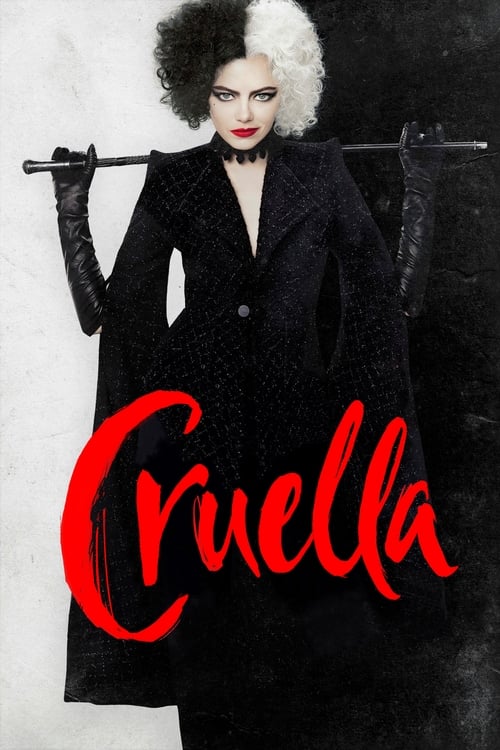
Cruella
2021 · Craig Gillespie
For a low-stakes, high-style night in — when you want dress-up, revenge-by-runway, and a villain to root for without anything actually hurting. A comfort watch with attitude, and an easy pick for a mixed crowd.
What it's about
In 1970s London, as punk rips through music and fashion, a gifted young grifter named Estella schemes her way from street cons toward the design career she's always wanted. Her talent catches the eye of the Baroness von Hellman, a ruthless fashion legend — and their collision turns into a war of spectacle, sabotage, and increasingly outrageous couture, out of which the persona called Cruella is born.
The experience
A glossy, fast-moving caper with a needle-drop-a-minute soundtrack and a streak of camp villainy it clearly relishes. It's long but rarely dull — the fun is watching two divas escalate against each other in ever more extravagant outfits.
Performances
Emma Stone and Emma Thompson play their rivalry as a delicious two-hander — Stone finding the wounded person under the persona, Thompson serving glacial, hilarious cruelty with total commitment.
The craft
The costume design is the star: Jenny Beavan's punk-couture creations won the Oscar, and several gown reveals are staged as full set-pieces. Craig Gillespie shoots it with swagger — gliding cameras, wall-to-wall 60s and 70s rock — and the production design makes London's fashion world a playground worth a big screen.
Why it matters
Part of Hollywood's wave of sympathetic villain-origin stories, it proved a Disney IP picture could borrow punk attitude and adult edge — and earned Jenny Beavan the Academy Award for Costume Design.
Snapshot
Cruella is Disney's origin story for one of its most enduring villains, the puppy-coveting Cruella de Vil, retooled as a punk-era fashion insurgency picture. Directed by Craig Gillespie and headlined by Emma Stone as the young grifter-turned-couturier Estella/Cruella and Emma Thompson as her monstrous mentor, the Baroness von Hellman, it transposes a character born in Dodie Smith's 1956 novel The Hundred and One Dalmatians — and cemented by Disney's 1961 animated feature — into 1970s London at the moment when punk was tearing the seams out of British fashion. The film sits at an unusual intersection: a corporate IP extension that borrows the tonal license of the adult-skewing villain-origin cycle (Maleficent, Joker) while functioning, underneath the branding, as a lavishly mounted showcase for costume design and two theatrically pitched star performances. It is best remembered for Jenny Beavan's Oscar-winning costumes and for the sheer density of its classic-rock needle-drops.
Industry & production
Cruella is a Walt Disney Pictures production, part of the studio's long-running strategy of mining its animated library for live-action reinterpretations — a cycle that runs from Alice in Wonderland (2010) through Cinderella, Beauty and the Beast, Aladdin, and The Lion King. The de Vil character had already been given live-action form by Glenn Close in the 1996 101 Dalmatians and its 2000 sequel; Cruella departs from those family comedies by centering the villain and aging up the register to PG-13.
The project passed through a long development period with multiple writers attached before Gillespie came aboard, and the finished screenplay is credited to Dana Fox and Tony McNamara, from a story credited to Aline Brosh McKenna, Kelly Marcel, and Steve Zissis; the "based on" credit reaches back to Dodie Smith's novel. That McKenna — author of The Devil Wears Prada — sits in the story credits is telling, since the finished film's fashion-world power struggle plainly rhymes with that earlier picture.
The release was shaped by circumstance. Cruella premiered in May 2021, while the theatrical exhibition market was still convalescing from the COVID-19 pandemic, and Disney employed its hybrid model: simultaneous theatrical release and streaming via Disney+ Premier Access, a paid tier on top of subscription. Reliable, apples-to-apples box-office figures from that hybrid moment are genuinely difficult to interpret, so precise gross comparisons should be treated cautiously; the film performed well enough that a sequel was publicly announced. Reported budget figures have circulated but I won't assert an exact number as settled fact.
Technology
Technologically, Cruella is a conventional large-scale digital production rather than a formal experiment. It was shot digitally by cinematographer Nicolas Karakatsanis, with the period-London world built from a combination of location shooting, constructed sets, and digital extension. The dominant technical labor is not in novel capture or effects pipelines but in the practical crafts — costume, hair, makeup, and production design — augmented by the now-standard invisible visual-effects work required to conjure a large, crowded 1970s city and to stage the fashion "happenings" that structure the plot. The Dalmatians themselves are realized through a blend of trained animals and digital animation, in line with contemporary studio practice for photoreal creature and animal work. This is a film whose spectacle is deliberately handmade in feel even where it is digitally assembled.
Technique
Cinematography
Karakatsanis, a Belgian cinematographer who first drew notice on Michaël R. Roskam's Bullhead and The Drop and who shot Gillespie's I, Tonya, gives Cruella a saturated, high-contrast look that leans into the period's textures — smoke, leather, sodium light, the sheen of a couture gown against grimy brick. The camera is mobile and often flamboyant, matching the film's showmanship: sweeping moves around the Baroness's galas and Cruella's guerrilla fashion stunts, with a palette that tracks Estella's arc from muted disguise toward the stark black-white-red of her Cruella persona. The visual grammar is closer to a music-driven, maximalist mode than to naturalism, which suits a story about spectacle and self-invention.
Editing
Tatiana S. Riegel, Gillespie's longtime editor (Oscar-nominated for I, Tonya), cuts the film to a propulsive, music-forward rhythm. The needle-drop soundtrack is essentially a structural device: montage sequences of scheming, thieving, and dressmaking are built around songs, and the editing frequently uses music as its metronome. At well over two hours, the film is long for its genre, and the editing's job is to sustain momentum across a plot that layers grift, revenge, and melodramatic revelation; the propulsion is largely successful even when the runtime is felt.
Mise-en-scène / staging
The film's richest expressive channel is its design. Production design and, above all, Jenny Beavan's costumes carry the meaning: the Baroness embodies imperious, sculptural mid-century haute couture, while Cruella's wardrobe is a punk détournement of it — garments as provocations, red-carpet ambushes, a dress that literally unfurls into spectacle. The staging repeatedly organizes itself around these fashion "events," which double as plot beats: each new Cruella appearance is an act of aggression against the Baroness. Costume here is characterization, weaponry, and theme at once, which is why the film's craft reputation rests so heavily on this department.
Sound
The soundtrack is the film's most conspicuous sonic element — a wall-to-wall run of familiar rock and pop from the era and adjacent decades, deployed as ironic commentary and energy. This choice is both an asset (drive, wit, immediate period signaling) and a point of critical contention, since the sheer volume of recognizable tracks can crowd the drama. Underneath the licensed music sits Nicholas Britell's original score, discussed below.
Performance
Performance in Cruella is pitched high and theatrical by design. Emma Stone plays the split of shy, talented Estella and the flamboyant, vengeful Cruella, modulating an English accent and a mounting relish for villainy; the role asks for movie-star charisma more than interior realism, and Stone supplies it. Emma Thompson's Baroness is the film's most purely enjoyable turn — a study in glacial cruelty and comic hauteur, clearly enabled by the acid dialogue of co-writer Tony McNamara. The two-hander dynamic between them is the film's engine. Supporting players — Cruella's henchmen-friends Jasper and Horace, and the loyal figures around the Baroness's house — provide texture and comic relief around the central duel.
Narrative & dramatic mode
Dramatically, Cruella is a villain-origin story crossed with a rise-and-revenge melodrama and a caper comedy. Its mode is heightened and ironic: the film knows it is spectacle and plays to the gallery. The plot machinery includes a childhood trauma, a concealed parentage revelation, an elaborate long-con revenge scheme, and a doubled identity — Estella by day, Cruella by provocation. The film's central and somewhat vexed project is to make a future dog-villain sympathetic without wholly defanging her; it resolves this by locating her villainy in wit, ambition, and justified rage against a worse antagonist, rather than in the cruelty the character is ultimately known for. Whether this reconciles with the character's canonical monstrousness is precisely the interpretive tension critics returned to.
Genre & cycle
Cruella belongs to two overlapping cycles. The first is Disney's live-action-remake program, of which it is a more revisionist, villain-centric entry alongside the Maleficent films. The second is the broader villain-origin / sympathetic-antagonist cycle that reached a commercial and critical peak with Joker (2019) — a comparison the film's marketing and reception invited, given its shared premise of tracing an iconic villain's psychological genesis in a gritty urban past. Within these frames, Cruella also draws on the fashion-world drama (The Devil Wears Prada) and the heist/caper film. Its punk-London setting further situates it in a small tradition of movies that mythologize British punk as a moment of aesthetic revolt.
Authorship & method
Craig Gillespie's authorship, insofar as it is legible, lies in tonal control — his I, Tonya had already shown a facility for combining tabloid melodrama, dark comedy, needle-drop energy, and a sympathetic-antihero framing, and Cruella is recognizably built from the same toolkit, scaled up to blockbuster budget and reunited with key I, Tonya collaborators (editor Riegel, cinematographer Karakatsanis). This is director-as-showrunner-of-craft more than director-as-solitary-auteur; the film's identity is a negotiation between Gillespie's sensibility and a Disney franchise mandate.
The collaborators are decisive. Costume designer Jenny Beavan is the film's true above-the-line author of style — a veteran whose work spans Merchant Ivory period drama to Mad Max: Fury Road, and whose costumes here won the Academy Award for Best Costume Design. Composer Nicholas Britell — celebrated for Moonlight, If Beale Street Could Talk, and the Succession theme — supplies an original score that must coexist with the dominant licensed soundtrack, providing connective tissue and emotional underscoring beneath the pop maximalism. Co-writer Tony McNamara, fresh from The Favourite and The Great, brings the barbed, anachronistic-feeling wit that gives the Baroness her bite, balanced against Dana Fox's more conventional structural craft. Editor Tatiana S. Riegel and cinematographer Nicolas Karakatsanis complete the recurring Gillespie unit.
Movement / national cinema
Cruella is not part of a film movement in any rigorous sense; it is Hollywood studio product made largely in Britain, drawing on British setting, talent, and craft traditions. Its meaningful "movement" reference is not cinematic but sartorial and musical: British punk of the mid-1970s, the world of Vivienne Westwood and Malcolm McLaren's King's Road, which the film treats as inspiration and set dressing. The film gestures at the anti-establishment energy of that subculture and repurposes it as a story of individual artistic ascent — a domestication of punk's politics into a tale of personal branding that some critics found pointed and others found contradictory.
Era / period
The film is doubly period: made in 2021, set in the 1970s (with a prologue in Estella's childhood). Its 2021 production context matters — the pandemic-era hybrid release, the maturation of the villain-origin trend, and Disney's deepening reliance on library IP. Its 1970s setting is stylized rather than documentary; the period is rendered as a heightened, fashion-forward London whose punk energy is aesthetic more than historical. The film is candid about being a fantasia on the decade rather than a reconstruction of it.
Themes
The film's governing themes are self-invention and the performance of identity: Estella must become Cruella, and the movie treats fashion as the medium through which an inner self is externalized and weaponized. Related threads include rivalry between two women bound by talent and buried kinship; the tension between conformity (Estella) and defiant authenticity (Cruella); class and the outsider's assault on entrenched cultural gatekeepers; and creativity as both liberation and self-destruction. Running beneath is the franchise's structural question — the nature-versus-circumstance origins of villainy — which the film answers ambivalently, framing "wickedness" as much as vitality and justified rebellion as it is genuine malice.
Reception, canon & influence
Critical reception was mixed-to-positive and notably bifurcated. Reviewers broadly praised the craft — Beavan's costumes, the production design, and especially the Stone–Thompson pairing, with Thompson's Baroness singled out as a highlight — while a significant strand of criticism questioned the film's length, its relentless soundtrack, and the conceptual coherence of turning a puppy-murdering villain into a sympathetic underdog heroine. The comparison to Joker recurred, sometimes admiringly and sometimes as a charge that the villain-origin template was being applied to material that resisted it.
The film's clearest institutional recognition came at the Academy Awards, where Jenny Beavan won Best Costume Design (a further Oscar in a distinguished career) and the film was also nominated for Makeup and Hairstyling — a canon position that confirms its identity as, above all, a design achievement.
Influences on the film (backward): Disney's own animated 101 Dalmatians and Dodie Smith's source novel supply the character; the Maleficent films establish the villain-sympathizing template within the Disney system; Joker looms as the prestige-adjacent model for the adult villain origin; The Devil Wears Prada (via story-credited McKenna) shapes the fashion-world mentor-protégée conflict; Gillespie's own I, Tonya is the immediate stylistic precedent; and British punk, Westwood-era couture, and the classic-rock canon furnish the aesthetic vocabulary.
Legacy (forward): As a recent film, Cruella's long influence is still forming, so claims here should stay modest. Its most concrete institutional legacy is a publicly announced sequel and the reinforcement of Disney's villain-centric remake strategy. Culturally, it functioned as a high-visibility showcase for costume design and helped keep the "sympathetic villain origin" conversation alive within family-facing studio filmmaking. Whether it exerts lasting influence on the form — or reads in retrospect as a well-crafted, contradiction-laden product of the streaming-transition moment — is a judgment the historical record has not yet settled.
A Deleuzian reading
A gown unfurls at a party.
The full Deleuzian reading of Cruella →
Reception
Released day-and-date on Disney+ Premier Access in 2021 to a chorus of 'why does this exist?' skepticism, it's since settled into being the rare Disney live-action villain project people actually defend — reclaimed as camp, carried by its costumes and its two Emmas.
How Cruella was received, from release to now →
How to watch Cruella: what to notice on a first viewing
- Watch each Cruella outfit answer a shape the Baroness wore first. Jenny Beavan builds the wardrobe as a duel. Thompson's Baroness gets sculptural, immobile mid-century couture. Stone's Cruella takes those same shapes and vandalizes them with punk cutting, street materials, and deliberate mess. Clothes here argue about who owns taste, so a garment does the work a punch would do in another movie.
- Watch Estella's muted colors give way to black, white, and red. Karakatsanis shoots the early Estella in dulled, disguised tones. As the persona takes hold, the frame keeps handing her stark black, white, and red, and that scheme spreads onto the rooms and the crowd around her. The color stops describing a scene and starts taking it over, which is how you can see the persona winning.
- Count how many scenes are cut to a song instead of dialogue. Editor Tatiana Riegel uses the needle-drops as a metronome. Scheming, thieving, and dressmaking arrive as montages built on records, and the cut lands on the beat rather than on a consequence. Momentum comes from music rather than from cause and effect, which is why the film moves even when the plot idles.
- Watch the camera sweep around a party instead of holding still. Karakatsanis keeps the camera moving through the Baroness's galas and Cruella's street stunts, circling guests and photographers. It shows an event off from every side rather than settling on one person's reaction. The camera treats each entrance as a performance staged for an audience, which is exactly what Cruella's attacks are.
- Watch Emma Thompson's face stay still while she says something cruel. Thompson plays the Baroness glacially, barely moving, delivering Tony McNamara's acid lines as if bored by them. Stone pitches Estella the opposite way, quick and eager, until Cruella starts borrowing Thompson's stillness. The two registers set the terms of the duel, and you can hear Estella learning her rival by ear.
The whole guide to watching Cruella, with the keys for a rewatch →
Influences: the films it descends from and the films it influenced
- I, Tonya (2017) — The immediate stylistic template — Gillespie, editor Tatiana Riegel and DP Nicolas Karakatsanis pair tabloid antihero sympathy with wall-to-wall classic-rock needle drops and direct-address, a toolkit Cruella scales up wholesale.
- Goodfellas (1990) — Establishes the wall-to-wall licensed-track soundtrack fused to first-person voiceover and freeze-frame/whip-pan music montage that structures Cruella's rise-of-a-criminal narration.
- A Clockwork Orange (1971) — Model for the stylized, wide-angle 1970s London of delinquent theatricality, where a charismatic villain addresses us over ironically deployed classical/pop cues in high-key saturated frames.
- Marie Antoinette (2006) — Blueprint for scoring a costume-heavy period world with anachronistic punk/post-punk needle drops, treating couture as the visual grammar of a young woman's self-invention.
- The Devil Wears Prada (2006) — Supplies the fashion-house mentor/protégée power struggle — imperious tastemaker versus striving ingénue — via shared story-writer Aline Brosh McKenna.
- Joker (2019) — The prestige-adjacent adult villain-origin model, staging a sympathetic descent-into-the-persona arc with a bravura lead performance in a theatrical register.
- Maleficent (2014) — Installs Disney's in-house template of reframing a canonical animated villain as a wronged, sympathetic protagonist against the original property.
- One Hundred and One Dalmatians (1961) — The source design DNA — Cruella De Vil's split black-and-white silhouette and vamp caricature is the visual thesis Beavan's costume arc deconstructs and rebuilds.
- Ocean's Eleven (2001) — Provides the heist-caper machinery — the con-crew ensemble, the withheld-plan reveal structure, and the slick mobile camera that Cruella grafts onto its revenge scheme.
- Moulin Rouge! (2001) — Precedent for jukebox pop-anachronism maximalism staged as fashion-happening spectacle, cut fast against saturated, high-contrast production design.
- Velvet Goldmine (1998) — Glam/punk-scene template for building identity through costume and constructed persona, with a doubled self-invention narrative carried on saturated performance-driven needle drops.
- Cinderella (2015) — Inherits Disney live-action's costume-forward spectacle but swings to the villain-origin, revisionist pole, showing the axis Cinderella helped define still governing later entries.
- Cruella 2 (2024) — The announced sequel is the film's most concrete institutional legacy, committing the Gillespie/Beavan design-and-needle-drop unit to a continuing franchise voice.
- Wicked (2024) — Extends the studio sympathetic-villain-origin into musical spectacle, staging defiance-as-self-invention through costume transformation and a two-women rivalry-turned-bond.
- The Favourite (2018) — Shares co-writer Tony McNamara's barbed, anachronistic-feeling wit and a cruel-comic court of rivals, rendered with restless wide-angle mobile camerawork.
- Mad Max: Fury Road (2015) — Beavan's other Oscar-winning design showcase — costume-as-worldbuilding, telling character and status through silhouette, texture and wear across an entire visual ecosystem.
- Maleficent: Mistress of Evil (2019) — Concurrent expression of Disney's villain-centric live-action franchise strategy, extending the sympathetic-antagonist reframing into sequel worldbuilding.
- The Hunger Games: The Ballad of Songbirds & Snakes (2023) — Sibling villain-origin of a canonical antagonist built on costume-as-character-motif, matching the prequel's use of wardrobe (the reptilian Snow palette, the arena styling) as a signaling device.
- Wonka (2023) — Shares Wonka's structural gambit — an origin-prequel for an iconic character who never demanded one — recasting a known figure as a sympathetic underdog before their canonical persona.
Similar films
- The Favourite (2018) — influence & lineage · same viewing thread
- Wicked (2024) — influence & lineage · same viewing thread
- One Hundred and One Dalmatians (1961) — influence & lineage
- The Devil Wears Prada (2006) — influence & lineage
- Marie Antoinette (2006) — influence & lineage
- Poor Things (2023) — same viewing thread
- Last Night in Soho (2021) — same viewing thread
- I, Tonya (2017) — influence & lineage · often watched together
All the films related to Cruella →
Watch it with: curated runs of related films
- Drunk on Design — Watch these together for the rush of maximalist, color-drenched cinema where a woman is made, remade, or consumed by an art form — ballet, fashion, gothic desire — and the production design does half the storytelling.