Cinderella
2015 · Kenneth Branagh
For a cozy night in when you want pure comfort — to believe in kindness, dress-up magic, and love at first dance. Zero challenge, all warmth; a safe pick with kids or after a brutal week.
What it's about
Ella is a warm-hearted young woman left in the care of her stepmother and stepsisters after her father's death, and they quietly reduce her to a servant in her own home. She holds on to her mother's parting advice — have courage, be kind — even as the household grows crueler. A chance meeting with a charming stranger in the woods, a royal ball, and a touch of magic give her one night to step out of the ashes.
The experience
Sincere, sumptuous, and unhurried — a fairy tale told completely straight, with no winking or ironic revision. It's gentle rather than gripping, but the sweep of the ball and the glow of the whole thing can leave you a little misty.
Performances
Cate Blanchett makes the stepmother genuinely formidable — glamorous, wounded, and cold all at once — while Lily James plays goodness without ever making it bland, which is harder than it looks.
The craft
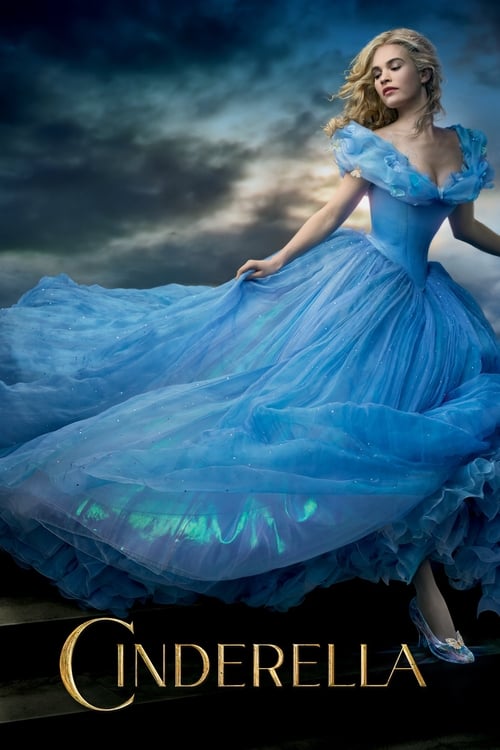
Branagh directs it like a storybook come to life: candy-colored production design, swirling camera moves at the ball, and costumes so lavish they're practically characters — the blue gown and glass slipper are showpieces. It's a film built to be gorgeous, and it rewards the biggest, brightest screen you have.
Why it matters
Its success proved a fairy tale could work without cynicism or revisionist twists, and it helped set the template for Disney's wave of live-action retellings of its animated classics.
Snapshot
Kenneth Branagh's Cinderella is Walt Disney Pictures' live-action retelling of its own 1950 animated feature, itself drawn from Charles Perrault's 1697 "Cendrillon" — the branch of the tale that supplies the fairy godmother, the pumpkin coach, and the glass slipper rather than the darker Grimm variant. Written by Chris Weitz and released in March 2015, the film is notable less for what it reinvents than for what it declines to reinvent. Arriving amid a wave of ironic, revisionist fairy-tale properties — Disney's own Maleficent (2014), Frozen (2013), the Snow White and the Huntsman cycle — it made the counterintuitive choice to play the story straight: sincere, courtly, unapologetically romantic. Its guiding maxim, spoken by Ella's dying mother, is "have courage and be kind," and the picture treats that ethic as a genuine organizing principle rather than a slogan to be deconstructed. Anchored by Cate Blanchett's chilly, wounded Lady Tremaine and Lily James's luminous Ella, dressed by Sandy Powell and designed by Dante Ferretti, it is a lavish, classically constructed studio fairy tale — and a foundational entry in the live-action remake cycle that would come to define Disney's output through the 2010s.
Industry & production
The film sits early in Disney's systematic program of translating its animated library into live action, following Alice in Wonderland (2010) and Maleficent (2014) and preceding The Jungle Book (2016) and Beauty and the Beast (2017). Its commercial logic was straightforward: monetize a pre-sold, globally recognized title through prestige production values. Development passed through several hands — Mark Romanek was attached to direct at one stage before departing over creative differences — before Kenneth Branagh took the project, with Chris Weitz's screenplay as the spine. Simon Kinberg, Allison Shearmur, and David Barron produced.
Production was based at Pinewood Studios in England, the natural home for a shoot of this scale and one congenial to Branagh's British theatrical network. The film was a substantial commercial success, grossing well over $500 million worldwide against its production budget — enough to validate the remake strategy and reinforce Disney's commitment to the format. It was released theatrically alongside Frozen Fever, a short Disney used to attach its most valuable animated brand to the new venture, a piece of cross-promotional packaging characteristic of the studio's contemporary release strategy.
Technology
Cinderella is a hybrid of old and new craft. By multiple accounts the film was photographed on 35mm film stock rather than digitally, a deliberate choice in keeping with its painterly, storybook aesthetic and the general trend among cinematographers of the era who sought film's texture for period and fantasy material; readers should treat the precise camera and stock details as a matter for the technical record rather than something I will pin down beyond the film-origination claim.
Its most conspicuous technological showpiece is the transformation sequence — pumpkin into coach, mice into horses, goose into coachman, lizards into footmen — realized through digital visual effects work led by MPC (Moving Picture Company). The design ambition there was to make the metamorphoses feel organic and continuous, the golden coach seeming to grow from the swelling pumpkin rather than simply cutting to a finished object. A smaller but often-cited piece of digital craft concerns the glass slipper: the Swarovski crystal shoe built for the production was a rigid display object that could not actually be worn, so the moment of the slipper sliding onto Ella's foot required digital compositing to marry the real crystal to a real foot. The blue ball gown, by contrast, was a triumph of physical rather than digital engineering (see below).
Technique
Cinematography
Haris Zambarloukos, Branagh's regular director of photography (Thor, Jack Ryan, later Murder on the Orient Express and Belfast), shoots the film in a lush, saturated, high-key register. The palette is keyed to emotional legibility: warm, honeyed light for Ella's childhood and the natural world she is aligned with; cooler, harder tones around Lady Tremaine's domain. The camera favors classical coverage and sweeping movement over fragmentation — craning through the palace ballroom, gliding with the dance — an approach that privileges spatial clarity and spectacle. The look is frankly beautiful and slightly heightened, closer to storybook illustration than naturalism, which is precisely the point.
Editing
Cut by Martin Walsh (an Oscar winner for Chicago), the film moves at a measured, confident pace that trusts its set pieces to breathe. The editing is conservative in the best sense — it lets performances land, holds on the reaction shots that carry the film's emotional beats, and reserves its most kinetic cutting for the transformation and the flight from the ball at midnight. The rhythm is that of classical narrative cinema rather than contemporary fast-cutting spectacle.
Mise-en-scène / staging
This is the film's richest dimension. Dante Ferretti, the celebrated Italian production designer (a frequent Scorsese and Fellini collaborator), builds a world of storybook grandeur — the chateau, the palace, the ballroom — rendered with operatic scale and painterly detail. Branagh, whose formation is theatrical and Shakespearean, stages the drama with a proscenium sensibility: the ball is choreographed as a grand set piece, entrances and reveals are theatrically timed, and the film is unafraid of frank spectacle. The staging consistently externalizes character through space and color, from the dusty attic that becomes Ella's confinement to the mirrored ballroom where her transformation is publicly consummated.
Sound
Patrick Doyle, Branagh's longtime musical collaborator since Henry V (1989), composes a full-blooded orchestral score in the late-Romantic idiom, lush and thematic, that underwrites the film's sincerity. The score works in the classical Hollywood tradition of leitmotif and emotional amplification rather than ironic counterpoint. The film gestures toward its animated predecessor's musical heritage — its songs live at the margins, over the credits, rather than making this a full musical, a structural choice that distinguishes it from Disney's later Beauty and the Beast remake.
Performance
Cate Blanchett's Lady Tremaine is the film's anchor and its most critically praised element — a performance of glamorous, glacial cruelty that Weitz's script and Blanchett's playing endow with a legible interior life: bitterness born of her own thwarted second marriage and precarious social standing. Lily James plays Ella with an open, unguarded warmth that risks blandness and largely avoids it by committing fully to the character's sincerity. Richard Madden's Prince Kit is given more agency and personality than the animated cipher. The supporting bench is deep and largely British-theatrical: Helena Bonham Carter as a comic, slightly dotty Fairy Godmother; Stellan Skarsgård as the scheming Grand Duke; Derek Jacobi (a Branagh mentor and frequent collaborator) as the dying King; Nonso Anozie as the Captain; Sophie McShera and Holliday Grainger as the stepsisters, played for broad comedy; Hayley Atwell and Ben Chaplin as Ella's parents in the prologue.
Narrative & dramatic mode
Weitz's screenplay is essentially a psychological deepening of a schematic tale. Its principal interventions are motivational: it gives Lady Tremaine a backstory and a wound, so that her cruelty reads as displaced grief and economic fear rather than motiveless evil; it introduces Ella and Kit before the ball, so their romance has a foundation beyond love-at-first-sight; and it frames the entire narrative around the mother's deathbed counsel to "have courage and be kind," which becomes the moral test the plot repeatedly stages. The dramatic mode is earnest melodrama in the older, non-pejorative sense — a mode of heightened moral clarity and emotional directness. Crucially, the film resists the era's reflex toward subversion. Ella is not reconceived as an action heroine, nor is her passivity apologized for; the script reframes her endurance and kindness as forms of strength, a reading it advances sincerely rather than defensively.
Genre & cycle
The film is a fairy-tale romance and a family fantasy, but its most important generic identity is as a live-action Disney remake — a cycle it helped codify. Where Alice in Wonderland and Maleficent had pursued reinvention and villain-sympathy, Cinderella established an alternative template: faithful, reverent, production-design-forward adaptation that treats the animated original as sacred text to be honored rather than interrogated. This "straight" model would inform Beauty and the Beast (2017), The Lion King (2019), and others. Within the broader fairy-tale-film landscape of the 2010s, its sincerity was almost contrarian, a deliberate rebuke to the ironic mode dominant since Shrek.
Authorship & method
Branagh brings to the material the same sensibility that animates his Shakespeare films: a belief in emotional sincerity, classical construction, star performance, and unabashed grandeur. His method is that of a theatrical director working at scale — casting from the British stage tradition, staging for spectacle and clarity, trusting language and performance. The film is very much the product of his repertory company of collaborators: cinematographer Haris Zambarloukos and composer Patrick Doyle, both long-standing Branagh partners whose contributions give the film its visual lushness and Romantic musical voice. Editor Martin Walsh provides classical narrative rhythm. Screenwriter Chris Weitz supplies the psychological grounding.
Two collaborators from outside Branagh's usual circle prove decisive. Production designer Dante Ferretti brings Old-World, operatic craft. And costume designer Sandy Powell — one of cinema's most decorated costumers — arguably co-authors the film's visual identity. Her celebrated blue ball gown was built from many layers of fine, differently colored fabric, engineered to shimmer and move like watercolor and to hold its shape in the dance; her designs for Blanchett drew on 1940s silhouettes to set the stepmother apart as a figure of hard, dated glamour. Powell's work earned the film its Academy Award nomination for Best Costume Design.
Movement / national cinema
The film has no allegiance to a film movement; it is a Hollywood-financed, globally aimed studio product. But it is deeply inflected by British filmmaking culture — shot at Pinewood, cast overwhelmingly from the British stage and screen, and directed by an artist formed in the British classical theater. In that sense it belongs to the long tradition of British-crewed, American-financed prestige spectacle, and its DNA is closer to Merchant-Ivory heritage sensibility crossed with Hollywood scale than to any national new wave.
Era / period
Produced and released in 2015, the film is a document of its exact industrial moment: the early consolidation of Disney's live-action-remake economy and the studio's search for a repeatable formula. Its diegetic setting is a deliberately unspecified, once-upon-a-time European past — a storybook nineteenth-century-ish court with no fixed historical coordinates, designed for timelessness rather than period accuracy. The vagueness is a feature: it frees the film from the burdens of historical realism and lets Ferretti and Powell build an idealized fairy-tale world.
Themes
The film's central theme is stated outright and pursued without irony: that kindness and courage constitute real moral strength, and that virtue is a practice of endurance rather than conquest. Around this it develops several supporting concerns — grief and its distortions (Lady Tremaine's cruelty as curdled loss; Ella's goodness as fidelity to her dead mother); class and precarity (the stepmother's scheming reframed as economic survival for women without independent means); and forgiveness, made explicit in Ella's closing words to Tremaine, "I forgive you," which reframes the traditional ending as an act of grace rather than triumph. The film also quietly thematizes its own project: its insistence on sincerity in an ironic age is itself an argument about the worth of earnest feeling.
Reception, canon & influence
Critical reception was broadly positive. Reviewers repeatedly singled out Cate Blanchett's performance, Sandy Powell's costumes, and Dante Ferretti's production design, and many welcomed the film's decision to play the story with conviction rather than winking revisionism — praising Branagh's craftsmanship and classical assurance even where they found the material slight. The costume design earned an Academy Award nomination, the film's most significant awards recognition. Dissenting notes tended to fault the story's fundamental conservatism and the limits of a heroine defined by patience, an old critique the film knowingly courted.
The influences on the film run backward through a clear lineage: Disney's own 1950 Cinderella as the immediate template, Perrault's 1697 tale as the ultimate literary source, and — in method and sensibility — Branagh's own Shakespearean film practice and the broader tradition of lavish studio spectacle. Its visual imagination is indebted to storybook illustration and to Ferretti's and Powell's deep grounding in classical design.
The influence it exerted is chiefly industrial. Cinderella helped establish the "faithful and reverent" mode of Disney's live-action remake cycle, a template distinct from the villain-revisionist model of Maleficent, and it demonstrated that sincerity and old-fashioned romance could still command a global audience. Subsequent remakes negotiated their relationship to the original along the axis this film helped define. Its costume work, particularly the blue gown, entered popular visual culture as an instantly recognizable image. It remains a touchstone in discussions of how the twenty-first-century studio system mines its own archive — and a rare, self-aware argument that a fairy tale can be retold straight and still mean something.
A Deleuzian reading
The pumpkin doesn't cut to a coach.
The full Deleuzian reading of Cinderella →
Reception
Greeted in 2015 as a pleasant surprise — critics braced for a cynical cash-grab and got an earnest fairy tale — its stock has only risen as each subsequent Disney live-action remake landed worse, and it's now routinely held up as the one that actually worked.
How Cinderella was received, from release to now →
How to watch Cinderella: what to notice on a first viewing
- Notice the light turn warm to cool as scenes shift. Zambarloukos keeps Ella's world honeyed and warm, while Lady Tremaine's rooms turn cooler and harder every time she enters. The color tells you whose feeling to trust before anyone speaks a line.
- Watch Ella's hands during the pumpkin's transformation into a coach. Branagh holds Ella still while mice, pumpkin, and gown transform around her; her hands rise but never act. Deleuze calls this the movement of world: stillness that lets everything else move for her.
- Listen for Patrick Doyle's orchestral score swelling under every scene. Doyle's late-Romantic score amplifies feeling directly rather than undercutting it with irony, the way the fairy-tale cycle around it often did. The music tells you to feel this sincerely, with no wink attached.
- Watch Blanchett's face for small tensions before she speaks. Small movements gather across Blanchett's glacial poise until a line lands like pressure finding a crack. Weitz gave Tremaine a wound, so cruelty reads as grief rather than motiveless evil.
The whole guide to watching Cinderella, with the keys for a rewatch →
Influences: the films it descends from and the films it influenced
- Cinderella (1950) — The immediate template: Branagh's film preserves the animated original's storybook-prologue framing, the pumpkin/mice transformation as central set-piece, and the comic servant business beat for beat, retooled as live-action rather than revised.
- Henry V (1989) — Patrick Doyle's debut score here — the swelling choral Romanticism of 'Non Nobis' — establishes the full-throated orchestral voice Doyle carries directly into Cinderella's ball and transformation cues.
- Hamlet (1996) — Branagh's large-format (65/70mm) prestige method — the mirrored-hall grand interiors, deep-focus symmetry, and belief that classical construction plus spectacle is its own argument — is the staging grammar of Cinderella's palace.
- Much Ado About Nothing (1993) — Branagh's sun-drenched, high-key romantic register and repertory-ensemble casting from the British stage tradition is the tonal blueprint for playing sincere emotion without irony at scale.
- The Red Shoes (1948) — The Technicolor fairy-tale maximalism and the engineered dance set-piece in which costume is choreographed to move as spectacle prefigure Sandy Powell's ball gown built to shimmer and hold its shape while dancing.
- The Age of Innocence (1993) — Dante Ferretti's operatic Old-World interiors here — opulent period surfaces as emotional architecture — are the same craft sensibility he brings to Cinderella's palace and manor.
- Interview with the Vampire (1994) — Ferretti's candlelit, gilded European grandeur and appetite for hand-built theatrical opulence supply the Old-World, operatic design language he applies to Cinderella.
- Orlando (1992) — Sandy Powell's costume-as-character method — using silhouette and fabric to fix period and psychology — is the approach behind the stepmother's hard 1940s glamour set against Cinderella's watercolor blue.
- Shakespeare in Love (1998) — Powell's Oscar-winning layered-fabric period luxury and Elizabethan construction demonstrate the couture-craft engineering that returns in the multi-layer, differently-colored blue gown.
- The Young Victoria (2009) — Powell + British heritage prestige: royal-romance costume as the film's chief visual argument, the direct precedent for costume co-authoring Cinderella's identity.
- Ever After (1998) — The prior live-action Cinderella played straight and non-musical, grounding the fairy tale in earnest romance rather than winking revision — the sincere-retelling mode Branagh inherits.
- Gone with the Wind (1939) — The MGM/Selznick Technicolor prestige melodrama where the gown becomes a narrative event, establishing dress-as-spectacle that the blue-gown reveal knowingly stages.
- The Jungle Book (2016) — Extends the reverent-remake template while pushing the same MPC photoreal transformation VFX pipeline into fully digital environments rather than dressing practical sets.
- Beauty and the Beast (2017) — The clearest heir to the 'faithful, non-revisionist' mode Cinderella established — a shot-conscious, sincerity-first restaging of the animated original with a signature ball-gown reveal as centerpiece.
- Cruella (2021) — Inherits Disney live-action's costume-forward spectacle but swings to the villain-origin, revisionist pole, showing the axis Cinderella helped define still governing later entries.
- Cinderella (2021) — A direct revisionist counter-response to Branagh's straight retelling — jukebox-pop, ironic, girlboss-reframed — legible only against the sincere template this film set.
- Murder on the Orient Express (2017) — Reunited Branagh with Zambarloukos and costume designer Alexandra Byrne on saturated storybook period design and opulent costume spectacle, the visual luxury carried into the train.
- Maleficent (2014) — The villain-revisionist remake model against which Cinderella defined the opposite 'faithful and reverent' axis — the two films bracket the two directions the remake cycle could take.
- Into the Woods (2014) — A near-contemporary Perrault/Grimm live-action fairy tale trading on Colleen Atwood costume spectacle and studio-scale storybook staging, sharing the mid-2010s prestige-fairy-tale market.
- How to Train Your Dragon (2025) — Faithful, near-reverent live-action re-recording of an animated classic, exemplar of the remake-cycle logic HTTYD operates within.
Similar films
- Beauty and the Beast (2017) — influence & lineage
- Cruella (2021) — influence & lineage
- Hamlet (1996) — influence & lineage
- The Chronicles of Narnia: The Lion, the Witch and the Wardrobe (2005) — shared sensibility
- Pride & Prejudice (2005) — shared sensibility
- Tangled (2010) — shared sensibility
- Beauty and the Beast (1946) — shared sensibility
- Carol (2015) — shared sensibility