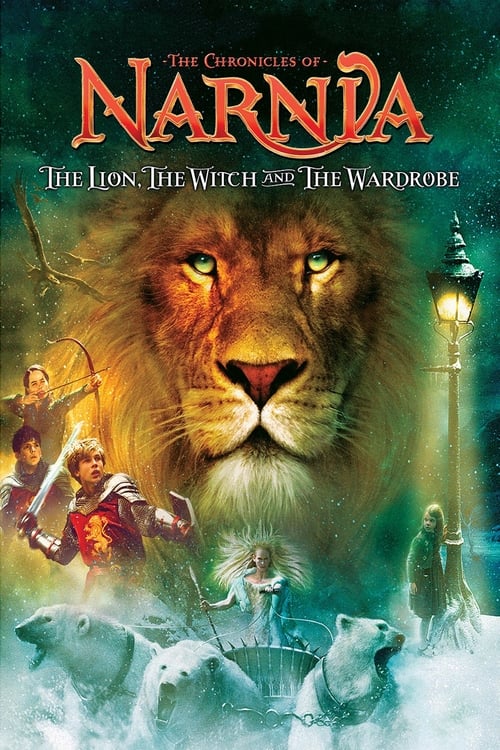
The Chronicles of Narnia: The Lion, the Witch and the Wardrobe
2005 · Andrew Adamson
For a family movie night or a snowed-in weekend when you want full-blown enchantment — comfort viewing with just enough menace to feel like it matters. Reach for it when you want to be swept somewhere else entirely.
What it's about
Four siblings, evacuated to a rambling country house during wartime, find the back of an old wardrobe opens into Narnia — a kingdom of talking animals and fauns frozen in a hundred-year winter by the White Witch. As the children are drawn into the land's fate, they're pulled toward Aslan, the great lion whose return promises a thaw, and toward a battle for Narnia's freedom. It's a story about ordinary kids handed extraordinary responsibility, and about the pull of temptation on one brother in particular.
The experience
Sweeping and earnest, with a storybook glow — wonder first, then real stakes and a few genuinely dark passages. It moves like a classic adventure: snowy hush, gathering armies, a big emotional swell at the center.
Performances
Tilda Swinton's White Witch is the reason to watch — icy, seductive, and genuinely frightening without ever raising her voice. Georgie Henley's wide-eyed Lucy grounds the wonder, and Liam Neeson lends Aslan a warm, gravelled authority.
The craft
Made at the height of the post-Rings fantasy boom, it pairs New Zealand and Czech locations with lavish creature effects and physical production — a fully built winter world you can practically feel the cold of. The scale rewards a big screen: snowfields, massed battle lines, and a lion that was a genuine effects landmark for its day.
Why it matters
It launched Disney's bid to turn C.S. Lewis's beloved books into a franchise and became one of the defining family blockbusters of the 2000s fantasy wave, proving the appetite for literary fantasy adaptations ran beyond Middle-earth.
Snapshot
The Lion, the Witch and the Wardrobe is the first screen adaptation of C.S. Lewis's 1950 novel produced with the full technological and financial arsenal of the post–Lord of the Rings Hollywood fantasy boom. Made by Walt Disney Pictures in partnership with Walden Media — the family-and-education-oriented company founded with backing from Philip Anschutz — it was a deliberate attempt to build a franchise from one of the most cherished children's literary properties of the twentieth century. Directed by Andrew Adamson, who had come to prominence as co-director of DreamWorks' Shrek films, it was his first live-action feature. The film wedded location shooting and elaborate physical production, primarily in New Zealand and the Czech Republic, to extensive digital effects supervised by Weta Digital and other houses, most conspicuously in the fully CG rendering of the lion Aslan. It was both a major commercial success and a cultural flashpoint, arriving amid intense discussion of Lewis's Christian allegory and of the parallel marketing of The Passion of the Christ–era faith-based audiences. The film launched a three-picture series and stands as a representative artifact of mid-2000s tentpole fantasy filmmaking.
Industry & production
The project sat at the intersection of two industrial logics. Disney was seeking a franchise to rival Warner Bros.' Harry Potter and New Line's Lord of the Rings, both then demonstrating that literary fantasy could sustain multi-film release calendars. Walden Media, meanwhile, pursued adaptations of canonical children's and educational literature, and it held the film rights to Lewis's series; the C.S. Lewis estate's involvement made faithfulness to the source, and to its religious dimension, a live production concern. The partnership paired Disney's distribution muscle and marketing reach with Walden's ownership of the property and its cultivation of family and church audiences.
Production was global in the manner of the era's large fantasy films. Principal photography took place substantially in New Zealand — leveraging the crews, infrastructure, and landscapes that The Lord of the Rings had established as a fantasy-production hub — with additional work in the Czech Republic and studio interiors. The film's release in December 2005 positioned it squarely in the holiday family market. It performed strongly at the worldwide box office, becoming one of the highest-grossing films of its year and profitable enough to green-light the sequels Prince Caspian (2008) and The Voyage of the Dawn Treader (2010). I do not have exact grosses memorized to a reliable figure and will not invent numbers; the salient point is that the film cleared the commercial bar for a franchise. Notably, the series' distribution later shifted: Disney declined to continue after Prince Caspian underperformed relative to expectations, and 20th Century Fox took over Dawn Treader — an industrial detail that speaks to the difficulty of sustaining the franchise the first film was designed to found.
Technology
The film is a characteristic product of the transitional moment when photoreal digital character animation had matured enough to carry a lead role but still leaned heavily on hybrid methods. Aslan is the central technological achievement: a computer-generated lion, developed with substantial creature work associated with Weta and other effects vendors, animated to sustain long dialogue scenes and physical action while remaining legible as a naturalistic big cat rather than a cartoon. This built directly on the creature and digital-fur techniques advanced by The Lord of the Rings and by the broader industry push toward believable CG animals.
Beyond Aslan, the production combined animatronics and practical creature suits — for the many talking beasts, fauns, centaurs, minotaurs, and the menagerie of the Witch's army — with digital augmentation and crowd multiplication for the climactic battle. Prosthetic and makeup work, physical sets for locations like Mr. Tumnus's cave and the Witch's icy fortress, and matte and environment work for the frozen Narnian landscape all figure in the film's construction. The eternal winter itself is a technological set piece, blending real snow-country locations with digital snow, ice, and thaw effects that visually dramatize the story's turn from frozen stasis to spring.
Technique
Cinematography
The film was shot by Donald McAlpine, an Australian cinematographer with a long and varied résumé spanning Baz Luhrmann's Romeo + Juliet and Moulin Rouge! as well as studio work such as Mrs. Doubtfire and X-Men Origins: Wolverine. His work here favors a storybook clarity: bright, saturated fantasy vistas balanced against the muted palette of wartime England in the framing story. The eternal-winter Narnia is rendered in cold blues and whites, and the film uses that chromatic scheme narratively, warming as Aslan's influence returns and spring breaks. The scale of the landscapes is emphasized through wide compositions that dwarf the children, a visual grammar inherited from the epic fantasy cycle, while the intimate wardrobe passages and domestic scenes are staged more closely to keep the child protagonists at the emotional center.
Editing
The film was edited by Sim Evan-Jones, who had cut Shrek for Adamson, alongside Josh Campbell and Jim May. The cutting must manage a wide tonal range — the slow, wondering discovery of Narnia; expository passages establishing the prophecy and the Witch's tyranny; and the large-scale climactic battle. The film's pacing is patient in its first act, allowing the wardrobe threshold and Lucy's first encounter with Tumnus to breathe, before accelerating into cross-cut action. The battle sequence is the most editorially demanding stretch, intercutting the two armies, the children's individual arcs, and Aslan's decisive intervention.
Mise-en-scène / staging
Production design realizes two contrasting worlds: the shadowed, blitz-era English country house with its rules and rationing, and the mythic geography of Narnia. The White Witch's court and her castle full of petrified statues furnish some of the film's most memorable staging — the frozen victims functioning as both décor and moral horror. The stone table, the site of Aslan's sacrifice, is staged as a ritual space, and the composition of that sequence deliberately evokes iconography of sacrifice and betrayal. Costume design by Isis Mussenden contributes strongly to characterization, most conspicuously in Tilda Swinton's White Witch, whose pale, sculptural gowns and, in battle, a mane-like garment and Aslan's-hide costume literalize her usurpation.
Sound
The score is by Harry Gregson-Williams, another Adamson collaborator from the Shrek films, working in a symphonic-and-choral fantasy idiom appropriate to the material, with a song, "Can't Take It In," by Imogen Heap over the end credits. The sound design contributes the distinct sonic textures of the two worlds — the muffled hush of snow, the crack of thawing ice, the din of the battle, and the vocal design of the CG and animatronic creatures, including the deep vocal presence of Aslan.
Performance
The film rests on a mixed cast of child newcomers and established adults. Georgie Henley as Lucy anchors the emotional throughline, her wonder at Narnia serving as the audience's; William Moseley (Peter), Anna Popplewell (Susan), and Skandar Keynes (Edmund) complete the Pevensie siblings, with Edmund's betrayal and redemption giving Keynes the most dramatically loaded arc among the children. The film's most-praised performance is Tilda Swinton's White Witch, a coolly imperious, androgynous tyrant that critics singled out as elevating the villainy above generic fantasy menace. Liam Neeson voices Aslan, lending gravitas and calm authority to the digital lion, while James McAvoy — then an emerging talent — gives the faun Tumnus a gentle, guilt-shadowed warmth. Jim Broadbent and Ray Winstone (voicing Mr. Beaver) round out a supporting cast of seasoned character actors.
Narrative & dramatic mode
The film follows the portal-fantasy structure of Lewis's novel: ordinary children, evacuated from wartime London, cross from the mundane world into a secondary world through the threshold of the wardrobe. The dramatic mode is that of the moral fairy tale sharpened into quest-and-battle epic. Its engine is a redemption arc — Edmund's seduction by the Witch, his betrayal of his siblings, and his rescue — braided with a sacrificial-savior arc in Aslan, who dies in Edmund's place at the stone table and is resurrected. The narrative moves from stasis (the "always winter, never Christmas" curse) through the arrival of the prophesied children, escalating conflict, sacrifice, and finally restorative victory and the crowning of the four siblings as kings and queens. It is unabashedly archetypal, trafficking in prophecy, chosen-child destiny, and the clear moral polarity of fairy tale rather than psychological ambiguity.
Genre & cycle
The film belongs to the mid-2000s cycle of literary-fantasy tentpoles that followed The Lord of the Rings (2001–2003) and Harry Potter (from 2001). It is simultaneously a family-adventure film and a fantasy epic, and it consciously blends the two registers: the intimate, child-scaled wonder of classic children's cinema with the large-army spectacle the Rings films had made a genre expectation. It also belongs to a longer lineage of children's portal fantasies on screen — the tradition running through The Wizard of Oz — and to the specific sub-cycle of faith-adjacent family films that studios courted in the years around The Passion of the Christ (2004). Within that industrial cycle it functioned as Disney/Walden's franchise bid, and its relative commercial ceiling helped mark the limits of the post-Rings fantasy gold rush.
Authorship & method
Andrew Adamson is the film's principal author, and his method is instructive. Coming from animation — he co-directed Shrek and Shrek 2 — he brought a sensibility attuned to world-building, creature performance, and the integration of computer imagery with storytelling, but Narnia was his live-action directorial debut. His approach was one of large-scale coordination: marshalling the New Zealand production ecosystem, the effects vendors, and a cast dominated by children into a coherent whole, while navigating the source's religious content and the estate's expectations of fidelity. He also co-wrote the screenplay, sharing credit with Ann Peacock and the writing team of Christopher Markus and Stephen McFeely — the latter pair going on to major careers scripting Marvel Studios films, making Narnia an early credit in a significant screenwriting partnership.
The key collaborators recur as a semi-repertory unit: cinematographer Donald McAlpine, composer Harry Gregson-Williams, editor Sim Evan-Jones (a Shrek holdover), and costume designer Isis Mussenden. Gregson-Williams and Evan-Jones in particular carried over from Adamson's animation work, suggesting a director importing trusted craftspeople into a new medium.
Movement / national cinema
The film does not belong to a movement in the art-historical sense; it is a Hollywood studio production. But it is a telling instance of a specific geography of production: the New Zealand fantasy-industrial complex that The Lord of the Rings established, which turned the country's landscapes and its concentrated post-production and creature-effects expertise into a global resource. In that sense Narnia is part of a transnational American cinema that outsources its physical and digital manufacture, drawing on New Zealand crews and Central European locations and studios while remaining thoroughly a product of the Los Angeles studio system in financing, authorship, and address.
Era / period
Narnia is emblematic of mid-decade 2000s blockbuster practice. It sits at the moment when digital creature performance had become reliable enough to anchor a film, when franchise-first development had become studios' dominant strategy, and when the family-fantasy market was at a commercial peak. It also reflects the era's cultural politics: the courting of faith audiences in the wake of The Passion of the Christ, and the ongoing negotiation, in adaptations of Lewis and of comparable properties, between honoring a work's religious substrate and pitching it to a broad secular family audience. Its release on the cusp of the transition from largely photochemical to increasingly digital-intermediate finishing also places it in a technical transitional window.
Themes
The film's themes are inherited from Lewis and rendered with relatively little dilution. Foremost is Christian allegory: Aslan's voluntary death in Edmund's place, at the hands of the Witch and her horde, and his subsequent resurrection through a "deeper magic," map onto the Passion and Easter — a reading the film neither hides nor over-italicizes, leaving it legible to those attuned to it and available as pure myth to those who are not. Around that core cluster the themes of sacrifice and substitution; sin, temptation, and redemption (Edmund's Turkish-delight seduction and forgiveness); the passage from childhood innocence to responsibility and rule; and the wartime frame's concerns with courage, loss, and the shelter of family. The seasonal metaphor — the thaw of an unnatural, joyless winter into spring — carries the film's larger movement from tyranny and death toward renewal and life.
Reception, canon & influence
Critically, the film met a generally favorable if not rapturous reception. Reviewers praised its scale, its faithfulness to a beloved book, and above all Tilda Swinton's White Witch, while some found the direction workmanlike and the spectacle familiar in the shadow of Peter Jackson's trilogy. Much critical discussion centered on the allegory — how overt it was and how the film handled it. The picture drew industry recognition for its craft, and it won the Academy Award for Best Makeup; I will not assert other specific wins or nominations I cannot verify precisely, but its recognition clustered around its visual and creature achievements rather than its writing or direction.
The influences on the film are clear and multiple: C.S. Lewis's 1950 novel first and foremost; the earlier BBC television adaptation of the Narnia books (1988) as a screen precedent the new film consciously superseded in scale; and, decisively, the immediate example of The Lord of the Rings, which supplied both the technological toolkit and the commercial template, down to the shared New Zealand production base. The broader tradition of literary children's fantasy on film, and of the Harry Potter series' demonstration that such properties could be serialized, also shaped its conception.
Its legacy forward is more modest than its makers hoped. The film launched a franchise that did not sustain itself: Prince Caspian and The Voyage of the Dawn Treader followed, but the series stalled after the third installment and never completed Lewis's seven-book cycle under that production regime. As of this writing a new Netflix-based Narnia effort associated with filmmaker Greta Gerwig has been announced, indicating the property's continued value even as the 2005 franchise itself proved finite. Within film history, the 2005 film is best understood as a well-made, commercially successful, but ultimately bounded example of the post-Rings fantasy cycle — significant as evidence of that cycle's reach and its limits, as an early showcase for James McAvoy and screenwriters Markus and McFeely, and as a definitive screen realization, for a generation of viewers, of one of the most widely read children's books of the twentieth century.
Reception
A big Christmas-season hit in 2005 that critics filed under 'solid but no Lord of the Rings' — now it's been warmly reclaimed as the one Narnia movie that actually worked, its stock rising as the sequels sputtered and the franchise died on the vine.
How to watch The Chronicles of Narnia: The Lion, the Witch and the Wardrobe: what to notice on a first viewing
- Notice the cold blues and whites drained from every Narnia frame. Cinematographer Donald McAlpine keeps the eternal winter chromatically cold, then slowly warms the palette as Aslan's influence returns. The color itself tells you who is winning before any character does.
- Watch how small the children look against the wide Narnia landscapes. McAlpine repeatedly frames the Pevensies as tiny figures dwarfed by mountains, forests, and castles, an epic-scale grammar borrowed from Lord of the Rings. Their smallness makes the destiny placed on them feel disproportionate and earned rather than easy.
- Look for statues scattered through the White Witch's castle halls. The petrified figures function as both decor and horror, a court literally built from her victims. Her power is shown as accumulation of the dead, not just cold or cruelty.
- Watch Tilda Swinton's stillness whenever she offers Edmund something sweet. Swinton plays the Witch as coolly imperious rather than shrieking, letting calm and generosity carry the menace instead of theatrics. Her villainy reads as seduction, so the menace arrives as an offer.
Influences: the films it descends from and the films it influenced
- The Lord of the Rings: The Fellowship of the Ring (2001) — Supplied the New Zealand production base, the massively-multiplied CG battle-army pipeline, and the motion-captured photoreal creature toolkit that Narnia's Battle of Beruna and Aslan directly draw upon.
- Jurassic Park (1993) — Codified the animatronic-plus-CG hybrid grammar — full-scale puppet for tactile contact shots, digital model for full-body motion — that Narnia reuses for Aslan and its creature ranks.
- Babe (1995) — Donald McAlpine's soft, naturalistic lensing of animatronic-and-CG talking animals is the direct technical rehearsal for his photography of the Beavers and Aslan.
- The Chronicles of Narnia (BBC serial) (1988) — The prior screen realization Adamson consciously superseded, its costumed pantomime-Aslan and studio battles replaced point-for-point by photoreal CG and location scale.
- Harry Potter and the Philosopher's Stone (2001) — Established the template of reverent, book-faithful serialization of a beloved British children's property into a franchised effects tentpole.
- The Passion of the Christ (2004) — Proved a mobilizable faith audience and church-marketing apparatus that Disney and Walden courted directly to sell the stone-table sacrifice's Christian allegory.
- Shrek 2 (2004) — Adamson's own animation grammar of creature-performance staging, carried into live action along with editor Sim Evan-Jones's comic cutting and composer Harry Gregson-Williams.
- Willow (1988) — The earlier sword-and-sorcery tentpole whose quest architecture and morph-driven creature effects prefigure the literary-fantasy blockbuster mold Narnia inhabits.
- The Lord of the Rings: The Return of the King (2003) — The Battle of Beruna directly deployed MASSIVE crowd-simulation software, and the production's formula — literary fantasy epic with practical creature suits augmented by digital characters, real New Zealand landscape as mythological terrain — replicates ROTK's technical and production template almost without modification, functioning as the first explicit industry attempt to replicate Jackson's workflow.
- The Golden Compass (2007) — The next post-Rings literary-fantasy tentpole to hang itself on photoreal talking-animal CG and a hushed-buildup-then-mass-battle structure.
- Bridge to Terabithia (2007) — Extends the portal-fantasy device, crossing children from a mundane world into a CG-populated imaginative kingdom staged against real landscape.
- The Spiderwick Chronicles (2008) — A literary children's-fantasy adaptation applying the same CG-creature-composited-into-real-location integration pioneered in the Narnia pipeline.
- The Chronicles of Narnia: Prince Caspian (2008) — Adamson's direct continuation, escalating the battle-crosscutting and reassembling the McAlpine / Gregson-Williams / Mussenden repertory unit.
- Where the Wild Things Are (2009) — Pushes further the animatronic-suit-plus-digital-face hybrid — Henson Creature Shop bodies with CG-augmented expressions — that Narnia's beast-people pointed toward.
- Alice in Wonderland (2010) — Industrializes the portal-fantasy tentpole model: a child crosses into a fully CG realm to topple a tyrant-queen in a climactic pitched battle.
- The Chronicles of Narnia: The Voyage of the Dawn Treader (2010) — The franchise's third entry inheriting the established creature-and-environment VFX pipeline under a new director while preserving the series' look.
- Peter Pan (2003) — A McAlpine-shot literary children's fantasy of the same moment, sharing his saturated chromatic-narrative scheme where color temperature maps onto emotional and seasonal states.
- Stardust (2007) — A same-era adaptation of a modern-classic fantasy novel built around a scenery-devouring witch-villainess in the imperious Swinton mold.
Similar films
- Alice in Wonderland (2010) — influence & lineage
- The Lord of the Rings: The Fellowship of the Ring (2001) — influence & lineage
- Puss in Boots: The Last Wish (2022) — shared sensibility
- Pan's Labyrinth (2006) — shared sensibility
- Cinderella (2015) — shared sensibility
- The Lord of the Rings: The Return of the King (2003) — shared sensibility
- Howl's Moving Castle (2004) — shared sensibility
- The Wizard of Oz (1939) — shared sensibility
All the films related to The Chronicles of Narnia: The Lion, the Witch and the Wardrobe →