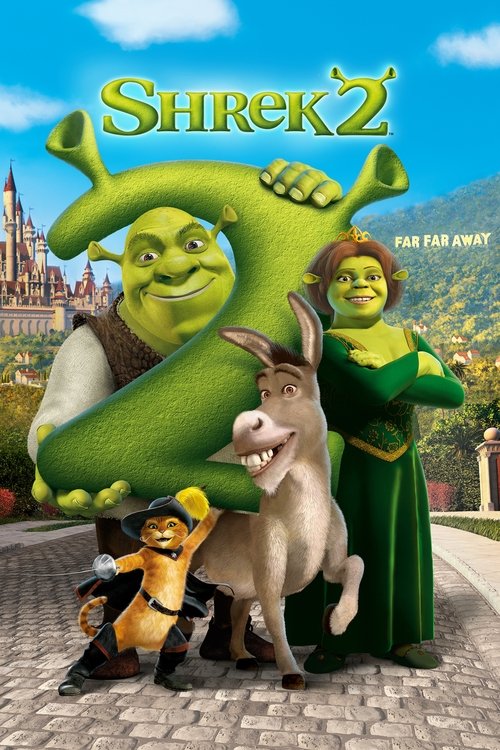
Shrek 2
2004 · Conrad Vernon
For family movie night, a comfort rewatch, or when you just need to laugh at something that holds up — zero challenge, all pleasure. One of the safest bets in animation for a mixed-age room.
What it's about
Newlyweds Shrek and Fiona travel to the kingdom of Far Far Away to meet her parents — and the in-law visit goes sideways fast. A scheming Fairy Godmother who runs happy endings like a rigged industry, a preening Prince Charming, and a hired ogre-killer named Puss in Boots all stand between the ogre and his happily-ever-after, with Donkey along for every mile.
The experience
Fast, dense with jokes, and genuinely sweet underneath the snark — the gags come at every age level at once, so kids howl and adults catch the Hollywood satire flying overhead. It's pure crowd-pleaser energy from the first minute.
Performances
Jennifer Saunders is silkily monstrous as the Fairy Godmother — she gets the film's best musical moment — and Antonio Banderas' Puss in Boots, a Zorro parody with kitten eyes, was so instantly beloved he launched his own films.
The craft
Far Far Away is Beverly Hills with turrets — red carpets, celebrity boutiques, brand parodies on every corner — and the sight-gag density rewards repeat viewings. The pop-needle-drop style that later became an animation cliché is at its sharpest and most earned here.
Why it matters
The rare sequel that outdid its original: it played in competition at Cannes, then became the highest-grossing animated film in history, holding the title for six years and cementing the fairy-tale spoof as a dominant mode of studio animation.
The rare sequel that outpaced its original in wit, scale, and cultural half-life. DreamWorks' fairy-tale demolition project sharpens here into full Hollywood satire: the kingdom of Far Far Away is Beverly Hills with turrets, complete with red carpets, celebrity boutiques, and a Fairy Godmother running happy endings as a rigged industry. The in-laws plot gives the franchise its best structure, and the new additions are permanent — Jennifer Saunders' silkily monstrous Godmother, and Antonio Banderas' Puss in Boots, a Zorro parody so instantly beloved he spun off two films of his own. It played in competition at Cannes in 2004, a genuine oddity for a studio cartoon, then became the highest-grossing animated film in history, a title it held for six years. The pop-song needle-drop, that now-exhausted animation reflex, has perhaps its finest hour in the finale: Saunders belting 'Holding Out for a Hero' over a castle siege, staged with the conviction of a Bond climax and the timing of a music hall act.
Reception
A monster hit on arrival — the highest-grossing film of 2004 and, for years, the biggest animated film ever — it's since been re-canonised by the internet as the rare sequel that tops the original, going from crowd-pleaser to genuine meme-age classic.
How Shrek 2 was received, from release to now →
Influences: the films it descends from and the films it influenced
- Shrek (2001) — Established the template Shrek 2 inherits wholesale: fractured-fairy-tale revisionism built on ironic pop needle-drops and celebrity-voiced leads playing against the Disney songbook.
- The Adventures of Robin Hood (1938) — Puss in Boots' swashbuckling — flourished blade, plumed defiance, balletic swordplay staged for comic timing — is lifted from the Errol Flynn/Curtiz Technicolor duel choreography the film openly parodies.
- The Mask of Zorro (1998) — Banderas voices Puss as a direct self-parody of his own Zorro: same rapier bravado, same accented seducer cadence, the swordsman-hero mannerisms imported intact into a cartoon cat.
- The Princess Bride (1987) — Set the tone Shrek 2 extends: earnest fairy-tale action played straight while the dialogue winks, the swordfight-as-comedy set piece, and self-aware fractured-storybook romance.
- Who Framed Roger Rabbit (1988) — Pioneered the celebrity-cameo/pop-culture-collision comic universe — a fantasy world stuffed with recognizable references — that Shrek 2's Far Far Away (a fairy-tale Hollywood) elaborates into wall-to-wall showbiz satire.
- Aladdin (1992) — Model for the fast, anachronistic, celebrity-voice-driven comedic sidekick (Williams' Genie → Murphy's Donkey and Saunders' Godmother) and the pop-culture-riff density Shrek 2 weaponizes as satire.
- Footloose (1984) — Source of Bonnie Tyler's 'Holding Out for a Hero,' whose ironic diegetic deployment during the castle climax is the film's signature needle-drop-as-set-piece device.
- Goldfinger (1964) — The climactic castle siege and last-second rescue are staged as a Bond parody — infiltration, gadget-cat, ticking countdown — borrowing the 007 third-act architecture wholesale.
- Cinderella (1950) — The straight Disney Fairy Godmother and bibbidi-bobbidi wish-fulfillment iconography that Shrek 2 inverts into a corrupt, contract-pushing celebrity power broker.
- Enchanted (2007) — Extends the fairy-tale-meets-modern-consumer-culture satire, staging animated-storybook tropes against a knowing 'real world' the way Shrek 2 stages them against a Rodeo Drive Far Far Away.
- Puss in Boots (2011) — The direct spin-off Shrek 2 spawned, building a whole feature on the Banderas swashbuckler-cat performance and its Zorro-parody swordplay introduced here.
- Puss in Boots: The Last Wish (2022) — Carries forward the same Banderas fencing-cat conceit, deepening the swashbuckler choreography and fairy-tale-figure ensemble (Goldilocks, Jack Horner) first monetized by Shrek 2's supporting cast of storybook celebrities.
- Shrek the Third (2007) — Continues the franchise's succession/in-laws-and-heirs plot machinery and celebrity-satire register, extending Shrek 2's move from love story to dynastic court intrigue.
- The Chronicles of Narnia: The Lion, the Witch and the Wardrobe (2005) — Adamson's own animation grammar of creature-performance staging, carried into live action along with editor Sim Evan-Jones's comic cutting and composer Harry Gregson-Williams.
- Hoodwinked! (2005) — Runs the same DreamWorks-era engine of fairy-tale-property remixing and anachronistic pop-culture gags, treating storybook characters as showbiz personalities.
- Happily N'Ever After (2007) — Directly imitates the Shrek formula of subverting the 'rigged happy ending' and Fairy Godmother machinery, targeting the same wish-granting-industrial-complex satire.
- Absolutely Fabulous (1992) — Jennifer Saunders imports her Ab Fab register — grandiose, gin-soaked, showbiz-monster comic diva — into the Fairy Godmother, whose 'Holding Out for a Hero' number is pure cabaret camp.
- The Emperor's New Groove (2000) — Shares the era's turn toward self-aware, joke-dense CG-adjacent comedy with a scheming sorceress-of-a-villain and rapid pop-timing gags rather than earnest musical sincerity.
- Toy Story 2 (1999) — The benchmark 'sequel surpasses original' in CG animation, proving a follow-up could expand the world and out-craft the first — the exact achievement Shrek 2 replicated commercially and formally.
Similar films
- Shrek (2001) — influence & lineage
- Puss in Boots: The Last Wish (2022) — influence & lineage
- The Princess Bride (1987) — influence & lineage
- Toy Story 2 (1999) — influence & lineage
- Tangled (2010) — shared sensibility
- The Super Mario Bros. Movie (2023) — shared sensibility
- Minions & Monsters (2026) — shared sensibility
- Zootopia 2 (2025) — shared sensibility