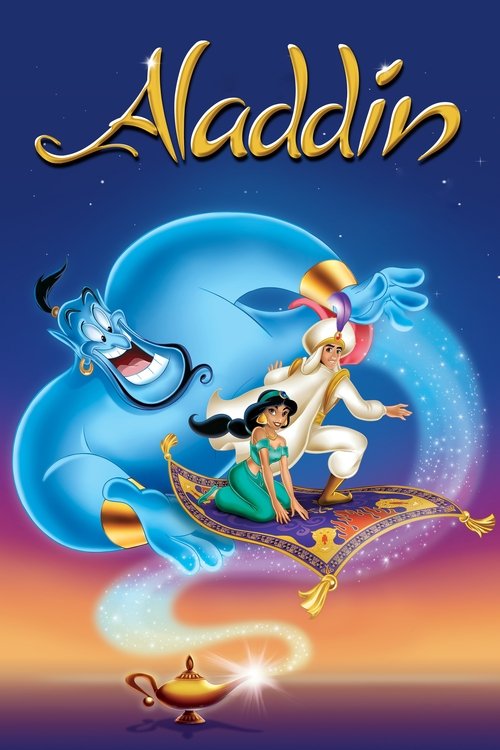
Aladdin
1992 · Ron Clements
For family movie night, a nostalgia fix, or any evening when you want to be swept up and singing along — comfort viewing of the highest order.
What it's about
In the desert city of Agrabah, Aladdin, a quick-witted street kid with a good heart, falls for Princess Jasmine — who by law can only marry a prince. Both he and the scheming vizier Jafar are after a magic lamp whose genie can grant wishes, and the race for it sweeps up flying carpets, a wisecracking parrot, and one very large personality in blue.
The experience
Fast, funny, and endlessly quotable — a Broadway-style musical comedy that moves at the speed of its Genie's imagination. It's pure delight with just enough menace to keep the adventure honest.
Performances
Robin Williams's Genie is one of the most famous voice performances ever recorded — a torrent of improvisation and shape-shifting that the animators turned into pure visual jazz, and that changed what a voice role could be.
The craft
The animation bends and morphs to keep pace with Williams, while early computer-generated imagery — most famously in the magic-carpet flights — blends seamlessly into hand-drawn craft. The Oscar-winning score and 'A Whole New World' give it songs that have outlived the decade.
Why it matters
The top-grossing film of 1992 worldwide and a pillar of the Disney Renaissance, it invented the celebrity-voice blockbuster and shaped every animated comedy that followed.
Snapshot
Aladdin is the fifth feature of the so-called Disney Renaissance, arriving in November 1992 between Beauty and the Beast (1991) and The Lion King (1994). Directed by Ron Clements and John Musker — the pairing responsible for The Great Mouse Detective (1986) and The Little Mermaid (1989) — it adapts "Aladdin and the Wonderful Lamp" from the One Thousand and One Nights into a Broadway-inflected musical comedy. Its lasting significance rests on two intertwined achievements: the marriage of a celebrity voice performance (Robin Williams as the Genie) to a plastic, metamorphic animation style, and the mature integration of computer-generated imagery into hand-drawn craft. Commercially it was the top-grossing film of 1992 worldwide, and it won two Academy Awards, for Original Score and Original Song ("A Whole New World"). It is remembered equally for its formal exuberance and for the controversy its Orientalist imagery and opening lyrics provoked.
Industry & production
The film was produced by Walt Disney Feature Animation during a period of institutional confidence engineered by studio chief Jeffrey Katzenberg, chairman Michael Eisner, and animation president Peter Schneider. The Renaissance model — a book-musical structure, a strong villain, comic sidekicks, and an Alan Menken score — had been validated by The Little Mermaid and Beauty and the Beast, the latter the first animated film nominated for the Best Picture Oscar. Aladdin was conceived within that template.
The project's origins lie with lyricist and de facto story architect Howard Ashman, who pitched an Aladdin treatment (modeled partly on 1930s–40s musicals and the Fleischer/Hope-Crosby "road" comedies) as early as 1988. Ashman's death from complications of AIDS in March 1991 reshaped the production: several of his songs were cut, and lyricist Tim Rice was brought in to complete the score with Menken. Katzenberg reportedly ordered substantial rewrites after an early version failed to satisfy him, tightening the story around Aladdin and elevating the Genie. The screenplay is credited to Clements, Musker, Ted Elliott, and Terry Rossio.
Two production controversies became part of the historical record. Robin Williams recorded the Genie largely for scale and on the understanding that his voice would not be used to sell merchandise; when it was, a public rift with the studio followed (later reconciled). Separately, the American-Arab Anti-Discrimination Committee protested the opening song "Arabian Nights," whose original lyric described a land "where they cut off your ear / If they don't like your face." Disney altered the lyric for the home-video release while retaining the "barbaric, but hey, it's home" line — one of the earliest high-profile disputes over cultural representation in a Disney animated feature.
Technology
Aladdin was produced using CAPS (the Computer Animation Production System), the Disney–Pixar digital ink-and-paint and compositing pipeline that had been phased in across The Rescuers Down Under (1990) and Beauty and the Beast. CAPS allowed hand-drawn line art to be scanned, colored digitally, and composited in multiple planes without the generational quality loss of the optical process.
The film's most-cited technical set piece is its use of true 3-D computer-generated imagery embedded within 2-D animation. The collapsing Cave of Wonders and, most memorably, the magic carpet — whose intricate ornamental border was modeled and rendered as a CG surface, then given expressive "acting" through digital manipulation — demonstrate the period's emerging hybrid method. The carpet is significant because it is a character, not merely an effect: the production had to solve how to make a computer-generated object read as warm and personable alongside drawn figures. This continued the experiments of the Beauty and the Beast ballroom and pointed toward the fuller CG integration of The Lion King's wildebeest stampede.
Technique
Cinematography
As with all cel-based animation, "cinematography" here denotes the design of the virtual camera, staging in depth, and lighting-by-paint rather than photographed light. Aladdin favors a highly kinetic, elastic camera: swooping moves through Agrabah's marketplace, plunging descents into the Cave of Wonders, and the vertiginous flight of "A Whole New World," where the carpet's CG geometry permits continuous, physically coherent camera travel that traditional multiplane work could not easily achieve. The palette is organized by dramatic register — warm ochres and sunlit sands for Agrabah, saturated golds for the cave's treasure, and cool blues and purples for Jafar and the night flight — using CAPS's color control to build mood across sequences.
Editing
H. Lee Peterson edited the film to a brisk comic tempo. The signature editorial challenge was the Genie's introduction ("Friend Like Me"), a rapid-fire montage of impersonations and visual gags that depends on precise cutting to sustain its accelerating rhythm. Song sequences are structured as self-contained set pieces — "One Jump Ahead" as a chase, "Prince Ali" as a parade — each with its own escalating internal logic, while the dialogue scenes are cut tighter and faster than in the studio's more romantic Renaissance entries, reflecting the film's comedic center of gravity.
Mise-en-scène / staging
The film's visual world is governed by a curvilinear design language derived from the caricaturist Al Hirschfeld, whose flowing, rounded line the artists took as a unifying principle: figures, architecture, and props share a swooping, calligraphic sensibility. Art director Bill Perkins and the visual-development team built Agrabah as a stylized fantasy Orient rather than a specific geography — an approach that produced both the film's graphic coherence and its later criticism as a composite Orientalist fantasy. Staging exploits verticality (rooftops, minarets, the cave's descent) and uses the Genie's shape-shifting to keep the frame in constant transformation.
Sound
Alan Menken's score, with songs by Ashman and Rice, is the film's structural spine. "Arabian Nights" functions as a framing overture; "One Jump Ahead" establishes Aladdin's character in motion; "Friend Like Me" is a big-band showstopper built for Williams's delivery; "Prince Ali" is a mock-triumphal procession; and "A Whole New World" is the romantic ballad and thematic climax. The sound design integrates Williams's dense verbal comedy — layered with sound effects that punctuate his transformations — into the musical texture. Menken won the Oscar for Original Score, and "A Whole New World" (Menken/Rice) won Original Song.
Performance
Vocal performance is the film's defining register. Robin Williams's Genie, recorded across many hours of improvisation, brought stand-up energy and a barrage of contemporary pop-culture impressions into an animated character, effectively inventing a new template for celebrity voice casting. Scott Weinger voices Aladdin, with Brad Kane providing his singing; Linda Larkin voices Jasmine, with Lea Salonga singing. Jonathan Freeman's silky, theatrical Jafar and Gilbert Gottfried's abrasive Iago supply the film's antagonist comedy. Crucially, the animators treated these performances as acting to be visualized: supervising animator Eric Goldberg built the Genie's design and timing directly around Williams's vocal rhythms, so that voice and drawing become a single performance.
Narrative & dramatic mode
The film operates in the mode of the integrated book musical crossed with romantic-comedy adventure. Its dramatic engine is a deception plot: Aladdin, a "diamond in the rough" street thief, uses the Genie to pose as "Prince Ali" and win Jasmine, and must ultimately choose authenticity over the disguise. Around this runs a doubled wish-fantasy — Aladdin's desire to rise and the Genie's desire to be freed — that gives the comedy an emotional undertow about bondage and self-worth. The structure is classically economical: a clear want, a magical enabling device with rules (three wishes, stated prohibitions), a midpoint of false triumph, and a climax in which Jafar's own wish for power (becoming a genie) becomes the trap that undoes him. The tone braids fast comedy, sincere romance, and menace more aggressively than most of its Renaissance siblings.
Genre & cycle
Aladdin sits at the intersection of the animated musical, the fairy-tale adaptation, and the swashbuckling adventure. Within Disney's own output it belongs to the Renaissance cycle of book-musical features (1989–1999) defined by the Ashman/Menken model. It also draws on the broader "Arabian fantasy" cinematic tradition — the genie, the flying carpet, the wondrous cave — while inflecting it with buddy-comedy conventions. Its commercial success helped consolidate the studio's late-century formula and, through the Genie, expanded the animated feature's tolerance for topical, self-referential humor, a mode later pushed further by rival studios.
Authorship & method
The film is a collaborative authorship centered on Clements and Musker, who as a directing team combined swashbuckling adventure sensibilities with comic invention. Their method emphasized character animation as performance and a willingness to let a voice actor reshape a character.
Key collaborators: Alan Menken (composer) supplied the through-composed musical architecture; lyrics came from the late Howard Ashman and Tim Rice, whose two hands are audible in the score's shift from Ashman's wit to Rice's more conventional romanticism. H. Lee Peterson edited. On the animation side — the true "cinematography" of the film — Glen Keane supervised Aladdin, Eric Goldberg the Genie (the film's stylistic signature), Andreas Deja the villain Jafar, and Mark Henn Jasmine; this cohort represented much of the studio's leading talent of the era. Art direction under Bill Perkins and the Hirschfeld-derived design gave the film its unified line. The screenplay's four-way credit reflects the studio's committee-driven, Katzenberg-supervised development process rather than a single writer's vision.
Movement / national cinema
As American studio animation, Aladdin belongs to no avant-garde movement but to a corporate-authorial tradition. Its relevant "movement" is the Disney Renaissance itself — a deliberate revival of the classical Disney feature after the studio's 1970s–80s decline, organized around the Broadway musical and enabled by digital production tools. The film's aesthetic borrowings are transnational in a superficial, appropriative sense (a generalized "Orient"), which is precisely what critics of its representation have identified: it is Hollywood's fantasy of another culture rather than a work in dialogue with the cinemas of the region it depicts.
Era / period
Aladdin is a document of early-1990s Hollywood: the height of the Disney Renaissance, the moment when CAPS and nascent CGI were remaking animation production, and the beginning of animated features as global merchandising and franchise properties. Robin Williams's performance is itself period-specific, saturated with early-'90s references, which anchors the film to its moment even as its fairy-tale frame reaches for timelessness. The representation controversy also marks the period — an early instance of the cultural-representation debates that would intensify around Disney's catalog in subsequent decades.
Themes
The film's central theme is authenticity versus disguise: the Genie's repeated moral, that Aladdin should "just be yourself," organizes the deception plot into a coming-of-age argument about worth being intrinsic rather than conferred by status. Related is the theme of freedom and bondage: the Genie possesses phenomenal power yet is enslaved to the lamp, and his longing for release mirrors — and morally outranks — Aladdin's social climbing, so that Aladdin's final wish (freeing the Genie rather than making himself a prince) resolves both arcs at once. Class and mobility run throughout, in the "street rat" who is a "diamond in the rough." Jasmine's refusal to be married off as property introduces a modest strand of feminine autonomy characteristic of the Renaissance heroines. And the wish-fantasy structure interrogates desire itself: what one asks for, and what it costs, culminating in Jafar destroyed by the very omnipotence he craved.
Reception, canon & influence
Critically, Aladdin was received as a triumphant entertainment, with near-universal praise for Robin Williams's Genie and Menken's songs, even as some reviewers and, more pointedly, the American-Arab Anti-Discrimination Committee criticized its portrayal of Arab characters and setting. It won the Academy Awards for Original Score and Original Song and additional nominations in sound categories, and it became the highest-grossing film of 1992 worldwide — a commercial peak for the studio's animation division.
Influences on the film (backward): the source tale from the One Thousand and One Nights; the two great screen Thief of Bagdad films — Raoul Walsh's 1924 Douglas Fairbanks vehicle (whose athletic hero informs Aladdin's physicality) and the 1940 Korda production (a clear reference point for the flying carpet, the genie, and the scheming vizier Jafar); the Hope-Crosby "road" comedies and 1930s–40s Hollywood musicals that shaped Ashman's original conception; and Al Hirschfeld's caricature line as the governing visual idiom.
Legacy (forward): Aladdin established celebrity improvisational voice casting and dense pop-culture referentiality as viable — even expected — in mainstream animation, a mode that competitors, especially DreamWorks (Shrek), would adopt and sharpen. Its hybrid 2-D/CG method fed directly into the more ambitious integration of The Lion King. It spawned a franchise — the direct-to-video sequels The Return of Jafar (1994) and Aladdin and the King of Thieves (1996), a television series, a long-running Broadway stage musical, and Guy Ritchie's live-action remake (2019). It also became a recurring case study in debates over Orientalism and representation in popular animation, its opening-lyric revision cited as an early example of a studio responding to such criticism. Within the Disney canon it stands as one of the Renaissance's defining works: the point at which the studio's animated feature most fully embraced comic virtuosity and technological hybridity at once.
A Deleuzian reading
The carpet has no face.
The full Deleuzian reading of Aladdin →
Reception
A monster hit in 1992 — the year's biggest film worldwide and the movie that turned the Disney Renaissance into a juggernaut — it's since been re-read twice over: warmly, as a monument to Robin Williams after 2014, and more critically, through decades of debate about its Orientalist caricatures (Disney altered the 'Arabian Nights' lyrics after protests as early as 1993).
How Aladdin was received, from release to now →
Influences: the films it descends from and the films it influenced
- The Thief of Bagdad (1940) — The Korda production supplies the concrete iconography — flying carpet, colossal bottled genie, and scheming vizier — that Aladdin restages almost beat for beat.
- Beauty and the Beast (1991) — Its CGI ballroom proved that computer-modeled sets could be tracked under hand-drawn characters — the technical proof-of-concept for Aladdin's CG carpet and Cave of Wonders.
- Good Morning, Vietnam (1987) — Direct heir to the model of recording Williams free-associating and assembling the performance in the edit — director-as-editor of an improviser's riffing.
- The Thief and the Cobbler (1993) — ZigZag's rhyming, zig-zagging verbal patter and angular villainy shadow Jafar and the Genie, and the released Thief cuts were re-tooled with songs to chase Aladdin's success.
- The Jungle Book (1967) — Fulfillment of the celebrity-voice template Jungle Book crystallized: Robin Williams's Genie is built entirely around the star's improvisational persona, the extreme endpoint of casting animation to a performer.
- Little Shop of Horrors (1986) — Extends Ashman's Calloway/Motown pastiche writing to 'Friend Like Me' and the fast-patter villain mode, and casts for voice-as-performance — Robin Williams occupying the authorial position Levi Stubbs holds over Audrey II.
- Hercules (1997) — Clements-Musker double down on Aladdin's method — a UPA/Hirschfeld-derived flat graphic idiom plus anachronistic pop-culture gag comedy driving the humor.
- Shrek (2001) — DreamWorks weaponizes Aladdin's dense pop-culture referentiality and celebrity-improv voice casting (Eddie Murphy's Donkey directly echoes Williams's Genie) into a house style.
- Mulan (1998) — Adopts Aladdin's flat, brushwork-inspired graphic backgrounds and its Broadway-structured comic-sidekick songs within a non-Western-set Disney Renaissance musical.
- Finding Dory (2016) — Pioneered the star-comedian voice performance (Williams) as a film's improvisational comic engine, the voice-acting lineage behind DeGeneres's expanded, riff-driven Dory.
- Shrek 2 (2004) — Model for the fast, anachronistic, celebrity-voice-driven comedic sidekick (Williams' Genie → Murphy's Donkey and Saunders' Godmother) and the pop-culture-riff density Shrek 2 weaponizes as satire.
- Treasure Planet (2002) — Musker/Clements' magic-carpet chases fused a CG-modeled carpet with hand-animated tassels, and Robin Williams' improv-driven Genie proved the voice-actor-leads-the-drawing method that shapes Brian Murray's Silver.
- Tangled (2010) — Fast screwball banter and the roguish-thief-courts-royalty dynamic are the direct comic-romantic engine Flynn Rider and Rapunzel replay as 'romance-as-negotiation.'
- The Princess and the Frog (2009) — Eric Goldberg's Genie establishes the Hirschfeld-derived caricature line and jazz-timed metamorphosis that Goldberg carries directly into Louis the alligator, along with the crowded comic-sidekick bench reviewers flagged in both films.
- Moana (2016) — Establishes the directors' trickster set-piece — a shapeshifting boaster's self-mythologising patter number ('Friend Like Me' → 'You're Welcome') animated as rapid-fire metamorphosis gags — alongside the magic carpet, a mute non-human companion given full character performance through silhouette and gesture, the direct staging precedent for the Ocean.
- The Thief of Bagdad (1924) — Fairbanks's athletic, acrobatic hero — vaulting walls and scaling buildings — is the physical template for Aladdin's parkour-like street-rat movement animated by Glen Keane.
- Road to Morocco (1942) — The Hope-Crosby anachronistic wisecracking and fourth-wall-breaking patter is the direct model for the Genie's self-aware, referential comic register Ashman first conceived.
- Snow White and the Seven Dwarfs (1937) — Establishes the Disney feature model of hand-drawn character animation as sincere performance, the foundation Aladdin's supervising animators inherit and extend.
- Pinocchio (1940) — Pioneers the seamless multiplane-camera integration of illustrated characters into deep, painterly environments that Aladdin translates into 2-D/CG hybrid staging.
- The Little Mermaid (1989) — The Clements-Musker/Ashman-Menken through-composed 'animated book musical,' where songs advance plot as Broadway numbers, is launched here and refined in Aladdin.
- Who Framed Roger Rabbit (1988) — Its rubber-hose 'plasmatic' squash-and-stretch, letting a character morph shape at will, is the elastic vocabulary Eric Goldberg deploys for the shape-shifting Genie.
- The Lion King (1994) — Takes Aladdin's proven 2-D/CG compositing further, using the same digital-multiplane pipeline for the wildebeest-stampede crowd simulation.
- Pocahontas (1995) — Directly inherits Aladdin's craft — Goldberg carries his caricatural, graphic-line design forward, and Menken again supplies the through-composed Broadway score.
- The Emperor's New Groove (2000) — Extends the Genie template of celebrity improvisational voice (David Spade/John Goodman) built into rapid-fire, self-aware comic timing as the film's engine.
- Genie's Broadway 'Friend Like Me' number — Cab Calloway lineage / Hirschfeld idiom (1992) — Goldberg animates the Genie to Al Hirschfeld's curvilinear caricature line, giving the film its unified graphic signature and vaudeville-showstopper staging.
- Space Jam (1996) — Extends Aladdin's normalization of celebrity improvisational voice and topical pop-culture gags as the comedic spine of a mainstream animated feature.
Similar films
- The Lion King (1994) — influence & lineage · same viewing thread
- Beauty and the Beast (1991) — influence & lineage · same viewing thread
- Mulan (1998) — influence & lineage · same viewing thread
- Hercules (1997) — influence & lineage · same viewing thread
- The Thief of Bagdad (1940) — influence & lineage
- Shrek (2001) — influence & lineage
- Tangled (2010) — same viewing thread
- The Princess and the Frog (2009) — same viewing thread
All the films related to Aladdin →
Watch it with: curated runs of related films
- Disney's Animated Golden Ages — Watch these together to trace Disney's storybook house style across three eras — the 1940 concert experiment, the hand-drawn renaissance, and the CG revival — and hear how each generation quotes the last.