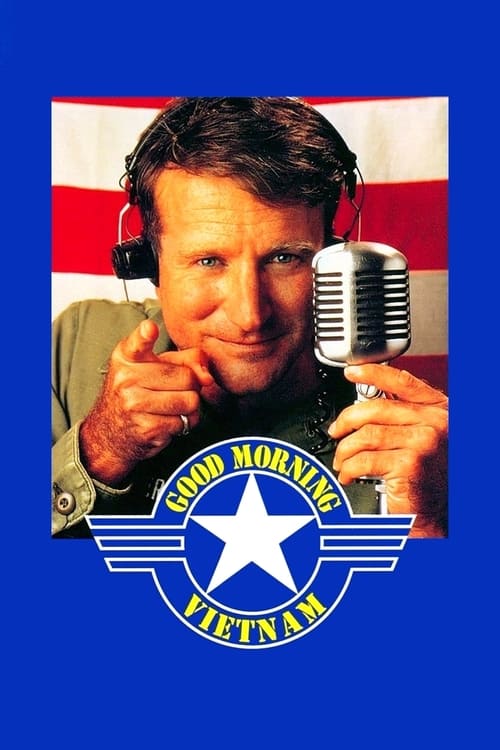
Good Morning, Vietnam
1987 · Barry Levinson
When you want to laugh hard but still feel something real by the end — comfort viewing with a conscience. Good for a night when pure fluff feels too thin.
What it's about
Saigon, 1965. An irreverent disc jockey arrives to host a morning show for Armed Forces Radio and turns the sleepy broadcast into a torrent of impressions, rock 'n' roll, and jokes at authority's expense. The troops love him; his by-the-book superiors want him silenced. As he gets to know the city and its people, the war he's been joking over starts pressing in on the comedy.
The experience
The first half is a rush — you're basically watching a stand-up set with a war lurking behind it — and then the film slows down and gets sadder, letting the laughter and the losses sit side by side. It's funny, then quietly heavy, without ever losing its warmth.
Performances
Robin Williams, in the role that earned him his first Oscar nomination, does something no one else could: the radio broadcasts are essentially uncut Williams improvisation, motor-mouthed and fearless, and he makes the turn into melancholy just as convincing.
The craft
Barry Levinson's smartest move was pointing the camera at Williams and getting out of the way — the DJ-booth scenes have the crackle of live performance. The period soundtrack of 1960s rock and soul does real storytelling work, sometimes playing warmly against very unfunny images, so good speakers earn their keep.
Why it matters
A major box-office hit that redefined Robin Williams from TV comic to serious film star, and it set the template for comedies that smuggle real grief in under the jokes.
Snapshot
Good Morning, Vietnam is a comedy-drama built around a single performance: Robin Williams as Adrian Cronauer, an irreverent disc jockey dispatched to Saigon in 1965 to enliven the Armed Forces Radio Service. The film's organizing tension is the friction between Cronauer's anarchic, improvised on-air comedy and the rule-bound military bureaucracy that wants the airwaves sanitized — a conflict that gradually opens onto the larger, darkening reality of the war itself. What begins as a vehicle for verbal pyrotechnics becomes, in its second half, a more sober meditation on how comedy can both console and evade. Released by Touchstone Pictures, it was a substantial commercial success — among the top-grossing films of its release season — and earned Williams his first Academy Award nomination for Best Actor. It remains a landmark in the negotiation between scripted narrative cinema and improvisational stand-up energy, and it durably reshaped the popular afterlife of at least one piece of music. It is, importantly, less a war film than a film about a performer adjacent to a war.
Industry & production
The picture was produced under the Touchstone Pictures banner, the Disney label created to release adult-oriented material outside the family-brand association of the parent studio; Good Morning, Vietnam belongs to the run of mid-1980s Touchstone hits that established the imprint's commercial credibility. It was produced by Larry Brezner and Mark Johnson, the latter a frequent Levinson collaborator. The project's origin is unusual: it grew out of the real Adrian Cronauer's effort to dramatize his experiences as an AFRS broadcaster, an idea that passed through development before being substantially reconceived by screenwriter Mitch Markowitz and tailored to Williams's gifts. The historical Cronauer has stated publicly that the rebellious, insubordinate figure on screen bears little resemblance to his actual, more conventional service — a candor worth foregrounding, since the film trades on a documentary aura it does not strictly honor.
Production took place not in Vietnam, which was inaccessible to an American crew, but in Thailand — principally in and around Bangkok, with Phuket standing in for additional locations. The choice was a practical necessity that became an aesthetic asset, lending the film a dense, humid, crowded sense of place. The casting brought together character actors who would anchor the dramatic scaffolding around Williams: Forest Whitaker as the eager Private Garlick, Bruno Kirby as the comically humorless Lieutenant Hauk, J.T. Walsh as the menacing Sergeant Major Dickerson, and Tung Thanh Tran and Chintara Sukapatana as the young Vietnamese siblings whose lives complicate Cronauer's. The commercial result was emphatic: the film crossed well over $100 million in North American release, ranking among the year's biggest earners and confirming Williams — to that point better known for Mork & Mindy and stand-up than for box-office drama — as a major film draw.
Technology
Good Morning, Vietnam is a conventionally produced 35mm studio feature of its moment, and its technological interest lies less in the apparatus than in its subject. The film is, at root, about a transmission technology — the radio — and the period-accurate broadcast booth, the turntables, the microphone, the patch of dead air that a DJ must fill, are the literal stage on which the drama is built. The narrative is organized around the act of broadcasting: who controls the signal, what may be said on it, how a voice reaches an audience it cannot see. In that sense the film is an artifact about analog mass media at a historical hinge, when American troops in the field experienced the war partly as a soundtrack piped in from a studio. The production's own technology is unremarkable for 1987 — naturalistic location shooting, no significant optical or effects innovation — but the diegetic technology of radio is the film's true engine.
Technique
Cinematography
The cinematography, by Peter Sova (who had shot Levinson's Diner and Tin Men), favors a warm, naturalistic register suited to the Southeast Asian locations. The camera works hard to capture the texture of Saigon's streets — crowds, markets, motorbikes, the press of bodies — and Sova lets the city breathe around Cronauer rather than isolating him in tidy compositions. The visual approach is generally unobtrusive, prioritizing performance and place over assertive stylization. Its most celebrated achievement is contextual rather than purely photographic: the imagery assembled for the "What a Wonderful World" sequence, which intercuts everyday Vietnamese life and Cronauer's exuberance with documentary-flavored scenes of violence and destruction.
Editing
Editing, by Stu Linder — Levinson's regular cutter — carries an unusually heavy structural burden here, because the film operates in two distinct rhythmic modes. The radio-booth monologues are largely cut to preserve the momentum of Williams's improvisation, holding on him to let the verbal cascade build. The dramatic scenes outside the booth are cut more conventionally. The signal achievement of the editing is the juxtaposition montage: setting Louis Armstrong's "What a Wonderful World" against escalating images of wartime horror, the cutting generates irony purely through assembly, allowing sound and image to comment on each other without a word of dialogue. It is one of the most-cited examples of song-against-image counterpoint in late-1980s American film.
Mise-en-scène / staging
The staging is bifurcated by design. The radio station is a contained, almost theatrical space — a booth framed by glass, observers on the other side, Cronauer performing to a literal and figurative audience. This is where the film's energy concentrates. Outside, the mise-en-scène opens into the dense, layered reality of the city and the military compound, the production design dressing Bangkok into a credible 1965 Saigon thick with period detail. The contrast is thematic: the controlled, performative interior versus the unruly, dangerous exterior the broadcast cannot contain.
Sound
Sound is arguably the film's defining technical dimension, as befits a story about radio. The soundtrack is dominated by licensed period music — mid-1960s rock, soul, and pop — deployed both as Cronauer's on-air playlist and as the film's emotional connective tissue; the resulting soundtrack album was itself a commercial success and helped popularize the curated needle-drop as a marketable object. The film foregrounds source music far more than any traditional orchestral score, an approach that reinforces its premise: we hear the war the way the troops did, through a transistor. The careful layering of broadcast voice, music, and ambient location sound is central to the experience.
Performance
The film lives or dies on Robin Williams, and it lives. His Cronauer is a controlled detonation of free-associative comedy in the booth — voices, accents, impressions, mock-newscasts — much of it improvised and then shaped in the edit. The crucial achievement is that Williams also delivers the dramatic register: the deflation, the anger, the wounded recognition that his comedy cannot fix anything. The supporting performances are calibrated as foils — Kirby's strangled earnestness, Walsh's cold authority, Whitaker's openhearted warmth — so that Williams's improvisational heat has something solid to play against. It is the performance that converted Williams from comic personality to dramatic actor in the public mind.
Narrative & dramatic mode
Structurally, the film is a comic premise that curdles into drama. The first act is propelled almost entirely by Williams's verbal energy and the low-stakes institutional comedy of a free spirit colliding with petty authority. The turn comes as Cronauer's relationships with the Vietnamese characters — his pursuit of Trinh and his friendship with her brother Tuan — pull him toward the human reality the war machine abstracts. A bombing that touches people he knows, and the revelation of Tuan's allegiances, force a reckoning the comedy cannot absorb. The dramatic mode is thus one of disillusionment: the entertainer learns the limits of entertainment. It is not a plot-driven war film but a character study in which the war functions as the off-screen pressure that eventually breaks through the on-air patter.
Genre & cycle
The film sits at the intersection of comedy, drama, and the war film, and it belongs to a specific cultural cycle: the wave of Vietnam War cinema that crested in the late 1980s. It arrived amid Platoon (1986) and Full Metal Jacket (1987) and just before Born on the Fourth of July (1989), a moment when Hollywood was finally processing the war at scale. But Good Morning, Vietnam approaches the subject obliquely — through the rear-echelon world of media and morale rather than combat. In doing so it joins a smaller lineage of war stories told from the margins of the fighting, and it is equally legible as an entry in the "anarchic individual versus the institution" comedy tradition. Its hybridity — broad comedy welded to anti-war seriousness — is precisely what distinguished it within the cycle.
Authorship & method
Barry Levinson directs, and his method here is best understood as curatorial restraint married to a willingness to surrender control. Levinson's signature in films like Diner is an ear for talk — overlapping, digressive, character-revealing dialogue — and Good Morning, Vietnam extends that interest to its logical extreme by handing the talk to an improviser and largely getting out of the way. Reportedly Levinson encouraged Williams to riff freely in the booth scenes and then built the broadcasts in the cutting room, a director-as-editor approach to performance. The film appeared the same year as Levinson's Tin Men and immediately before Rain Man (1988), the latter winning him the Academy Award for Best Director — a remarkably productive stretch.
Among collaborators: screenwriter Mitch Markowitz supplied the dramatic architecture and the scripted scenes around which Williams's improvisation could be organized — a structure robust enough to give the comedy somewhere to land. Cinematographer Peter Sova and editor Stu Linder were both established Levinson collaborators, providing continuity of craft. On the question of a composer: the film is notable for relying on licensed period source music rather than a dominant original orchestral score, so its "music" authorship lies more in song selection and music supervision than in a composer's through-written theme — a point where the conventional auteur-and-composer framing genuinely does not apply in the usual way.
Movement / national cinema
The film is a product of mainstream Hollywood studio filmmaking in its Touchstone/Disney configuration — not an art-cinema or movement work, and not aligned with any formal school. If it belongs to anything beyond commercial American cinema, it is to the loose tendency of 1980s star-driven vehicles engineered around a single performer's distinctive gift, and to the American film industry's belated, market-validated turn toward Vietnam as commercial subject matter. It is firmly a national cinema artifact: an American film, made by Americans, about an American at the edge of an American war, with the Vietnamese characters positioned — as critics have noted — largely in relation to the protagonist's moral education rather than as fully autonomous figures.
Era / period
Two periods are in play. The film depicts 1965 Saigon, the early escalation phase of American involvement, before the war's full catastrophe had registered at home — a setting that lets the film stage innocence curdling into knowledge. It was made and released in 1987, in the Reagan-era moment when American culture was at last willing to look squarely at Vietnam, two decades after the events and a dozen years after the war's end. That gap between depicted period and production period is part of the film's meaning: it looks back at 1965 with the retrospective irony of an audience that knows what came next, an irony the Louis Armstrong montage makes explicit.
Themes
The governing theme is the relationship between comedy and truth — whether humor is a form of honesty or a form of denial. Cronauer's gift is to make people laugh, and the film both celebrates that gift and interrogates its limits when set against suffering it cannot address. Adjacent themes include the control of information and the morality of propaganda: the military's insistence on sanitized news raises the question of what a state owes the people it sends to fight. There is a strong strand of authenticity versus institution — the individual voice against bureaucratic flattening. And there is the theme of recognition across difference: Cronauer's encounters with Vietnamese characters force him, and the audience, to see the war's human ground, even as the film's framing keeps that ground at the periphery of an American's story. Underlying all of it is disillusionment as a coming-of-age — not of youth but of a national self-image.
Reception, canon & influence
Critical reception centered, almost unanimously, on Williams. Reviewers recognized the radio monologues as a genuine event in screen comedy and credited the film with demonstrating that Williams could carry dramatic weight, while a recurring critical reservation held that the scripted dramatic material around the improvisation was the weaker tissue — that the film soared in the booth and sagged elsewhere. Williams's work was honored with an Academy Award nomination for Best Actor and a Golden Globe win in the musical-or-comedy category, cementing the performance as the film's enduring legacy.
Influences on the film run backward to two sources: the late-1980s Vietnam cinema cycle that made the subject commercially viable, and the longer tradition of the institutional-rebel comedy, in which a charismatic individual punctures official solemnity. It also draws on the specific texture of 1960s American radio and pop culture, which it reproduces with affection.
Its influence forward is twofold and durable. First, it advanced the model of the star-comedian improvisational vehicle, validating the practice of building a studio film around an improviser's riffing and shaping it in the edit — a template later filmmakers and performers would draw on. Second, and most concretely, its use of Louis Armstrong's "What a Wonderful World" against images of war became one of the canonical examples of ironic song-and-image counterpoint, reviving the song's cultural presence for a new generation and influencing how subsequent films deploy gentle standards against brutal imagery. The film itself has settled into the canon less as a war film than as the picture that revealed the dramatic Robin Williams — the first major step toward the screen actor he would become.
A Deleuzian reading
"Goooood morning, Vietnam!" The voice goes out across a country the man making it has barely seen.
The full Deleuzian reading of Good Morning, Vietnam →
Reception
A monster hit in 1987–88 that made Robin Williams a bona fide movie star and earned him his first Oscar nomination; today it's remembered less as a Vietnam film than as the definitive early showcase of Williams' improv genius, sitting slightly apart from the Platoon/Full Metal Jacket wave it rode in on.
How Good Morning, Vietnam was received, from release to now →
Influences: the films it descends from and the films it influenced
- M*A*S*H (1970) — Established the institutional-rebel war comedy whose overlapping, anarchic dialogue punctures military solemnity, and used the camp PA loudspeaker as a recurring diegetic-audio engine that anticipates the radio booth.
- A Thousand Clowns (1965) — Built a character study around a verbally torrential nonconformist whose riffing wit defies a humorless institution before the comedy curdles into poignancy — the talker-vs-bureaucracy template Williams inhabits.
- Diner (1982) — Levinson's own prototype for an ear for digressive, overlapping, character-revealing talk that he later pushes to its limit by surrendering the dialogue to an improviser and assembling it in the cut.
- Network (1976) — Made broadcasting the dramatic engine, treating the on-air voice as both bravura performance and a thesis on information control and propaganda — the booth-as-stage logic Levinson reuses.
- The Graduate (1967) — Pioneered licensed pop songs as de facto score, replacing a composer's through-written theme with curated source music — the music-supervision authorship model the film adopts wholesale.
- Mean Streets (1973) — Codified the jukebox needle-drop wedded to image, letting period pop records carry tone and irony rather than an orchestral score.
- Apocalypse Now (1979) — Set the Vietnam-cycle precedent for period source music (The Doors, Wagner over helicopters) and radio/broadcast texture played ironically against war imagery.
- Platoon (1986) — The immediate grunt's-eye Vietnam hit that made the subject commercially viable in the late '80s, opening the studio appetite that greenlit a Saigon-set picture.
- Lenny (1974) — Dramatized a stand-up comedian as serious-actor material, validating the comic-to-dramatic transformation built around a performer's verbal act.
- Reservoir Dogs (1992) — Extends the radio-DJ-as-music-engine ('K-Billy's Super Sounds of the Seventies') and the gentle standard against atrocity, scoring torture to a breezy pop record.
- Forrest Gump (1994) — Pushes wall-to-wall period needle-drops as historical scoring — including Vietnam sequences — building the ironic song-against-image juxtaposition into a structural principle.
- Aladdin (1992) — Direct heir to the model of recording Williams free-associating and assembling the performance in the edit — director-as-editor of an improviser's riffing.
- Mrs. Doubtfire (1993) — A star-comedian improvisational vehicle explicitly architected to leave room for Williams's riffing and shaped around it in post.
- Dead Poets Society (1989) — Advances the comic-to-dramatic turn the film unlocked, channeling Williams's verbal exuberance toward a teacher-as-liberator role with restrained pathos.
- The Fisher King (1991) — Develops the same manic-energy-into-wounded-pathos register, building a drama on Williams's ability to pivot from improvisational mania to raw vulnerability.
- Three Kings (1999) — Carries forward the war film whose ironic pop source cues and wisecracking comedy curdle into moral horror, the tonal whiplash the seed normalized.
- Full Metal Jacket (1987) — A same-year Vietnam film deploying ironic period pop ('These Boots,' 'Surfin' Bird') against brutality, with comedy that curdles abruptly into horror.
Similar films
- Full Metal Jacket (1987) — influence & lineage
- Forrest Gump (1994) — influence & lineage
- Platoon (1986) — influence & lineage
- Aladdin (1992) — influence & lineage
- The Graduate (1967) — influence & lineage
- Dr. Strangelove or: How I Learned to Stop Worrying and Love the Bomb (1964) — shared sensibility
- Groundhog Day (1993) — shared sensibility
- Sorry to Bother You (2018) — shared sensibility