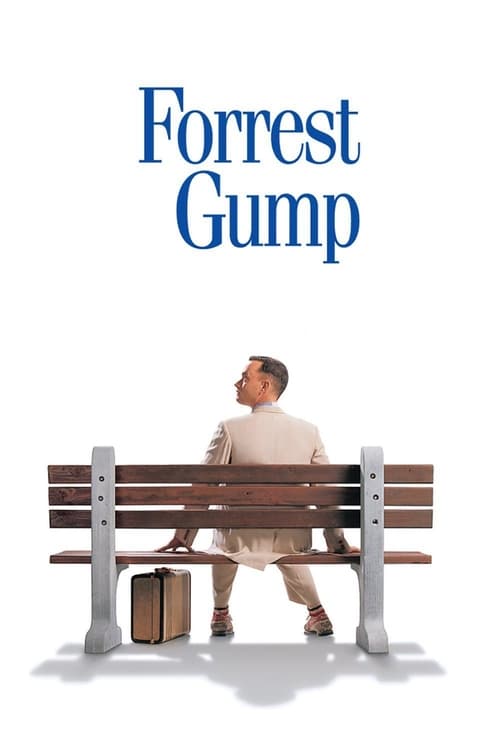
Forrest Gump
1994 · Robert Zemeckis
For a big, comforting movie night when you want to feel the whole range — laughter, nostalgia, a good cry — and come out soft-hearted. It's the definition of a crowd-pleaser; bring people who haven't seen it.
What it's about
Forrest Gump is a slow-witted, sweet-natured Alabama man who narrates his own improbable life from a bus-stop bench: a childhood in leg braces, a football scholarship, Vietnam, shrimp boats, and accidental front-row seats to three decades of American history. Through all of it runs one constant — his devotion to Jenny, the childhood love whose own path through those same decades is far rockier than his. It's a picaresque, a romance, and a tour of postwar America seen through the most guileless eyes imaginable.
The experience
Funny, warm, and unabashedly sentimental, with real melancholy underneath — it sweeps you along for over two hours and then goes for the heart without apology. Expect to laugh early and get misty late.
Performances
Tom Hanks won his second consecutive Best Actor Oscar for a role that could have been a caricature and instead became beloved — precise, dignified, never winking. Gary Sinise's Lieutenant Dan is the film's bitter counterweight, and their scenes together give the sweetness its spine.
The craft
Robert Zemeckis was at the height of his powers as a technologist-storyteller: the effects that place Forrest inside archival footage of presidents and protests were groundbreaking and still play seamlessly. The film is stitched together with famous needle-drops spanning thirty years of American pop music — it's a pleasure on good speakers, and its scale suits the biggest screen you have.
Why it matters
Six Academy Awards including Best Picture, a quotable-forever cultural phenomenon, and one of the most argued-about American films of the 90s — people still debate what its version of history means, which is part of why it endures.
Snapshot
Forrest Gump is the picaresque life story of a simple-hearted Alabama man (Tom Hanks) who, by accident and instinct, brushes against nearly every major event of postwar American history—from desegregation and Vietnam to Ping-Pong diplomacy, Watergate, and the early AIDS era—while remaining doggedly faithful to his childhood love, Jenny. Adapted from Winston Groom's 1986 novel and directed by Robert Zemeckis at the height of his powers as a technologist-storyteller, the film became a cultural and commercial phenomenon, winning six Academy Awards including Best Picture, Best Director, and a second consecutive Best Actor for Hanks. It is simultaneously one of the most beloved and most contested American films of its decade: a feat of sentimental craftsmanship and visual-effects innovation that critics have read variously as a humane fable of decency and as a conservative-leaning rewrite of the 1960s in which passivity is rewarded and political engagement punished. Its blend of digital trickery, needle-drop scoring, and folk-wisdom narration helped define a particular 1990s middlebrow Hollywood mode.
Industry & production
The film was produced by Paramount Pictures, with Wendy Finerman, Steve Tisch, and Steve Starkey credited as producers; Finerman is widely reported to have championed the Groom novel for years before it reached production. The screenplay was written by Eric Roth, who substantially restructured Groom's episodic, more satirical and sprawling novel—dropping subplots (the book sends Forrest into space and has him wrestle professionally, among other diversions) and centering the love story with Jenny as the emotional spine. By the early 1990s Zemeckis was a proven commercial director coming off the Back to the Future trilogy and Death Becomes Her, and Tom Hanks was transitioning from comedy into dramatic leading-man status (he had just won the Oscar for Philadelphia).
The production is frequently cited in industry histories for its unusual financial structure: rather than taking large upfront fees, Zemeckis and Hanks reportedly negotiated points on the film's gross, a gamble that paid off enormously given the film's blockbuster performance. Forrest Gump opened in the summer of 1994 and became one of the year's top earners worldwide and one of the highest-grossing films released to that point, with a long theatrical run sustained by word of mouth. (Specific grosses are well documented in trade sources, but I will not cite exact figures from memory.) Its commercial success, combined with its awards sweep, made it a defining studio property of the mid-1990s and a touchstone in debates about the economics of the "prestige blockbuster."
Technology
Forrest Gump is a landmark in the practical application of digital visual effects to a non-genre, dramatic film—work executed largely by Industrial Light & Magic. Its most celebrated achievements involve compositing Hanks's Forrest into archival footage so that he appears to interact with historical figures, including Presidents Kennedy, Johnson, and Nixon. ILM combined careful blue-screen photography of Hanks with manipulation of the original news footage, including reworking the mouths and expressions of archival figures to "speak" new dialogue, and matching film grain, color, and contemporaneous lens characteristics so the inserts read as period material.
Equally significant, though less remarked at the time, was the digital removal of actor Gary Sinise's legs to portray the double amputee Lieutenant Dan—accomplished by shooting Sinise with his legs wrapped in blue material and erasing them digitally, a then-novel use of effects in service of a performance rather than spectacle. The film also used digital crowd replication, most famously to multiply a modest number of extras into the vast antiwar throng on the National Mall. These techniques—seamless integration of synthetic and archival imagery into ordinary dramatic scenes—pointed toward the "invisible effects" paradigm that would dominate subsequent decades, and they earned the film the Academy Award for Best Visual Effects.
Technique
Cinematography
Don Burgess, a frequent Zemeckis collaborator, shot the film. The visual approach favors warm, accessible, classically composed imagery—golden Southern light, expansive Americana landscapes (the bus stop bench, the running montages across the continent)—rather than showy stylization. The cinematography's discipline is in part a service role: shots had to be conceived and lit to accommodate the digital compositing of Hanks into archival footage and the effects on Lieutenant Dan, requiring controlled blue-screen setups intercut invisibly with naturalistic location work. The recurring motif of the drifting feather that opens and closes the film—following it in a continuous-seeming descent through the air over Savannah—is one of the most discussed images, itself a blend of photography and digital manipulation.
Editing
Arthur Schmidt edited the film and won the Academy Award for Best Film Editing. The cutting is fundamental to the movie's whole conceit: the picture is structured as a frame narrative, with Forrest recounting his life from a bus-stop bench, and the editing must move fluidly across decades, tones, and registers—comedy, war, romance, tragedy—while integrating effects shots so that the historical inserts feel continuous with dramatic scenes. The montage sequences (Vietnam, Forrest's cross-country running, the ping-pong and shrimping enterprises) compress large spans of time into rhythmic, music-driven passages, and the editing repeatedly returns to the bench to re-anchor the audience in the present-tense telling.
Mise-en-scène / staging
The film's design (production design by Rick Carter) is an exercise in meticulous period reconstruction across roughly four decades, from a 1950s Alabama boarding house to Vietnam jungles, the Washington Mall, a 1970s shrimp boat, and beyond. Costume, vehicles, signage, and set dressing are deployed to make each era instantly legible, since the narrative leaps so rapidly through time. Staging frequently places the static, reactive Forrest at the center of dynamic historical action, a compositional strategy that visually encodes the film's central idea: history happens around and to its protagonist while he remains constant.
Sound
The film is saturated with a curated soundtrack of period popular music—an extensive run of rock, soul, and folk recordings deployed as both period markers and emotional cueing across the decades it traverses. This needle-drop strategy, exhaustively used, became one of the film's signatures and a model for the "jukebox" historical soundtrack. Alan Silvestri, Zemeckis's longtime composer, supplied the original orchestral score, whose gentle, recurring main piano-and-strings theme is among his best-known work and functions as the film's sentimental through-line beneath the licensed songs. Sound design also carries the war sequences, contrasting the score's tenderness with the chaos of combat.
Performance
Tom Hanks's central performance—built on a soft, deliberate Southern cadence, a fixed posture, and a guileless directness—won him the Best Actor Oscar and anchors the film's tone; the role's risk lies in sentimentality and in the representation of intellectual disability, which Hanks plays with restraint that many found moving and some found problematic. Robin Wright as Jenny carries the film's darker counter-history of the 1960s and '70s (the counterculture, abuse, addiction, illness). Gary Sinise's embittered, then redeemed Lieutenant Dan is the film's most dramatically charged supporting turn, and Mykelti Williamson plays Bubba; both, along with Sally Field as Forrest's mother, earned strong notice, with Sinise nominated for Best Supporting Actor.
Narrative & dramatic mode
Forrest Gump is built as a first-person retrospective frame narrative: Forrest narrates episodes of his life to strangers at a bus stop, his folksy aphorisms ("life is like a box of chocolates") becoming the film's connective tissue. Structurally it is picaresque—an episodic chain of adventures linking a naïve hero to a cross-section of society—but Roth's adaptation grafts a unifying romantic quest onto that loose form, so that the disparate episodes resolve toward Forrest's lifelong devotion to Jenny. The dramatic mode is fundamentally sentimental and fabular: causality is governed less by realist logic than by fairy-tale coincidence and the recurring philosophical tension the film stages between destiny ("we're all floating around accidental-like on a breeze," per Lieutenant Dan) and free will, dramatized in the bracketing feather motif. The reactive protagonist—who succeeds precisely by not striving in conventional terms—inverts the usual arc of the active hero.
Genre & cycle
The film is a genre hybrid: comedy-drama, romance, war film, and historical epic braided together. It belongs to a lineage of American "innocent abroad in history" narratives—stories in which a naïve or marginal figure becomes an inadvertent witness to or participant in great events. It is frequently grouped with the 1990s cycle of effects-driven prestige dramas and with Zemeckis's own body of work blending technical spectacle with populist emotion. Its needle-drop historical-montage approach and its baby-boomer nostalgia also align it with a broader 1990s cultural reckoning with the 1960s. As a "feel-good" awards blockbuster, it helped define a mid-decade middlebrow mode that prized emotional uplift and technical polish.
Authorship & method
Forrest Gump is most legible as an authored work through Robert Zemeckis's career-long project of fusing cutting-edge technology with broadly emotional, accessible storytelling—a method visible from Who Framed Roger Rabbit (live-action/animation integration) through Back to the Future (time-travel mechanics) and forward to his later motion-capture and digital-de-aging experiments. Gump applies that same instinct—using the most advanced available tools to serve a sentimental, populist narrative—to American history itself. His key collaborators form a recurring repertory: composer Alan Silvestri and editor Arthur Schmidt were longtime Zemeckis partners, and cinematographer Don Burgess shot several of his films. Screenwriter Eric Roth is the crucial authorial voice in adaptation, transforming Groom's broader satire into the more earnest, romance-centered structure; Roth's interest in a passive man borne through history would later echo in his screenplay for The Curious Case of Benjamin Button (also directed by a major auteur, David Fincher), and the two films are often discussed together for their shared episodic-fable architecture. The ILM effects teams should be counted among the film's authors given how constitutive the digital work is to its meaning.
Movement / national cinema
The film is a quintessential product of mainstream Hollywood, not of any avant-garde or art-cinema movement. It is, however, deeply about American national identity: its subject is the second half of the American twentieth century, narrated through a figure positioned as an everyman embodiment of homespun American virtue—endurance, loyalty, decency, luck. In that sense it belongs to a tradition of American national mythmaking on screen, and it can be productively read alongside the Hollywood studio system's recurring impulse to dramatize and reconcile national history for a mass audience.
Era / period
Released in 1994, the film sits at a particular technological and cultural moment: digital visual effects had just been validated for photorealistic use (the prior year's Jurassic Park, also an ILM project, was a watershed), and Gump extended that capability from creatures and spectacle into the manipulation of historical record and the texture of ordinary drama. Culturally, the mid-1990s was a period of baby-boomer ascendancy and nostalgia, and the film's affectionate, often depoliticized tour through the boomer past resonated powerfully. The film depicts roughly the 1950s through the early 1980s; it was made in and speaks very much to the sensibility of the early-to-mid 1990s, a relatively prosperous, retrospective American moment.
Themes
Central to the film is the tension between destiny and chance, posed explicitly by Lieutenant Dan and Forrest's mother and visualized in the floating feather: is a life shaped by fate, by accident, or by some mixture? Closely related is the theme of innocence and goodness as a kind of grace—Forrest prospers not through cunning or ambition but through simple constancy, kindness, and the willingness to keep moving (literally, in his running). The film meditates on American history as something experienced rather than authored, raising questions (which critics have pressed hard) about agency and political engagement: Forrest's apolitical passivity is rewarded, while Jenny's active immersion in the counterculture leads to suffering. Other persistent threads include loyalty and love (to Jenny, to Bubba, to his mother, to Lieutenant Dan), trauma and redemption (Lieutenant Dan's arc from despair to peace), disability and difference, and loss and mortality. The recurring images of running, of water and the shrimping sea, and of the bench-bound act of storytelling itself bind these themes together.
Reception, canon & influence
Critical reception in 1994 was strong but notably divided in a way that has only sharpened over time. Many reviewers praised the film's emotional power, Hanks's performance, and its technical artistry, and audiences embraced it overwhelmingly; it swept the Academy Awards, taking Best Picture, Director, Actor, Adapted Screenplay, Film Editing, and Visual Effects. At the same time, a significant critical counter-current—then and especially in later reappraisals—charged the film with sentimentality and with a conservative reading of recent American history: that it valorizes a passive, incurious protagonist while punishing or caricaturing the era's activists and dissenters, effectively sanding down the political conflicts of the 1960s into reassuring nostalgia. Its triumph over Pulp Fiction and The Shawshank Redemption at the 1995 Oscars has become a recurring shorthand in debates about Academy taste.
Influences on the film run backward to the American picaresque and to "innocent witness to history" narratives, to Groom's source novel, and technologically to the immediately preceding breakthroughs in photorealistic digital effects (Jurassic Park). Its forward legacy is multiple. Technically, its seamless insertion of an actor into archival footage and its "invisible" effects work influenced subsequent historical and biographical filmmaking and anticipated later digital manipulation of the human image. Narratively and tonally, it helped popularize the sweeping, music-saturated historical-life-story mode—Eric Roth's later The Curious Case of Benjamin Button is the clearest descendant. As a cultural object, the film entered the American vernacular through its catchphrases and images to a degree few films achieve, and it remains a fixture of debates about nostalgia, national memory, and the politics of "feel-good" cinema. It was selected for preservation in the National Film Registry by the Library of Congress, a marker of its recognized cultural significance. The genuine scholarly disagreement about what the film means—humane fable or ideological lullaby—is itself part of its lasting standing.
A Deleuzian reading
Forrest stands in the Oval Office, pumps the President's hand, and tells John F.
The full Deleuzian reading of Forrest Gump →
Reception
A box-office juggernaut and six-time Oscar winner in 1995 — including Best Picture over Pulp Fiction and The Shawshank Redemption — it's since become the go-to example of an Academy choice film fans love to relitigate, even as its popular affection never really faded.
How Forrest Gump was received, from release to now →
Influences: the films it descends from and the films it influenced
- Zelig (1983) — Optically inserts a passive everyman into doctored archival newsreels and period photographs, the direct formal template for Gump's seamless compositing of Hanks into historical footage.
- Dead Men Don't Wear Plaid (1982) — Splices a present-day actor into vintage film stock via matched lighting, framing, and editing — the 'invisible' archival-insertion gag that Gump later industrialized digitally.
- Being There (1979) — Builds an entire narrative around a blank, reactive protagonist onto whom American power and media project their own meanings, the behavioral model for Gump's incurious witness.
- Little Big Man (1970) — Frames national history through an aged narrator who improbably witnesses every defining event of his era — the picaresque 'innocent witness to history' frame structure Gump inherits.
- American Graffiti (1973) — Uses wall-to-wall diegetic period pop as the primary engine of nostalgia and era-marking, the needle-drop soundtracking method Gump scales across three decades.
- Who Framed Roger Rabbit (1988) — Zemeckis's prior breakthrough in seamlessly integrating a live performer with a separate image layer, the compositing R&D, ILM relationships, and crew that fed directly into Gump.
- Back to the Future (1985) — Established the Zemeckis–Silvestri–Schmidt repertory and his signature method of wedding meticulous period reconstruction to the era's most advanced effects technology.
- Jurassic Park (1993) — ILM's immediately preceding leap into photorealistic CGI made Gump's invisible digital compositing and crowd replication technically possible the very next year.
- In the Line of Fire (1993) — Popularizes the narratively motivated digital insertion of an actor into historical footage that ITLOF used quietly for its Dallas flashbacks a year earlier.
- Good Morning, Vietnam (1987) — Pushes wall-to-wall period needle-drops as historical scoring — including Vietnam sequences — building the ironic song-against-image juxtaposition into a structural principle.
- Rain Man (1988) — Centers a neurodivergent-coded static protagonist who refuses an arc yet forces change in everyone around him — Rain Man's 'static character forces change' inverted into sentiment.
- The Unbearable Lightness of Being (1988) — Carries the fiction-into-newsreel compositing into the digital era, inserting a performer into real archival footage as the now-standard model the film helped legitimize.
- The Curious Case of Benjamin Button (2008) — Eric Roth reuses the episodic-fable architecture of a passive man borne through history, paired with digital de-aging and face replacement that extends Gump's manipulation of the human image.
- Cast Away (2000) — Continues the Hanks–Zemeckis–Silvestri–Burgess repertory, building another emotional epic around Hanks as a solitary everyman carried by forces beyond his control.
- The Polar Express (2004) — Pushes Gump's interest in digitally manufacturing the human image all the way to full performance-capture, Zemeckis's next escalation of synthetic-human realism.
- Gladiator (2000) — Uses digital crowd replication to fill the Colosseum with multiplied extras, extending Gump's invisible technique of cloning sparse crowds into mass period spectacle.
- The Irishman (2019) — Digitally de-ages its actors to let single performers span decades of American history, the logical endpoint of Gump's manipulation of the actor's body across time.
- Big Fish (2003) — Structures an American everyman's life as episodic tall-tale fable, braiding personal myth with sweeping nostalgia in the same picaresque-fable architecture.
- I, Tonya (2017) — Advances the digital insertion of a performer into reconstructed real footage, the VFX lineage I, Tonya extends by grafting Robbie's face onto stunt skaters for the triple axel.
- Good Bye, Lenin! (2003) — The technique of compositing the protagonist's reality into doctored broadcast archive — Gump's fake newsreels prefigure the faked Aktuelle Kamera bulletins Alex fabricates for his mother.
- The Secret Life of Walter Mitty (2013) — The passive everyman carried through sweeping American landscapes, scored by curated period needle-drops that function as narration rather than underscore.
- Vaaranam Aayiram (2008) — Its retrospective first-person voiceover threading a man's episodic life through public historical events is the narration-led life-story architecture Vaaranam adopts (down to war and cross-continental settings).
- 42 (2013) — Burgess's schooling in invisible compositing and crowd multiplication — a few hundred extras tiled into a full period stadium, digital extension matched to practical light so the seam never reads — is the same toolkit that rebuilds Ebbets Field and Crosley Field here.
- Sleepy Hollow (1999) — ILM's rotoscoped erasure of Gary Sinise's legs — a live performer shot in a keyable covering, then subtracted while the surrounding practical world is untouched — is the exact technique behind the Horseman: an actor performing in a blue hood so the head can be removed without disturbing the practical costume, blood and horse.
- Slumdog Millionaire (2008) — Deploys a frame-narrative picaresque in which a naive protagonist recounts a life that repeatedly collides with the nation's defining historical events.
- JFK (1991) — Intercuts fabricated footage with real archival material to insert invented moments into the documentary record of American history — a contemporaneous experiment in the archival-blending Gump perfected.
- Born on the Fourth of July (1989) — The Lt. Dan arc — the embittered paralyzed Vietnam veteran who rages at a God and country that abandoned him before finding reconciliation — is a direct popular echo of Kovic's wheelchair-bound conversion.
- Midnight in the Garden of Good and Evil (1997) — Shot in Savannah's squares and Bonaventure-adjacent spaces just before Midnight, fixing the same city's visual iconography in prestige cinema using its location architecture as character.
- Nirvanna the Band the Show the Movie (2026) — Advanced the technique of digitally inserting a fictionalized everyman into authentic historical footage and altering archival figures to interact with him.
Similar films
- The Curious Case of Benjamin Button (2008) — influence & lineage
- Back to the Future (1985) — influence & lineage
- The Shawshank Redemption (1994) — shared sensibility
- Finding Nemo (2003) — shared sensibility
- The Notebook (2004) — shared sensibility
- Pulp Fiction (1994) — shared sensibility
- The Graduate (1967) — shared sensibility
- The Best Years of Our Lives (1946) — shared sensibility
All the films related to Forrest Gump →