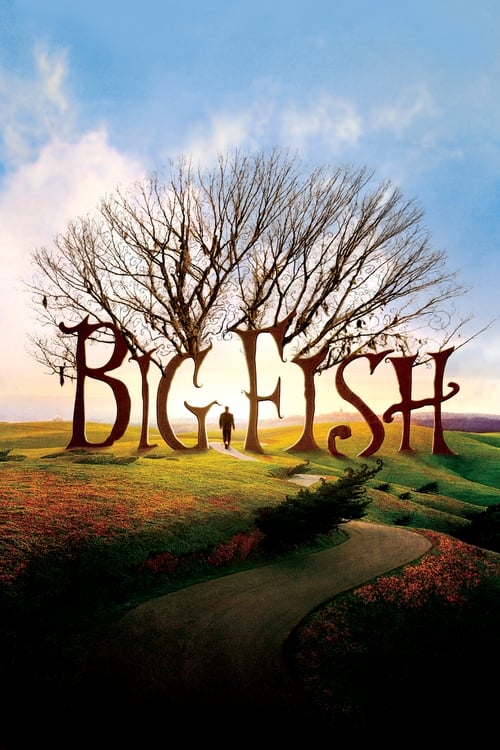
Big Fish
2003 · Tim Burton
For a night when you want to be swept up in a story and don't mind crying at the end of it — comfort viewing with real feeling underneath. Reach for it when you're thinking about your parents, or when you want fantasy that's about love rather than escape.
What it's about
Edward Bloom has spent his whole life telling tall tales about himself — a giant, a witch with a glass eye, a circus, a town too perfect to leave, an uncatchable fish. His son Will, a journalist with no patience for embellishment, has grown estranged from a father he feels he's never actually met. When Edward falls seriously ill, Will comes home and tries to sift the real man out of the legend, while the film plunges us into the wild, colorful adventures as Edward tells them.
The experience
Warm, whimsical, and openly sentimental — it swings between storybook wonder and a quiet, aching father-son standoff at a hospital bedside. The fantasy sequences are playful and buoyant, but the whole thing is building toward an emotional payoff that sneaks up on you and lands hard.
Performances
Albert Finney gives the dying Edward a charmer's twinkle and a stubborn dignity, while Ewan McGregor plays his younger self with an open-hearted, almost impossible optimism; Billy Crudup grounds it all as the son who just wants one true story.
The craft
Tim Burton trades his usual gothic shadows for saturated Southern sunlight, staging the tall tales as gorgeous, slightly heightened set pieces — a field of daffodils, a circus, a witch's swamp — that look and feel distinct from the muted present-day scenes. The production design and imagery reward a big screen, and the film's structure, weaving decades of yarns into one deathbed reckoning, is quietly intricate.
Why it matters
Widely read as Burton's most personal film, it showed the gothic fabulist could break hearts without a single haunted house, and it remains the movie people cite when they talk about fathers, sons, and the stories families tell about themselves.
Snapshot
Big Fish is Tim Burton's adaptation of Daniel Wallace's 1998 novel Big Fish: A Novel of Mythic Proportions, a father-son reconciliation told through the tall tales an dying man has spun about his own life. Salesman Edward Bloom (Albert Finney in old age, Ewan McGregor in his mythic youth) has always narrated his life as a sequence of impossible adventures — a giant, a witch who shows your death in her glass eye, a werewolf ringmaster, a perfect uncatchable fish. His son Will (Billy Crudup), a journalist estranged by exactly this habit of embellishment, returns home as his father is dying and tries to separate the man from the legend. The film sits at the emotional center of Burton's filmography: less gothic than Edward Scissorhands or Sleepy Hollow, warmer and more openly sentimental, and widely read as his most personal work because it arrived immediately after the deaths of both his parents. It earned broadly positive reviews, a single Academy Award nomination (Danny Elfman, Best Original Score), and has grown into one of Burton's most beloved titles, later adapted into a Broadway musical.
Industry & production
The project predates Burton's involvement. John August adapted Wallace's novel, and Steven Spielberg was attached to direct for a period, with Jack Nicholson reportedly considered for the Bloom role — a well-documented stage of development, though the specifics of why it dissolved are recounted variously in the press and should be treated as trade lore rather than settled fact. When Spielberg moved on, Burton came aboard for Columbia Pictures (Sony). The producing team was notably heavyweight: Richard D. Zanuck, a Hollywood veteran whose credits reach back to Jaws, alongside Bruce Cohen and Dan Jinks, fresh from American Beauty.
The timing is central to the film's reception history. Burton has said in interviews that his father died in 2000 and his mother in 2002, and that the material's reckoning with a father who is both intimately known and fundamentally unknowable spoke directly to his own situation. Whatever weight one gives to authorial biography, the account is consistent across his press for the film and is part of the standard record.
Production was based largely in Alabama — Wetumpka, Montgomery, Tallassee and surrounding areas — which supplied both the Southern setting the novel demands and the built environments, most famously the idyllic hidden town of Spectre. Precise budget and box-office figures vary between sources; the honest summary is that the film was a moderate commercial performer rather than a blockbuster, and that its cultural standing has outrun its original theatrical footprint.
Technology
Big Fish was shot photochemically on 35mm by Philippe Rousselot, and its effects strategy is instructive for its moment. The early 2000s were a period of rapidly maturing digital imagery, yet Burton leaned toward practical and in-camera solutions wherever possible. The giant, Karl, was played by Matthew McGrory, an unusually tall actor, with scale achieved substantially through forced perspective and staging rather than pure compositing. Digital effects were reserved for elements that could not be staged — the titular fish, certain transformations, and set extensions — and used with relative restraint compared to contemporaneous fantasy spectacle. The result is a film whose fantastical register reads as handmade and storybook rather than photoreal, a deliberate aesthetic choice that aligns the technology with the theme: these are images as told, not as documented.
Technique
Cinematography
Rousselot's photography is the film's most discussed craft element and the clearest signal of Burton working against type. Rather than the desaturated, high-contrast palette associated with the director's gothic mode, Big Fish is built on warm, saturated, golden light in its tall-tale sequences — deep greens, a famous field of yellow daffodils, sunlit small-town Americana rendered as memory rather than reality. The framing device is distinguished tonally: the "present tense" of Will at his father's bedside is cooler and more naturalistic, so that the switch into Edward's stories is legible as a switch into a heightened, idealized world. This calibrated contrast between mundane frame and mythic interior is the film's core visual grammar.
Editing
Chris Lebenzon, Burton's long-standing editor, cut the film, and the central editorial problem is structural: Big Fish continuously braids a naturalistic present with nested, non-chronological flashbacks, and the emotional payoff depends on those registers speaking to each other. The cutting has to sustain two temporalities and make the transitions between them feel like acts of storytelling — a father beginning a tale, a son resisting it — while withholding the reconciliation until the finale. The convergence of the two timelines in the closing river sequence, where Will finally takes over the telling, is the structure's resolution and the editing's decisive gesture.
Mise-en-scène / staging
Production designer Dennis Gassner and costume designer Colleen Atwood build a world that is recognizably American and Southern yet tilted toward fable. Spectre — the too-perfect town where the grass is soft enough to go barefoot — is the signature set: an emblem of arrested paradise that the film revisits in decay, so that the location itself carries a narrative arc. Atwood's costuming distinguishes the eras and registers, dressing the young Edward's picaresque in a brighter, more theatrical key. Burton's staging draws on circus iconography and sideshow tableaux, and critics have frequently noted a Felliniesque quality to the ringmaster-and-carnival material — a reasonable lineage to name, though best framed as critical observation rather than a documented citation.
Sound
Danny Elfman's score is the film's most decorated element and its emotional spine, working in his lyrical rather than his macabre mode; it received the film's sole Oscar nomination. The other notable musical component is Pearl Jam's "Man of the Hour," an original song written for the film and used over the end credits, which extends the picture's elegiac reading of a life into its final minutes. Beyond the music, the sound design supports the tonal split between frame and tale, though it is the score and song, not the effects work, that carry the film's sonic identity.
Performance
The performances are organized around a doubling conceit: two actors play Edward across a lifetime, and the film asks the audience to accept them as one continuous person. Ewan McGregor plays the young Bloom with an open, guileless charm that makes the tall tales endearing rather than boastful; Albert Finney supplies the old man's stubborn, twinkling insistence on his own legend, and it is Finney's work that gives the deathbed material its gravity. Billy Crudup grounds the film as the skeptical son, a necessarily reactive role that has to hold the audience's own doubt. The deep supporting bench — Jessica Lange and Alison Lohman as Sandra old and young, Helena Bonham Carter doubling as Jenny and the Witch, Steve Buscemi as the poet-turned-bank-robber Norther Winslow, Danny DeVito as the ringmaster Amos Calloway, and Marion Cotillard in an early English-language role as Will's wife Joséphine — populates the fables with faces vivid enough to survive their brief, iconographic appearances.
Narrative & dramatic mode
The film's mode is framed, nested storytelling shading into magical realism. Its engine is an unreliable narrator whose unreliability is the point: Edward's stories are literally impossible, and the drama lies not in debunking them but in Will's — and the audience's — shifting relationship to them. Structurally it alternates a realist frame (a son at a dying father's bedside) with fabulist interior tales, and it withholds resolution until it collapses the two: in the finale Will himself invents Edward's death as a grand return to the river, adopting his father's idiom as an act of love and thereby validating the whole method retroactively. This is the film's central dramatic move — it does not ask whether the tales were true, but reframes truth as something storytelling does rather than reports. A coda then reveals that fragments of the fantastical figures had real counterparts, gently confirming that the legends were embroideries on fact rather than pure fabrication.
Genre & cycle
Big Fish sits at the intersection of fantasy, adventure and family drama, but its more precise home is the magical-realist memory film — the life story told as tall tale. Its nearest cultural neighbor in American cinema is Forrest Gump, another fabulist sweep through a mythologized American life, and comparisons to Amélie's storybook whimsy were common at the time; within Burton's own work it rhymes most closely with Edward Scissorhands as sincere fable. It also draws on an older, distinctly Southern and American vernacular tradition — the fishing yarn, the traveling-salesman legend, the tall tale as regional folk form — which gives its fantasy a rootedness that distinguishes it from Burton's European-gothic register.
Authorship & method
As auteur text, Big Fish is the film most often cited to complicate the caricature of Burton as a purveyor of gothic spectacle. The recurring Burton preoccupations are all present — the misfit hero, the fascination with sideshow and carnival, the tension between conformist small-town normalcy and marvelous difference — but they are turned toward warmth and reconciliation rather than melancholy alienation. The collaborative signatures are equally legible: Danny Elfman's score continues the composer-director partnership that defines Burton's sound; Chris Lebenzon's editing manages the dual-timeline architecture; Colleen Atwood's costuming carries the design across eras. Rousselot's cinematography is the notable variable — not a Burton regular, and his lush, golden palette is a large part of why the film feels tonally distinct. John August's screenplay does the essential structural work of externalizing the novel's episodic mythology into a frame-and-tale drama with a payoff the book's looser form does not identically provide.
Movement / national cinema
The film belongs to no organized movement; it is a mainstream American studio production and is best understood as an authored work within Hollywood fantasy rather than as part of a school. If it has a national-cinema identity it is a specifically American one — Southern regional folklore filtered through a studio fantasist — even as critics reached for European touchstones (Fellini's circuses, French whimsy) to describe its texture. Naming those touchstones as influence-in-the-air is fair; asserting them as programmatic allegiance would overstate the record.
Era / period
Big Fish is a product of early-2000s Hollywood, and it is legible as a deliberate course-correction within Burton's own career: it followed his poorly received Planet of the Apes remake (2001) and reoriented him toward emotional sincerity over franchise spectacle. Technologically it belongs to the moment when digital effects were becoming ubiquitous, and its comparative restraint — favoring forced perspective, practical staging and a photochemical look — is itself period-significant, marking a filmmaker choosing handmade fantasy at exactly the point the industry was tilting toward the digital.
Themes
The governing theme is the relationship between storytelling and truth — the tall tale not as a lie but as a form of intimacy, a way of rendering a life larger so that it can be loved and remembered. From this flow the film's other concerns: the father-son estrangement and its healing; the labor of knowing a parent, who remains partly unknowable; mortality and how a person authors their own death; and the mythologizing of the American life, with its salesmen, small towns, and roads leading to hidden paradises. The film ultimately argues that memory and myth are not opposed to fact but are the means by which a life becomes meaningful to those who survive it — a person, Edward insists and the film finally agrees, becomes the stories people tell about him.
Reception, canon & influence
Critical reception on release was broadly positive, with particular praise for Elfman's score, Rousselot's photography, and the film's emotional generosity; the most common reservation was that it tipped into sentimentality. It received a single Academy Award nomination, for Elfman's score. Reading it against the deaths of Burton's parents became — and remains — the dominant critical frame, and its standing has risen over time into one of his warmest and most enduring films.
Its influences run backward to Daniel Wallace's source novel and, through it, to the Southern and American tall-tale tradition; to the fabulist-Americana lineage that Forrest Gump had recently made commercially potent; and to the circus-and-carnival imagery that critics tied to Fellini. Looking forward, its most concrete legacy is the stage adaptation Big Fish: The Musical, which reached Broadway in 2013 with a book by John August, extending the property into another medium. More diffusely, the film became a durable reference point for the "life-as-tall-tale" memory film and for father-son storytelling, and it is frequently invoked as the counterexample to any reductive account of Burton as a gothic stylist — evidence that his central subject was always the marvelous outsider, and that here he simply told that story as an act of love.
A Deleuzian reading
The witch has a glass eye.
The full Deleuzian reading of Big Fish →
Reception
Received warmly but modestly in 2003 — solid reviews, a Best Score Oscar nod for Danny Elfman, no huge awards splash — it has since been canonized by fans as the last truly great Tim Burton film, the sincere high point before the remake era.
How Big Fish was received, from release to now →
How to watch Big Fish: what to notice on a first viewing
- Watch the temperature of the light change when Edward starts a story. Rousselot shoots the hospital and the present cool and plain. The tall tales come in warm, saturated gold: deep greens, yellow daffodils, sunlit small-town streets. The switch happens every time. The color tells you which register you are in, and never tells you which one is true.
- Look at the props Edward offers as proof of his tall tales. Burton gives each tale a solid object, a glass eye, a ring, a flower, and lets Edward point at it as evidence. A prop makes a tall tale feel true, which is why Edward keeps one close.
- Watch Ewan McGregor's open face, then Albert Finney's stubborn grin. Two actors play Edward and the film never smooths the seam. McGregor makes the boasting guileless. Finney insists on the legend from a sickbed. You are asked to accept them as one man. Accepting the double is the same act as accepting the stories, and the film asks for both early.
- Notice the town of Spectre, where the grass lets people go barefoot. Gassner built a too-perfect place. Hold onto the first version: the shoes hanging on the wire, the softness underfoot. A place built from a storyteller's memory looks more like a wish than a map.
- Listen for Elfman's score in its lyrical mode, not his spooky one. The music that usually clanks and cackles in Burton films here swells and sings. It leads you into the tales and thins out at the bedside, doing the same tonal split the light does. The score is the film's emotional spine, telling you when to lean into wonder and when to sit still.
The whole guide to watching Big Fish, with the keys for a rewatch →
Influences: the films it descends from and the films it influenced
- Forrest Gump (1994) — Supplies the fabulist-Americana template Big Fish adapts: an episodic tall-tale life in which a folksy narrator threads one ordinary man through improbable set-pieces, the commercially proven structure August externalizes from Wallace's looser novel.
- Amarcord (1974) — Model for small-town memory rendered as grotesque tall tale — exaggerated caricatures and seasonal vignettes staged as remembered spectacle rather than literal event, the Fellini debt critics tied to Big Fish's Ashton.
- 8½ (1963) — Its circus-parade finale, in which the entire cast assembles as ring performers, is the direct antecedent of Big Fish's closing procession where every tall-tale figure gathers at the riverbank.
- Freaks (1932) — Establishes the sideshow/carnival iconography of the marvelous outsider — the giant, conjoined performers, the traveling circus — staged with real bodies, the visual grammar Burton's Calloway circus inherits.
- The Wizard of Oz (1939) — Prototype for the mundane frame-world giving way to a saturated fantasy palette, with the same actors doubled across both realms — the tonal-framing and dual-casting logic Big Fish uses to separate teller from tale.
- Citizen Kane (1941) — The unreliable-biography frame: a man's life reconstructed after his death through others' partial, contradictory tellings, so the 'true' figure remains an interpretive reconstruction rather than a fact.
- The Princess Bride (1987) — Nested storytelling frame in which a skeptical listener repeatedly negotiates a beloved teller's embellishments — the son/father listener-teller bargain over what to believe that structures Will and Edward Bloom.
- Edward Scissorhands (1990) — The core authorship line: Burton–Elfman scoring partnership, the marvelous-outsider hero in conformist suburbia, and a framing narration that turns a life into cherished myth.
- A River Runs Through It (1992) — Where DP Philippe Rousselot forged the Oscar-winning golden, river-centered Americana palette — lush warm naturalism around water and family — that he reprises to give Big Fish its tonally distinct glow.
- Midnight in the Garden of Good and Evil (1997) — Alabama tall-tale of Southern eccentrics framed by a returning outsider piecing together a milieu, extending Midnight's affectionate gallery-of-characters mode.
- The Adventures of Baron Munchausen (1988) — Inherits the unreliable-marvelous ending device exactly: the tall tales are validated when the story's impossible figures — giant, conjoined twins, witch — turn up as physical, practically-realized bodies in the teller's ordinary world.
- The Fall (2006) — Extends the teller/listener bargain: a bedridden storyteller conjures a lavish tale we watch literalized on practical locations, foregrounding how the listener's imagination and stakes reshape the images.
- Pan's Labyrinth (2006) — Carries forward magical realism as a coping device straddling a hard real world, realized through practical creature effects and forced perspective rather than digital fantasy.
- The Curious Case of Benjamin Button (2008) — Screenwriter Eric Roth (of Forrest Gump) reprises the framed episodic fabulist-life structure as a deathbed retelling, the direct lineal continuation of the tall-tale memory film Big Fish crystallized.
- Life of Pi (2012) — Advances the storytelling-and-truth thesis to its endpoint: an unreliable narrator offers two versions and asks which story you prefer, making the choice-to-believe the film's argument, exactly Will's arc.
- The Grand Budapest Hotel (2014) — Inherits the nested frame-tale architecture and storybook artifice, using layered narrators and openly constructed sets to present narration itself as a fond, embellished act of preservation.
- The Secret Life of Walter Mitty (2013) — The interleaving of a mundane frame narrative with heightened, tall-tale fantasy episodes as a structural engine — reality and daydream cross-cut as equal registers.
- Miss Peregrine's Home for Peculiar Children (2016) — Builds narrative out of tall-tale vignettes conjured from old images and eyewitness curiosities—the same wonder-from-found-photographs conceit Riggs's book supplies.
- Amélie (2001) — Contemporary parallel in saturated golden-green magical realism driven by a mischievous omniscient narrator who literalizes whimsy into vignettes, the same storyteller-controls-the-image device.
- The Lord of the Rings: The Fellowship of the Ring (2001) — Same-era forced-perspective scale work: the in-camera trickery Jackson used to shrink hobbits beside full-size actors is the technique Burton uses for the giant Karl and the grown Edward towering over Ashton.
Similar films
- Edward Scissorhands (1990) — influence & lineage
- The Princess Bride (1987) — influence & lineage
- The Fall (2006) — influence & lineage
- The Wizard of Oz (1939) — influence & lineage
- The Curious Case of Benjamin Button (2008) — influence & lineage
- Forrest Gump (1994) — influence & lineage
- Spirited Away (2001) — often watched together
- Ponyo (2008) — often watched together