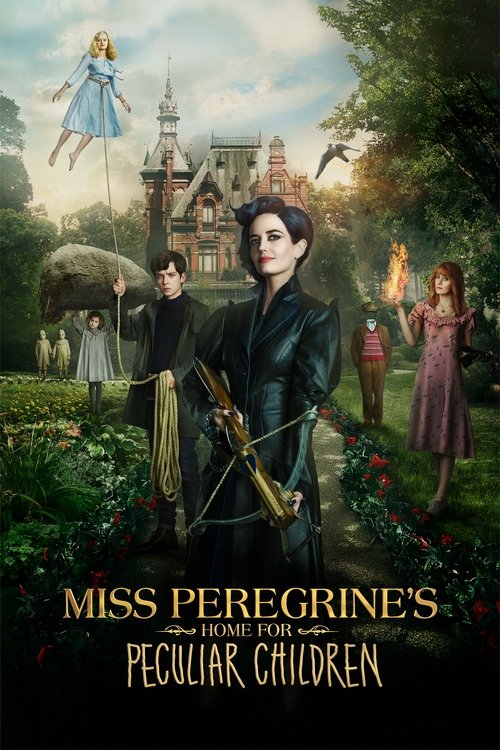
Miss Peregrine's Home for Peculiar Children
2016 · Tim Burton
For a rainy-evening escape into a strange, beautiful world — when you want fantasy with teeth, or a gateway spooky film to share with a brave teenager. Cozy-eerie rather than truly frightening.
What it's about
After a family tragedy, teenager Jacob follows his grandfather's tall tales to a remote Welsh island — and finds they were true. Hidden inside a single endlessly repeating day in 1943, the shape-shifting Miss Peregrine shelters a household of children with strange gifts, and Jacob's arrival draws him into their long war against monstrous predators who hunt the peculiar.
The experience
Gothic and whimsical in equal measure — a storybook adventure with a genuinely creepy streak, more macabre than most YA fantasy dares to be. It's atmospheric and image-drunk, favoring mood and invention over propulsive plotting.
Performances
Eva Green is the film's magnetic center as Miss Peregrine — clipped, birdlike, fiercely protective — a character actress performance that gives the fantasy its spine.
The craft
Tim Burton's production design and creature work are the draw: a lovingly detailed 1940s time-loop, inventive visualizations of each child's gift, and villains with real nightmare-fuel imagery. A handmade-feeling set piece involving skeletons is worth the ticket alone; the film rewards a big screen for its density of visual detail.
Why it matters
A late-career Burton hit that stands as his most successful graft of the gothic-whimsical sensibility onto the YA-franchise era, and it introduced Ransom Riggs's found-photograph novels to a much wider audience.
Snapshot
Miss Peregrine's Home for Peculiar Children is Tim Burton's adaptation of Ransom Riggs's 2011 young-adult novel, a fantasy adventure built around a Welsh island where a "peculiar" headmistress shelters gifted children inside a repeating loop of time. A teenager, Jacob Portman, follows the trail of his late grandfather's stories to that island, discovers the loop is real, and is drawn into a war between the peculiars and a faction of monstrous predators who feed on them. The film arrived at a particular moment in Burton's career — after the divisive live-action Alice in Wonderland (2010) and Dark Shadows (2012) and the smaller, sincere Big Eyes (2014) — and it reads as an attempt to graft his signature gothic-whimsical sensibility onto the franchise-scaled YA fantasy machine that had dominated the previous decade. It is a handsome, densely designed picture that critics generally found more accomplished as spectacle and atmosphere than as storytelling, and it stands as a revealing case study in how an idiosyncratic auteur negotiates studio material engineered for a possible series.
Industry & production
The film was produced and distributed by 20th Century Fox and released in the autumn of 2016. Its source, Riggs's debut novel, had been a substantial commercial success — a bestseller distinguished by its unusual construction around genuine vintage found photographs, which the author collected and wove into the narrative so that the "peculiar" children's uncanny images appear as documentary artifacts embedded in the text. That gimmick made the property visually pre-loaded in a way ideally suited to a filmmaker whose entire career has trafficked in the strange-photograph aesthetic, and the studio's interest in the book as potential franchise material fits squarely within the post-Harry Potter, post-Twilight, post-Hunger Games appetite for adaptable YA fantasy series.
Fox engaged Jane Goldman to write the screenplay, an experienced hand at genre adaptation. Burton came aboard as director, bringing with him several longtime collaborators — most conspicuously costume designer Colleen Atwood and editor Chris Lebenzon — while pairing with cinematographer Bruno Delbonnel, with whom he had just worked on Big Eyes. The production was mounted at genuine scale, with location work anchored to the atmosphere of a remote British island and a period-Blackpool climax, supported by extensive visual-effects work for the film's invisible monsters and set-piece action. Precise budget and box-office figures are not something I will assert here; the general record is that the film performed modestly rather than becoming the franchise cornerstone Fox might have hoped, and no sequel followed. That commercial outcome is itself part of the film's significance: it marks a point where the studio-scaled fantasy vehicle and Burton's authorial voice met without producing a durable series.
Technology
The film sits comfortably within the mature digital-production and digital-VFX era of the mid-2010s, and its technological interest lies less in any single innovation than in how it blends techniques. Its most notable choice is deliberately retrograde: the climactic confrontation stages a battle involving skeletons animated in a manner that consciously evokes stop-motion, an explicit homage to Ray Harryhausen, whose skeleton sequences in films like Jason and the Argonauts (1963) are foundational to Burton's imagination. Burton has been a lifelong Harryhausen devotee, and his own career includes hand-crafted stop-motion features; here he folds that tradition into a large digital production so that a handmade-feeling idiom coexists with contemporary CG creatures. The film's antagonists — the tall, tentacle-mouthed "Hollows" — are rendered as digital effects designed to be partly invisible, a conceit that leans on modern compositing to depict monsters the human characters largely cannot see. The picture also depends on digital environment work to realize the time-loop world, the island, and the seaside spectacle of the finale. In short, the technology is standard for a major 2016 fantasy release, distinguished mainly by its self-aware nostalgia for older effects craft.
Technique
Cinematography
Bruno Delbonnel's photography is among the film's strongest assets and the clearest marker of its ambitions above ordinary franchise product. Delbonnel, whose credits include Amélie, the Coen brothers' Inside Llewyn Davis, and a Harry Potter installment, brings a painterly, controlled-palette sensibility that suits both the storybook interior of the loop and the drearier "present-day" Florida and Welsh material. The loop world is lit with a warmer, more enchanted glow that distinguishes it from the flatter contemporary scenes, using color temperature and light quality to separate the film's temporal registers. Delbonnel favors composed, deliberate framing over restless coverage, which gives the fantastical imagery room to register as tableau — appropriate for a story that literally originates in still photographs.
Editing
Chris Lebenzon, Burton's editor across many films, cuts a narrative that carries a heavy expository load: the film must establish Jacob's family, the grandfather's mystery, the mechanics of the time loop, the ensemble of children and their distinct powers, and the rules of the monster threat. The editing is tasked with metering out a large amount of world-building, and much of the criticism directed at the film concerns pacing and density rather than the cutting itself — the sense that the story is overstuffed is partly a structural consequence of compressing a mythology-rich novel into a single feature. The action climax, by contrast, is assembled for kinetic clarity and showmanship.
Mise-en-scène / staging
This is the film's home territory. Production and costume design create the classic Burton register — the ornate, slightly funereal, handsomely uncanny — with Colleen Atwood's costumes doing significant characterizing work, especially for Eva Green's Miss Peregrine, whose severe, feathered, avian silhouette externalizes her identity as a shape-shifting guardian. The orphanage interior, the frozen instant of the loop, and the powers of the individual children (a girl lighter than air, a boy with bees inside him, an invisible boy, twins, a girl with fearsome jaws at the back of her head) are all staged as a curated cabinet of curiosities. Burton's compositions treat the ensemble almost as a living collection of the vintage photographs that inspired Riggs, and the staging repeatedly foregrounds symmetry, silhouette, and the macabre-cute juxtaposition that defines his visual grammar.
Sound
The score is credited to Michael Higham and Matthew Margeson rather than Danny Elfman, Burton's most frequent musical collaborator — a notable departure worth flagging, since Elfman's absence separates this film from the sonic signature of much of Burton's canon. The music supports the fairy-tale-turned-adventure arc without becoming the film's defining element. Sound design carries substantial weight in realizing the largely invisible Hollows, using audio cues to make present a threat the image often withholds; that reliance on sound to convey the unseen is one of the more thoughtful craft choices in the monster material.
Performance
Eva Green anchors the film. Her Miss Peregrine is the picture's most fully realized creation — brisk, watchful, faintly imperious, and tonally precise, embodying the Burton archetype of the elegant outsider. Green's presence gives the film a center of gravity that its young protagonist cannot fully supply. Asa Butterfield plays Jacob as an earnest, somewhat recessive audience surrogate; the role is written as the ordinary boy who discovers he is extraordinary, and the performance is functional within that design. Samuel L. Jackson, as the villain Barron, plays broadly and enjoyably against type in white-eyed, hammy menace. Terence Stamp brings gravity to the grandfather in the early scenes, and the supporting cast — including Ella Purnell as the buoyant Emma, Judi Dench, Chris O'Dowd, Allison Janney, and Rupert Everett — fills out the world in the manner of a well-appointed British-inflected ensemble.
Narrative & dramatic mode
The film operates in the coming-of-age portal-fantasy mode: an unremarkable adolescent crosses from a mundane world into a hidden magical one, discovers a secret inheritance, and is transformed by responsibility. Its distinctive narrative device is the time loop — a single day (established in the story as a date in September 1943) endlessly repeated to keep the children safe and ageless. This premise supplies both the film's melancholy (a life of perpetual arrested childhood, safety purchased at the cost of the future) and its plot mechanics (the loop can be entered, exited, and endangered). The screenplay layers a detective-story opening (Jacob investigating his grandfather's death and stories) onto a rules-heavy mythology and a monster-movie escalation. A recurring critical observation is that the film changes and reassigns certain characters' powers relative to the novel — most discussed is the swapping of the fire and levitation abilities between two of the girls — a choice that visibly reorganizes the source material for the screen. The dramatic mode ultimately shifts from wistful fairy tale toward comic-book-styled action in its third act, and the tonal seam between those modes is one of the film's central tensions.
Genre & cycle
The film belongs to the mid-2010s cycle of YA-novel fantasy adaptations pitched at potential franchise status, a wave that by 2016 had begun to lose commercial momentum as several attempted series failed to launch. Within that cycle it is a hybrid — part gothic fairy tale, part superhero-adjacent "team of gifted outsiders" story (the peculiars are, structurally, a found-family of super-powered children menaced by predators, a configuration with obvious kinship to the X-Men, a franchise Goldman herself had written for). It also draws on the "hidden magical school/home" lineage that Harry Potter had made the dominant template for the form. Burton's participation folds this material into his own long-running cycle of misfit-and-outsider fables, aligning it with Edward Scissorhands, Frankenweenie, and his other stories of the strange child who does not belong.
Authorship & method
As an auteur artifact, the film is legible primarily through Burton's abiding preoccupations: the sympathetic outsider, the beauty of the grotesque, the melancholy that shadows whimsy, and a reverence for old effects craft. The material was unusually congenial to him because Riggs's book is itself a Burtonesque object — a story generated out of eerie vintage photographs, exactly the kind of found imagery Burton has always been drawn to. The homage to Harryhausen in the finale is a direct statement of artistic lineage. Yet the film also shows the friction of Burton working within a pre-plotted franchise architecture rather than an original conception, and several observers have read it as a case of a personal sensibility applied to impersonal structural demands.
The key collaborators reinforce this reading. Screenwriter Jane Goldman, an accomplished genre adaptor (Stardust, Kick-Ass, X-Men: First Class, Kingsman), supplied the screen structure and the superhero-team inflection. Cinematographer Bruno Delbonnel, on his second consecutive Burton film after Big Eyes, gave the images their painterly refinement. Editor Chris Lebenzon and costume designer Colleen Atwood are core members of Burton's long-standing creative family, providing continuity with his broader body of work. The score by Michael Higham and Matthew Margeson, notable precisely because it is not by Danny Elfman, marks one place where the film steps outside Burton's usual signature.
Movement / national cinema
The film is a Hollywood studio production made under a major American distributor, but it is culturally and physically transatlantic. Its source is American (Riggs), its director American, yet its setting, casting, and craft lean heavily British — the Welsh island, the period English seaside climax, and a predominantly British cast headed by a French star (Green), a French cinematographer (Delbonnel), and British-inflected design. It belongs less to any national movement than to the internationalized studio-fantasy production model of its era, in which American franchise financing is realized through largely European locations and talent. Within a director-centered account, its truer "movement" is the personal Burton idiom, an authorial rather than national category.
Era / period
Two period frames matter. The film's production era — the mid-2010s — is the age of the franchise-hopeful YA adaptation and of mature digital effects, and the film is a characteristic, somewhat late-cycle example. Its diegetic period is the wartime past: the time loop is fixed in early September 1943, so that the enchanted world is a preserved fragment of the Second World War era, complete with the looming historical threat of aerial bombardment that the loop's magic holds perpetually at bay. This doubling — a contemporary teenager entering a sealed 1943 — lets the film trade on nostalgia and on the poignancy of a childhood frozen just ahead of catastrophe.
Themes
The film's controlling themes are legacy and inheritance (Jacob receives his purpose from his grandfather's stories and secret history), belonging and otherness (the peculiars are literal outsiders who find family among their own kind — the quintessential Burton concern), and the ambivalence of safety versus growth. The time loop dramatizes that last theme with unusual clarity: it is a refuge that is also a trap, protection that forecloses the future, and the narrative pushes its young hero toward accepting risk and mortality as the price of a real life. Grief and the persistence of the dead — the grandfather, the war, the photographs of people gone — thread throughout, giving the adventure a melancholy underlayer consistent with Burton's temperament.
Reception, canon & influence
Critical reception was mixed. The prevailing view credited the film's design, atmosphere, and Eva Green's performance while faulting it for narrative overload, uneven tone, and a third act that tips from fairy tale into conventional effects-driven action — a common verdict that it was more satisfying to look at than to follow. I won't attach specific review scores or quotations to that summary, but the general critical shape is well established.
Reading influences onto the film: most directly, Ransom Riggs's novel and its found-photograph conceit; behind that, Ray Harryhausen's stop-motion adventures, explicitly honored in the finale; the "hidden magical home/school" template codified by Harry Potter; the gifted-outsider-team structure of superhero properties such as the X-Men; and Burton's own back catalog of misfit fables. Looking forward, the film's legacy is comparatively modest. It did not spawn the franchise its studio backing implied, and no sequel materialized, so its influence lies less in what it launched than in what it exemplifies — a well-observed instance of an auteur's sensibility meeting late-cycle YA-franchise machinery, and of the limits of that meeting. Within Burton's own filmography it occupies a middle position: a fully characteristic work in imagery and theme, warmly received by his admirers for its atmosphere, but not counted among his defining films. The honest assessment is that its most lasting value is illustrative — of how the found-photograph gothic and the industrial fantasy blockbuster can be fused, and of why that fusion proved difficult to sustain.
A Deleuzian reading
Near the end, on a pier at Blackpool, skeletons fight.
The full Deleuzian reading of Miss Peregrine's Home for Peculiar Children →
Reception
Landed in 2016 to shrugging, mixed reviews as another entry in the 'late Burton slump' narrative, and it hasn't been dramatically reclaimed — though some defenders now rank it as the most watchable thing he made in that whole 2010s stretch, mostly on the strength of Eva Green.
How Miss Peregrine's Home for Peculiar Children was received, from release to now →
How to watch Miss Peregrine's Home for Peculiar Children: what to notice on a first viewing
- Watch the loop world glow warmer than the present day scenes. Delbonnel lights the time loop in an enchanted, golden warmth and the Florida and Welsh present in flatter, cooler tones, without a line of dialogue marking the difference. The color alone tells you which side of time you are standing in at any given moment.
- Notice the camera holding still on a composed image. Delbonnel favors deliberate, held framing over restless coverage, letting the fantastical imagery sit still long enough to be looked at like a photograph. The film keeps treating its own images as objects worth pausing on, the way the source book treats its found photographs.
- Notice the severe, feathered shape of Miss Peregrine's silhouette. Colleen Atwood's costume makes her read as a bird before she reads as a character, announcing her shape-shifting nature through shape alone. You know what she can become before the story tells you, just by looking at what she is wearing.
- Watch the children arranged like a curated collection. The orphanage interior stages its peculiar residents almost like specimens in a cabinet, each power given its own careful pose and placement in the frame. The staging turns a found family into something closer to a gallery of vintage photographs come to life.
- Listen for a threat you cannot fully see. The monstrous Hollows are largely invisible on screen, so sound design carries most of the work of making their presence felt in a scene. You are made to fear something the image is deliberately withholding from you.
Influences: the films it descends from and the films it influenced
- Jason and the Argonauts (1963) — Harryhausen's stop-motion skeleton-warrior battle is the explicit model for Peregrine's Blackpool-pier climax, where reanimated skeletons are staged as a direct hand-animated homage.
- The 7th Voyage of Sinbad (1958) — Harryhausen's Dynamation—compositing hand-animated puppet creatures into live plates—supplies the effects grammar Burton pastiches for the invisible Hollowgast reveals.
- Edward Scissorhands (1990) — Establishes the Burton macabre-cute misfit fable plus Colleen Atwood's silhouette-driven costume language that Peregrine inherits wholesale (minus Elfman's score).
- Beetlejuice (1988) — Its sight-gag grotesquerie and cabinet-of-curiosities set dressing of deformed bodies prefigure the peculiars' anatomies as staged spectacle.
- Sleepy Hollow (1999) — Burton's desaturated controlled palette and gothic tableau framing, again with Atwood, are the compositional template Delbonnel refines here.
- Big Fish (2003) — Builds narrative out of tall-tale vignettes conjured from old images and eyewitness curiosities—the same wonder-from-found-photographs conceit Riggs's book supplies.
- Amélie (2001) — Cinematographer Bruno Delbonnel's saturated-yet-controlled painterly palette and storybook tableau staging carry directly into Peregrine's look.
- A Very Long Engagement (2004) — Delbonnel's WWI sepia-and-desaturation wartime lighting scheme is the model for the film's 1943 diegetic sequences.
- Harry Potter and the Half-Blood Prince (2009) — Delbonnel shot it, and its hidden-magical-school template plus his low-key painterly HP grade feed Peregrine's cinematography and premise simultaneously.
- X-Men: First Class (2011) — Jane Goldman's screenplay codifies the gifted-outsider team sheltered by a mentor-guardian, the exact structural inflection she imports for the peculiars and Miss Peregrine.
- Guillermo del Toro's Pinocchio (2022) — Extends the same fusion Peregrine attempts—stop-motion craft homage, a WWII/fascist wartime setting, and a found-family of 'peculiar' outsiders—executed as sustained artisanal animation.
- Stardust (2007) — Goldman's transatlantic fairy-tale-adaptation blueprint—whimsical British fantasy anchored by a genuinely menacing antagonist—is reused in Peregrine's Barron.
- Pan's Labyrinth (2006) — Sets a child's dark fairy tale against a literal fascist-war backdrop and renders its horrors through practical creature design (Pale Man ↔ the Hollows' faceless bodies).
- Coraline (2009) — A portal into an uncanny alternate home ruled by a beautiful child-devouring caretaker, executed in the same macabre-cute stop-motion register Peregrine reveres.
- Frankenweenie (2012) — Burton's own feature-length stop-motion tribute to vintage monster-effects craft, the same reverence for old techniques Peregrine stages in its finale.
- A Series of Unfortunate Events (2004) — Colleen Atwood-costumed macabre-cute children's gothic driven by cabinet-of-curiosities design and Victorian-storybook tableau framing.
Similar films
- Edward Scissorhands (1990) — influence & lineage
- Coraline (2009) — influence & lineage
- Pan's Labyrinth (2006) — influence & lineage
- Beetlejuice (1988) — influence & lineage
- Big Fish (2003) — influence & lineage
- Guillermo del Toro's Pinocchio (2022) — influence & lineage
- Beetlejuice Beetlejuice (2024) — shared sensibility
- Cobweb (2023) — shared sensibility
All the films related to Miss Peregrine's Home for Peculiar Children →