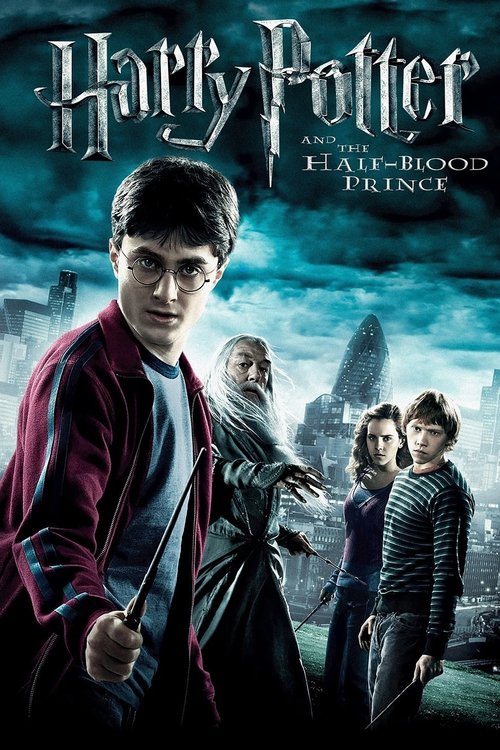
Harry Potter and the Half-Blood Prince
2009 · David Yates
For a long autumn evening deep in a series binge, when you want the cozy familiarity of Hogwarts shaded with real foreboding. Comfort viewing with a bruise in it.
What it's about
Harry's sixth year at Hogwarts unfolds under a darkening sky: Voldemort's followers are attacking both the wizarding and ordinary worlds, and Dumbledore begins privately tutoring Harry in the buried history of Tom Riddle, hunting the secret of the enemy's power through recovered memories. Meanwhile a battered old Potions textbook annotated by a mysterious 'Half-Blood Prince' gives Harry an edge in class, Draco Malfoy is carrying some secret burden, and the whole school is distracted by the messy business of teenage romance.
The experience
Slower and moodier than the earlier entries — more chamber drama than wand battle — with dawning dread underneath a surprising amount of warm, awkward teenage comedy. It's the series at its most melancholy, and it lands an emotional blow that sets up everything after.
Performances
Jim Broadbent is the standout as Professor Slughorn, a vain, likable man hiding a shameful memory — he gives the film its most affecting adult performance — while Alan Rickman's Snape grows ever more unreadable and magnetic.
The craft
Bruno Delbonnel's Oscar-nominated cinematography drains the palette to greens, grays, and candlelit golds, giving the film a painterly gloom unlike anything else in the franchise. Steve Kloves's script balances the memory-excavation plot with genuinely funny romantic subplots, and the big set pieces — a cave, a burning field, a besieged tower — reward a large screen.
Why it matters
The bridge installment that turned the series decisively toward its dark finale, and proof that a blockbuster franchise could slow down, mourn, and still dominate the box office. Its muted visual style shaped the look of the two Deathly Hallows films that closed the saga.
Snapshot
The sixth installment in Warner Bros.' eight-film adaptation of J.K. Rowling's Harry Potter novels, Half-Blood Prince is a transitional work in every sense: a bridge between the self-contained school-mystery structure of the early films and the road-movie finality of the two-part Deathly Hallows. Directed by David Yates in his second consecutive turn at the helm, adapted by returning screenwriter Steve Kloves from Rowling's 2005 novel, it trades the wand-battle spectacle audiences had come to expect for a chamber drama of adolescent romance, buried memory, and dawning dread. Its narrative engine is not action but excavation — Dumbledore and Harry sifting through the past of Tom Riddle to understand the enemy — and its emotional destination is the death of Albus Dumbledore atop the Astronomy Tower, the series' first killing of a central protector. Visually it is the boldest-looking Potter film, thanks to cinematographer Bruno Delbonnel, whose work earned the franchise its only Academy Award nomination for Best Cinematography.
Industry & production
By 2009 the Potter films were among the most reliable assets in Hollywood, a decade-spanning franchise produced by David Heyman (with David Barron) for Warner Bros. and shot, as ever, at Leavesden Studios outside London, the former aircraft factory the production had colonized since 2000. The film is best remembered industrially for its release delay: originally slated for November 2008, it was pushed to July 2009. Warner Bros. publicly attributed the move to securing a summer tentpole slot, a decision widely understood in the trade press as a response to the 2007–2008 Writers Guild of America strike, which had thinned the studio's 2009 summer pipeline. The delay was controversial with fans given that the film was essentially complete, but it positioned Half-Blood Prince as a marquee summer release rather than a holiday one.
The picture continued the franchise's practice of pairing globally famous young leads — Daniel Radcliffe, Rupert Grint, and Emma Watson, now visibly into late adolescence — with a deep bench of British character actors. Michael Gambon returned as Dumbledore in his most substantial outing, Alan Rickman as Snape, and Jim Broadbent joined as the new Potions master Horace Slughorn, a casting coup whose performance anchors much of the film's plot. The film was a major commercial success, grossing well over $900 million worldwide; I won't cite a precise figure from memory, but it ranked among the year's highest earners globally.
Technology
Technically, Half-Blood Prince sits within the mature, effects-heavy pipeline the franchise had refined over five prior films, with visual-effects work distributed across houses including Double Negative, Industrial Light & Magic, and others. Its most notable technological dimension is photographic rather than digital: Delbonnel and Yates committed to a heavily desaturated, low-key look achieved through lighting and color grading in a digital intermediate, deliberately draining warmth from Hogwarts to signal encroaching darkness. The film received an IMAX release; I'd caution that I don't have reliable detail on which sequences, if any, were formatted specifically for that presentation, so I'll leave that unstated rather than guess. The set-piece effects — the collapsing Millennium Bridge in the London-set opening, the Inferi rising from the black lake in the cave, the Quidditch sequences — represent competent, unshowy franchise craftsmanship rather than a technological leap. Where the film innovates is in restraint: spectacle is rationed, and the effects serve mood over wonder.
Technique
Cinematography
Bruno Delbonnel's photography is the film's defining formal achievement and the reason it stands apart visually from the rest of the series. Coming from Jean-Pierre Jeunet's Amélie and A Very Long Engagement, Delbonnel imported a painterly, controlled sensibility: silhouettes against blown-out skies, deep pools of shadow, a near-monochrome palette of slate grays, cold blues, and sickly greens. Interiors are frequently lit as if by single practical sources; the Astronomy Tower and cave sequences push toward abstraction. This look earned the film an Academy Award nomination for Best Cinematography — the only such nomination in the eight-film series — a recognition of how far the imagery departed from the brighter, storybook registers of the Chris Columbus and Alfonso Cuarón entries. (Cuarón's Prisoner of Azkaban had begun the tonal darkening; Delbonnel completed it as pure visual atmosphere.)
Editing
Mark Day, who cut the previous film and would edit the remaining installments, structures Half-Blood Prince around alternation rather than acceleration: the film cross-cuts between the comic register of teenage infatuation (Ron and Lavender, Harry and Ginny, Hermione's jealousy) and the gathering menace of Draco's secret mission and the Pensieve memories. The pacing is notably unhurried for a blockbuster, dwelling in conversation and reaction. The editing's key challenge is the memory structure — sequences within sequences, as Dumbledore and Harry step into recovered fragments of Riddle's past — which Day handles with clean transitional logic so the film's most expository material remains legible.
Mise-en-scène / staging
Production designer Stuart Craig, the franchise's constant architect, again governs the physical world, but the emphasis here shifts toward decay and intrusion. Hogwarts feels emptier and colder; the film opens with Death Eaters tearing through Muggle London and later stages an attack on the Burrow — a sequence invented for the film with no direct equivalent in the novel — that literalizes the war's spread into the domestic sphere. That interpolation drew criticism from some readers, but it exemplifies the film's staging strategy: making abstract dread concrete. The Slug Club dinners, the Potions classroom, and Slughorn's memory-haunted rooms are staged for character intimacy, while the cave and tower are staged for isolation and vertigo.
Sound
Nicholas Hooper, returning after scoring Order of the Phoenix, provides a score more elegiac than heroic, leaning on solo instruments and choral textures over the John Williams fanfares that defined the early films (Williams's "Hedwig's Theme" persists as the franchise's genetic marker). Hooper composed a Latin choral piece, "In Noctem," for a sequence that was ultimately cut, though the music survives on the soundtrack; his cues for Dumbledore's death and the film's quieter passages carry much of its mournful weight. The sound design balances the hush of the memory sequences against the sudden violence of the Inferi attack and the tower confrontation.
Performance
The film is, unusually for the franchise, a performance showcase for its supporting cast. Jim Broadbent's Slughorn — vain, wounded, self-serving, and finally shamed into confession — is the film's most fully realized new character, and his climactic memory scene with Radcliffe supplies the plot's crucial revelation about Horcruxes. Tom Felton, given real material at last as Draco Malfoy, plays adolescent terror and moral collapse with a restraint that reframes his character. Rickman's Snape moves toward his enigmatic center, and Gambon's Dumbledore is at his warmest and most fragile. Among the leads, Radcliffe and Watson handle the comedic beats of romantic misfire with more ease than earlier films allowed, while Grint's Ron becomes the primary vehicle for the film's humor.
Narrative & dramatic mode
Half-Blood Prince operates in a hybrid mode that is genuinely unusual for a fantasy blockbuster: a coming-of-age romantic comedy grafted onto a mystery-thriller of accelerating doom. For much of its middle stretch it is the lightest film in the series, preoccupied with jealousy, love potions, and the ordinary comedy of teenagers. This tonal buoyancy is a deliberate setup. The dramatic spine is investigative — Dumbledore recruiting Harry to extract a suppressed memory from Slughorn, the two of them reconstructing Voldemort's origins — and the film withholds catharsis, ending not in triumph but in mourning. The "half-blood prince" of the title is a mystery seeded and paid off almost as an afterthought (Snape's authorship of the annotated Potions textbook), a structural choice that subordinates the nominal title-plot to the larger movements of memory and death.
Genre & cycle
The film belongs to the fantasy-adventure franchise cycle that Potter itself did much to define — the multi-film, single-continuity adaptation of a completed literary series, a model that would shape The Hunger Games, Twilight, and the studios' broader pivot to "cinematic universes." Within that cycle, Half-Blood Prince represents the darkening, penultimate-chapter mode, comparable to The Empire Strikes Back in its refusal of resolution. It also sits within the British boarding-school fantasy tradition and, more locally, within the tonal trajectory of the Potter films themselves as they aged with their audience from children's cinema toward young-adult drama.
Authorship & method
David Yates, a director who came from British television with little blockbuster experience before Order of the Phoenix, emerged through this film as the franchise's stabilizing auteur. He would direct all four remaining Potter-universe films of this era and go on to the Fantastic Beasts series, making him the franchise's dominant creative hand. Yates's method favored actor-driven intimacy and atmospheric mood over set-piece maximalism, and Half-Blood Prince is the purest expression of that sensibility.
His key collaborators here define the film's texture. Cinematographer Bruno Delbonnel, a one-time contributor to the series, supplied its most distinctive visual signature and its sole cinematography Oscar nomination. Screenwriter Steve Kloves, who adapted every Potter film except Order of the Phoenix, returned to compress Rowling's dense novel, prioritizing the romantic and memory strands while streamlining subplots. Composer Nicholas Hooper provided a restrained, elegiac score. Editor Mark Day shaped the film's deliberate, alternating rhythm. Production designer Stuart Craig maintained the physical continuity of the wizarding world across the whole franchise. Rowling remained closely involved as the source author and a producer-adjacent authority, though the specific granularity of her input on this film is not something I'll characterize beyond the general fact of her ongoing consultation.
Movement / national cinema
Half-Blood Prince is a landmark of British film industry infrastructure more than of any aesthetic movement. Shot at Leavesden with a predominantly British cast and crew, the Potter films were foundational to the modern British studio-production economy, anchoring facilities, talent, and effects houses that outlived the franchise. The film draws on the deep well of British stage and screen acting and on a national literary tradition of school stories and fantasy, even as it was financed and distributed by an American major. Delbonnel's involvement adds a thread of French art-cinema craft to this otherwise Anglo-American production.
Era / period
The film arrives at the end of the 2000s, in the thick of Hollywood's consolidation around franchise filmmaking and just before the industry's full turn toward the shared-universe model. Its 2009 release places it alongside Avatar and a summer defined by tentpoles; its very scheduling — bumped to fill a strike-thinned summer — reflects the industrial logic of the moment. It also marks a generational hinge for its audience, who had grown up alongside the cast across nearly a decade, lending the film's themes of lost innocence and mortality an extratextual resonance.
Themes
The film's governing themes are memory and mortality. Its structure is literally built from recovered memories, and its argument is that understanding evil requires understanding its origins — the boy Tom Riddle before Voldemort. Against this runs a theme of adolescence: first love, jealousy, and the reluctant end of childhood, staged as comedy that the ending retroactively darkens. Trust and betrayal thread throughout — Slughorn's shame, Draco's coerced complicity, and above all Snape's fatal act, which the film presents as unambiguous betrayal (its true meaning deferred to the final installment). Finally, the film dwells on preparation and inheritance: Dumbledore readying Harry for a war the mentor will not live to see, passing knowledge across the threshold of his own death.
Reception, canon & influence
Critically, Half-Blood Prince was well received, widely praised for Delbonnel's cinematography, Broadbent's performance, and its atmospheric maturity, with some reviewers noting that its slower, romance-heavy middle and its invented Burrow-attack sequence tested the patience of viewers expecting more incident. Its Academy Award nomination for Best Cinematography was the franchise's only nomination in that category and one of relatively few the series received overall. I'd flag that beyond this Oscar recognition, I don't want to enumerate specific awards or box-office rankings from memory with false precision.
Influences on the film (backward): It inherits the darkening trajectory begun by Alfonso Cuarón's Prisoner of Azkaban, extends the intimate, television-honed direction Yates established in Order of the Phoenix, and imports the painterly visual grammar of Delbonnel's earlier work with Jeunet. More broadly it draws on the penultimate-darkness template of serialized fantasy and on the British literary and acting traditions the franchise had always mined.
Legacy (forward): Its most concrete legacy is internal — it consolidated David Yates as the architect of the franchise's back half and the Fantastic Beasts era, and its memory-driven structure set up the entire narrative machinery (Horcruxes, Snape's true allegiance) that Deathly Hallows Parts 1 and 2 would resolve. As part of the larger Potter enterprise, it contributed to the franchise's outsized influence on 2010s Hollywood: the multi-film adaptation of complete book series, the two-part finale as commercial strategy, and the British studio ecosystem the films helped sustain. Delbonnel's acclaimed work here also stands as a demonstration that a mature franchise blockbuster could sustain genuine authorial cinematography, a point often cited when the Potter films are weighed as craft rather than mere product.
A Deleuzian reading
A stone basin.
The full Deleuzian reading of Harry Potter and the Half-Blood Prince →
Reception
In 2009 critics were kinder than book fans, who fumed over the cut climax and an invented action scene at the Burrow; today it's widely reappraised as the series' visual high point, with Bruno Delbonnel's murky, painterly photography doing a lot of the heavy lifting.
How Harry Potter and the Half-Blood Prince was received, from release to now →
How to watch Harry Potter and the Half-Blood Prince: what to notice on a first viewing
- Look at how little color is left in Hogwarts. Bruno Delbonnel works in slate gray, cold blue and a green like water left standing too long. Interiors get lit as though from a single candle, and figures go black against blown-out skies. The feeling sits in the air of the room rather than on anybody's face.
- Watch where Harry stands inside the recovered memories. He and Dumbledore walk around in the past, choose where to stand, leave, come back, and set one visit against another. Nobody in those rooms can see them or react to them. The past here is a place you move through, not a clip that plays and hands you a fact.
- Count how often a joke sits right beside a threat. Mark Day cuts between love potions, Ron and Lavender, Hermione's jealousy, and Quidditch practice. The registers alternate rather than build toward each other. The comedy is not relief from the dread. It is the same school year, seen from inside.
- Watch Slughorn's face when a conversation turns personal. Jim Broadbent plays vanity and social discomfort in a man who hates being asked questions. Tom Felton plays Draco with restraint, letting strain register in how he moves. The supporting parts carry the film's weight while the leads handle most of the comedy.
- Notice how empty the castle looks this year. Stuart Craig's Hogwarts has gone cold and underpopulated. The film opens with an attack on a Muggle bridge and later brings the war into the Weasleys' house, while the school's routines carry on. The institution keeps its manners while it comes apart, and the design shows you both at once.
The whole guide to watching Harry Potter and the Half-Blood Prince, with the keys for a rewatch →
Influences: the films it descends from and the films it influenced
- Amélie (2001) — Establishes Bruno Delbonnel's signature digital color-grading and painterly chiaroscuro — pools of warm light against enveloping shadow — the exact grammar he desaturates and cools for Half-Blood Prince.
- A Very Long Engagement (2004) — Delbonnel's muted sepia-and-ash war palette and figures read as silhouettes against blown-out skies directly prefigure the film's painterly-silhouette Astronomy Tower and cliffside compositions.
- Harry Potter and the Prisoner of Azkaban (2004) — Introduced the franchise's darkening trajectory and a weathered, seasonal naturalism with untethered handheld camera — the tonal and lighting license Yates and Delbonnel inherit and deepen.
- Harry Potter and the Order of the Phoenix (2007) — Yates imports his British-television method of actor-driven intimacy and atmospheric mood over set-piece maximalism, the sensibility Half-Blood Prince refines into its purest form.
- Harry Potter and the Philosopher's Stone (2001) — Originates John Williams's Hedwig's Theme leitmotif and Stuart Craig's production-design vocabulary, the recurring musical and physical continuity Half-Blood Prince quotes and lets decay.
- Citizen Kane (1941) — Its structure of excavating a man's origin through nested, recovered fragments of testimony is the template for the Pensieve sequences, where Dumbledore and Harry investigate Voldemort's past as an inquiry into memory.
- The Third Man (1949) — Its expressionist low-key chiaroscuro and atmosphere of moral corruption seeping through a decaying world model the desaturated low-key lighting and decay-and-intrusion staging of Half-Blood Prince.
- The Empire Strikes Back (1980) — Codifies the penultimate-darkness template — the serialized saga's middle chapter that darkens tonally and ends on an unresolved downbeat loss, the structural mold Half-Blood Prince's Dumbledore death occupies.
- Harry Potter and the Deathly Hallows – Part 1 (2010) — Directly resolves the Horcrux-and-allegiance memory machinery Half-Blood Prince installs, and inaugurates the two-part-finale commercial strategy this film's penultimate structure sets up.
- Harry Potter and the Deathly Hallows – Part 2 (2011) — Pays off the nested-memory revelation (Snape's true allegiance seen through recovered Pensieve memory) that Half-Blood Prince plants as its central withheld structure.
- Fantastic Beasts and Where to Find Them (2016) — Consolidates Yates as the franchise's architect, carrying his actor-driven intimacy and muted, mood-forward atmosphere from the Potter back half into a new wizarding-world cycle.
- Inside Llewyn Davis (2013) — Delbonnel extends his Half-Blood Prince palette — cold, diffused, desaturated low-key light with soft haze — into a wintry chamber portrait, showing the technique detached from franchise scale.
- Darkest Hour (2017) — Delbonnel elaborates the shafts-of-light chiaroscuro and figures-in-silhouette compositions of Half-Blood Prince, isolating subjects in single beams within surrounding darkness.
- The Hunger Games: Mockingjay – Part 1 (2014) — Adopts the split-final-book commercial and structural model Half-Blood Prince and Deathly Hallows pioneered — a penultimate installment engineered as darkened setup rather than self-contained resolution.
- The Twilight Saga: Breaking Dawn – Part 1 (2011) — Extends the hybrid romance-forward YA franchise mode and the two-part-finale strategy, foregrounding relationship and mood over incident across a serialized book adaptation.
- Miss Peregrine's Home for Peculiar Children (2016) — Delbonnel shot it, and its hidden-magical-school template plus his low-key painterly HP grade feed Peregrine's cinematography and premise simultaneously.
- The Lord of the Rings: The Two Towers (2002) — Extends the same middle-installment craft of the multi-film literary adaptation, sustaining tension through cross-cut alternation between parallel narrative threads rather than a single climactic arc.
Similar films
- Harry Potter and the Prisoner of Azkaban (2004) — influence & lineage · same viewing thread
- Harry Potter and the Deathly Hallows: Part 2 (2011) — influence & lineage
- Harry Potter and the Deathly Hallows: Part 1 (2010) — influence & lineage
- The Lord of the Rings: The Two Towers (2002) — influence & lineage
- Harry Potter and the Goblet of Fire (2005) — same viewing thread
- The Lord of the Rings: The Fellowship of the Ring (2001) — shared sensibility
- The Perks of Being a Wallflower (2012) — shared sensibility
- The Sixth Sense (1999) — shared sensibility
All the films related to Harry Potter and the Half-Blood Prince →
Watch it with: curated runs of related films
- Young Under a Darkening Sky — Watch these in a run as the frame darkens — the institutions built to shelter the young (a school, a walled glade, a nation, a highway) curdle into deadly contests and regimes they have to outlast.