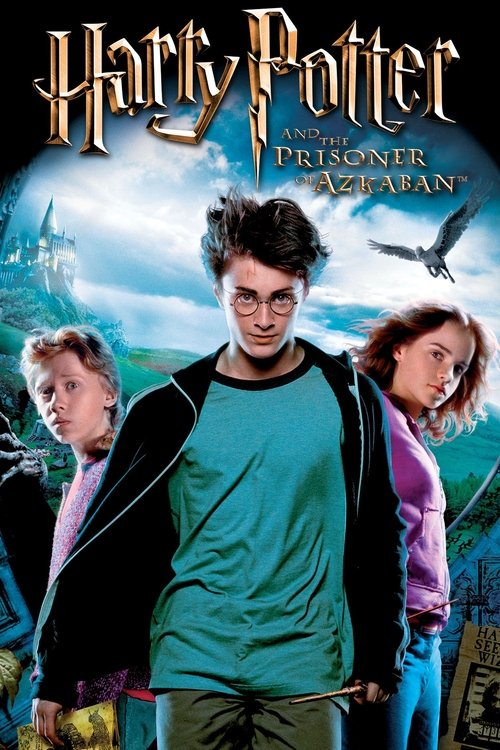
Harry Potter and the Prisoner of Azkaban
2004 · Alfonso Cuarón
For when you want comfort food with actual weather in it — a familiar world made suddenly richer and darker. Perfect for a rainy-night rewatch, or for showing a skeptic the moment this series got good.
What it's about
Harry's third year at Hogwarts begins under a shadow: Sirius Black, a convicted traitor with ties to his parents' deaths, has broken out of the wizard prison of Azkaban and seems to be coming for him. While soul-draining guards called Dementors patrol the school grounds, Harry, Ron, and Hermione dig into the past — and find that thirteen is the age when the adult world's betrayals start coming into focus.
The experience
Moodier and stranger than the sunny first two chapters — real dread creeps in with the Dementors, but there's still warmth, humor, and a final stretch that clicks together with genuine ingenuity. It feels like growing up: the magic is still there, but the light has changed.
Performances
Gary Oldman brings a haunted, feral intensity to Sirius Black, and David Thewlis makes the shabby new teacher Lupin the series' most quietly affecting adult — both give the kids something real to act against.
The craft
Alfonso Cuarón desaturated the candy palette, put the kids in street clothes, moved Hogwarts into craggy highlands, and let the camera prowl in long, curious takes — one shot of a tree shaking off the seasons does more world-building than pages of exposition. It's the rare blockbuster where you can feel a director thinking in images, and it rewards a big screen.
Why it matters
This is the installment that set the visual grammar for everything after it and proved a franchise could hand itself to a genuine auteur — a hiring decision studios have been imitating ever since.
The moment a franchise became cinema. Handed the third Potter after Chris Columbus's faithful, brightly lit installments, Alfonso Cuarón — fresh from Y Tu Mamá También, an eyebrow-raising hire for a children's property — desaturated the palette, put the young cast in street clothes, moved Hogwarts into craggy Scottish highlands, and let Michael Seresin's camera prowl in long, curious takes. The Dementors, drifting rag-shrouded embodiments of depression, gave the series its first genuine dread; a time-bending third act gave it its first structurally elegant plot; and a shot of the Whomping Willow shaking off the seasons showed a director thinking in images rather than illustrations. Cuarón treats adolescence itself as the subject — thirteen is when the world darkens — and his choices set the visual grammar every subsequent entry inherited. For Cuarón it was the hinge between his Mexican breakthrough and Children of Men, proof that a personal sensibility could survive, even flourish, inside the machine. It remains the series' consensus peak, and the rare blockbuster sequel routinely studied for its filmmaking rather than its lore.
A Deleuzian reading
The train stops between nowhere and nowhere and the lamps die.
The full Deleuzian reading of Harry Potter and the Prisoner of Azkaban →
Reception
Fans grumbled in 2004 that Cuarón cut too much of the book, and it remains the lowest-grossing Potter film — yet twenty years on it's the consensus pick for the best of the series, the moment the franchise grew up.
How Harry Potter and the Prisoner of Azkaban was received, from release to now →
Influences: the films it descends from and the films it influenced
- Y Tu Mamá También (2001) — Cuarón and DP Emmanuel Lubezki developed the roaming, unbroken handheld long take that drifts off the protagonists to observe the surrounding world — a grammar carried directly into Azkaban's courtyard and Hogwarts-grounds walking shots.
- Great Expectations (1998) — Cuarón's earlier literary adaptation established his taste for desaturating and color-grading a familiar canonical text into a moody, greenish palette rather than storybook brightness.
- A Little Princess (1995) — Cuarón's first children's fantasy fused magical-realist imagination with grounded emotional realism, proving fantasy for kids could be sincere and melancholic — the exact tonal template he brought to the franchise.
- The 400 Blows (1959) — Truffaut's empathetic, location-shot observation of an alienated adolescent boy models the naturalistic, street-clothes realism Cuarón applied to Harry's troubled teenage interiority.
- Days of Heaven (1978) — Néstor Almendros's available-light, magic-hour cinematography is the lineage from which Lubezki's naturalistic location lighting descends, replacing studio fill with soft directional daylight.
- 12 Monkeys (1995) — Gilliam's self-consistent predestination loop — where the climax reveals that an earlier scene was already caused by the time traveler — is the closed-loop mechanic Azkaban's Time-Turner third act reproduces.
- Back to the Future Part II (1989) — Zemeckis pioneered re-staging an earlier film's exact scenes from a new temporal vantage point, the structural device Cuarón uses when Harry and Hermione revisit the night's events from a hidden angle.
- Edward Scissorhands (1990) — Burton's gothic fairy tale legitimized the dark-fantasy blockbuster built around a lonely outsider, seeding the melancholic-monster register Azkaban gives Lupin, Sirius and the Dementors.
- Children of Men (2006) — Cuarón pushed Azkaban's immersive Lubezki long-take handheld and desaturated gray-green palette to its dystopian extreme with the celebrated unbroken action sequences.
- Gravity (2013) — The orchestrated, physics-driven single-take camera Cuarón rehearsed on Azkaban's Time-Turner and Quidditch scenes becomes the entire structural logic of the opening thirteen-minute shot.
- Harry Potter and the Goblet of Fire (2005) — The very next installment inherited Azkaban's darker desaturated grade and its street-clothes wardrobe, abandoning the earlier films' bright robes for muted, contemporary teen dress.
- Harry Potter and the Order of the Phoenix (2007) — Yates extended Cuarón's psychological-realist adolescence and cold color grading, treating the franchise as a study of teenage depression and institutional dread rather than whimsy.
- Logan (2017) — Mangold applies the auteur-in-franchise move Cuarón modeled — bringing naturalistic, desaturated, character-first realism and location grit to a corporate blockbuster property.
- Casino Royale (2006) — Following Azkaban's example of an installment that darkens and grounds a long-running series, it reinvented the franchise's visual grammar toward grittier, more realist texture.
- Skyfall (2012) — Mendes and Roger Deakins continue the auteur-elevates-blockbuster lineage Cuarón opened, lending a mainstream franchise painterly natural light and considered, authored compositions.
- The Batman (2022) — Reeves's rain-soaked, heavily desaturated auteurist darkening of a superhero franchise descends from Azkaban's proof that a tentpole can be visually somber, weather-bound and character-interior.
- Harry Potter and the Deathly Hallows: Part 1 (2010) — Cuarón rebuilt the franchise's visual grammar around handheld naturalism, weathered Scottish landscapes and overcast available light — the desaturated realist register Yates inherited and pushed to its bleakest in Part 1.
- Harry Potter and the Half-Blood Prince (2009) — Introduced the franchise's darkening trajectory and a weathered, seasonal naturalism with untethered handheld camera — the tonal and lighting license Yates and Delbonnel inherit and deepen.
- Harry Potter and the Deathly Hallows: Part 2 (2011) — Introduced the desaturated, naturalistic, handheld visual grammar and grounded emotional register that displaced the series' early storybook brightness and became the house style the finale inherited.
- Pan's Labyrinth (2006) — A New Mexican Cinema companion piece where a child's inner fantasy life is filmed against a genuinely threatening world, sharing Azkaban's insistence that fairy-tale imagery carry real menace and grief.
Similar films
- Harry Potter and the Goblet of Fire (2005) — influence & lineage · same viewing thread
- Children of Men (2006) — influence & lineage · same viewing thread
- Pan's Labyrinth (2006) — influence & lineage
- Gravity (2013) — influence & lineage
- Logan (2017) — influence & lineage
- Harry Potter and the Half-Blood Prince (2009) — same viewing thread
- The Maze Runner (2014) — same viewing thread
- Harry Potter and the Deathly Hallows: Part 2 (2011) — shared sensibility
All the films related to Harry Potter and the Prisoner of Azkaban →
Watch it with: curated runs of related films
- Young Under a Darkening Sky — Watch these in a run as the frame darkens — the institutions built to shelter the young (a school, a walled glade, a nation, a highway) curdle into deadly contests and regimes they have to outlast.