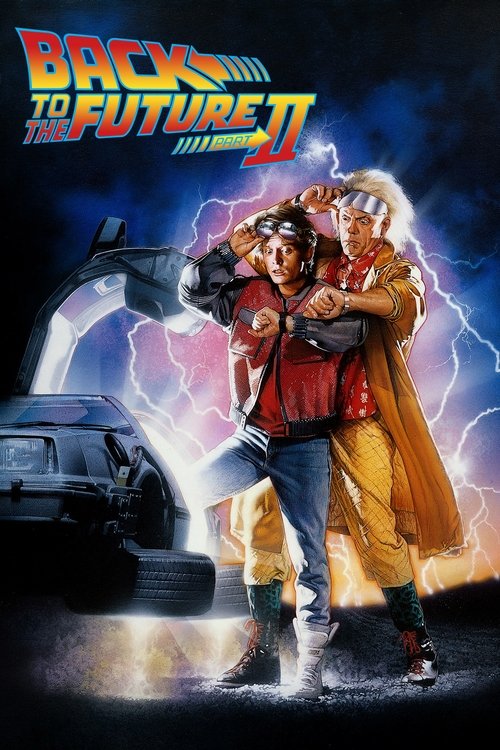
Back to the Future Part II
1989 · Robert Zemeckis
For a high-energy movie night when you want spectacle with brains, or a rewatch that rewards paying attention. Great with the first film fresh in your memory; even better with friends who'll argue about the timelines afterward.
What it's about
Doc Brown whisks Marty McFly to the year 2015 to fix a problem with his future kids — but when the bully Biff Tannen gets his hands on a sports almanac and the time machine, history itself gets rewritten into a nightmare version of Marty's hometown. Setting things right sends Marty back to 1955, where he has to work around the events of his own first adventure without being seen. It's a time-travel caper that keeps raising its own stakes.
The experience
Fast, dense, and gleefully clever — a blockbuster that treats its audience like puzzle-solvers, ricocheting between a gadget-filled future, a dark alternate present, and a past you think you already know. Darker and twistier than the first film, and more fun to think about afterward.
Performances
Michael J. Fox and Christopher Lloyd's chemistry carries it, with Fox and Thomas F. Wilson each juggling multiple roles and ages across the timelines with visible glee.
The craft
Robert Zemeckis builds one of the most structurally daring blockbuster sequels ever made, folding the story back through the original film's scenes from hidden angles — a feat of writing, production design, and then-groundbreaking effects that let actors share the frame with themselves. The 2015 sequences remain a landmark of playful future-building, from hoverboards to self-lacing sneakers.
Why it matters
Its vision of 2015 became a pop-culture reference point in its own right, and its restage-the-first-movie structure influenced how later franchises play with their own continuity.
Snapshot
Back to the Future Part II is the middle panel of a triptych that few of its makers originally intended to paint. The 1985 original ended on a joke — Doc Brown whisking Marty and Jennifer into the sky with the line "Roads? Where we're going, we don't need roads" — that Robert Zemeckis and Bob Gale have said was never meant as a sequel hook. Its runaway success made a continuation inevitable, and the pair responded not with a simple do-over but with one of the most structurally audacious blockbuster sequels of its era: a film that vaults forward to a neon 2015, doubles back through a poisoned "alternate 1985," and finally folds itself into the very scenes of the first movie, restaging 1955 from a hidden vantage. It is a picture obsessed with consequence, recursion, and the mechanics of its own continuity — a time-travel comedy that behaves like a puzzle box, and one whose reach exceeded the grasp of some 1989 audiences even as it dazzled them.
Industry & production
The film was produced under the Amblin Entertainment banner for Universal Pictures, with Steven Spielberg, Frank Marshall, and Kathleen Kennedy as executive producers and Bob Gale and Neil Canton as producers. Its defining industrial decision was logistical: Parts II and III were shot back-to-back as a single extended production, a strategy that let the company amortize sets, crew, and the returning ensemble across two films and release them roughly six months apart (Part II in November 1989, Part III in 1990). This is a comparatively early instance of the "shoot-two-sequels-at-once" model that later became standard for franchise filmmaking.
The production is inseparable from two casting disruptions. Crispin Glover, who had played George McFly, did not return; accounts point to a dispute over compensation. The filmmakers minimized George's role, reused footage, and cast Jeffrey Weissman in prosthetic makeup to evoke Glover's likeness in a handful of shots. Glover sued, and the resulting settlement is widely credited with prompting Screen Actors Guild rules restricting the reproduction of a performer's likeness without consent — a genuinely consequential piece of industry precedent. Separately, Claudia Wells was unavailable to reprise Jennifer and was replaced by Elisabeth Shue, which required the original's closing scene to be re-shot with the new actor. Michael J. Fox, Christopher Lloyd, Lea Thompson, and Thomas F. Wilson all returned.
Technology
Technologically, Part II is a landmark in motion-control compositing. To place Michael J. Fox opposite himself as three members of the future McFly family in a single unbroken dinner-table frame — and to stage the multiple Biff/Tannen encounters — Industrial Light & Magic developed and deployed an advanced computerized motion-control camera system (marketed as VistaGlide) that could precisely repeat a complex camera move so separately filmed passes could be married seamlessly, without the locked-off camera that older multiple-role trickery demanded. The result let the camera drift, pan, and reframe while an actor "shared" the shot with himself, a substantial advance over the static split-screen conventions that preceded it.
The film also leaned on VistaVision-format photography for effects plates and on ILM's optical and early digital compositing craft for its flying cars, its skyway traffic, and its hoverboard flights — the last of which required rigs, wirework, and careful matte work to sell teenagers gliding over Hill Valley's plaza and pond. The picture stands, in retrospect, at a hinge point between the optical-effects tradition and the digital compositing that would define the following decade.
Technique
Cinematography
Dean Cundey, Zemeckis's cinematographer on the original, returned and is central to the film's visual identity. His task was uncommonly demanding: the same director, actors, and Hill Valley locations had to read as three distinct worlds — a saturated, advertising-bright 2015; a lurid, smog-and-neon dystopian 1985; and the sunny, period-clean 1955 already established in the first film. Cundey's lighting and color strategies differentiate the eras while preserving a continuity of "look" that lets the audience feel the same town warped across time. His most exacting work supports the motion-control multiples, where lighting had to match perfectly across passes filmed at different times so composited selves shared a single, believable space.
Editing
Cut by Arthur Schmidt and Harry Keramidas, Part II is an editing feat as much as a directing one. Its back half performs a near-unprecedented act of intercutting a sequel into its predecessor: the 1955 sequences restage moments from the first film — the Enchantment Under the Sea dance, the skateboard chase — from new angles, requiring the second Marty to be edited around footage and blocking established four years earlier. The cutting must keep three timelines legible, honor the audience's memory of the original, and sustain comic and suspense rhythms across dense expository turns. That it remains followable at all is a testament to the editorial architecture.
Mise-en-scène / staging
Production designer Rick Carter and the art department built the film's most enduring images: the 2015 Hill Valley of hoverboards, holographic signage, and the Café 80s; the "Biff's Pleasure Paradise" casino tower that dominates the corrupted 1985 skyline; and the meticulous re-creation of 1955 sets to match the original. Zemeckis stages the multiple-role scenes with a visible relish for the impossible — actors passing objects to their other selves, occupying the same table — turning technical constraint into blocking that foregrounds the film's doubling motif.
Sound
The film's sound design carries a heavy load of invention: the whir of hoverboards, the mechanical clatter of self-fitting shoes and self-drying jackets, the hum of the DeLorean's flight systems, and the ambient wash of a future cityscape. As with the original, sound is used comedically and expositionally, cueing gadgets and gags. The record on specific sound-department credits and techniques is less discussed in the popular literature than the visual effects, and I won't overstate what is thinly documented.
Performance
The ensemble's achievement is one of multiplication. Michael J. Fox plays Marty, Marty Jr., and Marlene McFly, differentiating them through posture, voice, and comic register within single frames. Thomas F. Wilson is arguably the film's MVP, playing the aging, vengeful Biff, his grandson Griff, and the alternate-1985 casino tyrant — a range from buffoonery to genuine menace. Christopher Lloyd's Doc Brown supplies the manic exposition that holds the plot's physics together, while Lea Thompson's alternate-timeline Lorraine gives the dystopia its saddest, most human note.
Narrative & dramatic mode
Structurally, Part II is a triptych masquerading as a single chase. Act one is a satirical future-vision (2015); act two is a dystopian counterfactual (the alternate 1985 spawned by Biff handing his younger self a sports almanac); act three is a recursive heist inside the events of the original film (1955). The engine is the "grandfather paradox" logic of consequence: a small object placed in the wrong hands metastasizes into a ruined world, and the heroes must surgically extract it without disturbing the established past. The dramatic mode is comic-adventure shading into something darker and more anxious than the original — the alternate 1985, with its violence, corruption, and broken family, pushes the series toward genuine dread. The film closes on a formally daring cliffhanger: Doc is struck by lightning and vanished to 1885, Marty is stranded, and the screen delivers a "To Be Continued" that made the film explicitly the first half of a two-part story.
Genre & cycle
The film sits at the intersection of the time-travel adventure, the effects-driven family blockbuster, and the science-fiction comedy. It belongs to the late-1980s Amblin cycle of Spielberg-produced, technically ambitious popular entertainments, and to the specific sub-tradition of time-travel narratives concerned with paradox and alternate history — a lineage running back through literary science fiction and forward to the many "branching timeline" films it helped popularize. Within its own franchise it inaugurated the convention of the multi-part blockbuster shot as one production, a cycle-defining move.
Authorship & method
Back to the Future Part II is the product of the Zemeckis–Gale partnership operating at the peak of its technical ambition. Robert Zemeckis directs and co-conceived the story; his signature is the marriage of intricate, clockwork plotting to bravura visual-effects set pieces, and the film reflects his career-long fascination with technology as a storytelling instrument (a fascination that would carry through Death Becomes Her, Forrest Gump, and beyond). Bob Gale wrote the screenplay and co-wrote the story, and is the franchise's chief architect of its time-travel rules and its moral logic. Gale has stated on the record that the corrupt, casino-owning alternate-1985 Biff was modeled in part on Donald Trump — a documented authorial intention rather than a retrospective reading.
The key collaborators recur from the original, lending the sequel an authorial continuity: cinematographer Dean Cundey, composer Alan Silvestri, and the editorial and design teams. Silvestri's score reprises and develops the original's soaring, brass-forward main theme, adapting its heroic idiom to the film's darker turns. The near-total reunion of the creative team is itself part of the method — the sequel was engineered to feel of a piece with its predecessor, down to the reuse and re-lighting of original footage.
Movement / national cinema
This is mainstream American studio filmmaking of the high-Amblin period — Hollywood's late-1980s convergence of family entertainment, franchise thinking, and cutting-edge effects, produced within the Spielberg orbit. It is not aligned with any art-cinema movement; its "movement," insofar as it has one, is the industrial New Hollywood blockbuster tradition and its Amblin variant, which prized craftsmanship, sentiment, and spectacle in equal measure.
Era / period
Released in November 1989, the film is a document of the decade's closing moment — its imagined 2015 is a distinctly 1980s extrapolation, dreaming forward from Reagan-era consumer optimism into a future of branded gadgets and holographic advertising. Its dystopian 1985, meanwhile, reads as an anxious inversion of the same period's prosperity. The film thus captures both the era's confidence and its unease, projected across time. Its future has since been overtaken by the real 2015, an event ("Back to the Future Day," October 21, 2015) that became a genuine cultural occasion — a rare case of a film's fictional date being celebrated worldwide.
Themes
The film's governing theme is consequence: the idea that history is contingent, that a single misplaced object or choice can bifurcate reality into paradise or ruin. Bound up with this is the tension between determinism and free will — the series' recurring insistence that "your future is whatever you make it," here tested against the horror of a future gone wrong. Wealth and its corruptions form a second axis: the almanac is a fantasy of unearned gain, and Biff's ascent literalizes the moral rot of money divorced from merit. Family, as in the original, remains the emotional bedrock — the McFlys' fate across timelines is the measure of every abstract paradox. Finally, the film is thematically preoccupied with nostalgia and recursion, quite literally re-entering its own past; it interrogates the very act of looking back that the first film celebrated.
Reception, canon & influence
Contemporary reception was more divided than the original's near-universal warmth. A strain of criticism found Part II darker, more convoluted, and more mechanical than its predecessor — a middle chapter burdened by set-up and dense paradox, ending not on resolution but on a promissory "To Be Continued." Others admired its ambition and technical wizardry. I won't attribute specific reviews or box-office figures I can't verify precisely; what is clear is that the film was a major commercial success and that its critical standing has risen over time, with later reassessment celebrating exactly the structural daring that puzzled some 1989 viewers.
The influences on the film are legible: the paradox-and-alternate-history tradition of science-fiction literature; the Amblin/Spielberg house style of the 1980s; and, most concretely, its own predecessor, whose scenes it cannibalizes and reframes. Its debt to the original is not merely tonal but literal, built into its editing.
The influence of the film has been outsized. Technically, its ILM motion-control work advanced the art of same-frame multiple-role compositing that later productions refined and digitized. Culturally, its 2015 became a shared reference point — the hoverboard, the self-lacing Nike (which Nike later produced as real, limited products), the flying DeLorean, and Mr. Fusion entering the popular vocabulary of the future. Narratively, its "alternate timeline" structure and its recursive re-entry into a prior film's events helped normalize the branching-continuity storytelling now pervasive across franchise cinema. And its practice of shooting two sequels back-to-back became a template for the industry. If the original Back to the Future is the more beloved film, Part II is arguably the more influential experiment — the one that proved a blockbuster sequel could be a genuine formal puzzle and still fill theaters.
A Deleuzian reading
Marty is outside the gym, flat against the wall in the dark.
The full Deleuzian reading of Back to the Future Part II →
Reception
A monster hit in 1989 but critics found it frantic and convoluted next to the original — a 'darker, colder sequel.' Decades on it's been reappraised as the trilogy's boldest swing, and its stock spiked forever on October 21, 2015, the actual 'future' date, when the whole internet celebrated Back to the Future Day.
How Back to the Future Part II was received, from release to now →
Influences: the films it descends from and the films it influenced
- Back to the Future (1985) — Part II literally re-photographs and re-lights this film's footage and inserts new performances into it, making the original's editing the physical substrate of the sequel's intercutting-into-predecessor device.
- Who Framed Roger Rabbit (1988) — The immediately prior Zemeckis/Cundey/ILM collaboration perfected the precise eyeline blocking and locked-off motion-control passes that let a performer share a frame convincingly with an element absent at shooting — the exact technique reused for Michael J. Fox self-interacting as three family members.
- Star Wars (1977) — ILM's Dykstraflex repeatable-motion camera, invented here, is the foundational machinery that makes same-frame multiple-role compositing possible; Part II is that system applied to actors instead of spaceships.
- 2001: A Space Odyssey (1968) — Trumbull's obsessively registered VistaVision effects passes and front-projection set the precedent for large-format, sub-pixel-accurate motion-control compositing that ILM inherited and Part II leaned on for its layered future-Hill-Valley plates.
- It's a Wonderful Life (1946) — The 'alternate hometown gone rotten' structure — Pottersville versus Bedford Falls — is the direct dramaturgical template for dystopian casino-Biff 1985, a moral counterfactual staged as a corrupted mirror of familiar geography.
- The Parent Trap (1961) — Its traveling-matte and split-screen work letting one actor (Hayley Mills) touch and converse with herself established the self-interaction blocking grammar Part II industrializes with the Fox dinner-table scene.
- Superman: The Movie (1978) — Zoptic front-projection flying rigs and the literal 'reverse time by reversing motion' climax model the motion-control aerial work and time-machine spectacle Part II stages with the flying DeLorean.
- The Terminator (1984) — Its closed-loop, self-consistent time-travel logic — where the trip causes the very past it departs from — is the paradox-rulebook discipline Gale extends into Part II's branching-timeline bookkeeping.
- Used Cars (1980) — The earlier Zemeckis–Gale feature established their signature clockwork farce plotting and morally cartoonish huckster villainy — the DNA of Biff's grasping capitalism and the film's precision-timed gag architecture.
- Death Becomes Her (1992) — Zemeckis pushes the same motion-control compositing pipeline into early digital, using seamless body-and-face composites as narrative punchlines — the direct technical successor to Part II's optical self-interaction work.
- Forrest Gump (1994) — Compositing a present-day performer into re-lit archival footage of prior events is the digital maturation of Part II's method of inserting new performances into its own predecessor's frames.
- The Lord of the Rings: The Fellowship of the Ring (2001) — Its simultaneous shooting of a multi-film arc as one continuous production is the industrial descendant of Part II and III being filmed back-to-back to preserve continuity and cast.
- Avengers: Endgame (2019) — Its time-heist re-stages and intercuts characters into scenes from earlier franchise films — the recursive re-entry into predecessor footage that Part II pioneered, scaled to a shared universe.
- Looper (2012) — Stages a protagonist confronting his own future self in shared frames while tracking consequence-and-contingency across a mutable timeline — Part II's self-interaction blocking fused with its branching-timeline stakes.
- X-Men: Days of Future Past (2014) — Uses an alternate-timeline reset to retcon and re-thread a franchise's continuity, normalizing exactly the branching-continuity storytelling Part II proved a blockbuster audience would follow.
- Harry Potter and the Prisoner of Azkaban (2004) — Zemeckis pioneered re-staging an earlier film's exact scenes from a new temporal vantage point, the structural device Cuarón uses when Harry and Hermione revisit the night's events from a hidden angle.
- Spider-Man: No Way Home (2021) — Models the nostalgia-braid craft of characters re-entering and re-shooting prior-film scenes from new angles, weaponizing audience memory of the earlier installments.
- The Man from the Future (2011) — Pioneers the motion-control split-screen compositing that lets one performer share a single frame with his other-timeline self, the exact doubling technique O Homem do Futuro deploys when Zero confronts Zero across 1991 and the present.
- The Parent Trap (1998) — Dean Cundey's own schooling in VistaGlide motion control — lighting a set so a second pass matches the first frame-for-frame under a moving camera — is the exact competence he carries into The Parent Trap's twin coverage.
- Multiplicity (1996) — Builds an entire comedy around one actor (Michael Keaton) playing multiple copies who touch, pass objects, and share blocking in-frame — the direct extension of Part II's multiple-roles self-interaction staging.
- Adaptation. (2002) — Its Nicolas-Cage-as-twins scenes rely on the same locked-off motion-control passes and doubles-and-eyeline choreography Part II standardized for one performer inhabiting two bodies in a shot.
- Primer (2004) — Pushes recursive, self-intersecting timeline structure to its formal extreme — the puzzle-box narrative daring Part II legitimized by proving a mainstream sequel could be a genuine paradox machine.
- Gintama: The Final Chapter - Be Forever Yorozuya (2013) — Model for the mechanics of returning to a darkened, dystopian version of one's own home timeline, where familiar side-characters are grotesquely altered by the hero's removal from history.
Similar films
- Back to the Future (1985) — influence & lineage · same viewing thread
- Looper (2012) — influence & lineage · same viewing thread
- X-Men: Days of Future Past (2014) — influence & lineage
- Forrest Gump (1994) — influence & lineage
- Avengers: Endgame (2019) — influence & lineage
- The Terminator (1984) — influence & lineage · same viewing thread
- The Man from the Future (2011) — same viewing thread
- Tron (1982) — shared sensibility
All the films related to Back to the Future Part II →
Watch it with: curated runs of related films
- Tampering With the Timeline — A run of films that all reach for the undo button — meddling with the past, outrunning the future, and living with the paradoxes that snap back.