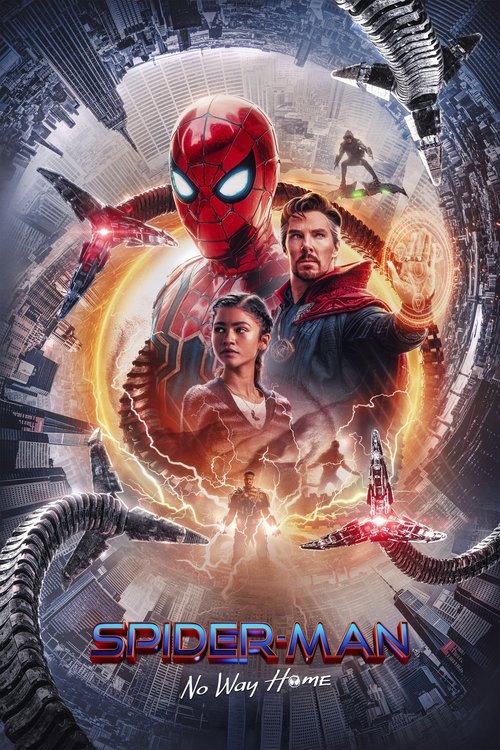
Spider-Man: No Way Home
2021 · Jon Watts
For a big popcorn night when you want spectacle with an actual heart — especially if Spider-Man movies were part of your growing up. Comfort food, but it will put a lump in your throat.
What it's about
Peter Parker's secret identity has been blown wide open, and his normal life — college applications, his friends, his aunt — is collapsing under the exposure. Desperate, he asks Doctor Strange for a spell to make the world forget, and the botched result tears holes between realities, pulling in enemies from earlier, incompatible versions of the Spider-Man story. A kid from Queens has to clean up a multiverse-sized mess he caused.
The experience
A crowd-pleaser that keeps topping itself — big laughs, bigger reveals, and fight scenes that spill across realities — then turns unexpectedly heavy, pushing its hero to the darkest place the trilogy goes. It's engineered for gasps and it earns real emotion by the end.
Performances
Tom Holland does his most demanding work in the role, carrying the story's grief as much as its jokes, and Willem Dafoe returns to a signature villain with a ferocity that steals every scene he's in.
The craft
The screenplay treats twenty years of studio history as living dramatic material rather than fan-service trivia, folding earlier eras' tones and loose ends into one story that still lands as Peter's. The portal-torn set pieces and multiverse mayhem are built for the biggest screen you can find.
Why it matters
Its December 2021 release became an event beyond the movie itself — the moment audiences flooded back to theaters mid-pandemic — and it reset expectations for what a legacy franchise could do with its own past.
His identity exposed to the world, Peter Parker asks Doctor Strange for a spell to make everyone forget — and the botched result tears open the walls between realities, pulling adversaries from earlier, incompatible versions of the Spider-Man story into his own. Jon Watts's trilogy-capper is the boldest act of franchise archaeology the superhero era produced, treating two decades of studio history — Raimi's operatic sincerity, the Garfield films' unfinished business — as living dramatic material rather than trivia. Beneath the multiverse machinery sits the character's oldest equation: power, responsibility, and what they cost a kid from Queens, pushed here to the trilogy's darkest and most consequential turn. The film's release in December 2021 became an event beyond itself — the moment audiences returned en masse to theaters mid-pandemic, screaming at reveals in packed rooms, posting the second-biggest opening weekend in domestic history. Whatever one makes of the nostalgia economy it perfected, it demonstrated something studios had begun to doubt: that moviegoing as a communal rite still had a pulse.
Reception
Landed in December 2021 as a full-blown cultural event — record pandemic-era box office, audiences screaming in theaters, credited with 'saving cinemas.' A few years on, the euphoria has cooled into a real debate about whether it plays as well at home without the crowd, or whether it was nostalgia lightning that only strikes once.
How Spider-Man: No Way Home was received, from release to now →
Influences: the films it descends from and the films it influenced
- Spider-Man 2 (2004) — Establishes the tragic-villain-as-broken-man ethic (cure, don't kill) and Doc Ock's articulated-arm puppetry that No Way Home reprises down to Alfred Molina's restored performance.
- Spider-Man (2002) — Dafoe's split-personality Green Goblin mirror-monologue staging is quoted directly, along with Raimi's origin-era beat of the mask arguing with the man wearing it.
- The Amazing Spider-Man 2 (2014) — The failed web-catch of Gwen Stacy's fall is formally restaged and inverted when Garfield's Spider-Man catches MJ, a shot-level quotation used as redemptive payoff.
- Spider-Man: Homecoming (2017) — Watts carries forward his own John Hughes-inflected suburban teen-comedy blocking and handheld high-school realism, grounding the multiverse spectacle in coming-of-age intimacy.
- Doctor Strange (2016) — Supplies the Inception-style folding-space and mandala spellcasting VFX grammar that drives the botched memory-spell and Mirror Dimension sequences.
- Avengers: Endgame (2019) — Provides the 'assemble' fan-service crescendo template — the portal-arrival crowd reveal restaged as three Spider-Men converging on the Statue of Liberty.
- Spider-Man: Into the Spider-Verse (2018) — Codifies the multiverse team-up of alternate Spider-people meeting and comparing origin scars; No Way Home is essentially its live-action realization with mentor-swapping banter.
- Superman II (1980) — Pioneers the plot engine of escaped inter-dimensional villains crossing into the hero's world, forcing a personal-cost bargain the hero must pay to restore order.
- Back to the Future Part II (1989) — Models the nostalgia-braid craft of characters re-entering and re-shooting prior-film scenes from new angles, weaponizing audience memory of the earlier installments.
- Star Wars: The Force Awakens (2015) — Blueprints the legacy-sequel nostalgia economy: resurrecting original-cast figures as the film's core emotional payload and marketing surprise.
- Avengers: Infinity War (2018) — Extends the franchise-crossover event film by stacking legacy characters from prior series into a single continuity for a mass-moviegoing payoff.
- The Amazing Spider-Man (2012) — The multiverse coda that reprises Garfield's Peter Parker, whose warmly received return retroactively vindicated the intimate-two-hander performance texture as the reboot's most durable craft achievement.
- Doctor Strange in the Multiverse of Madness (2022) — Directly continues the broken-spell fallout seeded in No Way Home's ending and hands the multiverse to Raimi's horror-inflected, kinetic camera.
- The Flash (2023) — DC's explicit adoption of the legacy-cameo multiverse formula, deploying Keaton's returning Batman as the exact Maguire/Garfield-style memory-payload gambit.
- Deadpool & Wolverine (2024) — Escalates the franchise-archaeology and cameo-resurrection economy, mining a defunct studio's back catalog for surprise returns as the film's central engine.
- Spider-Man: Across the Spider-Verse (2023) — Escalates the multi-Spider convergence into a 'canon event' thesis, turning the shared-trauma origin comparison into the film's structuring narrative rule.
- Spider-Man: Brand New Day (2026) — Its memory-erasure climax — the world forgetting Peter exists — is the literal narrative machinery the 'erasure-and-renewal' premise picks up and dramatizes.
- Ghostbusters: Afterlife (2021) — Same-year legacy-resurrection craft, reviving franchise elders for a tearful communal-memory finale built on withheld-then-revealed returning faces.
- Everything Everywhere All at Once (2022) — Extends the multiverse-as-emotional-therapy structure, staging verse-jumping variants of one person meeting to resolve a familial wound rather than merely fight.
Similar films
- Spider-Man: Across the Spider-Verse (2023) — influence & lineage · same viewing thread
- Spider-Man: Into the Spider-Verse (2018) — influence & lineage · same viewing thread
- The Amazing Spider-Man 2 (2014) — influence & lineage · same viewing thread
- Spider-Man (2002) — influence & lineage · same viewing thread
- Spider-Man 2 (2004) — influence & lineage
- Doctor Strange in the Multiverse of Madness (2022) — influence & lineage
- Avengers: Endgame (2019) — influence & lineage
- Deadpool & Wolverine (2024) — influence & lineage
All the films related to Spider-Man: No Way Home →
Watch it with: curated runs of related films
- Anyone Can Wear the Mask — A run of every screen Spider-Man — from Raimi's earnest Queens kid to the multiverse's infinite web-slingers — where the rival reboots stop competing and start rhyming into one myth retold.