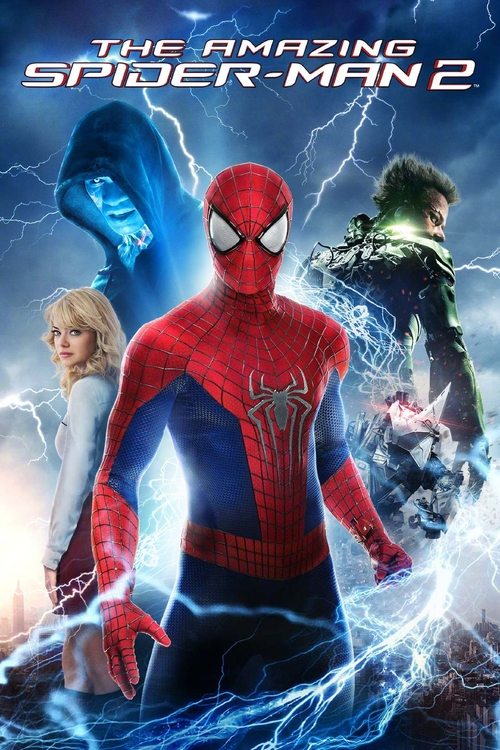
The Amazing Spider-Man 2
2014 · Marc Webb
For a popcorn night when you want superhero spectacle with a real love story at its center — comfort viewing with more emotional weight than you might expect going in.
What it's about
Peter Parker is trying to have it all: finishing high school, swinging over New York as Spider-Man, and staying close to Gwen Stacy despite a promise he made to her father to keep her out of danger. Then Electro arrives — a lonely engineer transformed by an accident into something the city has never seen — while an old friend resurfaces with an agenda of his own, and the shadowy corporation Oscorp seems to sit behind all of it. Peter has to hold his double life together as every part of it starts pulling in a different direction.
The experience
A big, busy blockbuster that keeps changing registers — breezy and quippy in the web-slinging, genuinely sweet whenever Peter and Gwen share the screen, then heavy with looming stakes. The romance is what lingers; the spectacle is loud, colorful, and relentless.
Performances
Andrew Garfield and Emma Stone have unforced, playful chemistry that makes Peter and Gwen feel like an actual couple rather than a plot device — it's the reason the film's quieter scenes outshine its loudest ones.
The craft
The swinging sequences are some of the most fluid and comic-book-vivid ever put on screen, with slow-motion mid-air choreography and an electric blue-and-crimson palette that pops on a big display. Electro's powers give the sound design real crackle. The script strains under the weight of multiple villains and franchise setup, and you can feel the seams.
Why it matters
Its underperformance ended Sony's planned Spider-Man universe and pushed the studio toward the deal that brought the character into Marvel's fold — making it one of the most consequential course corrections in modern franchise filmmaking.
Snapshot
The Amazing Spider-Man 2 is the second and final installment of Marc Webb's short-lived Spider-Man duology for Sony Pictures / Columbia, following the 2012 reboot that had itself arrived only five years after Sam Raimi's Spider-Man 3. It is a film pulled in two directions at once: an intimate romance between Andrew Garfield's Peter Parker and Emma Stone's Gwen Stacy, and a sprawling franchise-launcher freighted with villains, corporate conspiracy, and sequel-seeding. Its dramatic center is the adaptation of one of the most consequential storylines in superhero comics — the death of Gwen Stacy — while its commercial ambition was to build a Marvel-style shared universe around Spider-Man's rogues' gallery. The tension between those aims is the film's defining feature and, in most critical accounts, its central flaw. It is also, in retrospect, a pivotal industry object: its underperformance relative to expectations helped precipitate the collapse of Sony's planned "Sinister Six" universe and set in motion the negotiations that brought Spider-Man into the Marvel Cinematic Universe.
Industry & production
The film exists because of rights economics as much as storytelling. Sony's license to Spider-Man, acquired from Marvel in the late 1990s, carried an obligation to keep the character in active production or risk reversion. Raimi's aborted Spider-Man 4 had left Sony needing a fast pivot, and the 2012 reboot restarted the property with a younger cast and a more grounded, teen-romance register under music-video and (500) Days of Summer director Marc Webb. The 2014 sequel was conceived as the load-bearing entry of a new franchise architecture: it was announced alongside plans for a Sinister Six spin-off and a Venom film, and it openly plants seeds — Oscorp's weapons vault, the "special projects" villains-in-waiting — meant to pay off across later pictures.
The screenplay is credited to Alex Kurtzman, Roberto Orci, and Jeff Pinkner, with a story credit that also involves James Vanderbilt; the Kurtzman–Orci team were then among Hollywood's most in-demand franchise architects (Star Trek, Transformers). The picture was produced by Avi Arad and Matt Tolmach. It was shot largely on location in New York City — a point of pride for the production, which emphasized an authentically street-level Manhattan Spider-Man rather than soundstage abstraction.
Commercially, the film grossed less worldwide than its 2012 predecessor and was widely read within the industry as an underperformance relative to a nine-figure budget and Sony's universe-building expectations. The consequences were structural. The planned Sinister Six and Venom spin-offs stalled, and the 2014 Sony hack — which leaked internal emails, including correspondence about Spider-Man's future — exposed the studio's difficulties and coincided with the eventual 2015 agreement to co-produce Spider-Man with Marvel Studios, recasting the role with Tom Holland. Webb's duology thus became the hinge between two eras of screen Spider-Man, and The Amazing Spider-Man 2 the film whose reception effectively ended it.
Technology
The film was photographed by Daniel Mindel, a cinematographer known for his advocacy of photochemical capture, and it was shot on 35mm film rather than the digital formats then becoming standard for tentpoles — a deliberate choice consistent with Mindel's and the production's stated preference for film grain and a tactile New York palette. Elements were prepared for large-format and 3D presentation, with the picture released in 3D and IMAX; the 3D was executed as a post-conversion rather than native stereoscopic capture, as was industry norm for most live-action tentpoles of the period.
The most conspicuous technological showcase is the visual-effects rendering of Electro. Sony Pictures Imageworks led work on a translucent, bio-electric human body whose musculature and skeletal structure read as illuminated circuitry — a considerable challenge in subsurface scattering, volumetric lighting, and the integration of a live actor's face into a largely digital form. Spider-Man's web-swinging is likewise heavily effects-driven, with digital doubles for the highest-velocity Manhattan traversals, though the production continued to rely on physical stunt work and rigs for grounded beats. The picture's technical identity is thus split between an analog, film-based photographic base and a state-of-the-art digital superstructure for its marquee villain.
Technique
Cinematography
Mindel's photography favors a bright, saturated, comic-forward Manhattan — a marked contrast to the desaturated grit of many contemporaneous superhero films. Daylight sequences are clean and primary-colored; the web-swinging is staged for legibility and momentum, with a sense of the city's vertical geometry. The Electro set-pieces, particularly the Times Square confrontation and the climactic power-station battle, shift into a colder, high-contrast palette dominated by electric blues, exploiting the character's self-illumination as a practical-feeling motivated light source within the frame. The film-based capture lends skin and the New York exteriors a warmth that the effects work is designed to complement rather than overwrite.
Editing
Cut by Pietro Scalia and Elliot Graham, the film's editing is where its structural strain is most visible. Scalia is an Oscar-winning editor of considerable pedigree, but the material asks the cutting room to juggle multiple villain origins (Electro, Harry Osborn's Goblin, a late-arriving Rhino), a central romance with its own arc, and an ongoing mystery about Peter's parents — all while servicing franchise setup. The romantic scenes between Garfield and Stone are given room to breathe, and the climactic clock-tower sequence is edited with a deliberate, slowing precision. Against that, the connective tissue between plots is often felt as compression or abruptness, a symptom of a screenplay carrying more than a single film can resolve.
Mise-en-scène / staging
The production design leans into a heightened, near-storybook New York — Oscorp as gleaming corporate monolith, the streets as a legible playground for acrobatics. The film's most important staging decision is spatial and symbolic: the climax is set in a clock tower, amid exposed gears and machinery, so that Gwen Stacy's fall unfolds within a literal apparatus of time. The mechanism is not incidental décor; it externalizes the film's preoccupation with mortality and the impossibility of arresting fate.
Sound
The film's sound identity is inseparable from its score (below), but its most discussed design element is Electro's sonic characterization: a swirl of electrical crackle, distorted voices, and internal monologue rendered as an aural texture, blurring diegetic power-hum with non-diegetic scoring. The approach makes Electro's psychology audible — his sense of being unseen and then overwhelmingly seen — and represents one of the film's more genuinely experimental gestures.
Performance
Garfield's Peter is quicker-witted and more physically loose than Tobey Maguire's, a wisecracking Spider-Man closer to the comics' motormouth. The Garfield–Stone chemistry — the actors were a couple during filming — is the picture's most praised asset, giving the romance an unforced warmth that most reviews singled out even when panning the surrounding plot. Jamie Foxx plays Max Dillon/Electro in two registers: a cringing, invisible Oscorp technician and, after transformation, a vengeful god of the grid. Dane DeHaan brings a brittle, entitled menace to Harry Osborn, and Sally Field grounds Aunt May in working-class exhaustion. Paul Giamatti's Aleksei Sytsevich/Rhino is pitched broadly, almost cartoonishly, a tonal outlier reflecting the film's uneven register.
Narrative & dramatic mode
The film operates in a hybrid mode: a coming-of-age romantic melodrama grafted onto a multi-strand comic-book spectacle. Its most coherent throughline is the Peter–Gwen relationship, structured around a promise Peter made to Gwen's dying father to stay away from her, and the guilt and premonition that shadow their love. This gives the film a tragic architecture uncommon in the genre — the audience versed in the comics knows where Gwen's story ends, and the film courts that dread deliberately. Around that spine, however, the narrative accretes subplots that compete rather than converge: Electro's origin, Harry's illness and heel-turn, the conspiracy of Peter's parents. The result is a picture whose emotional climax lands with genuine force even as its plotting is frequently faulted for overload. The dramatic mode is ultimately elegiac — a superhero film organized around loss rather than triumph.
Genre & cycle
The Amazing Spider-Man 2 belongs to the post-2008, post-Iron Man superhero cycle, in which the shared cinematic universe became the dominant commercial template. It is a transitional artifact of that cycle: an attempt by a single studio holding one character to replicate Marvel Studios' interlocking-franchise model without Marvel's roster or its patient serialized structure. Its villain-stacking and end-of-film seeding are legible as universe-building conventions applied under commercial pressure. Within the narrower Spider-Man lineage, it sits between Raimi's operatic trilogy and the later MCU incarnation, and it is the film that adapts the genre's defining tragedy — the death of a hero's love — with unusual fidelity.
Authorship & method
Marc Webb's authorship is most legible in the romance. His background in music videos and indie romantic comedy ((500) Days of Summer) surfaces in the film's attention to the texture of a young couple's rapport, its comic timing, and its willingness to slow down for feeling; the spectacle sequences feel more like assigned obligations than personal signatures. The screenplay by Kurtzman, Orci, and Pinkner reflects the franchise-architecture sensibility of its authors, prioritizing connective mythology and setups for future films. Cinematographer Daniel Mindel supplies the film-based, high-color photographic identity. Editors Pietro Scalia and Elliot Graham manage — with mixed results — the reconciliation of romance and spectacle.
The score is a distinctive collaborative experiment: Hans Zimmer composed with an ad hoc ensemble billed as "The Magnificent Six," a collective that included Pharrell Williams and former Smiths guitarist Johnny Marr, among others. Electro's theme integrated electronic textures and vocalized inner monologue — whispered accusations rendered as music — an unusually pop-inflected and structurally adventurous approach to a blockbuster villain theme, and one of the film's more genuinely authored choices.
Movement / national cinema
The film is a product of the American studio blockbuster system, and specifically of the transatlantic production economy characteristic of major tentpoles — American financing and direction with a substantial contingent of international talent (Mindel, Marr, and others). Its emphatic New York location shooting positions it within a tradition of the city-as-character in American cinema, and it belongs to no art-cinema movement; its "movement" is the industrial one of the shared-universe franchise era rather than any national or stylistic school.
Era / period
Released in 2014, the film sits at a specific inflection point. Marvel Studios had by then proven the shared-universe model with The Avengers (2012), and rival studios were racing to build their own connected franchises from the properties they held. The Amazing Spider-Man 2 is a high-visibility test of whether that model could be reverse-engineered around a single hero — and its stumble became an instructive case study. Its production and release also fell in the shadow of the 2014 Sony hack, which laid bare the studio's strategic anxieties and coincided with the industry's growing recognition that not every franchise could be a universe.
Themes
Time and mortality dominate. The clock-tower climax, the recurring imagery of gears and hands, and the wristwatch that returns as a memento all bind the film to the idea of time running out — for Gwen, for Peter's parents, for Harry. Promises and their violation form a second axis: Peter's broken vow to Captain Stacy is the engine of the tragedy, and the film argues that fidelity to another's wish can conflict with the truth of one's feelings. Invisibility and recognition run through Electro's arc — a man who feels unseen, seized by a hunger to be noticed at any cost, a resonant portrait of grievance curdling into violence. Beneath these sits the franchise's persistent theme of inheritance and legacy: what parents pass to children, and the burden of the Parker and Osborn bloodlines.
Reception, canon & influence
Critical reception was mixed to negative. Reviewers widely praised the Garfield–Stone romance and the emotional weight of the Gwen Stacy sequence while faulting the film for overstuffing — too many villains, too much sequel-seeding, and a plot straining under franchise obligations. The consensus verdict was of a film with a strong emotional core buried inside an overloaded blockbuster.
Influences on the film (backward): Its dramatic climax is a direct adaptation of "The Night Gwen Stacy Died," the 1973 Amazing Spider-Man comics storyline (issues #121–122) long regarded as a watershed that helped end the innocence of the Silver Age of superhero comics. The film's structural DNA also draws on the Raimi trilogy's template of romance-plus-villain and on the Marvel Studios shared-universe model it sought to emulate.
Legacy (forward): The film's most significant influence is industrial and cautionary. Its underperformance and the collapse of the Sinister Six and Venom spin-offs it was built to launch contributed to Sony's strategic reset and the landmark 2015 arrangement to co-produce Spider-Man with Marvel Studios, ending Webb's duology and rebooting the character a second time in under a decade with Tom Holland. Andrew Garfield's tenure, cut short here, acquired a substantial and sympathetic critical reappraisal in later years, and his eventual return in Spider-Man: No Way Home (2021) — where his Peter is given a redemptive echo of the fall he could not prevent — retroactively enriched this film's tragic center. In the longer view, The Amazing Spider-Man 2 stands as a key exhibit in the history of the shared-universe era: proof that the franchise-architecture strategy could not simply be willed into existence, and a film remembered less for what it built than for the reboot its failure set in motion.
A Deleuzian reading
A hand comes down through the dark of a clock tower, and a line of web goes with it.
The full Deleuzian reading of The Amazing Spider-Man 2 →
Reception
In 2014 it was the sequel that killed its own franchise — mixed reviews and soft box office scuttled Sony's Sinister Six plans and pushed Spider-Man into the MCU deal. Post-No Way Home (2021), it's been warmly re-examined, with fans campaigning hard to #MakeTASM3.
How The Amazing Spider-Man 2 was received, from release to now →
How to watch The Amazing Spider-Man 2: what to notice on a first viewing
- Count how often Webb frames a hand reaching for someone. The reach is this film's basic gesture: a web line fired at a falling body, an arm out through the dark. Webb stages it in rescues and in small domestic moments alike. You are being trained to treat a reach and a save as the same event.
- Notice how Electro lights every room he walks into. Sony Imageworks rendered him translucent, with musculature glowing like circuitry. Daniel Mindel drops the palette into cold electric blue whenever he appears, and that blue swallows the primary colors around him. He is not lit by the scene. He is the light source, which is how the film builds a mood out of one character.
- Listen for whispering inside Electro's music. Hans Zimmer and his Magnificent Six braid accusations, electrical crackle, and grid hum into the score, so you cannot tell where the power station stops and the music starts. You hear what Max thinks without him saying it. A man who feels unseen gets made audible instead.
- Look for clocks, gears, and the wristwatch that keeps returning. Hands and mechanisms turn up across the film, in Oscorp, in gifts, in the architecture itself. The design keeps time running visibly behind scenes about young people making plans. The film is counting something down while it plays as a romance. The props are the things keeping score.
- Watch Garfield and Stone talk over each other. Webb came from romantic comedy and gives the couple room: overlapping lines, unforced comic timing, scenes that slow down for no plot reason. Garfield keeps talking under the mask too. The romance is where this picture is actually built. The rest reads as freight it agreed to carry.
The whole guide to watching The Amazing Spider-Man 2, with the keys for a rewatch →
Influences: the films it descends from and the films it influenced
- The Amazing Spider-Man (2012) — Direct predecessor that established the Garfield–Stone naturalistic rapport and Daniel Mindel's film-shot, high-saturation photographic identity carried forward wholesale.
- (500) Days of Summer (2009) — Webb's music-video/indie-romcom method — slowing down for a young couple's texture and comic timing — is the authored register that survives intact in the Peter–Gwen scenes.
- Spider-Man 2 (2004) — Supplied the structural template of romance-plus-sympathetic-villain, the two-track blockbuster that intercuts a doomed love story against a tragic antagonist's arc.
- Superman: The Movie (1978) — The operatic-sincerity superhero mode and the hero-reverses-catastrophe-to-save-the-woman motif, which ASM2 pointedly inverts into an unreversed failure.
- Vertigo (1958) — The fatal plunge from a tower and the man's failed downward reach are restaged almost shot-for-gesture in Gwen's clock-tower death, apparatus-of-time backdrop included.
- The Dark Knight (2008) — Zimmer's villain-as-sound-design conception — a single sonic signature standing in for the antagonist's psyche — is the direct precedent for Electro's whispered-accusation theme.
- Inception (2010) — Zimmer's practice of folding rock guitarists (Johnny Marr played on Inception) into orchestral scoring is scaled up into ASM2's 'Magnificent Six' ad hoc ensemble.
- Watchmen (2009) — Dr. Manhattan's translucent, internally-lit body is the subsurface-scattering VFX lineage Electro descends from — a glowing superhuman rendered as light passing through flesh.
- Tron: Legacy (2010) — Motivated electric/neon light treated as a character and an electronic score fused to the environment prefigure Electro's Times Square palette and synth-vocal soundworld.
- Venom (2018) — The villain-led Sony spin-off salvaged from the Sinister Six / symbiote architecture ASM2 was explicitly built to launch before its collapse.
- Spider-Man: Into the Spider-Verse (2018) — Pushes ASM2's saturated comic-book palette to its formal endpoint, rendering halftone dots and panel logic as the literal grammar of the image.
- Spider-Man: No Way Home (2021) — Restages ASM2's tower fall as redemption — Garfield's Peter catching MJ mid-plunge — a staging that only reads because it completes the failed reach of the Gwen sequence.
- Man of Steel (2013) — Zimmer's collaborative-collective deconstruction of the superhero theme, built with a percussion-and-guitar ensemble rather than a lone composer, runs parallel to the Magnificent Six experiment.
- Captain America: The Winter Soldier (2014) — The Marvel Studios shared-universe assembly method — seeding connective mythology inside a self-contained plot — is exactly the model ASM2's Kurtzman/Orci screenplay tried to reverse-engineer.
- Batman v Superman: Dawn of Justice (2016) — Extends the same franchise-architecture overload — a single film buckling under crammed universe-seeding — that critics diagnosed in ASM2's multi-strand editing.
Similar films
- The Amazing Spider-Man (2012) — influence & lineage · same viewing thread
- Spider-Man: No Way Home (2021) — influence & lineage · same viewing thread
- Spider-Man: Into the Spider-Verse (2018) — influence & lineage · same viewing thread
- Spider-Man 2 (2004) — influence & lineage
- Man of Steel (2013) — influence & lineage
- Spider-Man: Brand New Day (2026) — same viewing thread
- Spider-Man: Across the Spider-Verse (2023) — same viewing thread
- Spider-Man (2002) — same viewing thread
All the films related to The Amazing Spider-Man 2 →
Watch it with: curated runs of related films
- Anyone Can Wear the Mask — A run of every screen Spider-Man — from Raimi's earnest Queens kid to the multiverse's infinite web-slingers — where the rival reboots stop competing and start rhyming into one myth retold.