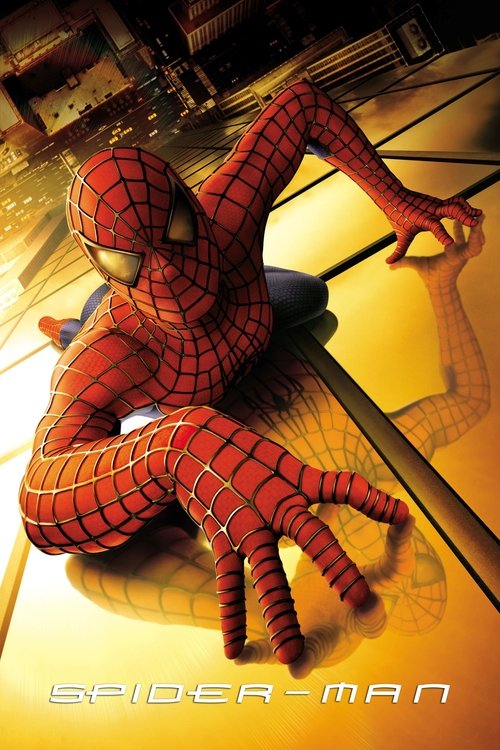
Spider-Man
2002 · Sam Raimi
For a classic popcorn night, or when you want the superhero story at its most heartfelt and uncynical — comfort viewing that still delivers a lump in the throat with its famous lesson about power and responsibility.
What it's about
Peter Parker is a bookish, bullied Queens teenager, hopelessly in love with the girl next door, when a bite from a genetically engineered spider gives him powers he has to figure out on the fly. A hard early loss teaches him what those powers are for, just as Norman Osborn — his best friend's father, an industrialist undone by his own experiment — becomes the cackling menace terrorizing New York. It's the original superhero equation: an ordinary kid, an extraordinary gift, and the cost of doing the right thing.
The experience
Bright, earnest, and irresistibly fun, with a streak of real pain under the primary colors — it swings between comic-book zip, gee-whiz romance, and genuine menace whenever the Goblin appears. Sincere in a way that's aged into a virtue.
Performances
Tobey Maguire's soulful, slightly dorky Peter set the template for every screen Spider-Man since, and Willem Dafoe is genuinely frightening as Norman Osborn — a man arguing with his own reflection, playing corporate menace and unhinged villain in one body.
The craft
Sam Raimi brings a comic panel's energy to the screen — swooping camera moves through Manhattan canyons, expressive faces, a total lack of embarrassment about big emotion — with a rousing orchestral score to match. The swinging sequences were a sensation in 2002 and still play best huge and loud.
Why it matters
The film that made the superhero movie Hollywood's dominant form — a record-shattering opening that proved comic-book characters could anchor the biggest films on the calendar and set the template for two decades of the genre.
Snapshot
Sam Raimi's Spider-Man is the film that turned the comic-book superhero from a niche or campy proposition into the dominant commercial form of twenty-first-century Hollywood. Adapting the Marvel character created by Stan Lee and Steve Ditko in 1962, the film distilled four decades of continuity into a clean origin: bookish Queens teenager Peter Parker (Tobey Maguire) is bitten by a genetically engineered spider, gains adhesive and preternatural agility along with a "spider-sense," loses his Uncle Ben (Cliff Robertson) to a robber he could have stopped, and learns that "with great power comes great responsibility." Against him stands Norman Osborn (Willem Dafoe), an industrialist whose performance-enhancing serum splits him into the murderous Green Goblin. Released by Columbia Pictures (Sony) in May 2002, it was a phenomenon: it is widely credited with setting the record for the largest opening weekend to that date and becoming the first film to cross $100 million in three days. More durably, it validated the modern superhero blockbuster as a franchise engine and made emotional sincerity — rather than irony — the register for the genre.
Industry & production
Spider-Man reached the screen only after one of the longest and most litigious rights sagas in Hollywood. The film character had been optioned and re-optioned since the 1980s, passing through Cannon Films, Carolco, and a tangle of studios; Menahem Golan, James Cameron (who wrote a widely circulated "scriptment" in the mid-1990s), and others were attached at various points. Overlapping claims among Cannon's successors, MGM, and Sony were not resolved until roughly 1999, when Sony/Columbia secured the film rights and set the project moving.
Sam Raimi, a lifelong Spider-Man reader best known for horror (The Evil Dead films) and the underseen original superhero picture Darkman (1990), campaigned for the job and was hired to direct. David Koepp — a veteran of Jurassic Park and Mission: Impossible — took the sole credited screenplay, though the script passed through other hands during development (Cameron's earlier treatment shaped some story DNA, and later writers contributed uncredited work; the exact division of labor is only partly documented in the public record). Casting favored talent over stardom: Tobey Maguire, then known for indie and coming-of-age roles, was chosen over more conventional action leads; Kirsten Dunst played Mary Jane Watson, James Franco played Harry Osborn, Rosemary Harris and Cliff Robertson played Aunt May and Uncle Ben, and Willem Dafoe insisted on physically wearing the Green Goblin armor himself rather than ceding the part to stunt performers. J.K. Simmons was cast as newspaper publisher J. Jonah Jameson, a piece of casting that proved so definitive it followed the actor across two decades and multiple franchises.
The production carried an unusually direct historical shadow. A teaser had been built around a helicopter caught in a web strung between the World Trade Center towers, and promotional imagery reflected the towers in Spider-Man's eyepiece; after the September 11, 2001 attacks these materials were pulled and altered. The finished film, arriving in spring 2002, became for many audiences an early instance of New York on screen after the attacks, and its imagery of ordinary Manhattanites rallying to the hero's aid read, in that moment, as civic affirmation.
Commercially, the result reset expectations for the genre. Beyond its record opening, it drove Sony to fast-track a franchise; Spider-Man 2 (2004) and Spider-Man 3 (2007) followed, with Raimi and much of the principal cast returning.
Technology
The film sits at a hinge point in digital effects. A fully persuasive, freely swinging, human-scaled Spider-Man had never before been rendered, and the visual-effects work — supervised by John Dykstra with Sony Pictures Imageworks — combined stunt photography, wire work, and computer-generated "digital doubles" for the web-swinging aerials through the Manhattan skyline. Where earlier superhero films leaned on practical stunts and matte work, Spider-Man used CG bodies and virtual camera moves to achieve motion no stunt performer could execute, then blended them with photographed plates. The results were, by 2002 standards, a leap — though the seams are visible in retrospect, and some swinging shots read as more weightless and video-game-like than later refinements would allow.
A key design decision was practical and character-driven rather than technological: Raimi gave Peter organic web-shooters, biologically generated from his wrists, replacing the comics' mechanical wrist devices that Peter invents. This streamlined the origin (no need to dramatize a teenager engineering advanced adhesives) and reinforced the film's biological-transformation theme, though it remains a point of contention among purists. The genetically engineered "super-spider," updated from the comics' radioactive spider, likewise re-grounded the premise in the era's anxieties about genetic engineering rather than atomic radiation.
Technique
Cinematography
Don Burgess, whose credits include Forrest Gump, shot the film in a bright, saturated, comic-book palette — primary reds and blues, clean key light — that deliberately courted the look of a four-color panel rather than gritty realism. Burgess and Raimi favored a swooping, mobile camera for the action, most memorably in the point-of-view and tracking "web-swing" sequences that let the audience share Peter's exhilaration of first flight. The framing frequently invokes comic-panel composition, with characters posed against skyline verticals and the city rendered as an idealized, heightened New York.
Editing
Bob Murawski — Raimi's longtime collaborator — cut the film with Arthur Coburn. The editing balances two rhythms: a patient, almost tender pace in the Queens/high-school and Peter–Mary Jane scenes, and a kinetic, impact-driven cutting style in the action, inherited from Raimi's horror background. The origin montage of Peter discovering and testing his powers is a model of economical comic staging, and the Goblin's attacks carry the percussive, shock-cut energy of Raimi's Evil Dead work.
Mise-en-scène / staging
Raimi stages the film as heightened melodrama with a comic reader's eye for the iconic image. Set-pieces are built around single indelible compositions — the upside-down rain-soaked kiss between Peter and Mary Jane; the Thanksgiving dinner where Norman silently deduces Spider-Man's identity; the Goblin's ultimatum forcing a choice between saving Mary Jane and a tram car of children. Production design renders both a warm, lived-in working-class Queens and the sleek corporate menace of Oscorp, externalizing the film's class and moral contrasts.
Sound
Danny Elfman's score is central to the film's identity. Building on his foundational superhero work for Tim Burton's Batman (1989), Elfman supplies a soaring, brass-forward main theme and a nervier, dissonant palette for the Goblin, giving the film an operatic emotional scale. Sound design emphasizes the whip and snap of webbing, the mechanical shriek of the Goblin's glider, and the impact of bodies against glass and steel.
Performance
The performances pitch sincerity against theatrical excess. Maguire plays Peter with a soft, watchful earnestness — awkward, decent, occasionally comic — that anchors the fantasy in adolescent feeling. Dunst grounds Mary Jane in vulnerability rather than glamour. The film's most discussed turn is Dafoe's: he plays Norman/Goblin with full-throated, split-personality relish (the mirror monologue between his two selves is a bravura set-piece), even as the rigid, expressionless Goblin mask he wears drew criticism for muting his face during action scenes. Simmons's Jameson, blustering and rapid-fire, and Cliff Robertson's brief, weighty Uncle Ben supply, respectively, comic relief and the film's moral keystone. Bruce Campbell (a Raimi mainstay) and Stan Lee appear in cameos.
Narrative & dramatic mode
The film is a coming-of-age origin structured as classical melodrama. Its dramatic engine is not primarily the villain but Peter's moral education: power arrives before wisdom, and the death of Uncle Ben — the direct consequence of Peter's selfish inaction — converts adolescent wish-fulfillment into ethical obligation. The screenplay braids three arcs: the superhero origin, a chaste and yearning romance, and a surrogate-father tragedy in which Norman Osborn becomes a dark mirror of the mentor Peter has lost. The mode is unabashedly sentimental and sincere, trusting emotional directness where later superhero films would hedge with irony. Its through-line, "with great power comes great responsibility," is delivered as near-scripture and functions as the thesis the plot repeatedly tests.
Genre & cycle
Spider-Man arrived mid-cycle in the revival of the comic-book film and became its inflection point. Blade (1998) and Bryan Singer's X-Men (2000) had demonstrated that Marvel properties could work as serious, contemporary action cinema; Spider-Man proved they could be the biggest films in the world. It helped codify the template that would dominate the following two decades: the origin story as first installment, the sincere hero, the sequel-ready mythology, the summer tentpole built on a recognizable IP. Where the 1990s superhero film had drifted toward camp and self-parody (the later Batman entries), Raimi's film re-established earnestness — arguably the single most consequential tonal decision for the genre that followed.
Authorship & method
The film is a genuine director's picture despite its scale. Raimi imports his sensibility wholesale: the horror-honed action grammar, a streak of macabre humor, the loyalty to a repertory of collaborators (composer, editor, actor Bruce Campbell), and a fundamentally romantic, pulp-loving heart evident as far back as Darkman. His method fused the comic reader's reverence for iconic imagery with the craftsman's economy of a filmmaker who came up making genre films on tight budgets.
The key collaborators reinforce that authorship. Cinematographer Don Burgess supplied the saturated comic-book look. Composer Danny Elfman — already the defining voice of the modern screen superhero after Batman — gave the film its operatic emotional register. Editor Bob Murawski, Raimi's regular cutter, translated the director's horror rhythms into blockbuster action. Screenwriter David Koepp, a specialist in structurally clean, character-forward blockbusters, built the origin's efficient three-act shape. Visual-effects supervisor John Dykstra (a veteran reaching back to the original Star Wars) delivered the digital web-swinging that made the fantasy literally take flight.
Movement / national cinema
This is mainstream American studio filmmaking at its most industrially ambitious — a Hollywood tentpole rather than a work of any art-cinema movement. It belongs to the lineage of the effects-driven summer blockbuster inaugurated in the 1970s and 1980s, and specifically to the turn-of-the-millennium consolidation of the studios around exploitable intellectual property. If it has a "national" character, it is its idealized vision of New York City — Queens and Manhattan as mythic American space — a self-image that acquired unintended poignancy in the immediate post-9/11 moment of its release.
Era / period
Spider-Man is a document of its exact instant: 2002, a digital-effects industry maturing to the point where a fully CG human hero could headline a film, and a culture reorienting after September 11. Its updates to the source — genetic engineering in place of atomic radiation, corporate biotech villainy — locate it firmly in millennial anxieties rather than Cold War ones. Its release also coincided with, and helped accelerate, the studios' pivot toward franchise IP as the core of their business, a strategy that would define the ensuing two decades.
Themes
The governing theme is responsibility as the price of power — an ethic learned through guilt and loss rather than triumph. Around it cluster several others: adolescence and transformation, with superpowers functioning transparently as a metaphor for puberty and the terror and exhilaration of a changing body; the double and the divided self, dramatized in Norman Osborn's literal split and in the mask/identity motif that recurs across the cast; surrogate fatherhood and mentorship, as Peter navigates the loss of Ben and the corrupting counter-example of Norman; and duty versus desire, resolved when Peter renounces the romance he wants to protect Mary Jane. Class hums quietly beneath — the modest decency of working-class Queens against the amoral wealth of Oscorp.
Reception, canon & influence
Critical reception was broadly warm to enthusiastic. Reviewers praised Raimi's sincerity, Maguire's and Dafoe's performances, and the emotional weight given to a comic-book premise, while some faulted the CGI web-swinging as weightless and the Goblin's rigid mask as a design misstep. The commercial reception was seismic: its record-setting opening (the first three-day gross reported above $100 million, and the largest opening weekend recorded to that point) reframed what a comic-book film could earn and effectively launched Sony's franchise.
Looking backward, the film draws on Lee and Ditko's original 1962 comics and their soap-operatic Marvel storytelling, on the superhero-film grammar established by Richard Donner's Superman (1978) and Burton's Batman (1989), on Raimi's own Darkman, and on the recent proof-of-concept of Blade and X-Men. Looking forward, its influence is difficult to overstate: it demonstrated that the sincere, origin-driven superhero blockbuster was the most reliable engine in Hollywood, seeding the template that the Marvel Cinematic Universe would industrialize from 2008 onward. Its own line continued directly through Spider-Man 2 — often cited as one of the finest superhero films ever made — and Spider-Man 3, and indirectly through two subsequent screen reboots of the character. J.K. Simmons's Jameson became so canonical that he reprised the role decades later. More than any single stylistic bequest, Spider-Man (2002) is remembered as the film that made the superhero movie the center of the popular-cinema universe.
A Deleuzian reading
Rain in an alley, and a man hanging upside down from a thread.
The full Deleuzian reading of Spider-Man →
Reception
In 2002 it was a phenomenon — the first movie ever to crack $100 million in a domestic opening weekend — and it kick-started the modern superhero era. Two decades on, the Raimi trilogy has been re-embraced as the sincere, big-hearted template that later, glossier franchises are measured against.
How Spider-Man was received, from release to now →
How to watch Spider-Man: what to notice on a first viewing
- Listen for the buzzing tingle that arrives just before danger reaches Peter. Raimi gives spider-sense a sound and a duration. It fires early, and the film holds a beat while Peter decides what to do with the warning. You are watching the pause between seeing and acting turned into a special effect.
- Look at how often pure red and blue fill the frame. Burgess lights everything cleanly and saturates the palette toward primary colors. Queens interiors glow warm, Oscorp goes sleek and cold, and nothing is dirtied down toward realism. The look tells you the film is printing comic panels, not chasing gritty credibility.
- Watch the camera hurtle through Manhattan during the web-swings. Raimi turns the rushing ground-level camera of his horror films inside out. These moves belong to no stunt performer and no possible human position, yet they carry Peter's glee. You feel a boy's exhilaration from a viewpoint nobody could actually occupy.
- Watch Maguire's face when he is not speaking. Maguire plays Peter soft and watchful, absorbing things before responding. Dunst matches him by playing Mary Jane's vulnerability rather than glamour. Both underplay while Dafoe goes theatrical. The quiet acting is what keeps the fantasy attached to adolescent feeling.
- Count how long the Queens scenes run compared to the fight scenes. Murawski cuts the kitchen table and high-school material patiently, then switches to percussive, impact-driven shock cuts whenever the Goblin appears. Two rhythms, cleanly separated. Raimi's horror grammar is doing the violence while melodrama gets the time.
The whole guide to watching Spider-Man, with the keys for a rewatch →
Influences: the films it descends from and the films it influenced
- Superman (1978) — Established the earnest, origin-first blockbuster register — treating a costumed premise with operatic sincerity and marquee flying effects — that Raimi adopts wholesale rather than winking at the material.
- Batman (1989) — Danny Elfman's brooding, leitmotif-driven superhero orchestration is carried directly forward: he scores Spider-Man in the same operatic-emotional idiom he defined for the modern screen hero here.
- Darkman (1990) — Raimi's own dry-run for a masked, romantic pulp hero and a disfigured self-divided villain, fusing horror-honed action grammar with comic-book iconography years before he had the license.
- Evil Dead II (1987) — The hurtling first-person 'force' camera that rushes through space at ground level is the direct stylistic ancestor of the web-swing POV shots that plunge through Manhattan canyons.
- Dr. Jekyll and Mr. Hyde (1931) — Dafoe's Norman-versus-Goblin mirror-dialogue — one actor performing a split self conversing across a reflection — is a direct debt to the Jekyll/Hyde divided-self staging tradition.
- Blade (1998) — Proof-of-concept that a Marvel property could be adapted as a serious, effects-driven genre film, clearing commercial ground Raimi's production directly stepped onto.
- X-Men (2000) — The immediate predecessor that validated a character-forward, restrained Marvel adaptation, establishing the market and tone template Sony refined into a mass blockbuster.
- The Matrix (1999) — Its virtual/photographed-camera hybrid — a lens flying through impossible geometry using digital-double stunt bodies — is the technical grammar Dykstra's team extended to make the CG web-swinging physically plausible.
- Spider-Man 2 (2004) — Extends the same horror-inflected set-piece method — the operating-table 'birth' of the Goblin becomes the surgical-tentacle massacre — and perfects the elevated-train rescue as the swing-POV apotheosis.
- Batman Begins (2005) — Inherits the sincere, psychologically weighted origin structure — earning the costume through character before spectacle — that Spider-Man proved audiences would take seriously.
- Iron Man (2008) — Industrializes Koepp's clean origin three-act into a repeatable blueprint, launching the MCU on the demonstrated thesis that the sincere origin blockbuster is Hollywood's most reliable engine.
- Spider-Man: Into the Spider-Verse (2018) — Takes the iconic-comic-composition and hero-pose staging to a graphic extreme, rendering Ben-Day dots, panel gutters and onomatopoeia into the image itself — Raimi's reverence made the medium.
- Doctor Strange in the Multiverse of Madness (2022) — Raimi re-imports his horror shock-cutting, jump scares and macabre camera lunges into the industrialized MCU, closing the loop by proving his 2002 grammar still defines superhero action.
- Spider-Man: No Way Home (2021) — Dafoe's split-personality Green Goblin mirror-monologue staging is quoted directly, along with Raimi's origin-era beat of the mask arguing with the man wearing it.
- The Amazing Spider-Man (2012) — TASM restages Raimi's exact origin beat-sheet (the fateful spider bite, the failed intervention that gets Uncle Ben killed, the rooftop web-test montage) while deliberately trading his expressionist, primary-color comic-book stylization for a grittier handheld register.
- Daredevil (2003) — A near-immediate Sony/Marvel copy of the template: saturated comic palette, brooding-loner origin, and rooftop-parkour traversal engineered as this film's web-swing analog.
- Hellboy (2004) — Shares the comic-reader's reverence for iconic panel compositions, staging shots to match a splash-page rather than to naturalistic blocking, the same instinct behind Raimi's frozen comic tableaux.
- Sin City (2005) — Pushes Raimi's 'compose the frame as a comic panel' impulse to literal fidelity, reproducing the source art's exact layouts — the extreme endpoint of iconic-comic staging.
Similar films
- Spider-Man: Into the Spider-Verse (2018) — influence & lineage · same viewing thread
- Spider-Man 2 (2004) — influence & lineage
- Superman (1978) — influence & lineage
- Doctor Strange in the Multiverse of Madness (2022) — influence & lineage
- Iron Man (2008) — influence & lineage
- Batman Begins (2005) — influence & lineage
- Blade (1998) — influence & lineage
- The Amazing Spider-Man (2012) — same viewing thread
All the films related to Spider-Man →
Watch it with: curated runs of related films
- Anyone Can Wear the Mask — A run of every screen Spider-Man — from Raimi's earnest Queens kid to the multiverse's infinite web-slingers — where the rival reboots stop competing and start rhyming into one myth retold.