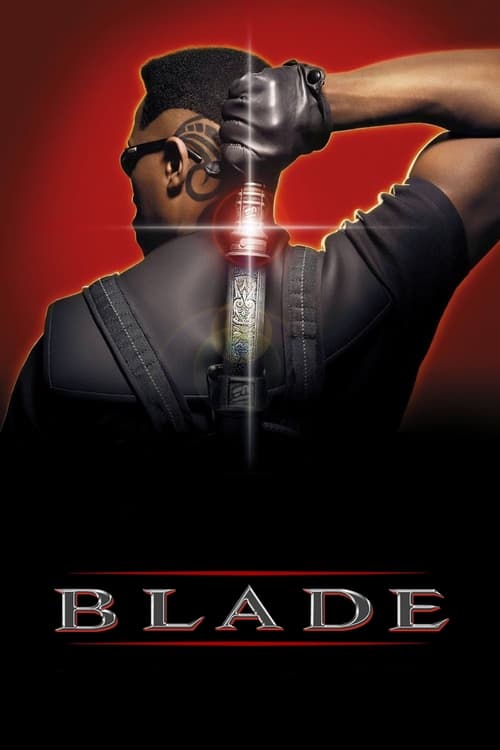
Blade
1998 · Stephen Norrington
For when you want pure midnight adrenaline — loud music, martial arts, monsters, and a hero who never smiles. Zero homework required; maximum style delivered.
What it's about
Beneath the clubs and boardrooms of the modern city, a hidden vampire aristocracy runs the night and treats humans as livestock. Standing against them is Blade, a half-human, half-vampire warrior with all their strengths and none of their weaknesses, waging a one-man war with swords, silver, and sunlight while an ambitious young vampire plots something that could tip the balance for good.
The experience
Sleek, brutal, and propulsive — a techno-scored, neon-and-leather action machine that treats its comic-book premise with total straight-faced cool. The fights hit hard, the world-building is genuinely eerie, and it never slows down long enough to wink.
Performances
Wesley Snipes is the whole engine: a real martial artist playing the Daywalker with icy, withheld charisma, every movement precise, letting a look do what other superheroes need speeches for.
The craft
Stephen Norrington fuses Hong Kong-style action choreography with horror atmosphere and club-culture production design — the opening rave sequence alone is one of the great genre cold opens. It's cut fast, scored to pounding electronica, and built for good speakers.
Why it matters
The film that proved a Marvel character could carry a hard-R hit, quietly opening the door for the entire superhero boom that followed — and a landmark for a Black actor leading a comic-book franchise.
Snapshot
Blade is the film that proved a Marvel property could carry a hard-R action picture and, in doing so, quietly laid the foundation for the superhero era that followed. Adapted from a supporting character introduced in Marv Wolfman and Gene Colan's The Tomb of Dracula in the early 1970s, it arrives stripped of costume-hero convention: no origin-by-committee, no cape, no wisecracking sidekick. Instead, Stephen Norrington and screenwriter David S. Goyer build a vampire-hunting procedural set inside a nocturnal, club-lit, techno-scored city where an entrenched vampire aristocracy administers human beings as livestock and property.
Wesley Snipes plays the half-human "Daywalker" as a study in withheld affect — a martial-arts action star repurposed as a monster who polices monsters. The film's sensibility is closer to Hong Kong action cinema and industrial club culture than to the Silver Age comics idiom then dominant on screen. It fuses gunplay, blade choreography, body horror, and a rave-adjacent visual language into something that reads, in retrospect, as a hinge: the last major superhero film to be marketed largely as a horror-action picture, and the first to demonstrate that the comics catalog extended well beyond the two or three characters Hollywood had been circling.
Its opening set piece — a blood sprinkler activating over a subterranean vampire club while unsuspecting prey realizes what room he is in — is among the most efficient scene-setting sequences in nineties genre film, and remains the film's most quoted moment.
Industry & production
Blade was produced by New Line Cinema and released in August 1998. The context matters. Marvel Entertainment had emerged from bankruptcy proceedings in the mid-1990s having licensed its characters widely and cheaply; the prevailing industry read was that comic-book adaptations were a depleted vein, an assumption underwritten by the collapse of the Warner Bros. Batman cycle with Batman & Robin (1997). Blade was not a marquee asset. He was a second-tier character from a horror title, and the license landed at New Line — a studio built on A Nightmare on Elm Street, comfortable with genre, and comfortable with an R rating.
That combination of low expectations and genre-native financing is the production's defining condition. Nobody was protecting a franchise, so the filmmakers were free to make a violent, unlovable, tonally unified picture. Norrington came to it with one prior feature, Death Machine (1994), a low-budget British science-fiction actioner made largely on ingenuity and practical craft. Goyer, then known for genre scripts including Dark City (1998), wrote a screenplay that treats vampirism as an institution — with archives, hierarchies, a ruling council, and a real-estate portfolio — rather than as a gothic curse.
The casting of Wesley Snipes was central and consequential. Snipes was a bankable star coming off New Jack City, Passenger 57, Demolition Man, and U.S. Marshals, and a serious martial artist. He was also a producer on the film. A Black lead carrying a genre tentpole was not the industry default in 1998, and the film's success complicated the standing studio assumption on that point — a fact worth stating plainly, since it is often elided in accounts that credit Blade only with reviving Marvel.
Production was not frictionless. The third act was substantially reworked; the finished confrontation between Blade and Deacon Frost differs from what was originally conceived, and the film's climactic blood-god transformation relies on visual effects that were compressed late in the schedule and show it. Norrington and Snipes have both, over the years, described the shoot in terms suggesting real creative disagreement, though accounts are partial and contested and the specifics of who prevailed on what are not reliably documented in the public record. Norrington did not return for the sequels; Guillermo del Toro directed Blade II (2002) and Goyer himself directed Blade: Trinity (2004).
Commercially, the film substantially outperformed expectations for a hard-R adaptation of a minor comics property and generated two sequels plus a television series. Precise figures vary by source and I won't assert numbers I can't verify here, but the outcome is not in dispute: Blade was profitable enough to reframe how Marvel's remaining licenses were valued, directly conditioning the deals that produced X-Men (2000) and Spider-Man (2002).
Technology
The film sits on a technological fault line, and its unevenness is instructive. Its practical effects are excellent: prosthetic vampire dentition and ash-out makeup effects, squib and blood work, wire-assisted stunt choreography, and physical set construction for the club and the archive interiors. Its digital effects are of their moment — 1998 being roughly the midpoint between Jurassic Park and The Matrix, when compositing was reliable but organic CG transformation was not.
The vampire disintegration effect — bodies crazing into cinder and ash rather than simply exploding — is the film's most successful hybrid, blending practical burn and particulate work with digital assist, and it became a genre-standard image. Conversely, the climactic La Magra sequence, in which Frost becomes a swirling blood entity, is the film's technological reach exceeding its grasp: fluid simulation and volumetric rendering were simply not mature, and the sequence has aged more visibly than anything else in the picture.
Sound technology deserves separate mention. Blade was engineered for the multichannel digital theatrical environment then standardizing across exhibition, and its low-end — the sub-bass of the club sequence, the impact reports of the gunfire — is designed for a room with real subwoofers. It is a film that assumes the theatrical sound system as a compositional instrument, not merely a delivery mechanism.
The film also arrived at the moment when DVD was replacing VHS as the collector format. Its dense, dark, detail-heavy image and aggressive sound mix made it a natural demonstration disc, and home-video circulation on DVD materially extended its cultural reach among a younger audience beyond its theatrical run.
Technique
Cinematography
Theo van de Sande shot the film, and his contribution is the single most legible authorial signature after Snipes's performance. The palette is severe: cyan-to-steel blues for night exteriors and institutional interiors, sodium and amber for the few warm spaces, and a saturated arterial red reserved almost exclusively for blood and for the club. Van de Sande lights for contrast rather than legibility — faces fall into partial shadow, backgrounds go to true black, and the frame frequently withholds spatial information until an action reveals it.
The camera favors low, canted angles for Blade himself, treating him architecturally, and handheld coverage for chaos. Anamorphic-feeling widescreen composition places figures at frame edges with empty scope between them, an isolating strategy that reads the vampire world as socially cold rather than sensually decadent — a deliberate inversion of the Anne Rice-derived vampire imagery dominant earlier in the decade. Practical light sources are motivated and visible: strobes, monitors, fluorescents, the cold wash of the archive. The result is a film that looks industrial rather than gothic, which is precisely the point.
Editing
Cut by Paul Rubell, the film's editorial grammar splits cleanly between its modes. Dialogue and exposition are cut conventionally, sometimes flatly. Action is cut with a percussive, rhythm-first approach that privileges impact over geography — hits land on musical accents, and the assembly is willing to sacrifice continuous spatial reading for kinetic charge.
This is a transitional style. It retains enough master-shot discipline that Snipes's actual physical competence is visible — the choreography is not hidden by cutting, as it would routinely be a decade later — while adopting the accelerated, montage-inflected rhythms that music video and club culture had normalized. The blood-rave opening is the clearest case: it builds through rhythmic acceleration synchronized to the score, holds on the sprinkler reveal, then detonates. Rubell would go on to cut Collateral and Miami Vice for Michael Mann, and his sense of controlled velocity is already present here.
Mise-en-scène / staging
Production design by Kirk M. Petruccelli constructs a vampire society that is bureaucratic and moneyed rather than aristocratic-romantic. The vampires occupy boardrooms, archives, warehouses, and clubs; their power is expressed through property, records, and institutional continuity. The archive of the vampire language, with its stone glyphs and scholarly apparatus, plays as a corporate legal department more than a crypt.
Costume — Sanja Milkovic Hays's work — codes the divide sharply. Blade's black leather duster, body armor, tactical webbing and wraparound eyewear read as paramilitary equipment, a uniform of function. The pure-blood elders wear tailoring; Frost's faction wears club fashion. The staging consistently frames Blade as a solitary vertical against horizontal crowds, and interiors are built with sightlines that let action move through depth rather than across a flat plane.
Sound
The sound design is one of the film's genuine achievements: the whisper-and-hum of the UV lamps, the metallic articulation of the sword drawn from the back scabbard, the wet subtractive quality of the ash-outs. Weapon sounds are given individual identities, so that the audience can track the fight aurally.
Mark Isham's score is the deliberate surprise. Isham, a trumpeter and composer with a jazz and ambient-electronic background, writes something closer to dark ambient and industrial texture than to orchestral heroism — drones, processed low brass, rhythmic pulse. It refuses the leitmotif-driven superhero idiom entirely. Layered against this is a curated soundtrack of electronic and hip-hop tracks, most famously New Order and Arthur Baker's "Confusion" in a Pump Panel reconstruction over the opening massacre. That cue is the film's thesis statement in miniature: club euphoria and slaughter occupying the same beat.
Performance
Snipes plays Blade with almost no interiority offered to the audience. He is terse, physically precise, and affectively closed — a performance built on stillness punctuated by explosive movement, which is the correct choice for a character defined by suppression. The martial arts are demonstrably his own, and the film's willingness to hold shots on his movement is a form of respect for that skill.
Kris Kristofferson's Whistler supplies the film's only warmth and most of its grain — a weathered, profane, mortal counterweight. Stephen Dorff's Deacon Frost is the film's most contemporary read: a striving, contemptuous parvenu who resents the pure-bloods' inherited status and wants to burn the hierarchy down. He plays it as ambition rather than menace, which makes him legible as a nineties character. N'Bushe Wright's Karen Jenson carries the audience-surrogate function and the medical-rationalist counterpoint, treating vampirism as pathology; Udo Kier's Dragonetti embodies the old order's exhausted formality.
Narrative & dramatic mode
The screenplay operates as a hybrid: horror-procedural in structure, revenge tragedy in motive, action film in delivery. Goyer dispenses with an origin sequence in the conventional sense — the prologue shows Blade's mother bitten while giving birth, and the film then cuts to the adult hunter mid-career, trusting the audience to assemble the rest. This is unusually economical for the genre and a significant part of why the film moves.
The plot is engine-driven: Frost seeks to translate a prophecy and awaken La Magra, the blood god, which requires the blood of a Daywalker. The mechanics of that prophecy are the film's weakest material — expository, arbitrary, dependent on translation scenes — and the third act consequently sags relative to the first hour. The stronger narrative line is the reversal in which Blade's own suppressed nature becomes both the villain's necessary instrument and, ultimately, his own weapon.
Two dramatic modes deserve note. The first is the vampire-as-institution conceit: the film's most interesting scenes are political, concerning who governs, who inherits, and who is merely turned. The second is the addiction structure — Blade's serum, his tremors, his dependence, Whistler's role as reluctant supplier — which gives the character a legible cost and grounds the mythology in bodily need rather than metaphysics. The film's register is grim and largely humorless by design; what levity exists belongs to Whistler.
Genre & cycle
Blade sits at the intersection of three cycles. First, the late-nineties vampire cycle, which had swung between literary romanticism (Interview with the Vampire, 1994; Bram Stoker's Dracula, 1992) and self-aware pulp (From Dusk Till Dawn, 1996). Blade rejects both, replacing seduction with sociology.
Second, the martial-arts-inflected Hollywood action film. Hong Kong choreography, gun-fu staging, and wire-assisted movement had been migrating into American production through the mid-nineties, and Blade is a mature example arriving one year before The Matrix codified the idiom for a mass audience.
Third, and most consequentially, the comic-book adaptation. The film belongs to a small group of late-nineties adaptations — The Crow (1994), Spawn (1997), Men in Black (1997) — that treated comics as source material for genre films rather than as a genre unto themselves. Blade's specific innovation was tonal fidelity to horror rather than to the four-color idiom.
It also participates in a Black action tradition running from the blaxploitation horror of Blacula (1972) through New Jack City — an inheritance the film registers in its urban setting, its soundtrack, and its central premise of a protector operating outside institutional sanction.
Authorship & method
Blade is best described as a film of collaborative rather than singular authorship, with unusual weight on the star.
Stephen Norrington brought a hands-on, effects-literate craft sensibility from his background in creature and makeup effects work before directing, which shows in the film's tactile confidence and its preference for practical solutions. His direction is strongest in texture and atmosphere and weakest in the mythology-driven third act. His subsequent career was brief and troubled — The League of Extraordinary Gentlemen (2003) effectively ended his feature directing — and he has spoken publicly with some bitterness about the studio filmmaking process, though the details of specific disputes remain incompletely documented.
David S. Goyer is the through-line of the franchise and, arguably, its author. He wrote all three films, directed the third, and carried the sensibility developed here — dark, mythology-heavy, procedurally structured comic-book adaptation — into Batman Begins and The Dark Knight with Christopher Nolan and into Man of Steel. The Goyer approach that would define a decade of DC filmmaking is visible in embryo in Blade.
Theo van de Sande, a Dutch cinematographer with credits across a wide tonal range, gave the film its defining look. Paul Rubell established its cutting rhythm. Mark Isham provided the anti-heroic score. Wesley Snipes, as star and producer, shaped the character's physicality and, by many accounts, the project's existence. The film's method is essentially fusion: take a horror premise, execute it with Hong Kong action grammar, score it with club electronics, shoot it like a crime film.
Movement / national cinema
This is an American studio genre film, but its aesthetic passport is stamped elsewhere. The action grammar is Hong Kong — the Woo-derived gunplay, the choreographic clarity, the willingness to let a body do the work. The visual and musical culture is transnational club culture, specifically European and British techno and industrial scenes filtered through American hip-hop production.
Norrington's Britishness matters at the level of sensibility: an outsider's view of an unnamed American metropolis, closer to the grimy futurism of British genre comics (2000 AD, and the Vertigo line then reshaping American comics with British writers) than to Hollywood urbanism. The result reads as part of a broader late-nineties Anglo-American genre convergence that also produced Dark City and, imminently, The Matrix.
Era / period
1998 is the film's subject as much as its date. The picture is saturated in fin-de-siècle anxiety: millennial prophecy, an ancient order about to be overturned, blood as both contagion and inheritance. Read against its decade, the vampire-as-viral-pathogen framing — Karen's attempt to treat vampirism as a blood-borne disease with a serological cure — is inseparable from a decade of public consciousness shaped by HIV/AIDS, and the film's insistence on blood as medium of transmission, identity, and property is culturally specific in a way that dates it precisely.
Equally of the moment: the club-culture aesthetic at the peak of American electronica's crossover; the leather-and-shades action iconography that would define 1999; and the corporate-conspiracy structure, in which the real antagonists are institutions with lawyers. The film is also, structurally, a pre-9/11 New York-coded action picture, unbothered by the security-state framing that would soon reshape the genre.
Themes
Hybridity and the refusal of belonging. Blade is neither human nor vampire and is claimed by neither. The film treats this as a permanent condition rather than a problem to be resolved — he does not choose a side and get accepted; he remains outside, and the film honors that.
Blood as property. The vampires' power is inherited and bureaucratic. "Pure-blood" is a class position, and Frost's rebellion is explicitly about a self-made outsider being denied entry by an aristocracy of birth. Read racially — with a Black protagonist, a purity-obsessed elite, and a system that farms human beings — the allegory is available without being announced.
Addiction and control. The serum structures Blade's life. Suppression is survival, but the same appetite he suppresses is his power. The film's climax literalizes this: he wins by accepting the thing he has spent his life refusing.
Predation as economy. Humans are livestock, blood banks are supply chains, and the club is a feeding facility with a dress code. The film's most durable idea is that monstrousness at scale requires administration.
Reception, canon & influence
Contemporary critical reception was mixed-to-positive and broadly patterned: reviewers praised Snipes, the opening sequence, the visual style, and the film's tonal conviction, while criticizing the plot's reliance on prophecy exposition, the underdeveloped supporting characters, and a third act that resolves into generic effects work. Several critics noted the disjunction between the first hour's confidence and the finale's incoherence. The film was not treated as a landmark on release; that reading is retrospective.
Influences on the film (backward). The Wolfman/Colan comics origin supplies the character but little else. More determinative are: Hong Kong action cinema, particularly John Woo's gun choreography and the general Hong Kong insistence on visible physical skill; The Crow (1994), for its gothic-industrial urban palette and its model of a comics adaptation as a rock-scored revenge film; Terminator 2 (1991) and Aliens-lineage action design for the armored-protagonist iconography; the vampire-as-society tradition running through Near Dark (1987), which similarly stripped vampires of gothic trappings and rendered them as an itinerant subculture; and Blacula (1972) as precedent for the Black-led vampire film. Club and rave visual culture — music video grammar, strobe lighting, industrial texture — is arguably the strongest non-cinematic influence.
Legacy (forward). Three claims are defensible. First, and most cited: Blade demonstrated that Marvel's non-marquee characters had feature value, which materially conditioned the licensing and greenlighting environment that produced X-Men (2000) and Spider-Man (2002), and thus the entire subsequent superhero economy. Marvel executives and industry historians have consistently identified it as the turning point. That the modern superhero era begins with an R-rated horror film starring a Black actor is one of the more underacknowledged facts in popular film history.
Second, it established a template for the "monster hunter in a leather coat" cycle — Underworld (2003), Van Helsing (2004), Constantine (2005), Priest (2011) — and for the tonal register in which supernatural mythology is executed as tactical action.
Third, its aesthetic fusion of martial arts, leather-and-shades iconography, and electronic score preceded and arguably prepared audiences for The Matrix (1999), which arrived seven months later and absorbed the culture entirely.
The franchise's own trajectory is instructive: Blade II (2002), with del Toro directing, is widely regarded as a superior action film and a stronger piece of monster design, while Blade: Trinity (2004) is generally considered the weakest entry. The character returned to Marvel Studios' control in the 2010s, with a reboot announced and repeatedly delayed — a development history that, as of this writing, remains unresolved and is best not characterized in detail given how much has changed and may still change.
Blade's canonical position is secure but oddly shaped: it is rarely taught, rarely restored, rarely written about as art — and yet nearly every account of how the superhero film came to dominate global cinema has to begin with it.
Reception
In 1998 it was received as a solid, slightly disreputable action hit — a vampire movie that critics shrugged at. Now it's routinely credited as the film that proved Marvel could work on screen, two years before X-Men and a decade before the MCU.
How Blade was received, from release to now →
How to watch Blade: what to notice on a first viewing
- Look at where the film lets any red onto the screen. Van de Sande runs cyan and steel blue through the night exteriors and institutional interiors. Saturated arterial red is held back almost entirely for blood and for the club. The palette rations one color. When red arrives you already know what it means, without a line of dialogue.
- Listen to the club track running under the opening slaughter. A Pump Panel reconstruction of New Order's Confusion plays through the blood-sprinkler sequence. The beat does not change when the killing starts. Euphoria and feeding share one tempo. That cue is the film's argument in miniature. The horror is not an interruption of the party. It is the party's purpose.
- Notice how low the camera sits when Blade walks in. Norrington shoots Snipes from beneath and often on a tilt, treating him like architecture. Chaos around him gets handheld coverage. He gets steady, angular, upright framing. Camera height does the characterization. He reads as a structure moving through rooms rather than a man reacting to them.
- Watch how still Snipes stays between bursts of movement. Blade is terse and affectively closed. Snipes gives you almost no interior, then detonates into martial arts the film holds long enough for you to see he is really doing it. Stillness is the character. He is built on suppression, so the performance withholds until suppression stops working.
- Look at the rooms the vampires actually occupy. Petruccelli's design puts them in boardrooms, archives, warehouses, and clubs. There are records, elders in tailoring, and a language archive staged like a legal department. No crypts, no candelabra. Power here is property and paperwork. The film's durable idea is that monstrousness at this scale needs administration.
The whole guide to watching Blade, with the keys for a rewatch →
Influences: the films it descends from and the films it influenced
- Blacula (1972) — Establishes the Black-led vampire film's sonic grammar — Gene Page's funk-soul cues and a live-band nightclub set piece make contemporary urban music, not orchestral gothic, the vampire's native soundtrack, the direct precedent for Blade's techno-scored club predation.
- Enter the Dragon (1973) — Frames the martial-arts star in sustained wide full-body takes with minimal coverage so the skill is verifiable on camera; Snipes' fights are staged and cut on the same show-the-whole-body principle rather than the American concealment-cutting norm.
- The Hunger (1983) — Opens on nightclub predation cut to a diegetic goth needle-drop (Bauhaus's 'Bela Lugosi's Dead') behind smoke, strobe and steel mesh — Blade's blood-rave transposes the device intact into the Pump Panel remix of 'Confusion.'
- Aliens (1986) — The armory/loadout scene and paramilitary costume coding render monster-fighting as an equipment discipline of visible ordnance, harness and body armor — the template for Whistler's workshop and Blade's silver/UV arsenal.
- Near Dark (1987) — Strips vampires of capes and castles into an itinerant subculture with its own economy and internal rules, staging feeding as a group assault on a working-class interior; Blade's vampire-as-organization premise descends from that de-gothicizing.
- The Killer (1989) — Two-gun choreography in which figures fire while moving through legible architectural space, with action beats cut to musical phrasing rather than to impact — the direct model for Paul Rubell's percussive music-synced assembly of Blade's gunplay.
- Terminator 2: Judgment Day (1991) — Codifies the leather-coat-and-shades entrance with a concealed weapons bag, and stunt design that treats a superhuman body as heavy industrial machinery; Blade's introduction reproduces that costume grammar and weight.
- New Jack City (1991) — Renders a narcotics syndicate as a vertically-integrated corporation with territory, product and lieutenants — the organizational schema Goyer grafts onto vampire society, with blood as trafficked commodity and Snipes' star image of the immaculately-costumed operator carried over.
- The Crow (1994) — Rain-slick desaturated cyan-into-black urban palette lit from practical sodium and smoke sources, plus the comics adaptation scored as a contemporary industrial-rock album; van de Sande's lighting and Isham's ambient-industrial cues both extend it.
- From Dusk Till Dawn (1996) — Turns a single night-spot interior into a vampire nest that flips mid-scene, dispatched with improvised UV/holy-water hardware and squib-heavy practical gore — the structural rhyme for Blade's blood-rave and House of Erebus sieges.
- X-Men (2000) — Replaces comic-book spandex with black tactical leather and codes factions by uniform — the costume solution Blade proved viable by dressing a Marvel property as paramilitary realism rather than four-color pageantry.
- Blade II (2002) — Extends the craft directly: Donnie Yen choreographs the fights into Hong Kong ensemble staging, and the Reaper's split-jaw prosthetic design fulfills Norrington's creature-shop instinct at a scale the first film's third act couldn't reach.
- Underworld (2003) — Takes the cyan-steel-blue grade as an entire film's signature look and literalizes vampire bureaucracy into a coven house with elders, succession rules and an armed security detail, led by a leather-coated hunter.
- Constantine (2005) — Runs the occult as a licensed institution with jurisdictions and intermediaries, and sends a trench-coated protagonist out after a curated relic loadout — Blade's monster-hunter-with-a-kit cycle restaged in theological dress.
- John Wick (2014) — Recombines Blade's two most durable devices: the Red Circle sequence stages strobe-lit techno-scored predation in a club with legible full-body gun-fu cut on the beat, inside a criminal underworld governed by explicit bureaucratic rules.
- Spider-Man (2002) — Proof-of-concept that a Marvel property could be adapted as a serious, effects-driven genre film, clearing commercial ground Raimi's production directly stepped onto.
- John Carpenter's Vampires (1998) — Arrives the same year at the hunter-as-tactical-contractor: a paid crew with winch-and-stake rigs and a daylight-drag kill method, treating vampire elimination as blue-collar equipment work instead of scholarly ritual.
- The Matrix (1999) — Developed in parallel and released seven months later with the same fusion — leather-and-shades costume, Hong Kong-trained choreography imported wholesale into a Western action frame, and gun set pieces cut to industrial-electronic needle-drops.
Similar films
- The Matrix (1999) — influence & lineage
- John Wick (2014) — influence & lineage
- Sin City (2005) — same viewing thread
- The Dark Knight (2008) — same viewing thread
- The Avengers (2012) — same viewing thread
- Batman Begins (2005) — same viewing thread
- The Dark Knight Rises (2012) — same viewing thread
- The Batman (2022) — same viewing thread
All the films related to Blade →
Watch it with: curated runs of related films
- The Superhero Movie Grows Up — Watch these as one arc — Raimi's warmth into Nolan's gravity into Logan's elegy and The Batman's rain-soaked noir — the two decades the comic-book film reached for real weight.