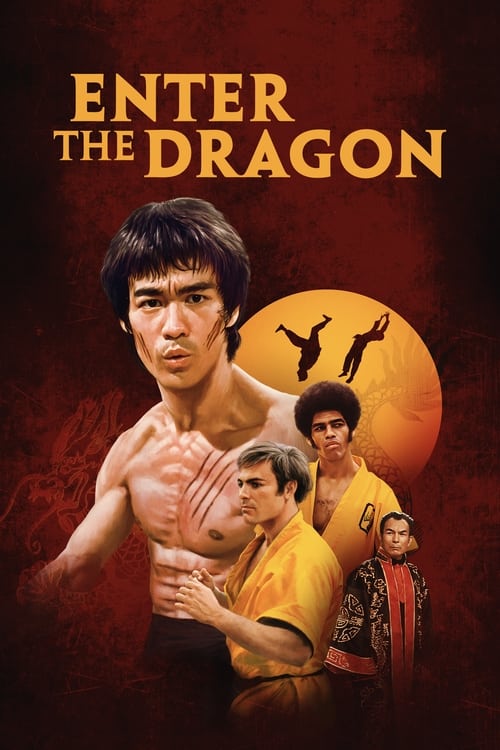
Enter the Dragon
1973 · Robert Clouse
For a crowd-pleasing action night — friends, snacks, zero irony required. Total comfort viewing if you love watching the best ever do the thing they were best at.
What it's about
A Shaolin-trained martial artist is recruited to spy on a reclusive crime lord by entering the man's invitation-only tournament on a private island fortress. Alongside two American fighters with debts and demons of their own, he competes by day and investigates by night — with a personal score of his own to settle.
The experience
Pure pulp pleasure: a Bond-style espionage plot that exists to deliver fight after fight, each one escalating in invention and speed. It's funky, swaggering, and endlessly quotable, and Bruce Lee's sheer velocity still startles fifty years on.
Performances
Bruce Lee, in his only completed Hollywood-funded starring vehicle, is magnetic beyond the fighting — the stillness, the stare, the philosophy delivered between blows — with John Saxon and Jim Kelly bringing easy charisma as his fellow competitors.
The craft
Lee's fight choreography is the main event: fast, legible, and built around his own uncanny speed, culminating in a hall-of-mirrors set piece that's been imitated ever since. Lalo Schifrin's funk-laced score is a classic in its own right — this one earns good speakers.
Why it matters
It blew martial arts cinema into the global mainstream, and Lee's death just days before its premiere transformed the film into both a monument and a farewell — the template for decades of action stars and tournament plots to come.
Snapshot
Enter the Dragon is the film that drove martial arts into the mainstream of global popular culture. A Warner Bros.–Concord Production co-production shot entirely in Hong Kong, it arrived as Bruce Lee's first Hollywood-funded feature and became — by brutal irony — his eulogy: Lee died on July 20, 1973, six days before its Hong Kong premiere and nearly a month before its American release on August 19. What the audience received was less a simple genre picture than a Trojan horse — a Bond-inflected tournament thriller whose true freight was the philosophy, physicality, and racial pride Lee had spent a career assembling. Its financial success was enormous by any contemporary measure, transforming a modestly budgeted exploitation project into a cultural watershed that permanently altered the aesthetics and demographics of action cinema.
Industry & production
The film's origins lie in the convergence of two opportunistic readings of the same market data. In Hong Kong, Raymond Chow's Golden Harvest had made Lee a regional superstar with The Big Boss (1971) and Fist of Fury (1972); Lee had also directed and starred in Way of the Dragon (1972), proving he could command an entire production. In Hollywood, Warner Bros. producer Fred Weintraub — who had already shepherded Woodstock (1970) — tracked the surprise American success of dubbed Shaw Brothers films in urban grindhouse theaters and saw an untapped audience. The deal Weintraub and partner Paul Heller brokered with Concord Production (Lee and Raymond Chow) placed Lee on a modest fee with points, gave Warner Bros. international distribution rights, and established the production as a genuinely bilateral venture: American money and distribution infrastructure, Hong Kong creative infrastructure and locations.
Shooting took place largely on the Shaw Brothers back lot in Clearwater Bay and at the Golden Harvest facilities, with location work on the outlying island of Lung Kwu Tan. The budget is widely reported at approximately $850,000 — a figure that underscores how cheaply Hollywood believed it could acquire the kung fu phenomenon. In production Lee chafed against the script's pulp compressions, clashed repeatedly with screenwriter Michael Allin (whom Lee reportedly had removed from set), and effectively rewrote or improvised significant portions of his own dialogue and the philosophical framing of the opening sequence. He exercised near-total control over the design and execution of every fight scene. Weintraub and Clouse were pragmatic enough to let him.
Technology
The production was shot on 35mm with a spherical lens in an aspect ratio consistent with the standard theatrical 1.85:1 frame of the period. Cinematographer Gilbert Hubbs, a Hong Kong-based operator with extensive experience in Clouse's preferred working methods, employed a relatively mobile camera by the conventions of early-1970s action filmmaking. The production did not rely on anamorphic widescreen processes, which is notable given the scope of some of its set-pieces — the climactic mirror maze in particular exploits the shallower telephoto compression of spherical glass to multiply and confuse Lee's image.
The construction of Han's island fortress was accomplished through Shaw Brothers' standing sets augmented by purpose-built structures; the production's art department, working under tight schedule, used the studio's existing infrastructure more extensively than original reporting suggested. The mirror room, comprising hundreds of reflective panels arranged in an adjustable labyrinth, was a genuine practical set constructed for the finale, not a trick of double exposure or rear projection. Sound post-production was completed partly in the United States, where the English-language track was finalized and Lalo Schifrin's score was recorded.
Technique
Cinematography
Hubbs's work is functional rather than expressive in the European sense, but it serves the film's primary purpose: showcasing Lee's body in motion with minimal interference. The camera tends to hold mid-range two-shots and wide framings during combat, giving Lee room to display full technique without the compensatory cutting that would characterize post-Lee martial arts cinematography. There is a deliberate compositional flatness to the island interiors — corridors, cells, dungeons — that makes the film's outdoor and arena sequences feel expansive by contrast. The underground dungeon sequence, lit in amber and shadow, represents the most atmospherically sustained visual work in the picture, anticipating the horror-inflected dungeon crawls of later action films.
Editing
Kurt Hirschler and George Watters's editing strategy is worth examining against what came before and after. The cuts within Lee's fight sequences are notably fewer and longer than in comparable Hong Kong productions of the period, a choice that may have emerged partly from Clouse's Hollywood rhythms and partly from Lee's own insistence that his technique be legible. Lee was publicly critical of excessive cutting as a technique for disguising inadequate performers, and the editing reflects this bias. The final action sequence, however, adopts a more rapid intercutting approach as multiple characters converge — an approach that would become the genre default, creating the paradox that Enter the Dragon's own influence would eventually undermine the clarity it modeled.
Mise-en-scène / staging
The fight choreography — Lee's own work, with assistance from his long-time collaborator Sammo Hung on the martial arts side — is the film's primary mise-en-scène claim to originality. Lee designed each confrontation as a problem in spatial geometry: where the camera should be, how the opponent's size or style creates a visual counterpoint to his own economy, how a room's dimensions define the grammar of the fight. The opening teaching scene, in which Lee corrects a student's emotional approach, is a compressed manifesto — "don't think, feel" — that functions as an aesthetic declaration for every action sequence that follows. Han's compound is staged with a conscious awareness of threshold and enclosure: gates, doorways, and corridors organize the film's power relations spatially, with Lee perpetually penetrating inward toward a defended center.
Angela Mao's prologue sequence, playing Lee's sister Su Lin — who kills herself rather than submit to Han's men — is staged in the idiom of the then-current Hong Kong female martial arts film, giving the picture a generic breadth that American viewers would have found unfamiliar and kinetically startling. Its inclusion functions both as narrative motivation and as a signal that the film inhabits a broader tradition than the Western spy-thriller scaffolding suggests.
Sound
Lalo Schifrin's score deserves its canonical status. Drawing on his jazz-funk idiom — honed on Bullitt (1968) and the Mission: Impossible television series — Schifrin produced a main theme of extraordinary economy: a five-note ostinato over a groove that blurs funk, rock, and Asian modal inflection without resorting to pastiche. The score is most effective in its silence: Schifrin pulls back during key fight sequences, letting foley and Lee's own vocalizations fill the space. Lee's combat cries — high, sudden, asymmetrical — became among the most imitated sounds in popular culture, and their effectiveness derives from their integration into the film's sound design as rhythm rather than noise. The post-dubbed English track, like all Hong Kong–American co-productions of the era, creates the characteristic audio uncanny of the period: lips and voices in productive tension.
Performance
Lee's screen presence is the subject of considerable critical writing, and the consensus is essentially correct: he operates at a different register from everyone else in the film. His stillness is the key — an absolute economy of movement outside of action that reads on camera as concentrated force. John Saxon brings professional American character-actor competence to Roper, anchoring the Western audience identification figure without competing for the frame. Jim Kelly's Williams is more interesting than his limited screen time suggests: Kelly, a genuine martial arts champion in his film debut, projects a confrontational cool directly derived from the blaxploitation hero archetype, and his scenes carry a political edge — notably his exchange with a white police officer in Los Angeles before departure — that the rest of the film largely elides. Kien Shih's Han is a theatrical conception rather than a psychologically developed antagonist, and the script makes little effort to develop him, but his prosthetic weapon-hands provide the film's most visually distinctive villain motif.
Narrative & dramatic mode
The film's narrative architecture is transparently a transposition of the James Bond formula onto a martial arts setting: the lone operative with exceptional skills, the isolated villain's fortress, the tournament as a cover for criminal enterprise, the local contact feeding intelligence. Han maps directly onto the Bond supervillain type — the island lair, the physical deformity (the prosthetic hands), the army of disposable fighters. This structural borrowing was conscious and functional: it gave American distributors and audiences a legible genre container while allowing Lee to fill it with a very different kind of heroism.
What differentiates Lee's protagonist from Bond is the philosophical dimension. Lee is not primarily motivated by institutional loyalty or masculine competitiveness but by a sense of duty tied to honor, the protection of the defenseless (his dead sister), and the maintenance of a practice. The film's moral economy is closer to the Confucian xia (wandering knight-errant) tradition of wuxia literature than to the Cold War technocrat Bond embodies. This tension between the Western spy-thriller container and the Chinese philosophical content is the film's central productive instability, and it never fully resolves — which is part of why the film continues to repay analysis.
Genre & cycle
Enter the Dragon arrived during a specific, short-lived window in American popular culture: the kung fu craze of 1972–1975, precipitated by the grindhouse success of dubbed Shaw Brothers and Golden Harvest films and accelerated by the television series Kung Fu (1972–1975), which Lee had reportedly been considered for before the role went to David Carradine. The film crystallized the cycle's commercial potential for major studios while simultaneously outlasting it — where dozens of cheaper imitations flooded the market and were quickly forgotten, Enter the Dragon accrued a secondary life as the genre's defining text.
It belongs simultaneously to several overlapping cycles: the blaxploitation action film (through Kelly, through its urban American reception, through its Schifrin score's funk affiliations), the spy thriller, the tournament film (a sub-genre it effectively invented in its Hollywood form), and the Hong Kong martial arts film. Its generic hybridity was the condition of its crossover success and the source of its lasting formal influence.
Authorship & method
Robert Clouse was a competent journeyman director with no special claim to martial arts expertise; his role was essentially to keep the production on schedule and translate Hong Kong material into a form legible to Hollywood distributors. He would go on to direct several subsequent martial arts pictures, including The Big Brawl (1980) with Jackie Chan, none of which achieved Enter the Dragon's reach. The auteur of Enter the Dragon, by any serious reckoning, is Bruce Lee.
Lee's collaborators require naming. Lalo Schifrin's score is a co-equal creative contribution. Gilbert Hubbs's cinematography, while not independently distinguished, was responsive enough to Lee's choreographic needs to serve as an effective instrument. The writing credit belongs to Michael Allin, though the extent of Lee's uncredited revisions — particularly of the film's opening philosophical passages — remains a matter of production record rather than conjecture; Weintraub's own accounts confirm the scope of Lee's intervention. On the martial arts choreography side, Lee worked within a Hong Kong tradition that included early contributions from Sammo Hung, whose own career as director and choreographer would become one of Hong Kong cinema's most significant.
Movement / national cinema
Enter the Dragon occupies a genuinely transnational position that complicates any single national cinema claim. It is a Hong Kong production in its location, its creative labor, its industry infrastructure, and a significant proportion of its cast. It is an American production in its financing, distribution, and narrative template. It belongs to the history of Hollywood's periodic discovery and absorption of global popular film forms — a process that, in this case, was mediated by a single performer who used the transaction to carry his own agenda across the Pacific.
Within Hong Kong cinema history, the film sits at the intersection of the Shaw Brothers martial arts tradition (the studio infrastructure, many of the background performers) and the emerging Golden Harvest model of independent production that Chow was using to challenge Shaw's dominance. Lee himself was a product of the Hong Kong film industry's willingness to absorb overseas Chinese talent — born in San Francisco, raised substantially in Hong Kong — which makes his story an emblem of the diasporic networks that structured the industry.
In American cinema history, the film is the founding document of what would become a durable Asian action cinema pipeline into Hollywood — a pipeline that would eventually carry Jackie Chan, Jet Li, John Woo, and others, each negotiating variants of the same tension between imported form and American market expectations.
Era / period
1973 occupies a specific location in American cultural history: the Watergate summer, the final phase of Vietnam withdrawal, the aftermath of the civil rights movement, and the height of a New Hollywood that was itself beginning to fragment under the pressure of blockbuster economics. Enter the Dragon's multiracial triumvirate — Lee, Saxon, Kelly — reads, in retrospect, as an idealistic image of coalition that its era was simultaneously producing and undermining. The film's arrival in inner-city theaters alongside the blaxploitation cycle was not accidental; it was marketed to overlapping audiences who recognized in martial arts heroism a fantasy of physical empowerment outside white institutional structures.
The early 1970s were also the period in which the economics of exploitation cinema were being transformed by the realization — demonstrated by Jaws two years later — that a low-cost genre picture could be scaled into a mass-market phenomenon. Enter the Dragon was an early proof of concept for this transformation in the action genre specifically.
Themes
The film's most persistent thematic concern is authenticity in combat and selfhood. Lee's teaching in the opening sequence — the finger pointing at the moon, "don't think, feel," the priority of emotional content over technique — frames everything that follows as a test of genuine versus performed martial ability. Han, whose prosthetic weapons literally replace the hand, embodies the corruption of technique divorced from self. The dungeon of imprisoned fighters, reduced to instruments of Han's will, extends this logic: the tournament is a system for converting authentic martial artists into commodities.
Questions of racial dignity run through the film at an oblique angle. Williams's political consciousness is invoked and then abandoned by the screenplay, which lacks the nerve to sustain it — but the film's visible pleasure in defeating white authority figures is registered by the blaxploitation audience's enthusiastic reception. Lee's own conception of the film was explicitly connected to Chinese-American dignity and the representation of Asian masculinity in Hollywood, which had historically coded Asian men as comic, menacing, or subservient. His Lee is none of these things.
Reception, canon & influence
Critical reception at the time of release was mixed: American reviewers who acknowledged the film at all tended to frame it as exploitation product of unusual quality rather than significant cinema. Its enormous popular success — the film earned back its modest budget many times over and became one of the highest-grossing films of its year — was noted without being taken as a critical signal. The reappraisal came gradually, accelerating in the 1990s as martial arts aesthetics permeated mainstream action cinema and the question of Lee's place in film history became unavoidable. The film is now routinely listed among the most influential action films ever made and has been recognized by the Library of Congress as culturally significant, though the specific date of that designation is not something this account can confirm with precision.
Influences on the film are extensive. The Bond template provides the structural spine, with Dr. No (1962) — another island-fortress villain story — the most direct precedent. The Shaw Brothers wuxia and martial arts tradition, particularly the One-Armed Swordsman cycle and the films of Chang Cheh, supplied the aesthetic vocabulary of tournament spectacle and the moral weight placed on martial skill. Bruce Lee's own earlier pictures — The Big Boss, Fist of Fury — established the characterological template: the restrained hero driven past restraint by a violation of family or community. Hollywood's blaxploitation cycle supplied the tonal permission for explicit racial anger and the genre market that created Jim Kelly's casting.
Legacy and forward influence is where the film's impact becomes difficult to overstate. The tournament-on-an-island format became one of the most frequently recycled genre structures of the subsequent decades, surfacing in everything from Bloodsport (1988) to the entire Mortal Kombat franchise — a video game series whose iconography and narrative architecture are so close to Enter the Dragon as to constitute direct derivation. Jackie Chan's early career was consciously defined against the Lee model even as it was enabled by the market Lee created; Chan's films represent a sustained formal argument with Enter the Dragon's aesthetic. The film's success opened the door to Hong Kong directors and performers in Hollywood a full generation before John Woo's The Killer reached American art houses, establishing the commercial proof that Western audiences would follow Asian action talent. Hip-hop culture's sustained engagement with martial arts iconography — from the Wu-Tang Clan's foundational mythology to the pervasive sampling of Schifrin's score — runs directly through Enter the Dragon, which served as many American listeners' primary point of contact with Hong Kong film. In formal terms, the film's insistence on legible technique over edited illusion established a standard that most of its successors failed to maintain, making it — paradoxically — more contemporary in its action aesthetics than the genre cycles it generated.
A Deleuzian reading
Han runs into the mirror room and for ninety seconds the most legible body in cinema is lost.
The full Deleuzian reading of Enter the Dragon →
Reception
A box-office smash on release — made for under $1M, it grossed hundreds of millions worldwide — but treated by many critics at the time as an exotic action programmer; it has since been canonized as the definitive martial-arts crossover film and was added to the US National Film Registry in 2004.
How Enter the Dragon was received, from release to now →
Influences: the films it descends from and the films it influenced
- Come Drink with Me (1966) — Hu's staging through thresholds and interior enclosures — doorways and corridor choke-points as choreographic constraints — is the direct formal ancestor of Lee's spatial-geometry fight design: each room in Han's fortress defines a new grammar for the confrontation held within it.
- One-Armed Swordsman (1967) — Chang Cheh's Shaw Brothers tournament film embedded within xia knight-errant narrative — the formal martial competition as arena for the chivalric code — is the genre template Lee and Clouse transpose into a Bond-inflected co-production, carrying over the elimination-bout structure and the wounded-hero-overcomes logic.
- Goldfinger (1964) — The villain's private island fortress, the assembled roster of adversaries sorted by national and stylistic difference, and the infiltrating operative's double-identity structure are lifted wholesale from the Bond formula, giving Enter the Dragon's narrative architecture instant legibility for Western audiences unfamiliar with wuxia conventions.
- The Big Boss (1971) — Lee's first Golden Harvest feature established the economy-of-stillness performance register — extended, charged pauses before explosive action — and the Golden Harvest production infrastructure (Raymond Chow, Concord) that Enter the Dragon scales up into an international co-production.
- Shaft (1971) — Isaac Hayes's wah-wah and brass jazz-funk scoring is the direct template Lalo Schifrin draws on for Enter the Dragon's score, while Jim Kelly's character imports the blaxploitation cool performance model — physical mastery legible as racial pride — from the Shaft persona.
- Fist of Fury (1972) — Lo Wei and Lee's second collaboration refined the wide-shot fight-framing philosophy — holding the camera at a distance sufficient to display Lee's full technique without compensatory cutting — and the rhythm of cutting to opponents' reactive close-ups, both carried directly into Enter the Dragon's fight sequences.
- Way of the Dragon (1972) — Lee's own direction established the climactic one-on-one duel as a fully staged choreographic showcase set-piece — the Colosseum fight with Chuck Norris — in which location architecture frames the fighters as geometric counterpoints; Enter the Dragon scales this into a multi-bout tournament with the same spatial logic governing each encounter.
- Black Belt Jones (1974) — Clouse immediately replicates Enter the Dragon's blaxploitation–kung fu hybrid formula with the same Jim Kelly, a post-dubbed English track, and jazz-funk scoring, demonstrating that the genre cross-pollination was understood by its own production team as a replicable industrial model rather than a one-off accident.
- Game of Death (1978) — Lee's pre-shot tower footage — each floor a different spatial enclosure with a different opponent physicality — extends Enter the Dragon's architectural staging principle into its logical form: the building itself as a sequence of geometrically distinct fight chambers, each imposing new constraints on the choreography.
- The 36th Chamber of Shaolin (1978) — Lau Kar-leung extracts Enter the Dragon's opening training-as-philosophy sequence — in which Lee corrects a student on the difference between emotional investment and technical execution — and expands it into an entire film: the disciple's progressive mastery through physical discipline becomes the narrative subject rather than a prologue.
- Drunken Master (1978) — Yuen Woo-ping inherits Lee's wide-shot fight-framing philosophy — camera held back to show the performer's full body in motion — while inverting the performance register from Lee's economy-of-stillness to comic physical exaggeration, establishing Jackie Chan's alternative idiom against the exact formal standard Enter the Dragon codified.
- Police Story (1985) — Chan formalizes Lee's anti-cutting principle as the ethical signature of his action cinema — holding wide shots long enough for the audience to verify the stunt's physical reality — citing a different justification (stunt credibility) than Lee (technique legibility), but inheriting the same formal logic that Enter the Dragon modeled against the genre's compensatory-editing default.
- Bloodsport (1988) — The Kumite tournament directly descends from Han's island tournament format: an international field of fighters with stylistically distinct disciplines eliminated sequentially, the protagonist's physical economy tested against an undefeated final opponent — Enter the Dragon's narrative architecture reproduced almost beat for beat.
- Kill Bill: Volume 1 (2003) — Tarantino reconstructs Enter the Dragon's chamber-by-chamber spatial logic as homage — the Crazy 88 hierarchy and O-Ren's retinue functioning as a tournament bracket — while directly borrowing the jazz-funk scoring palette and Lee's choreographic principle that each fight space defines its own grammar through its dimensions and obstacles.
- The Raid (2011) — Evans and choreographer Iko Uwais apply Lee's spatial-geometry principle — each room's dimensions and surface obstacles define the fight's grammar — to a single-building vertical assault, producing the most formally rigorous extension of Enter the Dragon's architectural staging logic in the action cinema's subsequent history.
- Batman Begins (2005) — The martial-arts training-and-mastery narrative that underpins the League of Shadows first act's structure of discipline, mentorship, and rite of passage.
- Cowboy Bebop: The Movie (2001) — Bruce Lee's Jeet Kune Do economy of motion is the acknowledged basis for animating Spike's close-quarters fighting style — trapping, redirection, and relaxed readiness over brute force.
- Who Killed Captain Alex? (2010) — Codified the escalating one-against-many combat grammar — clear lines of attack, a beat per blow — that structures Captain Alex's commando-vs-Tiger Mafia set-pieces.
- John Wick: Chapter 4 (2023) — Supplies the tournament-gauntlet architecture and, via Donnie Yen's Bruce Lee lineage, the insistence on framing an authentic martial artist head-to-toe so technique reads as craft, not cutting.
- Five Fingers of Death (1972) — The post-dubbed English-language track convention for Hong Kong martial arts product in American theatrical release was established by this Shaw Brothers export, and the urban grindhouse audience it cultivated is the precise market Enter the Dragon was engineered to expand — both films share the dubbing pipeline and exploitation-circuit distribution strategy.
- Black Dynamite (2009) — Jim Kelly's Afro'd, real-credentialed martial artist legitimizes the crossover of blaxploitation and kung-fu that Michael Jai White's genuine multi-black-belt pedigree extends.
Similar films
- The 36th Chamber of Shaolin (1978) — influence & lineage
- Come Drink with Me (1966) — influence & lineage
- Police Story (1985) — influence & lineage
- Duel to the Death (1983) — shared sensibility
- Dragon Inn (1967) — shared sensibility
- A Touch of Zen (1970) — shared sensibility
- Crouching Tiger, Hidden Dragon (2000) — shared sensibility
- A Better Tomorrow (1986) — shared sensibility
All the films related to Enter the Dragon →