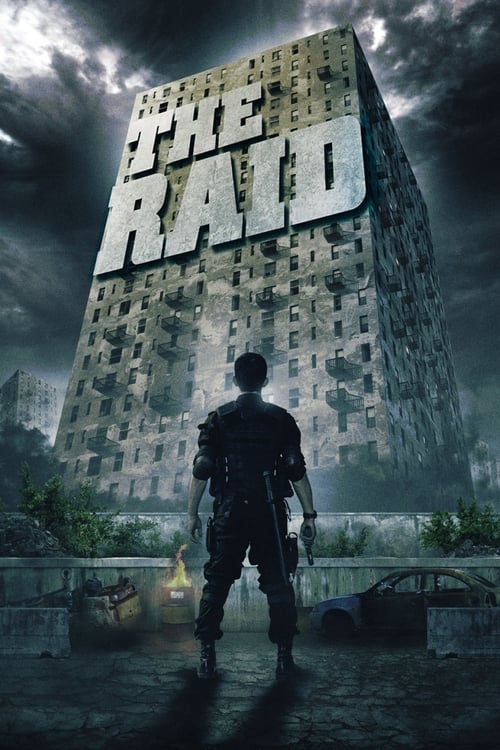
The Raid
2012 · Gareth Evans
When you want action, full stop — the kind of night where you crave momentum and jaw-dropping physical spectacle over dialogue. Perfect with friends and a loud sound system.
What it's about
Before dawn, an elite SWAT team slips into a decaying Jakarta tower block that serves as a fortress for the city's worst criminals, run by a drug lord who watches every hallway from a bank of monitors. The plan is simple: floor by floor, take the building. It stops being simple almost immediately, and a young rookie has to fight his way through a high-rise that has become a trap.
The experience
Pure adrenaline, sustained for an hour and a half — relentless, brutal, and choreographed with a clarity that makes you gasp and occasionally laugh out loud at the audacity. It's exhausting in the best way; your shoulders will be up around your ears.
Performances
Iko Uwais, a genuine pencak silat practitioner, does things with his body that don't seem possible, and the film wisely lets you see every move he makes.
The craft
Made for around a million dollars, it strips action filmmaking to one building, one morning, one direction: up. The camera actually follows the fights instead of chopping them into confetti, so every hit lands and every stunt registers — this is a big-screen, good-speakers film if there ever was one.
Why it matters
It reset the bar for action cinema worldwide, put Indonesian martial arts on the global map, and its fingerprints are all over a decade of contained, choreography-first action films that followed.
Snapshot
A Welsh filmmaker, an Indonesian martial art, and an apartment block in Jakarta: the conjunction that produced The Raid is improbable enough to feel like myth. Shot for approximately one million US dollars in 2011, the film strips action cinema to its most austere architecture — one building, one morning, one direction (up) — and delivers what many critics and practitioners regard as the most purely accomplished action film of its era. Its commercial and critical success reshaped international expectations of the genre, accelerated the global visibility of Pencak Silat, and established a template for contained, choreography-centred action that continues to reverberate.
Industry & production
Gareth Evans, born in Wales, relocated to Indonesia while working on a documentary about Pencak Silat. The encounter with the martial art — and with one of its practitioners, Iko Uwais — redirected his career entirely. Their first collaboration, Merantau (2009), was a more conventionally structured debut that proved the commercial viability of Uwais as a screen presence and of Evans's approach to staging Silat. The Raid was the consolidation of everything Merantau had tested.
The production company was PT Merantau Films, Evans's Jakarta-based outfit, co-produced with XYZ Films, the Los Angeles-based genre specialist that handled international sales and helped secure finishing funds. The film's budget — around one million dollars by most accounts, though precise figures were not publicly itemized — is remarkable given the production's logistical complexity: hundreds of extras, elaborate stunt work, practical construction of interior sets, and a shooting schedule demanding extraordinary physical endurance from its performers.
The original Indonesian title is Serbuan Maut, meaning roughly "Deadly Assault." For its US theatrical release through Sony Pictures Classics, the film was retitled The Raid: Redemption to avoid confusion with a 2011 French film also called The Raid. The subtitular addition is narratively specious — Evans has acknowledged this — but the domestic Indonesian release and most international markets retained the unadorned title.
The film premiered at the Toronto International Film Festival's Midnight Madness program in 2011, where it won the section's audience award. The response was immediate and loud enough to generate pre-release discussion that framed its theatrical debut as an event.
Technology
The Raid was photographed on Red digital cameras, placing it squarely within the transition-era digital action cinema of the early 2010s. The choice was practical as much as aesthetic: digital acquisition allowed the production to manage its budget, shoot across long hours, and make fast adjustments to lighting in low-ceilinged interior environments where film-based rigs would have been prohibitively cumbersome. Cinematographer Matt Flannery, Evans's collaborator from Merantau, exploited the camera's sensitivity in dimly lit corridors, achieving a gritty, granular image that suited the material without resorting to the over-processed desaturation common in action cinema of the period.
A notable post-production circumstance: the film carried two distinct scores. The original Indonesian release was scored by composers Fajar Yuskemal and Aria Prayogi. For international distribution, XYZ Films commissioned a replacement score from Mike Shinoda (of Linkin Park) and Joseph Trapanese, which was used in the US, UK, and most international prints. The two scores represent meaningfully different tonal choices — Yuskemal and Prayogi's work more percussive and rooted in Indonesian sonic registers, Shinoda and Trapanese's leaning toward electronic propulsion — and the coexistence of both versions complicates any single account of the film's sonic identity. Viewers who encountered the international release encountered a different work at the level of atmosphere and rhythm, a fact under-discussed in most critical writing on the film.
Technique
Cinematography
Matt Flannery's work on The Raid is a study in constraint as resource. The apartment building — largely a purpose-built set rather than a found location, which gave Evans control over wall placement and floor structure — is rendered as a labyrinthine vertical trap. Flannery's camera is rarely still and rarely distant: the dominant register is close, handheld, and kinetic, pressing into the action to maintain legibility while denying the spectator the safe remove of wide coverage. This proximity is not incoherence. One of the film's genuine achievements is that its most frenetic sequences remain spatially comprehensible; the spectator always knows who is where in the corridor or room, which direction the protagonist is moving, and where threat is likely to emerge. That kind of spatial clarity under chaos is technically demanding and frequently absent from action films that mistake rapid cutting and close framing for energy.
Rack focus is used with precision to shift attention between action planes in a single shot, occasionally allowing two combatants to exist in the same frame at different depths, one sharp while the other stalks or recovers. Light sources are diegetically motivated — bare bulbs, flashlights, muzzle flare — which grounds the image in its environment and provides natural variation in exposure across the building's different floors.
Editing
Evans edited the film himself, a combination of roles (director-editor) that shaped the film more deeply than is sometimes acknowledged. His editing strategy is organized around rhythm rather than impact: cuts are placed to carry momentum across blows rather than to land on them, which means that the viewer's experience of violence is one of flow rather than percussion. This distinguishes the film from action cinema that uses editing to simulate impact through shock cuts. The action sequences in The Raid are choreographed to be comprehensible in long or medium takes, and Evans's editing honors that legibility rather than fragmenting it. The set-piece pacing — bursts of explosive action interrupted by brief respiration, both for the characters and for the audience — follows a logic more musical than purely narrative.
Mise-en-scène / staging
The building is not merely a location but a spatial argument. Evans and his choreographers structured the raid in terms of vertical progress: each floor represents a new threshold of danger and a new set of constraints. Corridors narrow. Rooms contract. The architecture imposes conditions on how bodies can move and how combat must be conducted. Narrow hallways preclude wide-stance techniques and force engagements that are grappling and close-quarters in nature, which happens to showcase Pencak Silat's strengths — its efficiency against multiple opponents in confined space, its integration of joint manipulation, its reliance on improvised-weapon improvisation using whatever the environment provides.
The staging of the central set-pieces — the machete gang corridor sequence, the bathroom fight, the climactic two-on-one confrontation — is built around the principle of spatial arithmetic: how many bodies fit in this space, and what does that constraint make possible or impossible? This is choreography conceived architecturally, which is distinct from the open-space martial arts displays that characterize much of Hong Kong or Thai action cinema.
Sound
The foley and sound design work on The Raid is exceptional and constitutes a significant part of its affective power. The sound of impacts — bone on flesh, bodies on concrete, the particular register of a machete on a refrigerator door — is crafted to be felt as much as heard, emphasizing mass and weight. The contrast between silence (pre-breach, the pre-dawn approach, moments between engagements) and sudden violence is calibrated carefully, each transition amplifying the force of the other. The building's acoustic environment — the hollow reverb of stairwells, the contained deadness of furnished rooms — is used to differentiate spatial zones without resort to visual information alone.
Performance
Iko Uwais had been practicing Pencak Silat since childhood and performs his own action sequences without doubles, a fact legible in the continuity of physical presence within single shots. His performance as Rama is not primarily verbal or psychologically nuanced — the film does not ask that of him — but his embodied presence carries a specific form of credibility: the spectator believes this person can do these things, which is the foundational contract of martial arts performance cinema.
Yayan Ruhian, co-choreographer and Silat instructor, plays Mad Dog, the film's most memorable antagonist. His physical register is distinct from Uwais's: where Uwais performs Silat with a quality of flowing economy, Ruhian brings a coiled, almost ecstatic intensity, performing a figure for whom violence is something like vocation. The two-on-one finale between Mad Dog, Rama, and Sergeant Jaka (Joe Taslim) is widely regarded as one of the finest extended fight sequences in contemporary action cinema and is achieved almost entirely in practical performance.
Narrative & dramatic mode
The Raid belongs to the tradition of the siege narrative: a small group, trapped in a hostile environment, must survive against overwhelming opposition. The lineage includes Rio Bravo (1959), Assault on Precinct 13 (1976), and Die Hard (1988). Evans strips the formula further than most of his predecessors, reducing backstory and subtext to their minimum functional doses. Rama's pregnant wife establishes mortal stakes without development. The revelation that Andi, a gangster inside the building, is Rama's estranged brother provides the film's sole structural complication beyond the physical ordeal. The narrative is largely a delivery mechanism — a reasoned argument for why these characters must fight through this building — rather than a psychological investigation. This is not a limitation so much as a generic commitment: the film is interested in choreographic drama, in the drama of physical problem-solving under duress, and its narrative serves that interest without apology.
Genre & cycle
The Raid sits at the intersection of the martial arts film and the action-thriller, drawing on both without being reducible to either. Its most immediate generic context is Southeast Asian martial arts cinema, a cycle that includes Tony Jaa's Ong-Bak (2003) and Tom-Yum-Goong (2005), which had already demonstrated international appetite for physically extreme, stunt-authentic action from outside Hollywood. The Raid extends this cycle by adding the spatial economy of the siege thriller and the political neutrality of the building-as-closed-system, which appealed across markets that might have been indifferent to specifically Thai or Indonesian cultural contexts.
The film also participates in a broader cycle of "extreme action" cinema in the 2010s — European, East Asian, and Southeast Asian productions characterized by escalating physical commitment, long-take choreography, and a conscious rejection of CGI enhancement for action sequences. Within this cycle, The Raid functions as something of a benchmark film: the standard against which subsequent entries were measured.
The coincidental release in the same year of Pete Travis's Dredd (2012), which shares almost exactly the Raid's premise (a law enforcement officer trapped in a high-rise housing block controlled by a drug lord), is a documented curiosity. The two productions developed independently and with no knowledge of one another, which was verified publicly at the time; the coincidence is best understood as two productions independently identifying the same latent commercial and dramatic logic.
Authorship & method
Evans functions as writer, director, and editor — a concentration of creative control rare outside micro-budget independent cinema. This integration is meaningful: the choreography, the shot selection, and the editing rhythm are conceived as a unified system rather than as contributions from separate departments later assembled. Evans collaborated closely with Uwais and Ruhian on the action choreography, a process he has described as iterative and improvisational — sequences were developed in rehearsal, shaped through conversation about what the camera could capture in the available space, and refined after initial test filming. The director's role was to translate Silat vocabulary into cinematic syntax, identifying angles and durations that would communicate the technique's logic to an audience unfamiliar with the art form.
Matt Flannery as cinematographer and Evans as editor represent the film's core technical partnership. The original Indonesian score composers Fajar Yuskemal and Aria Prayogi deserve recognition within the auteur account of the film as Evans intended it, even as the international score by Shinoda and Trapanese is what most of the film's global audience heard.
Movement / national cinema
The Raid occupies an unusual position within Indonesian national cinema: it was directed by a foreigner, but funded through an Indonesian production entity, performed by Indonesian actors, and shot on Indonesian locations. Its relationship to Indonesian cinema is therefore one of complex belonging rather than straightforward national authorship. The film nonetheless had significant consequences for Indonesian film culture: it brought international attention to Pencak Silat as a cinematic art form, elevated the profiles of Uwais and Ruhian to international standing, and established the commercial viability of Indonesian action films in export markets. Subsequent Indonesian action productions operated in an industrial landscape partially transformed by the film's success, even if its aesthetic model was not widely replicated domestically, where genres and production priorities differ considerably from those Evans imported.
Era / period
The film is a product of the early 2010s digital action cinema moment, characterized by the maturation of affordable high-resolution digital cameras, the global distribution reach of VOD and digital platforms that could carry subtitled foreign-language genre films to niche-but-substantial audiences, and an international critical ecology (festival circuits, online film culture, genre-specialist press) capable of amplifying a low-budget Indonesian action film into a global cultural event. This was a transitional window in which a film with $1 million of production capital and no major stars could achieve mainstream critical visibility, a window that would begin to close as the mid-2010s streaming economy created both new opportunities and new consolidations.
Themes
Violence as labor is the film's most consistent thematic register. Rama and his colleagues are not action heroes in the Hollywood tradition of effortless mastery; they tire, they suffer, they bleed. Combat is presented as physically exhausting, tactically improvisational, and economically motivated — these are working-class men doing a dangerous job. This emphasis on the cost and effort of violence, rather than its glamour, is part of what gives the film its distinctive texture and aligns it, however obliquely, with the social conditions of its setting: a Jakarta slum whose residents are neither romanticized nor demonized but simply present, living in proximity to the organized violence that the raid both perpetuates and attempts to suppress.
The building also operates as an image of systemic corruption as architecture: a structure in which criminality is not aberrant but structural, housing not just the drug lord at its apex but a network of compliant, compromised, or coerced tenants. The revelation that police command elements have a stake in the operation suggests that the building's social order mirrors the city's political order, though Evans does not press this interpretation hard; it remains a contextual texture rather than a sustained argument.
Reception, canon & influence
Critical reception on the festival circuit in 2011 was overwhelmingly positive and quickly exceeded the martial arts genre audience to reach broader critical discourse. Reviews consistently noted the film's formal achievement — the spatial legibility of action sequences, the practical stunt work, the editing discipline — as distinguishing it from contemporaneous Hollywood action cinema. It entered critical conversations about action cinema canon rapidly, appearing on retrospective best-of lists for the decade with unusual speed for a non-Anglophone production.
The film's backward influences include Hong Kong action cinema of the John Woo and Johnnie To schools; the practical stunt philosophy of Jackie Chan's production company; Tony Jaa's Ong-Bak cycle; Korean crime action films of the 2000s; and, structurally, the American siege thriller lineage running from Rio Bravo through Die Hard. Evans has cited various of these, and the synthesis he achieved was one of the film's most discussed qualities: a Malay martial art delivered through a Western director's command of genre architecture, with Hong Kong's physical commitment and Korean cinema's willingness to sustain genuine darkness.
The film's forward influence is extensive and measurable. The Raid 2 (2014), Evans's own sequel, expanded the setting into a sprawling crime epic while maintaining the choreographic ambition, becoming a significant work in its own right. Iko Uwais and Yayan Ruhian appeared in Star Wars: The Force Awakens (2015), a casting that reflected their elevated international recognition. The film's corridor-fight aesthetic influenced set-piece design in numerous subsequent productions, from the Daredevil television series (the hallway sequences in particular were cited by their directors in reference to The Raid) to the John Wick franchise's philosophy of long-take, geographically coherent action choreography. Its demonstration that international genre audiences would seek out subtitled action cinema was commercially meaningful for distributors and emboldened the production of subsequent Southeast Asian genre films with export ambitions.
Where The Raid sits in the longer arc of action cinema history remains a question of active critical negotiation. Its claim on the canon is secure; the nature of that claim — whether it represents a formal peak, a generic cul-de-sac, or a generative opening — depends on what action cinema does with the decade that followed it.
A Deleuzian reading
A corridor.
The full Deleuzian reading of The Raid →
Reception
No reappraisal needed — it detonated at TIFF Midnight Madness in 2011 and arrived already crowned, with critics calling it the best action film in years. A decade-plus on, its stock has only risen: it's now the standard-issue benchmark every new action movie gets measured against.
How The Raid was received, from release to now →
Influences: the films it descends from and the films it influenced
- Police Story (1985) — Chan's insistence that the stunt performer and actor be the same body — physical cost rendered genuinely visible on screen — established the performer-as-spectacle philosophy Evans extends by casting Iko Uwais and Yayan Ruhian, actual Pencak Silat practitioners, so that technique and performance are inseparable rather than doubled by a stunt double.
- Die Hard (1988) — Codified the siege thriller's spatial grammar that Evans directly inherits: a single building as narrative container, vertical ascent floor by floor as dramatic escalation, and the lone protagonist's accumulating physical attrition as the engine of suspense — The Raid transposes this structure wholesale into the Tench Nasir apartment block.
- Hard Boiled (1992) — The hospital basement sequence's two-and-a-half-minute single take — Woo and cinematographer Wong Wing-Hang tracking through corridors and rooms with continuous camera movement — established the sustained-take corridor action grammar that Evans systematizes across The Raid's entire structural logic.
- The Mission (1999) — To's extreme geometric precision in staging bodies within architectural space — characters defined entirely by their spatial relationship to walls, columns, and angles — established a grammar of space-as-constraint that Evans literalizes: The Raid's choreography is incomprehensible without the architecture, exactly as To designed the Milkyway mall sequence.
- Oldboy (2003) — The corridor fight's choreography around performer exhaustion within a single unbroken take — Oh Dae-su genuinely staggering, unable to stand straight, enemies collapsing with him — is the direct template for The Raid's insistence that physical cost accumulate visibly across takes rather than being reset between cuts.
- Ong-Bak (2003) — Established the contemporary Southeast Asian action cinema premise that a martial art's genuine technical vocabulary — here Muay Boran, no wirework, no CGI — is itself sufficient spectacle; Evans extends the same argument to Pencak Silat, with the audience's unfamiliarity with the art form serving as a discovery engine identical to Jaa's debut.
- SPL: Sha Po Lang (2005) — The climactic alley duel between Donnie Yen and Wu Jing — an actual corridor too narrow to fully extend a limb — forced a grappling, elbow-and-knee fighting style from two performers doing their own stunt work; this spatial-constraint-dictates-technique principle is the direct precursor to The Raid's Pencak Silat in doorways and stairwells.
- Flashpoint (2007) — Yip and Donnie Yen's integration of MMA ground-fighting — takedowns, submission locks, elbows from guard — into Hong Kong action choreography is the immediate precursor to The Raid's Pencak Silat joint locks and ground work; Evans extends the grappling register Flashpoint introduced to a full film's worth of close-quarters architecture.
- Chocolate (2008) — Pinkaew's floor-by-floor escalation through a warehouse building — Jeeja Yanin fighting a different class of opponent on each level with accumulating injury — is the clearest structural blueprint for The Raid's vertical-ascent narrative, predating it by four years within the Thai action cycle Evans drew from.
- Merantau (2009) — Evans's debut with Uwais developed the camera-to-Silat translation methodology — identifying which angles and focal lengths communicate Pencak Silat's low-line sweeps and standing joint manipulation — that The Raid then systematizes at full feature scale across a controlled architectural environment.
- Enter the Dragon (1973) — Evans and choreographer Iko Uwais apply Lee's spatial-geometry principle — each room's dimensions and surface obstacles define the fight's grammar — to a single-building vertical assault, producing the most formally rigorous extension of Enter the Dragon's architectural staging logic in the action cinema's subsequent history.
- Police Story 3: Super Cop (1992) — Evans holds the camera back to full-body distance and cuts on contact rather than mid-move, preserving the spatial anchoring that lets a viewer track who is where in a corridor — the legibility principle this film's fights model.
- The Raid 2 (2014) — Evans stress-tests the enclosed-space choreographic system by exporting it to new environments — the car-fight transfers architectural constraint to a moving vehicle interior, the kitchen sequence to an industrial galley — demonstrating that the grammar is spatial logic rather than a single location gimmick.
- John Wick (2014) — Stahelski and Leitch adopted The Raid's foundational demand for spatial legibility — the audience always knowing where each body stands relative to every other — as the organizing principle of their 'gun fu,' extending the long-take, geographically coherent action philosophy to firearms choreography in closed-room and corridor environments.
- The Night Comes for Us (2018) — Tjahjanto casts the full Raid ensemble — Uwais, Yayan Ruhian, Joe Taslim — and applies the architecture-as-constraint staging principle at an extreme violence register; the stairwell and bathroom sequences are formal descendants of The Raid's corridor grammar, testing how much physical excess the spatial legibility discipline can contain.
- Extraction (2020) — Hargrave's simulated single-take twelve-minute action sequence through Dhaka streets and buildings — pre-planned as continuous geography stitched invisibly across multiple shooting days — is the most direct formal response to The Raid's demonstration that sustained-take choreographic action through architectural space could function as a feature film's load-bearing structure.
- Nobody (2021) — Evans established sustained practical close-quarter violence in a single contained location as a viable action grammar — each room a new obstacle, choreography legible in real space — and Nobody's warehouse Rube Goldberg climax applies this building-as-gauntlet structure directly.
- Bullet Train (2022) — Pioneers the single-location action film where a fixed vertical structure forces continuous corridor combat, the confinement logic the train car reproduces.
- Mad Max: Fury Road (2015) — Miller's pre-planning of every action sequence in exhaustive storyboard form and then cutting the film himself over three years mirrors Evans's writer-director-editor integration; both films derive their action clarity from a single creative intelligence controlling choreographic design and editorial rhythm simultaneously, rather than assembling departments afterward.
- Headshot (2016) — Stamboel and Tjahjanto's Uwais-starring vehicle deploys the same Pencak Silat vocabulary through a co-authorship model identical to Evans's — Uwais as choreographer-performer shaping sequences through rehearsal — while extending the siege structure episodically across multiple confined locations rather than a single building.
- Mission: Impossible - Fallout (2018) — Sibling whose brutal, close-quarters martial combat staged for real impact and continuous readability set the contemporary bar for the bone-crunching legibility Fallout pursues.
- Rebel Ridge (2024) — Choreographs confined-building combat for total spatial legibility, the audience always oriented in the floor plan — the sightlines-and-geography action craft Rebel Ridge applies at lower intensity.
- Who Killed Captain Alex? (2010) — Structures the entire film as escalating, continuous fight-choreography set-pieces — the pure action-rhythm-as-architecture that Captain Alex chases with far less money but the same intent.
- Joni's Promise (2005) — Extends the same Indonesian-revival drive toward internationally legible genre spectacle and kinetic urban craft that Joni's Jakarta-set energy anticipated within the national cycle.
Similar films
- The Raid 2 (2014) — influence & lineage · same viewing thread
- The Night Comes For Us (2018) — influence & lineage · same viewing thread
- The Mission (1999) — influence & lineage · same viewing thread
- John Wick (2014) — influence & lineage
- Die Hard (1988) — influence & lineage
- Ong-Bak (2003) — influence & lineage
- Oldboy (2003) — influence & lineage
- Police Story (1985) — influence & lineage
All the films related to The Raid →
Watch it with: curated runs of related films
- Elegant Savagery — A run of sleek, merciless thrillers where vengeance arrives in tailored suits and is paid in broken bone — watch these when you want beauty and brutality in the same frame.