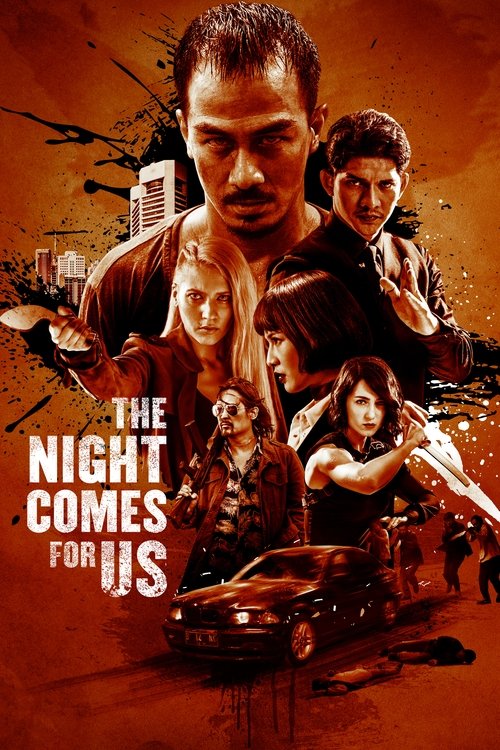
The Night Comes For Us
2018 · Timo Tjahjanto
For when you're craving pure adrenaline and have the stomach for serious gore — a turn-it-up, wince-and-cheer night, not a casual background watch. Comfort food for action diehards; a gauntlet for everyone else.
What it's about
Ito, an elite enforcer for a Southeast Asian Triad, breaks with the syndicate after refusing to kill a young girl during a village massacre. Sparing her makes them both targets, and over roughly one night in Jakarta, waves of gangsters — including the protégé he once trained — come to collect. What follows is a running siege of ambushes, standoffs, and close-quarters brawls between people who all used to be on the same side.
The experience
Relentless, brutal, and gleefully excessive — wall-to-wall fight choreography that keeps topping itself with whatever's within arm's reach. It's exhausting in the way a great rollercoaster is exhausting, with just enough loyalty-and-guilt drama between beatdowns to make the hits matter.
Performances
Joe Taslim brings wounded gravity and real martial-arts credibility to Ito, and Iko Uwais is ferocious as his former protégé — their history gives the final stretch genuine emotional stakes.
The craft
Timo Tjahjanto stages action with a horror director's appetite for damage: long, legible fight scenes where props, tools, and architecture all become weapons, cut for impact rather than confusion. The sound design makes every hit land in your sternum — good speakers turn it into a full-body experience.
Why it matters
It pushed the Indonesian hard-action wave to its ferocious extreme and, via its global Netflix release, became an instant cult benchmark for screen violence — the film action fans dare each other to watch.
Snapshot
The Night Comes For Us is an Indonesian action-crime thriller that pushes the "hard action" template established by The Raid films toward an almost delirious extreme of bodily violence. Directed by Timo Tjahjanto and adapted from his own unpublished graphic-novel concept, the film follows Ito (Joe Taslim), one of the "Six Seas" enforcers of a Southeast Asian Triad, who breaks with the syndicate after refusing to execute a young girl during a village massacre. His defection makes him the target of the organization — including his former protégé Arian (Iko Uwais) — and the film becomes a compressed, roughly one-night siege of ambushes, escapes, and set-piece brawls across Jakarta. Produced with backing from the American genre outfit XYZ Films and distributed globally by Netflix in 2018, it functions as both a showcase for Indonesia's martial-arts talent pool and a deliberate escalation of the genre's tolerance for gore. It reunites Taslim and Uwais, the two breakout leads of Gareth Evans's The Raid (2011), and in doing so stages a kind of summit meeting of contemporary Indonesian action stardom.
Industry & production
The film sits at the intersection of Indonesia's domestic genre industry and a transnational financing model. XYZ Films, the Los Angeles–based company that had helped shepherd The Raid to international audiences, was central to packaging and financing, and the production drew on Indonesian infrastructure including Infinite Frameworks, the Batam-based studio active in the region's genre output. This hybrid arrangement — local craft labor and locations, international sales and platform distribution — is characteristic of how Indonesian action cinema reached global viewers in the 2010s.
Distribution was the decisive industrial fact. Rather than a theatrical rollout, the film premiered on the festival circuit (notably at Fantastic Fest in Austin) and then launched worldwide on Netflix in October 2018. This placed it in front of a mass streaming audience without the ratings-board frictions that its extreme violence would have invited in conventional theatrical markets, and it made the film a reference point in discussions about how streaming platforms were absorbing "extreme" genre cinema. Because the film bypassed traditional box office, there is no meaningful theatrical gross to cite; its reach and reputation are streaming- and word-of-mouth-driven, and precise viewership figures were not disclosed by the platform. Any dossier should be candid that the hard commercial data for this title is thin by design.
Technology
Technologically the film belongs to the digital-capture era of mid-budget action, shot on modern digital cameras that allow the long, low-light, handheld-adjacent coverage the genre favors. Its most significant "technology," however, is practical rather than photographic: the film is built around physical stunt work and practical special-effects makeup — squibs, prosthetics, blood rigs, and articulated gore appliances — rather than digital augmentation. Where computer effects appear, they tend to be in service of cleanup and enhancement rather than spectacle. The commitment to practical effects is itself an aesthetic thesis: the wounds, the arterial spray, the breaking of bodies are meant to read as weight and consequence, and the tactility of latex and stage blood is inseparable from the film's impact. This aligns it with a broader strain of horror-adjacent action that prizes handmade grue over the frictionless clean of CG violence.
Technique
Cinematography
The photography prioritizes legibility of physical action within tight, often industrial or domestic interiors — apartments, corridors, a butcher's back room, a garage. Handheld and shoulder-mounted operating keeps the camera inside the fights, close enough to register impact but composed enough to preserve spatial geography, a lesson inherited from the Evans-era Raid aesthetic. Lighting favors saturated, sometimes lurid sources — neon, practical fixtures, hard pools against darkness — that heighten the nocturnal, comic-book register signaled by the title. The published record on the below-the-line camera crew is comparatively sparse in English-language sources, so specific operator and gaffer credits should be verified against the film's own titles rather than asserted here.
Editing
The cutting is aggressive but structurally disciplined: set pieces are allowed to build and breathe, escalating from a first blow to sustained, multi-combatant chaos, then resolving with a punctuating act of violence. The editing sustains long enough takes that choreography remains readable, then accelerates at moments of impact so that the gore lands as a shock accent. The film's overall shape is essentially a chase-and-siege chain — one confrontation flows into the next with minimal connective tissue — and the editorial rhythm serves that propulsion, using brief lulls mainly to reset stakes before the next assault.
Mise-en-scène / staging
Staging is the film's signal achievement. Fights are conceived environmentally: combatants weaponize whatever the space offers — a butcher's hooks and blades, a broken bottle, a length of cord, kitchen implements, the geometry of a cramped apartment. The choreography leans harder on edged weapons, improvised objects, and grappling than on the pure empty-hand pencak silat exchanges that defined The Raid, giving the violence a scrappier, more attritional character. The famous late-film duel is staged as a war of endurance between two exhausted, ruined bodies rather than a display of clean technique. Production design keeps the world grounded and grimy — working-class Jakarta interiors, back rooms, and thresholds — so that the extremity of the action registers against an ordinary texture.
Sound
Sound design foregrounds the visceral: the crunch and wet impact of blows, the scrape of blades, the ambient hum of the nocturnal city. The mix is engineered to make violence felt as much as seen, with impact effects layered aggressively. A propulsive, percussive score underpins the set pieces, though English-language documentation of the specific music credits is limited; those should be confirmed from the film's titles rather than attributed speculatively.
Performance
Performance here is inseparable from physical capacity. Joe Taslim anchors the film with a weary, wounded gravity — Ito is a man already dying by degrees, and Taslim plays exhaustion and moral fatigue as much as prowess. Iko Uwais brings his characteristic speed and precision to Arian, and the film's meta-charge comes from setting these two Raid alumni against each other. Julie Estelle, as the enigmatic "Operator," delivers one of the film's standout sequences and expands the roster of formidable female fighters in Indonesian action. The ensemble — including performers drawn from the region's action and dramatic ranks — commits fully to the punishing physical demands, and the acting register is pitched toward endurance and pain rather than quips.
Narrative & dramatic mode
The narrative is deliberately spare, functioning as a delivery system for escalating action while retaining a clear moral spine. The inciting choice — sparing the girl — is an act of conscience that ruptures Ito's identity as an instrument of the syndicate, and the ensuing pursuit externalizes his internal break. The dramatic mode is tragic and fatalistic: the title itself frames the story as a reckoning that cannot be outrun. Betrayal, loyalty, and the impossibility of clean exit from a criminal life structure the emotional stakes, and the relationship between Ito and Arian carries a broken-brotherhood weight that gives the climactic duel its charge. The film does not aspire to narrative complexity; its economy is a feature, clearing space for the physical storytelling to carry meaning.
Genre & cycle
The film belongs to the contemporary Indonesian "hard action" cycle that The Raid (2011) and The Raid 2 (2014) brought to global attention — a wave defined by verité-adjacent camerawork, brutal close-quarters combat, and a foregrounding of Indonesian martial arts and stunt talent. Within that cycle, The Night Comes For Us stakes out the position of maximal extremity, crossing action with the sensibility of body horror. It also participates in a longer international lineage of Triad and yakuza crime cinema — the honor-bound assassin, the syndicate that will not release its own — while translating those genre conventions into an Indonesian idiom and pushing the violence past the thresholds those traditions typically observe.
Authorship & method
Timo Tjahjanto is the film's defining author. He emerged as one half of the "Mo Brothers" with Kimo Stamboel, co-directing genre features such as Macabre (2009) and Killers (2014), and built a solo reputation in horror — including the anthology segment "Safe Haven" in V/H/S/2 (2013) and the demonic feature May the Devil Take You (2018). The Night Comes For Us fuses that horror pedigree with hard action, and Tjahjanto's authorship is legible precisely in the film's willingness to render violence with a horror director's appetite for viscera. He originated the material himself, conceiving it as a graphic-novel property before it became a film, which underscores the personal, auteurist provenance of the project rather than a work-for-hire assignment.
On the collaborative side, the film's identity is co-authored by its performers-as-choreographers and stunt teams — the pool of Indonesian action talent whose fight design and physical execution are the film's substance. Because reliable English-language documentation of specific cinematographer, editor, and composer credits is uneven, this dossier flags those attributions as items to confirm from primary sources rather than restating them with false confidence. What is secure is the through-line of authorship: a horror-trained director imposing his sensibility on the action genre, with a stunt-and-performance collective supplying the craft of the combat.
Movement / national cinema
The film is a flagship of the 21st-century Indonesian action renaissance, a national-cinema phenomenon that turned Jakarta's stunt community and the traditions of pencak silat into an internationally recognized brand. This movement is notable for how it reached the world: through festival programming, boutique international distributors, and streaming platforms, rather than through the traditional art-house or major-studio channels that historically mediated national cinemas abroad. The Night Comes For Us both depends on and advances that movement — depends on the talent base and reputation The Raid established, and advances it by demonstrating that the Indonesian action brand could sustain a distinct authorial vision and a distinct level of extremity.
Era / period
Produced and released in 2018, the film is a document of the streaming-transition era, when platforms were aggressively acquiring genre content and reshaping how "extreme" cinema found audiences. It arrives late enough in the 2010s action cycle to be self-aware about its lineage — casting Raid alumni is a knowing gesture — and it reflects the period's practical-effects revival within action-horror. The nocturnal, neon-inflected, comic-derived visual register also situates it within a broader late-2010s genre aesthetic that prized stylized violence and graphic-novel textures.
Themes
Thematically the film turns on the cost of conscience. Ito's single act of mercy is framed as both his redemption and his death sentence, dramatizing the idea that within a system built on violence, moral choice is punished rather than rewarded. Loyalty and betrayal recur as paired forces — the syndicate demands total loyalty, and every relationship is shadowed by the possibility of its violation. The broken bond between Ito and Arian gives the film a fallen-brotherhood theme, mentor and protégé set against each other by an institution that consumes them both. Underneath runs a fatalism about the impossibility of escaping a criminal life clean, and a bodily preoccupation — the film insists, through its relentless depiction of wounds and endurance, on the sheer physical price of survival.
Reception, canon & influence
Critically and among genre audiences, the film was received as a landmark of extreme action, frequently singled out for the intensity and inventiveness of its set pieces and for delivering the Taslim–Uwais confrontation that fans of The Raid had wanted to see. Discussion tended to cluster around its violence — whether it crossed into excess, or whether that excess was the point — and around its status as a worthy successor within the Indonesian hard-action canon. Because it launched on a streaming platform without a theatrical box office, its canonization has been reputational and cult-driven rather than measured in commercial returns; a dossier should be honest that its "success" is documented through critical and audience esteem more than through disclosed figures.
Looking backward, the film's clearest influences are The Raid and The Raid 2, which established the visual grammar, the talent pool, and the international appetite it draws on, alongside the Hong Kong and Japanese crime-cinema traditions of the honor-bound assassin and the inescapable syndicate. Tjahjanto's own horror background is the other decisive input, supplying the body-horror intensity that distinguishes the film from its action forebears. Looking forward, its legacy is bound up with the continued global visibility of Indonesian action talent and with Tjahjanto's subsequent trajectory as a director whose work bridged Indonesian genre cinema and larger international projects. Within the wider action landscape, the film stands as a reference point in the argument that streaming had become a viable — even ideal — home for uncompromising, hyper-violent genre filmmaking that theatrical distribution would have blunted.
Reception
It hit Netflix in October 2018 with almost no fanfare and became an instant word-of-mouth sensation among action fans, hailed as the gnarliest thing on the platform. Years on it's settled in as a modern action classic, and Tjahjanto's rise (The Big 4, The Shadow Strays, his Hollywood jump with Nobody 2) keeps sending new viewers back to it.
How The Night Comes For Us was received, from release to now →
How to watch The Night Comes For Us: what to notice on a first viewing
- Watch what object each fighter grabs from the room around them. Combatants weaponize whatever the space offers, butcher's hooks, broken bottles, cord, kitchen implements, so every location becomes part of the fight's design. The environment doing the fighting is what separates this from a clean-technique martial arts film.
- Notice the neon and hard light pooling against the dark. Lighting favors saturated, lurid sources, neon signs, practical fixtures, hard pools of light against darkness, giving the nights a comic book register. The lurid light announces this as heightened pulp before the first blow lands.
- Notice the camera stay close but never lose the room's layout. Handheld and shoulder mounted shots keep the camera inside each fight, close enough to register impact but composed enough that you always know where everyone stands. Staying spatially clear is what makes the violence legible instead of just chaotic.
- Listen for how wet and heavy each impact sounds. The sound design layers crunch, scrape, and impact aggressively, engineering the violence to be felt in your body as much as seen on screen. The mix makes you flinch at sound before your eyes even catch up.
- Watch Taslim play exhaustion as much as fighting skill. Taslim carries a weary, wounded gravity through Ito, a man already dying by degrees, so his prowess always reads through fatigue rather than ease. The exhaustion tells you this is costing him something every time he wins a round.
The whole guide to watching The Night Comes For Us, with the keys for a rewatch →
Influences: the films it descends from and the films it influenced
- Merantau (2009) — Established the Evans–Uwais method of shooting pencak silat in sustained wide framing that keeps every strike spatially legible — the readability grammar TNCFU inherits before it accelerates into chaos.
- The Raid: Redemption (2011) — Codified the confined-architecture siege structure and the silat-choreography-shot-clean approach, and seeded the exact talent pool (Uwais, Taslim, Ruhian) TNCFU reassembles.
- The Raid 2: Berandal (2014) — Pioneered escalating environmental weaponization (hammers, baseball bats, the kitchen finale) and a syndicate-betrayal narrative scale that TNCFU directly extends into knife-and-improvised-object carnage.
- Macabre (Rumah Dara) (2009) — Tjahjanto's own gore-forward horror feature that trained his appetite for lingering, practical-effects viscera — the body-horror sensibility he later imposes on the action genre.
- Killers (2014) — Tjahjanto's earlier fusion of intimate, prolonged killing and psychological dread that rehearses TNCFU's insistence on making violence cost something physically and morally.
- V/H/S/2 — 'Safe Haven' (2013) — The Tjahjanto–Evans collaboration whose escalating practical-gore chaos and handheld immediacy is the clearest bridge between his horror craft and the action-body-horror hybrid of TNCFU.
- The Killer (1989) — Originated the honor-bound assassin melodrama — the killer who wants out and pays in blood — supplying the 'cost of conscience' and fallen-brotherhood emotional architecture beneath TNCFU's fatalism.
- A Bittersweet Life (2005) — The template of the lone enforcer who defies his syndicate and is hunted through escalating brutality, marrying elegant framing to sudden savagery in a way TNCFU's Ito arc echoes.
- Ichi the Killer (2001) — Fused yakuza crime with transgressive body-horror gore and slice-anatomy practical effects, licensing the extreme-excess-as-the-point ethos TNCFU pushes to its limit.
- Riki-Oh: The Story of Ricky (1991) — Cult benchmark for gleefully cartoonish practical-gore dismemberment and exploding bodies, the maximalist splatter register TNCFU revives with straight-faced intensity.
- Oldboy (2003) — The corridor one-take hammer brawl set the standard for reading a melee as a single legible spatial event before it degrades into exhaustion — the readable-then-accelerated logic TNCFU builds set pieces around.
- The Raid (2012) — Tjahjanto casts the full Raid ensemble — Uwais, Yayan Ruhian, Joe Taslim — and applies the architecture-as-constraint staging principle at an extreme violence register; the stairwell and bathroom sequences are formal descendants of The Raid's corridor grammar, testing how much physical excess the spatial legibility discipline can contain.
- The Big 4 (2022) — Tjahjanto's later action feature that recycles his TNCFU-honed practical-gore-plus-silat set-piece construction, confirming the through-line of a horror-trained director's action signature.
- Kill (2023) — Explicitly cited its debt to TNCFU in staging a confined-space (train) knife-and-improvised-weapon bloodbath with the same readable-then-overwhelming escalation and visceral impact mix.
- Headshot (2016) — Tjahjanto's immediate prior action feature with Iko Uwais, sharing the endurance-over-technique performance style and the impact-heavy silat brutality TNCFU intensifies.
- The Villainess (2017) — Extends the same era's push toward frenetic, near-POV handheld melee that stays kinetically legible under speed — a parallel experiment in accelerated combat cinematography.
- Triple Threat (2019) — An explicit summit of the transnational martial-arts talent pool (Uwais, Jaa, Adkins, Zhang) that TNCFU also draws on, foregrounding performers-as-choreographers as the film's craft substance.
- Furie (Hai Phượng) (2019) — Contemporary Southeast Asian hard-action entry sharing the close-quarters, injury-legible fight design and endurance-driven single-protagonist rampage structure.
Similar films
- The Raid 2 (2014) — influence & lineage · same viewing thread
- Ichi the Killer (2001) — influence & lineage
- The Villainess (2017) — influence & lineage
- The Killer (1989) — influence & lineage · same viewing thread
- A Bittersweet Life (2005) — influence & lineage · same viewing thread
- The Raid (2012) — same viewing thread
- The Furious (2026) — same viewing thread
- Kill (2024) — same viewing thread
All the films related to The Night Comes For Us →
Watch it with: curated runs of related films
- Elegant Savagery — A run of sleek, merciless thrillers where vengeance arrives in tailored suits and is paid in broken bone — watch these when you want beauty and brutality in the same frame.