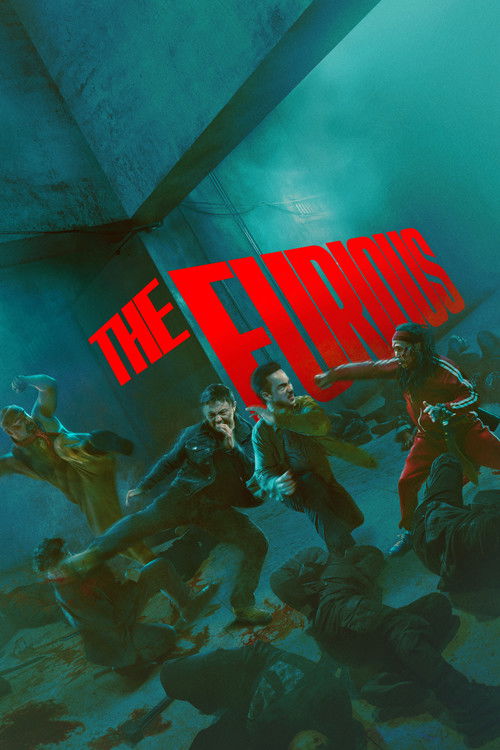
The Furious
2026 · Kenji Tanigaki
For when you want a full-throttle martial arts night — visceral, cathartic, no half measures. Fair warning that the subject matter is grim, so it's an adrenaline pick, not a light one.
What it's about
When a criminal network kidnaps Wang Wei's young daughter and the corrupt local police shrug, he goes after her himself. His only ally is Navin, a dogged journalist whose own wife has vanished, and together the two men punch their way up the chain of a child-trafficking operation. It's a rescue mission fueled by grief and rage, fought hand to hand.
The experience
Relentless is the word — brutal, fast, and surprisingly heavy-hearted, with the desperation of two fathers-and-husbands giving every fight real stakes. The action lands hard and keeps coming; you come out winded.
The craft
Director Kenji Tanigaki is one of the most respected action choreographers working — a veteran of Hong Kong and Japanese action cinema — and it shows in fight sequences built on real bodies, long takes, and escalating invention rather than digital trickery. This is choreography-as-storytelling, and it deserves a big screen where you can feel every impact.
Why it matters
Part of the ongoing renaissance of pan-Asian action cinema, where elite fight choreographers step into the director's chair and push screen combat forward.
Snapshot
The Furious is a Bangkok-shot, English-language martial-arts thriller that marks the solo directorial debut of Kenji Tanigaki, the Japanese-born action director who spent three decades as one of Hong Kong action cinema's most sought-after choreographers, most durably as Donnie Yen's right hand. Produced by veteran Hong Kong impresario Bill Kong through Edko Films, the picture follows Wang Wei (Xie Miao), a mute tradesman with a buried past who tears through a trafficking syndicate to recover his kidnapped daughter after corrupt police refuse him, aided only by Navin (Joe Taslim), a journalist searching for his own missing wife. Reported at a roughly US$20 million budget and running 113 minutes, it premiered in the Midnight Madness section of the Toronto International Film Festival in September 2025 before a 2026 theatrical rollout handled internationally by Lionsgate. Positioned squarely as a choreographer's showcase, the film is best understood less as a story than as a delivery system for a specific, deliberately unadorned philosophy of screen combat — Tanigaki's stated ambition to strip action back to "an acoustic guitar."
Industry & production
The film sits at the intersection of several industrial currents in mid-2020s Asian action production. Its lead producer, Bill Kong of Edko Films, is among the most consequential financiers in modern Chinese-language cinema — the money and taste behind Crouching Tiger, Hidden Dragon (2000) and much of Zhang Yimou's international output — and his involvement signals a prestige, festival-forward packaging of what is, structurally, a genre revenge picture. Production combined Edko with Zhejiang Hengdian Film on the financing side and the US genre specialist XYZ Films as co-producer and world-sales agent, a now-familiar configuration in which a Hong Kong–China creative core is routed to Western distribution through a boutique with cult-market fluency. Lionsgate's role in international theatrical distribution places the film in commercial company with the John Wick franchise, an alignment that reviewers noticed and that the marketing did not discourage.
Two industrial choices define the project. First, it was shot entirely in Bangkok over an approximately three-month principal-photography span in 2024, tapping Thailand's deep stunt and Muay Thai labor pools and its cost advantages — a continuation of a long pattern in which Hong Kong action production travels to Thailand for bodies, locations, and value. Second, it was made in English, a deliberate bid for the pan-Asian and global genre audience that has grown around The Raid and streaming action. That the record on granular production logistics remains thin so soon after release is worth stating plainly; figures such as budget and the compressed shooting schedule are as reported and should be treated as provisional rather than settled.
Technology
The Furious is not a technology-forward film in the sense of visual-effects spectacle; its most meaningful technical decisions are analog and photographic. The signature move, described by Tanigaki himself, is the use of a narrow 90-degree shutter angle in place of the cinematic-standard 180 degrees. Halving the shutter angle shortens the exposure per frame, reducing motion blur and yielding a crisper, harder-edged, faster-reading image during rapid movement — the same principle Steven Spielberg exploited for the combat of Saving Private Ryan (1998), here repurposed to make hand-to-hand exchange legible at speed. The rest of the film's "technology" is the craft technology of the stunt trade: rigging and wirework used sparingly and surgically rather than as a continuous crutch, and problem-solving props developed on Tanigaki's earlier films — rubber weapons that permit performers and camera to work in genuinely close quarters, and traction-enhancing footwear for complex ground movement. The throughline is that the film's innovations serve the visibility and physical credibility of the body, not the augmentation or replacement of it.
Technique
Cinematography
Shot by Meteor Cheung, the cinematography is built to serve choreography rather than to editorialize over it. Tanigaki's stated method — shooting wide master shots first and tolerating a degree of authentic "messiness" — implies a camera that holds space long enough to establish geography and consequence before it moves in. Combined with the 90-degree shutter, the images read as clean and hard rather than smeared, prioritizing spatial clarity, the classic virtue of Hong Kong action photography as against the concussive incoherence of much Hollywood combat coverage. The Bangkok setting supplies a grimy, humid, neon-and-concrete palette appropriate to a trafficking underworld.
Editing
Editor Chris Tonick's task in a Tanigaki film is defined by the choreography's own logic: cutting to reveal and sustain physical action rather than to manufacture it. Where much contemporary action editing shreds a fight into unreadable fragments to disguise doubling or limited performer skill, the tradition Tanigaki works within — and the casting of genuine martial artists — allows longer takes and cuts placed on completed movements, so that impact and continuity remain intelligible. Reviewers' repeated emphasis on the choreography's clarity and inventiveness is, in practice, praise for the editing discipline that preserves it.
Mise-en-scène / staging
Staging is the film's true authorship. Tanigaki's governing principle, articulated in interviews, is to "choreograph the unchoreographed" — to design sequences that read as spontaneous, improvised survival while remaining exactingly orchestrated, and to privilege the realism of the performers' commitment over the realism of surface appearance. Fights are built around environment and available objects, and the film reportedly ranges across a deliberately eclectic vocabulary — judo, kung fu, karate, taekwondo, and, appropriately to its setting, Muay Thai — staged so that distinct fighting bodies collide with distinct textures. The violence is graphic and inventive by design, including kills executed with a bow and arrow, extending the tradition of the memorable set-piece weapon.
Sound
The score is credited to an unusually cross-idiomatic team: composers Elliot Leung and Olivia (Xiaolin), working alongside the experimental American producer Flying Lotus. That last name is the notable one — Flying Lotus's involvement suggests a texture-forward, electronic-leaning sonic register rather than conventional orchestral action scoring, consistent with the film's stated ambition to feel stripped-down and immediate. On the design side, the credibility of impact sound is inseparable from the film's realist project; in choreography of this kind, sound carries the weight that the narrow shutter refuses to blur.
Performance
Casting is dramaturgy here. Xie Miao, in the lead, is himself a piece of action-cinema history: as a child in the mid-1990s he co-starred opposite Jet Li in The New Legend of Shaolin (1994) and My Father Is a Hero (1995), then largely vanished from screens, making The Furious a genuine return. His character's muteness converts a performance constraint into an expressive premise, forcing meaning into the body — a gift to a choreographer-director. Around him, the film assembles an all-star roster of contemporary action performers: Joe Taslim and Yayan Ruhian, both indelible from Gareth Evans's The Raid films; Jeeja Yanin (Jeeja Vismitananda), the Muay Thai dynamo of Prachya Pinkaew's Chocolate (2008); and the American martial artist Brian Le of the Martial Club collective. The picture is, in casting terms, a summit of the modern Asian and diasporic action scene.
Narrative & dramatic mode
Dramatically, The Furious is candidly formulaic, and reviewers said so: it is a vigilante rescue thriller whose beats — abduction, institutional betrayal, the ordinary man revealed as extraordinary, escalating confrontation — are drawn from a well-worn template. The dual-protagonist structure, pairing a mute father with a journalist chasing his own vanished wife, doubles the theme of the private search that the state will not conduct. The muteness of the hero pushes the film toward a near-silent, gestural mode of storytelling in which motive and emotion are legible through action, aligning the narrative form with the choreographic form. This is action cinema in its purest expression: plot as scaffolding, deliberately spare, so that meaning is transmitted through movement, consequence, and the accumulating physical toll.
Genre & cycle
The film belongs to two overlapping cycles. The first is the "aggrieved everyman on a rampage" thriller that Taken (2008) codified and that John Wick (2014) refined into balletic gun-fu — a lineage the film openly invites, with a trafficking-syndicate villainy that echoes Taken directly. The second, and more essential, is the post-Raid wave of hard-hitting Asian martial-arts action that since 2011 has restored close-quarters, weaponized, realist combat to international prominence, and whose talent pool this film literally gathers on screen. The Furious thus functions as both an entry in the vigilante-thriller cycle and a consolidation of the modern martial-arts-showcase cycle, using a Western narrative armature to house an emphatically Asian action tradition.
Authorship & method
The film is authored, unmistakably, by an action director stepping fully into direction. Kenji Tanigaki's career runs from stunt work on Donnie Yen's 1990s vehicles through Hong Kong Film Award–winning action choreography on SPL (2005) and Flash Point (2007) and continued Yen collaborations into the 2020s, with earlier directorial experience co-helming Enter the Fat Dragon (2020). His self-professed method — Jackie Chan as childhood inspiration, Yasuaki Kurata as mentor, and Yen's MMA-inflected close-quarters style as formative influence — synthesizes Japanese and Hong Kong lineages into a realist idiom. His key collaborators reinforce the authorial signature: cinematographer Meteor Cheung and editor Chris Tonick execute the clarity-first coverage the choreography demands; the Leung/Olivia/Flying Lotus scoring team supplies the "acoustic" texture Tanigaki said he wanted; and a screenwriting team (Mak Tin-shu, Lei Zhilong, Shum Kwan-sin, and producer Frank Hui) supplies the lean narrative frame. The consistent testimony is that Tanigaki conceived The Furious as a back-to-basics work — "an acoustic guitar," minimal wirework — a deliberate corrective to the ornate spectacle of larger productions.
Movement / national cinema
The Furious is a genuinely transnational object that resists a single national label. Its financing and creative leadership are Hong Kong–Chinese; its director is Japanese; it was shot in Thailand with Thai and Indonesian talent; and it was made in English for global release. In this it exemplifies the deterritorialized condition of contemporary Asian action cinema, in which capital, craft labor, and performers circulate across the region and its diaspora faster than any national-cinema framework can contain. Yet its craft DNA is specifically that of the Hong Kong action tradition — the primacy of legible physical performance, the reverence for the stunt team, the choreographer as auteur — carried by one of that tradition's most direct living inheritors.
Era / period
The film is a product of the mid-2020s, a moment defined by the international ascendance of physical, performer-driven action after a decade in which The Raid and John Wick revalued craft over digital spectacle, and by the maturation of hybrid financing routes that carry Asian genre films to Western audiences through specialist distributors. It also reflects an industrial pragmatism of its period — English-language production, Thai shooting economies, festival launch as a legitimation strategy for genre work. Made in 2024 and released across 2025–2026, it stands as a representative artifact of this action-cinema renaissance and of the globalized production logic that now underwrites it.
Themes
Beneath the choreography, the film circles a coherent thematic core: the failure of the state and the resulting privatization of justice. Corrupt or indifferent police force both protagonists into vigilante self-help, and the antagonist — a human-trafficking syndicate preying on children — is a maximally legible embodiment of institutional rot and vulnerability exploited. The paired searches for a lost daughter and a lost wife make familial love the engine of violence and frame the film's brutality as an expression of protective desperation rather than glamour. The hero's muteness sharpens a further theme — the eloquence of the body when speech and institutions both fail — so that the film's action is not decoration on its themes but their primary language.
Reception, canon & influence
As reported, critical reception was strong: the film drew warm festival notices out of Toronto's Midnight Madness and, per aggregators, a very high critical approval on Rotten Tomatoes and a favorable Metacritic score, with reviewers near-unanimously singling out the choreography as its triumph while noting the conventionality of its plot. These figures, and any box-office totals circulating so close to release, should be read as provisional; the definitive record has not yet settled. On influence: the vectors pointing into the film are clear and well-documented — Jackie Chan's prop-driven physical comedy of combat, Donnie Yen's MMA-inflected realism, the Raid films' hard close-quarters idiom, and the Taken/John Wick revenge-thriller template. The vectors pointing out — what The Furious will shape — cannot yet be responsibly assessed. Its plausible legacy lies in two places: as the film that confirmed Tanigaki as a director in his own right rather than a choreographer-for-hire, and as a late, self-aware assembly of the modern Asian and diasporic action generation on a single screen. Whether it becomes a genuine touchstone or a well-made consolidation of an existing wave is a judgment the historical record is not yet in a position to make.
A Deleuzian reading
A man who cannot speak walks into a room, and the camera does not flinch.
The full Deleuzian reading of The Furious →
Reception
Detonated as a midnight sensation at TIFF 2025, then spent nine months as action fans' most-hyped 'trust me on this' title before the June 2026 release confirmed it — near-perfect Rotten Tomatoes score and instant 'best martial arts film since The Raid' anointment.
How The Furious was received, from release to now →
How to watch The Furious: what to notice on a first viewing
- Watch how long the camera holds before any cut in each fight. Tanigaki and cinematographer Meteor Cheung shoot wide masters first, holding space so you see where each fighter stands and how far a blow travels. This spatial clarity, not fast cutting, is what lets you actually see the fight happen.
- Notice what objects a fighter grabs off the walls and floors. Fights are built around environment and available props, and different fighting styles like judo, Muay Thai, and taekwondo collide with different textures scene to scene. The choreography treats the setting itself as a weapon, not just a backdrop.
- Watch Wang Wei's hands and posture instead of listening for dialogue. Xie Miao plays a mute man, so every intention, threat, or grief has to show in a stance, a look, a way of stepping into a room. The body has to carry all the meaning speech would normally do.
- Listen for the electronic textures under the score's fight-scene pulse. Composers Elliot Leung and Olivia work with Flying Lotus, giving the score a texture-forward, electronic edge rather than orchestral swells. The stripped-down sound matches the film's declared 'acoustic guitar' idea: nothing dressing up the hits.
- Track Navin's search for his wife alongside Wei's search for his daughter. The film pairs a mute father and a journalist, both hunting for someone the police won't look for, running their two searches in parallel. Doubling the search doubles the film's point: when institutions fail, families do the state's work alone.
The whole guide to watching The Furious, with the keys for a rewatch →
Influences: the films it descends from and the films it influenced
- Police Story (1985) — Establishes the prop-driven idiom Tanigaki inherits — everyday objects (chairs, ladders, panes of glass) turned into choreographic instruments and shot in unbroken wide frames that let the audience read every impact.
- The Legend of Drunken Master (1994) — Model for sustained, escalating close-quarters exchanges whose comic timing is woven into the combat rhythm rather than cut around it.
- Fist of Legend (1994) — Yuen Woo-ping's stripped-down, ground-grappling realism as a corrective to wire-fantasy wuxia — and the film featuring Yasuaki Kurata, Tanigaki's mentor, whose realist hand-to-hand ethos Tanigaki cites.
- SPL: Kill Zone (2005) — Tanigaki's own Hong Kong Film Award–winning choreography that first codified his MMA joint-lock realism and the alley knife-fight legibility The Furious extends.
- Flash Point (2007) — Direct precursor in which Tanigaki and Donnie Yen imported MMA grappling and submission holds into Hong Kong action, the 'close-quarters realist' vocabulary the seed film is built on.
- Ip Man (2008) — Yen's rapid Wing Chun chain-punch cadence and centerline efficiency, a rhythmic template for the seed's economy-of-motion hand-to-hand.
- Ong-Bak (2003) — No-wire, no-undercrank, no-CGI Muay Thai aesthetic prizing visible body-on-body impact — the 'acoustic guitar' austerity Tanigaki explicitly aimed for.
- The Raid: Redemption (2011) — The hard confined-corridor pencak silat idiom of relentless close-quarters combat in tight architectural space that the dossier names as a direct input.
- The Raid 2 (2014) — Extends the debt to legible long-take fight coverage and the weaponized environment (kitchen, car interior) as a choreographic arena.
- Taken (2008) — Supplies the lean single-mission rescue/revenge narrative frame — a specialist protagonist cutting a linear path — that the dossier cites as the plot template.
- John Wick (2014) — Revives wide-framed, long-take, coverage-clear martial and gun choreography in Western action and hands down the escalating one-provocation revenge structure.
- The Night Comes for Us (2018) — Raid-generation hyperviolent silat that pushes the same confined-space, weaponized-object close-quarters brutality further into visceral texture.
- Kill (2023) — Confines the Raid/Taken revenge idiom to a single moving train, extending the hard close-quarters, prop-weaponized combat grammar the seed consolidates.
- Nobody (2021) — Carries the Wick/Taken everyman-revenge template into grounded, bone-crunching brawling with the same legible, impact-forward coverage.
- Enter the Fat Dragon (2020) — Tanigaki's own earlier co-direction, a dry run for translating Jackie Chan–style prop comedy of combat into a modern Yen vehicle.
- Raging Fire (2021) — Tanigaki-choreographed late-career Yen realism — grounded urban brawling with clarity-first coverage — the immediate stylistic cousin to the seed.
- Twilight of the Warriors: Walled City (2024) — Tanigaki's own action direction staging dense vertical close-quarters combat inside the cramped Kowloon set, sharing the seed's architecture-as-arena method.
Similar films
- The Raid 2 (2014) — influence & lineage · same viewing thread
- The Night Comes For Us (2018) — influence & lineage · same viewing thread
- John Wick (2014) — influence & lineage
- Ong-Bak (2003) — influence & lineage
- The Raid (2012) — same viewing thread
- Kill (2024) — same viewing thread
- The Man from Nowhere (2010) — same viewing thread
- Hard Boiled (1992) — same viewing thread
All the films related to The Furious →
Watch it with: curated runs of related films
- Elegant Savagery — A run of sleek, merciless thrillers where vengeance arrives in tailored suits and is paid in broken bone — watch these when you want beauty and brutality in the same frame.