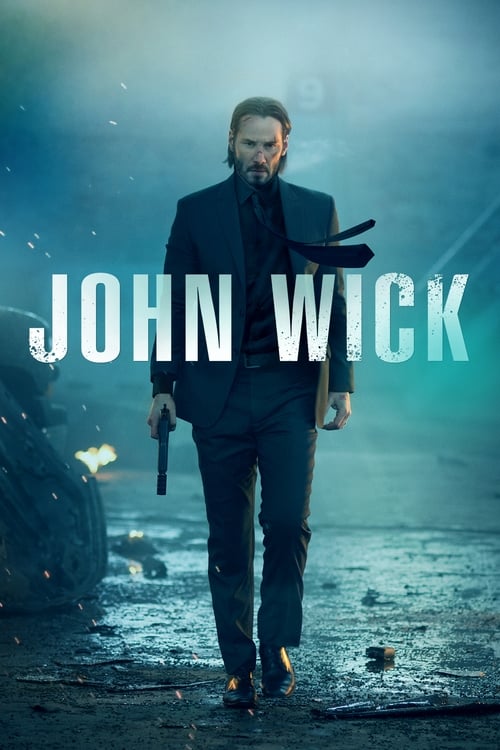
John Wick
2014 · Chad Stahelski
For when you want catharsis with style — a switch-your-brain-to-alert-not-off action night where the craft is the pleasure. Pure adrenaline comfort food, best watched loud.
What it's about
A retired hitman, freshly widowed, is trying to grieve quietly when Russian mobsters break into his house, steal his car, and kill the puppy his wife left him. That mistake pulls him back into a hidden world he'd escaped — an underworld with its own currency, its own rules, and a hotel where killers check their weapons at the door — and he goes through it like a storm.
The experience
Sleek, propulsive, and weirdly elegant: the violence is choreographed like dance and shot so you can actually see it, which makes every fight land harder. It's grim on paper but plays with a dry, deadpan wit.
Performances
Keanu Reeves, doing much of the fight and gun work himself, gives the role a wounded stillness that makes the mayhem mean something — it's the part that redefined his career.
The craft
Directed by a former stunt coordinator, it shoots action in long, legible takes at full body length — no shaky-cam, no cheating — a style that changed what audiences expect from a gunfight. The neon-noir look and the world-building-by-implication (gold coins, unspoken rules, no exposition dumps) are just as influential as the choreography.
Why it matters
It quietly rewired American action cinema: the clean, long-take 'gun-fu' style became the new standard, and a $20 million sleeper grew into one of the defining franchises of its era.
Snapshot
John Wick is a lean revenge thriller that reorganized the grammar of American screen action in the 2010s. Its premise is almost insultingly small: a retired contract killer, grieving his late wife, is provoked back into violence when Russian gangsters break into his home, steal his car, and kill the puppy she left him. From that thin pretext the film extrudes an entire shadow civilization — a hitman's economy of gold coins, blood oaths, and a neutral-ground hotel called the Continental. The picture's importance lies less in its story than in its execution: long-take, clearly staged gunfight choreography ("gun-fu") shot at full body length, joined to a stylized noir-comic world that withholds exposition. Directed by former stunt coordinator Chad Stahelski (with David Leitch as uncredited co-director), written by Derek Kolstad, and built around a recommitted Keanu Reeves, the film resurrected Reeves as an action lead and launched one of the most influential action franchises of its era. It is a textbook case of craft personnel — stunt professionals — seizing authorship of a genre and remaking it in their own image.
Industry & production
John Wick originated as a Derek Kolstad spec script, reportedly titled Scorn, conceived for an older protagonist before Reeves attached. Production was driven by Basil Iwanyk's Thunder Road Pictures together with Stahelski and Leitch's stunt collective 87Eleven Action Design, with backing arranged through what became a Summit Entertainment/Lionsgate release. Made on a modest budget — widely reported in the low tens of millions, a figure I'll flag as approximate rather than cite precisely — the film was an unglamorous independent-scale production rather than a studio tentpole, which is central to understanding both its aesthetic discipline and its outsized return.
The defining production fact is that its directors came from the stunt world rather than from screenwriting, film school, or the camera department. Stahelski had been Reeves's stunt double on The Matrix; he and Leitch ran 87Eleven, a training and choreography studio. This inverted the usual hierarchy in which action is a second-unit afterthought subordinated to a director's "real" scenes. Here the choreography was the script's reason to exist, and pre-visualization, rehearsal, and rigorous physical preparation drove the schedule. Reeves trained extensively in firearms handling, judo, and jiu-jitsu so that sequences could be performed and photographed in sustained takes rather than assembled from fragments. The Directors Guild's restrictions on credited co-direction for first-time directors meant only Stahelski received the directing credit, though Leitch's co-authorship is part of the established record. The film was shot largely in and around New York City.
Technology
John Wick was made with then-current digital cinema tools rather than any proprietary innovation; its technological signature is the disciplined application of conventional equipment. The production used digital capture and modern lighting practice to sustain very dark, saturated, practically-sourced night interiors — the neon-bathed nightclub, the rain-slick streets — while retaining enough shadow detail to read action clearly. The more meaningful "technology" is methodological: 87Eleven's pre-visualization pipeline, in which fight and gun sequences were storyboarded, choreographed, and rehearsed on video as "pre-vis" or "stunt-vis" long before principal photography. This let the filmmakers design camera moves around blocking that already worked, rather than discovering coverage on the day. Reeves's documented live-fire tactical training (associated with the Taran Tactical range) belongs here too: the verisimilitude of his reloads, malfunction clearances, and weapon transitions is a function of trained motor skill captured in-frame, not of editing or visual effects sleight of hand.
Technique
Cinematography
Jonathan Sela's photography is the film's most imitated single element. The governing decision is distance and duration: action is framed in wide and medium-wide shots, often at full body length, with the camera moving fluidly to keep combatants and their spatial relationships legible. Where the dominant 2000s action idiom (post-Bourne) favored telephoto fragmentation, handheld jitter, and cutting that implied violence it never quite showed, John Wick reverses the terms — you see the whole body act. The palette is heavily stylized: cold teals and electric blues, neon magentas and greens, pools of warm practical light against deep blacks. The Red Circle nightclub sequence is the showcase — strobing color, water, glass, and a roaming camera tracking Reeves through tiers of a club — and it functions almost as a thesis statement on how to photograph choreography you trust.
Editing
Elísabet Ronaldsdóttir's cutting is, paradoxically, defined by restraint. The editing's job is to preserve the long takes the choreography earned, cutting on motion and impact rather than to manufacture energy through density. Shots are held long enough to register a complete action — a takedown, a reload-and-fire, a body falling — so that the audience reads cause and effect. This "let it breathe" approach is the formal counterargument to chaos-cinema; the rhythm is propulsive but the cuts are motivated, and the geography of each fight remains continuously clear. The result feels faster than faster-cut films precisely because nothing is hidden.
Mise-en-scène / staging
Staging is where the stunt-team authorship is most visible. Fights are blocked as continuous spatial problems: Wick moves through a room solving a sequence of threats, the camera reorienting to keep sightlines open. The "gun-fu" hybrid — close-quarters grappling flowing into pistol fire, with frequent headshot finishes — treats the firearm as a martial-arts instrument and the human body as the unit of action. Production design extends the staging into world-building: the Continental's brass-and-marble formality, the gold coins, the tailored suits as armor, the recurring iconography of professional courtesy among killers. Much of the film's celebrated "lore" is conveyed not through dialogue but through staged behavior — how characters defer to house rules, how money changes hands — making mise-en-scène the primary vehicle of narrative information.
Sound
The score by Tyler Bates and Joel J. Richard fuses propulsive electronic and rock textures with ambient, almost elegiac passages, and the film leans on licensed source music in its club and action set pieces to drive rhythm. Sound design foregrounds the mechanical specificity of weapons — the discrete clicks of magazines, slides, and dry-fires — which reinforces the film's fetish for competence and makes the violence feel procedural rather than chaotic. Stretches of near-silence around the grief beats (the wife, the dog) set off the percussive sound of the action.
Performance
Reeves's performance is a study in subtraction. He speaks little; the role's emotional register is carried by physical bearing, stillness, and the contrast between Wick's affectless calm and his lethal efficiency. Reeves's near-decade of action collaboration with Stahelski pays off in the legibility of his movement — he performs enough of the choreography in unbroken frame that the camera need not lie for him. The supporting ensemble sketches the world economically: Michael Nyqvist as the rueful crime patriarch, Alfie Allen as his reckless son, Willem Dafoe and Adrianne Palicki as fellow professionals, Ian McShane as the Continental's proprietor, and Lance Reddick as its concierge — performances pitched to a deadpan, ceremonial register that sells the mythology without explaining it.
Narrative & dramatic mode
The narrative is structurally minimal — a linear revenge arc with a clear inciting wound and an escalating series of obstacles — but its dramatic mode is distinctive: operatic minimalism. The film treats a B-movie premise with the gravity of tragedy, opening on bereavement and the death of the dog as a displaced expression of grief for the wife. Crucially, it withholds exposition, trusting the audience to infer the rules of its world from context. The mode is closer to myth or fable than to psychological realism: Wick is less a character than a force, repeatedly described in awed, near-folkloric terms by those who fear him. This combination of emotional simplicity and worldly opacity — feel everything, explain nothing — is the film's signature dramatic strategy.
Genre & cycle
John Wick sits at the intersection of the revenge thriller, the hitman film, and the neo-noir, and it deliberately revives the "heroic bloodshed" lineage of Hong Kong cinema for an American register. Within the action cycle of its moment, it is a corrective: against shaky-cam realism it offers balletic clarity; against gritty grounding it offers stylized fantasy. It also helped consolidate a 2010s cycle of "competence" action built around a hyper-skilled, laconic professional moving through an elaborate criminal underworld. The film's genre intelligence is in how its world-building converts a stand-alone revenge story into a franchise engine — the Continental and the High Table are mythological scaffolding designed to be expanded.
Authorship & method
The authorship of John Wick is genuinely collaborative and rooted in stunt craft. Chad Stahelski (credited) and David Leitch (uncredited co-director), as principals of 87Eleven, brought a method in which action is authored from the ground up through rehearsal and pre-visualization, with the directors treating choreography as the film's primary text. Writer Derek Kolstad supplied the spec script and the seeds of the mythology — the coins, the code, the Continental — that the directors then expressed largely through staging rather than dialogue. Cinematographer Jonathan Sela contributed the wide, color-saturated visual language; editor Elísabet Ronaldsdóttir enforced the long-take discipline; composers Tyler Bates and Joel J. Richard supplied the hybrid score. Keanu Reeves functions as a fourth author: his physical commitment and his long working relationship with Stahelski made the in-camera approach feasible. The method's through-line is trust in performed, photographed reality — a stunt professional's ethic elevated to directorial principle.
Movement / national cinema
The film belongs to American studio-adjacent genre cinema but is consciously transnational in its borrowings. Its deepest debt is to Hong Kong action of the 1980s–90s — John Woo's "heroic bloodshed," with its gun ballets, codes of honor, and operatic male melancholy — filtered through American production values. There is also a clear inheritance from French and Japanese genre minimalism: the laconic professional killer governed by ritual. It is not the product of a national movement so much as a synthesis that re-imports international action sensibilities into Hollywood, and in doing so it influenced a wave of subsequent American and international action filmmaking.
Era / period
John Wick arrived in 2014 at a moment when mainstream action was dominated by superhero spectacle and effects-heavy ensembles, and when the realist, fast-cut style of the Bourne era had hardened into cliché. Against that backdrop a mid-budget, hard-R, single-protagonist action film with classical staging read as both retro and fresh. The period context also matters commercially: it demonstrated that a relatively inexpensive, sharply executed genre film could break out and seed a franchise without pre-existing IP, an increasingly rare proposition in the 2010s. The film is very much of its decade in its franchise ambitions, yet aesthetically it reaches back past its era for its values.
Themes
The film's surface theme is grief — the dog and the stolen car are vessels for mourning a dead wife, and Wick's rampage is displaced bereavement. Beneath that runs a meditation on professional identity and the impossibility of escape: Wick tried to leave "the life" for love, and the world refuses to release him. The recurring motifs of rules, debts, and honor among killers dramatize a moral order that is rigid yet entirely amoral — a code without conscience. There is a melancholy fatalism throughout, the sense of a man who is supremely competent at the one thing he wishes he no longer had to do. The film also flirts with an almost mythic theme of reputation: Wick exists as much as a legend in others' fearful speech as a man on screen.
Reception, canon & influence
Critically, John Wick was received as a pleasant surprise — praised for the clarity and craft of its action, its stylish world-building, and Reeves's committed, pared-down performance, with some reviewers noting the thinness of its story as the cost of its purity. It became a genuine sleeper, its reputation growing through word of mouth and home viewing into something like a modern action benchmark; I'll avoid citing specific box-office figures, but the gap between its modest budget and its commercial and cultural footprint is part of its legend.
Looking backward, its influences are legible and openly acknowledged: John Woo and Hong Kong heroic bloodshed; the ritualized lone-killer minimalism associated with Jean-Pierre Melville's Le Samouraï; the revenge-noir tradition; spaghetti-western iconography of the implacable avenger; and the spatial logic and "leveled" progression of video games, to which critics frequently compared its set pieces. Looking forward, its influence is enormous. It restored Keanu Reeves to front-rank action stardom and spawned a multi-film franchise plus expanded-world projects. More broadly, it helped reverse the shaky-cam orthodoxy, legitimizing long-take, full-body, geographically coherent action as the new prestige standard — an approach visible in films choreographed or directed by 87Eleven alumni and in a wave of imitators (the lone-professional, clear-staging school of action that followed). Co-director David Leitch's subsequent career, and the elevation of stunt performers toward recognized authorship, are part of the same legacy. John Wick stands as the moment the stunt community asserted itself as the rightful author of the action film.
A Deleuzian reading
Halfway through, John Wick takes a sledgehammer to his own basement floor.
The full Deleuzian reading of John Wick →
Reception
Dumped into October 2014 with modest expectations — a Keanu revenge flick from two stuntmen — it surprised critics, over-performed, and is now credited with rewiring modern American action cinema and kicking off the 'Keanaissance.'
How John Wick was received, from release to now →
Influences: the films it descends from and the films it influenced
- Le Samouraï (1967) — Supplies the ritualized lone-assassin grammar Wick runs on: a near-silent professional defined by code, costume, and procedure rather than dialogue, with exposition withheld and character built entirely through repeated gesture and object-handling.
- The Killer (1989) — Establishes the heroic-bloodshed template of balletic, balletically-edited two-gun shootouts treated as operatic emotion, the direct source of Wick's 'gun-fu' fusion of pistol marksmanship and close-quarters martial movement.
- Hard Boiled (1992) — Pioneers the sustained, geographically legible gunfight staged in long developing takes through continuous space — the spatial-clarity ethic Wick revives against shaky-cam orthodoxy.
- Point Blank (1967) — Models the implacable revenge-noir protagonist advancing through a stylized criminal underworld as a series of escalating confrontations, the 'leveled' progression structure critics map onto Wick.
- Once Upon a Time in the West (1968) — Donates the spaghetti-western iconography of the silent, mythic avenger — minimalist dialogue, ceremonial standoffs, and a protagonist whose reputation precedes him as world-building shorthand.
- The Matrix (1999) — Established Reeves's months-long pre-shoot fight rehearsal and full-body, in-camera choreography under Hong Kong supervision — the exact performer-trains-to-do-it-himself method Stahelski (Reeves's stunt double here) later made directorial principle.
- Drive (2011) — Sets the immediate neo-noir aesthetic precedent: a taciturn minimalist protagonist framed in saturated neon-and-shadow palettes over a synth/electronic score, sudden bursts of brutal violence punctuating stillness.
- Casino Royale (2006) — The spatial clarity in action staging — camera held wide, cuts to geography rather than confusion — that Casino Royale's parkour chase established as the post-Bourne alternative becomes John Wick's signature grammar; the grief-driven, inward protagonist also inherits the Craig emotional template.
- The Man from Nowhere (2010) — Wick extends the withdrawn male professional — specific physical discipline staged in long-take sequences within confined architectural geometry — into global commercial cinema, absorbing the legible-choreography/spatial-constraint formal vocabulary that Lee's film helped disseminate through pre-streaming international audiences.
- The Raid (2012) — Stahelski and Leitch adopted The Raid's foundational demand for spatial legibility — the audience always knowing where each body stands relative to every other — as the organizing principle of their 'gun fu,' extending the long-take, geographically coherent action philosophy to firearms choreography in closed-room and corridor environments.
- A Bittersweet Life (2005) — Globalizes the choreographed lone-killer-in-immaculate-spaces mode — cold-luxury underworld design, escalation set-pieces, and a grief-driven impassive avenger descended from this stylish-noir lineage.
- Kill Bill: Vol. 1 (2003) — Extends the long-take, legible, choreography-forward 'gun-fu' set piece against waves of color-coded adversaries — the descendant of the House of Blue Leaves staging philosophy of clear, balletic combat geography.
- Atomic Blonde (2017) — Wick co-director's solo film extends the long-take ethic into the celebrated single-shot stairwell brawl, exhausting both fighters in apparent real time to foreground photographed exhaustion and impact.
- Mission: Impossible — Fallout (2018) — Adopts the 87Eleven gospel of star-performs-the-stunt in-camera (Cruise's bathroom fight and HALO jump), shot in clear wide framing so the audience reads a verified physical feat, not editing.
- Extraction (2020) — Directed by an 87Eleven stunt alumnus, it stages a faux-continuous 12-minute 'oner' chase-and-fight, the most literal extension of Wick's long-take, stunt-team-as-author lineage.
- Nobody (2021) — Written by Wick's Derek Kolstad and choreographed by 87Eleven, it transplants the same withheld-mythology lone-professional formula and gun-fu staging onto a new everyman-killer vehicle.
- Bullet Train (2022) — Leitch's later work crystallizes the stunt-director aesthetic: enclosed-space, fully-rehearsed comic-brutal choreography with legible geography, descended directly from the 87Eleven pre-visualization method.
- The Furious (2026) — Revives wide-framed, long-take, coverage-clear martial and gun choreography in Western action and hands down the escalating one-provocation revenge structure.
- The Fall Guy (2024) — Origin of the 87North house style Leitch carries into the film: performer-driven fights shot in legible wide framing with clarity-first cutting that holds the geography instead of hiding action in cutaways.
- Deliver Us from Evil (2020) — The contemporary vocabulary of professional violence: wide, minimally cut framings that keep the shooter's feet and the room's exits visible, reloads and weapon retention played as audible beats, and a rules-based underworld of fixers and safe channels.
- Kill (2024) — Reinstates full-body framing and long-lens-free coverage as a house style — stunt-team authorship visible in the cut — establishing the market conditions and choreographic ethic behind Bhat handing co-authorship to Se-yeong Oh and Parvez Shaikh.
- The Raid: Redemption (2011) — Parallel revival of long-take, full-body martial-arts action with coherent spatial geography and percussive impact-foley, made by a stunt-choreography-first team — the other foundational text of the post-2010 clear-staging school.
- Haywire (2011) — Casts a real fighter (Gina Carano) and shoots hand-to-hand combat in wide, unscored, minimally-cut takes to preserve authentic physical reality — the same anti-shaky-cam trust in photographed performance.
- Kingsman: The Secret Service (2014) — Contemporary exploitation of the unbroken 'oner' fight set piece (the church massacre) as a showcase of choreographed continuity, sharing Wick's year and its bet on staged-in-camera spectacle over coverage.
- Mad Max: Fury Road (2015) — Companion assertion of practical, in-camera stunt authorship — real bodies and rigs photographed for real — elevating the stunt department to the film's primary creative voice alongside the director.
- The Equalizer (2014) — Released the same year, it consolidated the quiet, ritualistic, hyper-competent older-protector template — a code-bound professional whose stillness makes the eventual violence read as severe rather than spectacular.
- Kingsman: The Golden Circle (2017) — Parallel reinvention of action as legible, unbroken 'gun-fu' choreography presented as a continuous show-stopper rather than impressionistic cutting.
- Mission: Impossible - Dead Reckoning Part One (2023) — Extends the same stunt-team-led directing where action choreographers run the camera, producing the spatially coherent, fully legible fight geography McQuarrie prizes.
- Mission: Impossible - The Final Reckoning (2025) — Stahelski's stunt-team aesthetic insists on wide, unbroken, full-body framing of choreographed practical action so the audience reads the real performer's competence — the same anti-shaky-cam, see-the-whole-stunt staging philosophy that governs the M:I set pieces.
- Upgrade (2018) — Sets the standard for legible, continuous action — wide framing and sustained takes that keep choreography spatially readable — the clarity ethic Andy Canny's editing preserves against modern chaos-cutting.
- The Raid 2 (2014) — Stunt-team directors applying the same wide-framed, uncut 'gun-fu' legibility doctrine, making it a twin pillar of the mid-2010s clarity-first action revival.
Similar films
- The Matrix (1999) — influence & lineage
- Nobody (2021) — influence & lineage
- The Killer (1989) — influence & lineage
- Hard Boiled (1992) — influence & lineage
- John Wick: Chapter 4 (2023) — shared sensibility
- The Equalizer (2014) — shared sensibility
- The Raid 2 (2014) — shared sensibility
- Captain America: The Winter Soldier (2014) — shared sensibility
All the films related to John Wick →