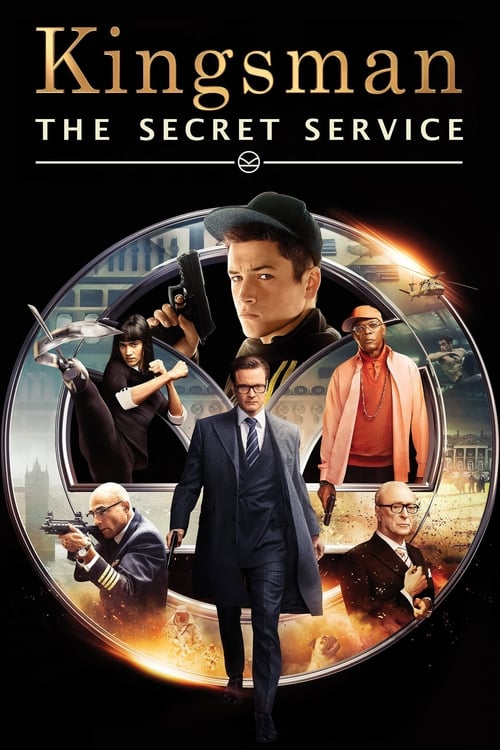
Kingsman: The Secret Service
2015 · Matthew Vaughn
For when you want an action movie with wit and swagger — a Friday-night crowd-pleaser that's naughtier than you expect. Comfort viewing with a mean streak.
What it's about
Eggsy, a sharp but aimless kid from a South London council estate, is plucked out of a police station by a Savile Row gentleman who turns out to be an agent of Kingsman, a secret spy organization hidden behind a tailor's shop. Thrown into a lethal training program against posh recruits, he has to prove himself just as a lisping tech billionaire unveils a plan that threatens the entire planet.
The experience
Gleeful, foul-mouthed, and shockingly violent in a way that keeps making you laugh at things you probably shouldn't — it lurches on purpose between drawing-room elegance and cartoon carnage. The pace never flags, and the big set pieces genuinely drop your jaw.
Performances
Colin Firth is the revelation, weaponizing decades of impeccable-gentleman typecasting into a shockingly convincing action hero. Taron Egerton, in his breakout, holds the screen against him with cocky, likeable ease, and Samuel L. Jackson has a ball as the squeamish billionaire villain.
The craft
Vaughn's action scenes are the draw: long, swirling, seemingly unbroken takes that turn brawls into choreography, cut to needle-drops with perfect comic timing. The suits, gadgets, and tailor-shop production design are their own pleasure. One mid-film sequence is among the most audacious action scenes of its decade — see it big and loud.
Why it matters
A sleeper hit that resurrected the gentleman-spy spoof for a generation raised on grittier spies, launched a franchise, and made Taron Egerton a star. Its church-pew style of hyperkinetic single-take mayhem has been imitated ever since.
Snapshot
Kingsman: The Secret Service is Matthew Vaughn's gleeful, foul-mouthed demolition-and-restoration of the gentleman-spy picture: a film that adores the Roger Moore–era Bond, the Harry Palmer thrillers and The Avengers (the bowler-hatted British series, not the Marvel one) even as it detonates their decorum with extreme, cartoon-graphic violence. Adapted from the Mark Millar–Dave Gibbons comic The Secret Service, it fuses a Pygmalion class fable — a South London council-estate kid remade as a Savile Row super-spy — with a self-aware spoof of supervillainy and a tonal register that lurches deliberately between elegance and shock. Built around Colin Firth playing brutally against his Mr. Darcy image and introducing Taron Egerton, it became a sizable commercial hit and the foundation of a franchise. Its signature is the "Free Bird" church massacre, an orgiastically choreographed single-take-feeling set piece that is the film in miniature: technically dazzling, morally provocative, and impossible to ignore.
Industry & production
The film originates in the Millarworld pipeline that had already served Vaughn well. In 2010 he and screenwriter Jane Goldman had turned Millar's Kick-Ass into a profitable, controversy-courting independent hit; The Secret Service, the comic by Millar and Watchmen artist Dave Gibbons, was reportedly conceived in conversation with Vaughn from the outset, so that comic and film developed in tandem. Vaughn produced through his own Marv outfit, with 20th Century Fox distributing — a studio-backed but director-driven arrangement that gave Vaughn the latitude to push the violence and tone harder than a more cautious tentpole would allow.
Vaughn took the project after stepping away from directing X-Men: Days of Future Past, returning to the mid-budget, R-rated, personality-forward filmmaking that suits him better than franchise machinery. The budget was reported in the region of $80 million — modest by blockbuster standards — and the film went on to gross several hundred million dollars worldwide, comfortably enough to greenlight sequels. (Specific grosses circulate widely; the durable fact is that it substantially outperformed its cost and launched a series.)
Casting was central to the film's commercial logic. Firth, who had won an Academy Award for The King's Speech, was cast precisely for the dissonance of seeing a byword for English restraint perform balletic carnage. Egerton, a near-unknown drama graduate, was elevated to lead — a genuine star-making gamble. Samuel L. Jackson, Michael Caine, Mark Strong, Sofia Boutella and Sophie Cookson filled out a cast that balanced marquee value with newcomers. A much-publicized commercial dimension was the bespoke tailoring: the production partnered with the menswear retailer Mr Porter to produce a real, purchasable Kingsman clothing line, blurring product and film in a way that suited a movie literally about the seductions of the well-cut suit.
Technology
Kingsman is a digital-era action film that uses contemporary tools to manufacture a heightened, comic-book hyperreality rather than realism. It was shot digitally, and its action language depends on a now-standard toolkit: variable-speed photography (speed-ramping between slow motion and accelerated bursts), digital stitching to disguise edits within apparently continuous moving-camera shots, and extensive visual effects to extend and "cartoon" violence the practical camera could not safely or legibly capture. The exploding-heads finale — bodies of the world's elite popping in synchronized fireworks of color set to Elgar — is a frankly artificial digital flourish, deliberately rendered as pyrotechnic spectacle rather than gore, sidestepping censorship by making slaughter abstract and almost beautiful.
The film's most discussed technological achievement is the apparent long-take choreography of its fights, in particular the church sequence, which combines whip-pans, in-camera fight choreography, careful blocking and invisible digital joins to produce the illusion of an unbroken, swirling single movement through a melee. Whether or not any given shot is literally continuous, the effect of continuity is engineered through post-production compositing as much as staging — a thoroughly modern technique deployed in service of an old-fashioned thrill, the desire to watch a single body move through space without the alibi of cutting.
Technique
Cinematography
George Richmond, shooting his first feature for Vaughn (a collaboration that would continue across the director's subsequent work), gives the film a clean, saturated, high-gloss surface that flatters its world of tailoring, wood-panelled clubs and lacquered villainy. The camera is restless and frequently mobile, prone to fast tracking, circling and whip-panning during action, then settling into composed, almost advertising-slick framings for the dialogue scenes. The visual rhetoric is one of control and its violation: orderly symmetrical compositions for the Kingsman world, then kinetic chaos unleashed within them. Richmond's lighting keeps even the most brutal sequences bright and legible — there is little of the desaturated murk of "gritty" action; Kingsman wants you to see everything clearly, the better to register both the craft and the transgression.
Editing
Editing is where Vaughn's films live, and Kingsman was cut by Eddie Hamilton and Jon Harris, longtime Vaughn collaborators. The film's rhythm is its defining technique: precise, musical, often syncopated to needle-drop songs so that violence falls on the beat. The church massacre is essentially a montage masquerading as a continuous take, its cuts hidden but its tempo aggressively foregrounded against Lynyrd Skynyrd's "Free Bird." Elsewhere the editing is witty rather than frenetic — match cuts, comic timing, and the deliberate withholding and release of information in the recruitment-trial structure. The cutting consistently privileges legibility and punchline over disorientation, a discipline that separates Vaughn's action from the incoherent "chaos cinema" he is implicitly critiquing.
Mise-en-scène / staging
Production design (Paul Kirby) builds a world of pointed contrasts: the warm mahogany and leather of the Kingsman tailor shop and its subterranean HQ versus the cold mountaintop lair and Day-Glo excess of Richmond Valentine. The tailor's fitting room as gateway to a secret armory literalizes the film's theme — that the suit is the armor, manners the weapon. Gadgetry is staged with affectionate Q-branch nostalgia: weaponized umbrellas, signet-ring tasers, poison pens, bulletproof brogues. Valentine's villainy is staged as garish American tech-mogul kitsch — baseball caps, fast food served on fine china, a squeamishness about the very blood he intends to spill — set against the antagonist henchwoman Gazelle, whose prosthetic blade-legs (worn by dancer Sofia Boutella) turn disability and athleticism into balletic lethality, one of the film's most striking design-and-performance fusions.
Sound
The sound design pairs crisp, exaggerated foley — the snap of an umbrella shield, the wet impact of bladed limbs — with one of the more pointed pop soundtracks of its decade. Source music is dramaturgical rather than decorative: "Free Bird" scores the church, Edward Elgar's "Pomp and Circumstance" elevates the exploding-heads climax into mock-imperial triumph, and earlier cues (KC and the Sunshine Band, Dire Straits) wink at the film's retro-spy lineage. The original score by Henry Jackman and Matthew Margeson supplies brassy, propulsive spy-movie heroics that the songs then puncture, the two registers in constant ironic dialogue.
Performance
Firth's performance is the film's anchor and its best joke: he plays Harry Hart with watchmaker precision, importing every ounce of his cut-glass English gravitas into a man who dispatches rooms full of people without loosening his tie. The comedy and the menace come from the gap between manner and act. Egerton's Eggsy carries the emotional through-line with unforced charm and a credible arc from defensive bravado to earned poise. Jackson's Valentine is a deliberately unconventional villain — lisping, blood-averse, almost endearing — a choice that divided viewers but consciously refuses Bond-villain gravitas. Strong (as Merlin) and Caine (as Arthur) provide ballast, while Boutella's near-wordless physical performance makes Gazelle the franchise's most memorable creation.
Narrative & dramatic mode
Structurally the film is a double helix: an underdog initiation story braided with a save-the-world spy plot. The dominant template is Pygmalion / My Fair Lady — the mentor Harry refining the rough Eggsy — explicitly acknowledged within the film's own dialogue about class and self-invention. The recruitment trials supply a tournament structure (a cohort of candidates winnowed by escalating tests, several with cruel twists) that generates suspense and theme simultaneously, since each trial dramatizes loyalty, courage and the question of what makes a "gentleman." Running underneath is a metafictional spy-movie commentary: characters discuss old spy films, lament that modern ones have become "too serious," and the narrative repeatedly flags its own genre awareness — most famously in the exchange anticipating a "non-conventional" climax. The dramatic mode is thus comic-ironic, sincere about its emotional spine (mentorship, class mobility, a son honoring a dead father) while corrosively flip about genre convention and violence.
Genre & cycle
Kingsman belongs to the self-aware spy-spoof-cum-homage cycle, a lineage running from the 1960s Eurospy boom and Our Man Flint through the Austin Powers parodies to the post-2000s reflexive action film. Crucially it arrives during a period when the dominant spy mode — the grounded, traumatized Bond of the Daniel Craig films and the Bourne series — had drained the genre of its camp pleasures. Kingsman is best read as a corrective reaction: a deliberate reclamation of the gadgets, the volcano lairs, the quippy outrageousness that "serious" spy cinema had abandoned, only filtered through an R-rated, ultra-violent, comic-book sensibility inherited from Vaughn's Kick-Ass. It also sits within the broader 2010s wave of Mark Millar comic adaptations and within a particularly British strain of class-conscious genre filmmaking.
Authorship & method
The governing authorship is Vaughn's, in close partnership with co-writer Jane Goldman. Their collaboration — across Stardust, Kick-Ass, X-Men: First Class and Kingsman — is among the more consistent writer-director pairings of modern British genre cinema, marked by a blend of genuine sentiment, structural cleverness, irreverence and a taste for provocation. Vaughn's method is recognizable: take a genre at a moment of exhaustion, identify what audiences secretly miss about it, and supply that pleasure in an amplified, transgressive form. He works repeatedly with a trusted craft team — here editors Eddie Hamilton and Jon Harris, cinematographer George Richmond, and composers Henry Jackman and Matthew Margeson — and favors needle-drop scoring, kinetic but legible action, and tonal whiplash as a deliberate aesthetic. Source author Mark Millar and artist Dave Gibbons are essential co-authors of the world; Vaughn and Goldman reshaped the comic substantially, foregrounding the class-fable and the genre commentary.
Movement / national cinema
The film is emphatically a product of British commercial cinema, financed and distributed through Hollywood but rooted in English iconography: Savile Row tailoring, gentlemen's clubs, the council estate, class as destiny. It participates in a long tradition of British spy fiction (Fleming, Deighton, le Carré as the serious pole it reacts against) and in the post-Guy Ritchie strain of stylized British crime-and-action filmmaking — Vaughn himself produced Ritchie's Lock, Stock and Snatch and directed Layer Cake before turning to comics. There is no formal "movement" here in an avant-garde sense; rather, Kingsman exemplifies a transnational mode of British-flavored, American-financed genre entertainment.
Era / period
Kingsman is a thoroughly 2010s artifact. Its villain is a billionaire tech utopian whose doomsday scheme is delivered through free SIM cards and mobile connectivity — a satire of Silicon Valley philanthro-capitalism and of a culture saturated by smartphones, arriving just as anxieties about Big Tech were curdling. Its hyper-violent, ironic register reflects a post-Kick-Ass, post-prestige-TV appetite for transgression, while its fashion tie-ins and franchise ambitions mark it as a product of the modern IP economy. The class politics — meritocratic uplift shadowed by a sneer at the actual ruling class, whose heads literally explode — speak to a decade of intensifying inequality debate.
Themes
The central theme is class and self-fashioning: the proposition, both endorsed and gently interrogated, that a "gentleman" is made by conduct rather than birth — "manners maketh man." The suit functions as the film's master metaphor, armor and disguise and aspiration at once. Mentorship and surrogate fatherhood drive the emotional core, as Eggsy inherits a paternal lineage of service. Against this sits a misanthropic streak embodied by Valentine, whose Malthusian "cull the herd" logic frames humanity as a virus — a nihilism the film both flirts with (its glee at mass death) and rebukes. Reflexivity is itself thematic: the movie is about the pleasures and ethics of spy fiction, and its notorious crude final gag, like its violence, is a calculated test of how far an audience will follow its provocations.
Reception, canon & influence
Critical reception was broadly positive, with particular praise for the film's energy, Firth's against-type physicality, the inventiveness of the action and the wit of its genre commentary. The dissents were equally pointed and have followed the film into its legacy: the church massacre's ecstatic violence struck some as morally queasy, and the closing sexual joke involving a Scandinavian princess drew sustained criticism as gratuitous and regressive — a flashpoint in debates about the film's "edgelord" sensibility. Kingsman thus occupies a contested place: widely enjoyed, rarely canonized as art, but genuinely influential.
Looking backward, the film's influences are worn openly: the Connery–Moore Bond films, The Avengers television series, Harry Palmer, Get Smart and the Eurospy tradition for tone and iconography; My Fair Lady/Pygmalion for structure; and Vaughn's own Kick-Ass for the template of comic-violent reflexive adaptation. Looking forward, its impact was substantial. It launched a franchise — Kingsman: The Golden Circle (2017) and the period prequel The King's Man (2021) — and made a star of Taron Egerton. More broadly it helped revive the appetite for fun, gadget-laden, self-aware spy entertainment, demonstrating that mid-budget, R-rated, personality-driven action could compete with tentpoles; its kinetic-but-legible set-piece style and its musically-scored violence were widely imitated. Its commercial fashion strategy (the Mr Porter line) became a frequently cited case study in film-to-retail integration. The church sequence in particular entered the canon of modern action set pieces, routinely invoked in discussions of choreography, "oner" aesthetics and the ethics of stylized screen violence — a single scene that crystallized both why the film was celebrated and why it remained controversial.
A Deleuzian reading
Start with the church.
The full Deleuzian reading of Kingsman: The Secret Service →
Reception
A sleeper hit in early 2015 that critics found fun but vulgar — now it's remembered as the moment the mid-2010s spy revival got its swagger, and widely held up as the clear high point of a franchise its own sequels couldn't match.
How Kingsman: The Secret Service was received, from release to now →
Influences: the films it descends from and the films it influenced
- Goldfinger (1964) — Establishes the Q-branch gadget-briefing scene and the lethal-prosthetic henchman (Oddjob's hat) that Kingsman reverently reconstructs as the umbrella/signet-ring armory and Gazelle's blade legs.
- My Fair Lady (1964) — Supplies the Pygmalion makeover-initiation armature — a guttersnipe re-tailored by a fastidious gentleman-mentor — that Goldman maps directly onto Eggsy's class-fashioning under Harry Hart.
- A Clockwork Orange (1971) — Models the ironic counterpoint of grandly familiar music against stylized brutality (Singin' in the Rain) that the church massacre weaponizes with Lynyrd Skynyrd's 'Free Bird.'
- Lock, Stock and Two Smoking Barrels (1998) — Vaughn produced it; its British-geezer genre kineticism — snap cuts, needle-drop scoring and freeze-frame character intros — is the editorial dialect Kingsman speaks.
- The Matrix (1999) — Pioneers the speed-ramped, digitally-augmented fight choreography (bullet-time deceleration into snap-back) that the church oner accelerates and varies.
- Children of Men (2006) — Demonstrates the digitally-stitched faux-continuous long take through combat space, the exact illusion Kingsman's church 'oner' assembles from hidden cuts.
- Hot Fuzz (2007) — Codifies the British meta-genre-pastiche action grammar — whip-pans, ramped micro-montage and affectionate genre commentary — that Vaughn deploys at feature scale.
- Wanted (2008) — The prior Mark Millar adaptation; its curved-bullet speed-ramping and recruit-from-nobody assassin initiation prefigure Kingsman's amoral kinetic spectacle.
- Kick-Ass (2010) — Vaughn and Goldman's own template of reflexive R-rated comic-violence scored to needle-drops — Hit-Girl's hallway slaughter to 'Bad Reputation' is the church scene's prototype.
- Layer Cake (2004) — The fullest extension of Vaughn's revisionist high-gloss genre method — remixing and dignifying a popular form with class-hierarchy commentary and choreographed needle-drop set-pieces.
- Kingsman: The Golden Circle (2017) — Directly extends the musically-scored legible oner, staging the lasso bar brawl as a single-take set piece cut to Prince's 'Let's Go Crazy.'
- The King's Man (2021) — Prequel that retrofits the gentleman-spy origin with the franchise's ramped, music-cued trench-combat choreography and gadget-tailoring iconography.
- Atomic Blonde (2017) — Builds the stairwell fight as a digitally-stitched single-take brawl scored to period needle-drops, inheriting Kingsman's legible-kinetic-musical set-piece formula.
- Bullet Train (2022) — Carries forward the candy-saturated, ramped, ironically-scored comic-assassin spectacle with whip-pan transitions that Kingsman re-legitimized for mid-budget action.
- X-Men: First Class (2011) — Same Vaughn/Goldman method of period spy-glamour and the whip-pan recruitment/training montage, rehearsing the suave-mentor-builds-team beats Kingsman reuses.
- Deadpool (2016) — Shares the metafictional fourth-wall reflexivity and R-rated comic-violence-to-pop-soundtrack register that Kingsman helped prove commercially viable.
- Baby Driver (2017) — Cuts action to the diegetic beat as dramaturgical source music, the same sound-driven editing logic that syncs Kingsman's violence to its track choices.
- John Wick (2014) — Contemporary exploitation of the unbroken 'oner' fight set piece (the church massacre) as a showcase of choreographed continuity, sharing Wick's year and its bet on staged-in-camera spectacle over coverage.
- The Man from U.N.C.L.E. (2015) — Contemporary sibling reviving the self-aware retro spy with bespoke tailoring literally weaponized as character — costume-as-identity in the same key as Joanna Johnston's wardrobe work.
- John Wick: Chapter 4 (2023) — The church massacre's whip-panned, speed-ramped single-take gun-fu is a contemporaneous experiment in continuous choreographed gunplay staged for legibility, kin to JW's long-take doctrine.
- The Gentlemen (2020) — Built an entire film's costume design around Savile Row bespoke as functional armor and class disguise, with the fitting room staged as a threshold scene — the identical use of the suit as passport that The Gentlemen makes into its thesis.
Similar films
- Kingsman: The Golden Circle (2017) — influence & lineage
- The King's Man (2021) — influence & lineage
- Goldfinger (1964) — influence & lineage
- Hot Fuzz (2007) — influence & lineage
- Deadpool (2016) — influence & lineage · same viewing thread
- The Man from U.N.C.L.E. (2015) — same viewing thread
- Skyfall (2012) — same viewing thread
- Carry-On (2024) — same viewing thread
All the films related to Kingsman: The Secret Service →
Watch it with: curated runs of related films
- Rogue Heroes, Rigged Systems — A run of slick, propulsive 21st-century spectacle — spies, super-soldiers, sci-fi survivors, and dystopian rebels all squaring off against some vast machine or shadowy apparatus — best watched back-to-back when you want momentum, style, and a lone figure taking on the whole board.