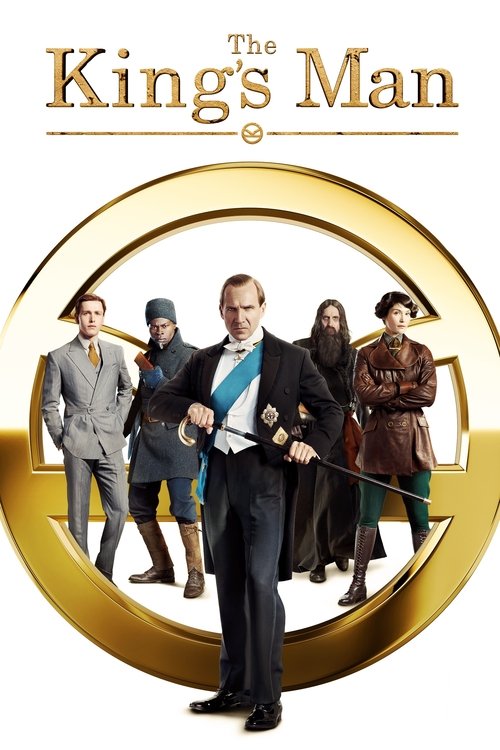
The King's Man
2021 · Matthew Vaughn
For when you want a big handsome period adventure with a wild streak — history class as rewritten by someone who kept doodling swordfights in the margins. More of a curiosity than a comfort watch.
What it's about
On the eve of the First World War, Orlando, the Duke of Oxford — a grieving aristocrat sworn to pacifism — discovers that a shadowy cabal of history's worst schemers is engineering a war that will kill millions. With his son itching to enlist and the crowned heads of Europe sleepwalking toward catastrophe, he assembles a covert network of servants and spies to stop it, laying the foundations of the Kingsman agency.
The experience
An odd, ambitious ride that swings between straight-faced wartime tragedy and full-tilt franchise lunacy — one scene is muddy trench horror, the next a deranged fight with a dancing mystic. The tonal whiplash is the experience; it's never boring and never quite what you expect.
Performances
Ralph Fiennes anchors the whole thing with real gravity, playing grief and duty completely straight amid the mayhem — and he's a startlingly good action lead. Rhys Ifans' Rasputin is an unhinged, scene-devouring creation.
The craft
The period craft is genuinely lavish — palaces, no-man's-land, and a knife-fight staged like a ballet — and the WWI sequences are shot with a hush and dread the earlier films never attempted. Vaughn threads his signature swirling action camera through 1910s Europe with real invention.
Why it matters
The franchise's riskiest swing: a prequel that traded neon spy comedy for period tragedy-adventure, dividing audiences but proving the series could change costume. It gave the Kingsman world an origin myth stitched into real history.
Snapshot
The King's Man is the third entry in Matthew Vaughn's Kingsman franchise and its first prequel, reaching back across roughly a century to invent an origin myth for the independent intelligence agency introduced in Kingsman: The Secret Service (2014). Where the earlier films were contemporary, neon-bright spy comedies built on the collision of Savile Row tailoring and ultraviolent slapstick, The King's Man relocates that sensibility to the years surrounding the First World War, threading a fictional secret society through the documented catastrophe of 1914–1918. Ralph Fiennes anchors the film as Orlando, the Duke of Oxford, a grieving aristocrat and reformed warrior whose pacifism is tested by a conspiracy of history's villains. The result is a tonal hybrid that the franchise had not previously attempted: part period adventure, part costume melodrama of fathers and sons, part the franchise's trademark balletic carnage. It is also the franchise's most divisive installment, an experiment in grafting comic-book maximalism onto the iconography of the Great War. Long delayed by the COVID-19 pandemic, it finally reached theaters in December 2021 into an exhibition market still in convalescence.
Industry & production
The King's Man was produced through Vaughn's company Marv (Marv Films/Marv Studios) and distributed by 20th Century Studios — the renamed 20th Century Fox, which Disney had absorbed in 2019. The film thus arrived as one of the franchise's transitional artifacts, conceived under Fox and delivered under Disney's ownership, a corporate handover that mirrored broader consolidation in Hollywood at the close of the 2010s. It is adapted, like its predecessors, from the comic The Secret Service by Mark Millar and Dave Gibbons, though the prequel narrative is largely original to Vaughn and his collaborators rather than drawn directly from the source.
The production's defining external fact is its release history. Originally announced for a 2019 window and subsequently for early 2020, the film was repeatedly postponed as the pandemic disrupted theatrical distribution worldwide. Its eventual December 2021 release placed it in a marketplace still operating below pre-pandemic attendance, and contemporary trade coverage framed its commercial performance against that depressed baseline. I will not cite specific grosses here, as reporting them precisely from memory risks error; the salient point is that the film opened into a recovering rather than a healthy box office, which shaped how its returns were read.
The shoot drew on British studio infrastructure and location work to recreate Edwardian and wartime Europe, with substantial set construction for trench, manor-house, and continental interiors. The cast assembled an unusually deep bench of British and European character actors — Gemma Arterton, Rhys Ifans, Djimon Hounsou, Harris Dickinson, Daniel Brühl, Charles Dance, Stanley Tucci, Matthew Goode, and Tom Hollander in a triple role as the cousin-monarchs of Britain, Germany, and Russia.
Technology
The King's Man was shot and finished digitally, consistent with mainstream studio practice by the late 2010s, and leans heavily on the now-standard pipeline of practical photography augmented by digital set extension and effects compositing. Period reconstruction of this kind — wartime no-man's-land, early-twentieth-century cityscapes, aerial and mountaineering sequences — depends on the seamless marriage of built sets, location plates, and CG environment work, and the film deploys that toolkit throughout. The franchise's signature mode of action staging, in which the camera appears to flow through choreography in extended takes, again relies on the contemporary repertoire of stabilized rigs and digitally stitched "oner" effects rather than literal single takes; the apparent continuity is constructed in post as much as captured in camera. Where the earlier films pushed this toward cartoonish velocity, here the technology is bent toward a somewhat heavier, more weighted physicality, particularly in the war and combat sequences.
Technique
Cinematography
Ben Davis served as director of photography. Davis, whose résumé includes a long run of Marvel Studios features as well as Kingsman: The Golden Circle, brings a polished large-canvas sensibility to the period setting. The film's palette shifts deliberately with its tonal registers: the Oxford estate and drawing-room scenes favor warm, painterly interior light consistent with prestige costume drama, while the war material moves toward desaturated mud-and-gray naturalism that quotes the visual grammar of canonical WWI cinema. The camera retains the franchise's appetite for kinetic movement — sweeping, athletic moves through action — but tempers it against more composed, classical framing in the dramatic passages. The contrast is intentional, marking the film's oscillation between heritage solemnity and pulp spectacle.
Editing
Jason Ballantine edited the film, continuing his association with the franchise. The cutting carries forward the series' established rhythm — punchy, percussive action assembly capable of the speed-ramping and beat-matched violence the Kingsman films are known for — but it is asked here to modulate between that mode and a slower, more sentimental dramatic tempo. This is the structural tension the editing must manage, and it is also the locus of the film's most common criticism: that the abrupt shifts between elegiac war tragedy and comic-book set piece can feel tonally unmoored. The Rasputin sequence and the climactic mountain confrontation are the showcases of the action-cutting craft; the father-son and grief material relies on a more conventional, restrained rhythm.
Mise-en-scène / staging
Production design by Darren Gilford and costume design by Michele Clapton — the latter best known for her work on Game of Thrones — give the film its considerable surface richness. The wardrobe is one of its genuine pleasures, ranging across military dress uniforms, aristocratic tailoring, and the bespoke ethos that is the franchise's emblem: the suit-as-armor motif here acquires a literal period genealogy. Staging foregrounds the tactile world of Edwardian and wartime Europe, with the recurring tailor's-shop conceit positioning Savile Row as the secret organization's cover. The set-piece staging is the film's structural spine — the Rasputin fight built around a grotesque, dance-inflected choreography; the harrowing crawl across no-man's-land; the cliffside finale — each conceived as a distinct spectacle with its own spatial logic.
Sound
The score is credited to Matthew Margeson, returning from the earlier films, with Dominic Lewis. The musical approach blends orchestral period grandeur with the propulsive cues the franchise uses to drive its action, and it leans more toward sweeping, emotive scoring than the pop-needle-drop irony that punctuated the contemporary entries. The sound design across the war sequences works toward immersive, concussive realism in keeping with the film's bid for occasional gravity, while the action set pieces retain the heightened, impact-forward mix typical of the series.
Performance
Ralph Fiennes gives the film its dramatic center, playing the Duke of Oxford with a controlled, wounded dignity that grounds the more outlandish material; his pivot from pacifist mourner to man of action is the engine of the character arc. Rhys Ifans delivers the most discussed supporting turn as Grigori Rasputin, a grotesque, sinuous, scenery-devouring performance that crystallizes the film's pulp instincts. Tom Hollander's triple casting as King George V, Kaiser Wilhelm II, and Tsar Nicholas II — the historical first cousins whose family quarrel the film stylizes into the war's hidden cause — is a pointed conceit, both satirical and structural. Harris Dickinson as the son Conrad, Gemma Arterton and Djimon Hounsou as the Duke's confederates, and Daniel Brühl, Charles Dance, Stanley Tucci, and Matthew Goode fill out a dense ensemble of historical and invented figures.
Narrative & dramatic mode
The film's dramatic mode is the central source of both its ambition and its uneven reception. It interweaves three registers that do not always cohere: a sincere father-and-son tragedy about a pacifist parent trying to shield his son from war; a secret-history conspiracy thriller in which a hidden mastermind, "the Shepherd," manipulates real events — the Sarajevo assassination, Russian court intrigue, the machinations around the war's course — to engineer global catastrophe; and the franchise's established comic-action spectacle. The film deliberately courts genuine pathos in its war material, including a mid-film turn that subverts the expected adventure trajectory and reaches for tragic weight unusual in the series. This swing between earnest grief and arch villainy is the film's defining formal gamble. Where it lands, it lends the franchise an emotional dimension its predecessors lacked; where it misfires, the registers undercut one another, and critics frequently located the film's weakness precisely in that whiplash.
Genre & cycle
The King's Man sits at the intersection of the spy film, the period war film, and the comic-book adaptation. As a prequel it belongs to the wider 2010s–2020s cycle of franchise expansion through origin stories, mining an established property for backstory and brand extension. Within the espionage genre, it self-consciously reaches back past the contemporary spy idiom toward the gentleman-adventurer tradition, recasting the secret agent as Edwardian aristocrat. Its grafting of the WWI war film onto pulp adventure aligns it with a small lineage of works that treat the Great War as a backdrop for heightened genre play, but the prestige seriousness it borrows from canonical war cinema sits in deliberate friction with its comic-book heritage. The film is best understood as a franchise's attempt to broaden its generic range — to prove the Kingsman template portable across eras and tones — rather than as a straightforward continuation of the series' contemporary-spy mode.
Authorship & method
Matthew Vaughn is the franchise's defining authorial presence, and The King's Man extends his recognizable method: the conversion of comic-book source material (here loosely) into glossy, hyper-stylized action cinema; the recurring fixation on class, mentorship, and the bespoke suit as emblem of an idealized Englishness; and the construction of bravura set pieces designed as discrete spectacles. Vaughn co-wrote the screenplay with Karl Gajdusek, developing a largely original prequel narrative rather than adapting an existing comic arc. His key collaborators here include cinematographer Ben Davis, editor Jason Ballantine, composers Matthew Margeson and Dominic Lewis, production designer Darren Gilford, and costume designer Michele Clapton. The film's most distinctive authorial choice is its willingness to risk the franchise's comic identity on a more somber, emotionally invested register — an evolution of Vaughn's method toward something closer to historical melodrama, even as it retains his appetite for outré violence. Whether that evolution is judged a maturation or a miscalculation is the crux of the critical conversation around the film.
Movement / national cinema
The King's Man is a British-led production deeply invested in a particular vision of Englishness — the gentleman's club, the tailor's shop, the country estate, the ethic of noblesse oblige — and it belongs to the long tradition of British genre filmmaking that exports a stylized national self-image. It is simultaneously a fully transnational studio product, financed and distributed through a Hollywood major, shot with international personnel, and pitched at a global audience. It does not belong to any art-cinema movement; its lineage is commercial and popular. Within British cinema specifically, it can be read alongside the heritage-film tradition's fascination with the Edwardian and wartime period, here detourned through pulp spectacle — a kind of heritage cinema weaponized for the comic-book age.
Era / period
The film is set principally in the 1910s, spanning the prelude to and duration of the First World War, with a framing reach toward the conflict's aftermath and the founding of the agency. Its production era — late 2010s into 2021 — is equally legible in the film, both in its digital craft and in its sensibility: it is a product of the franchise-saturation moment, when studios extended properties backward and outward, and of the prestige-comic-book convergence that defined blockbuster filmmaking of the period. The pandemic that delayed it is itself part of its era-defining context, marking it as one of the films caught and reshaped by the 2020–2021 disruption of theatrical cinema.
Themes
The film's governing themes are grief and the relationship between fathers and sons, refracted through a pacifist's reluctant turn to violence; the manipulation of history by hidden hands, dramatized in the conceit that the war's vast machinery was steered by a small cabal; and the class ethic of duty and service, embodied in the secret organization's founding and in the recurring elevation of loyal subordinates. The triple-cousin monarchy conceit advances a satirical thesis about war as family dysfunction writ catastrophically large. Running beneath all of this is the franchise's persistent preoccupation with the suit and the gentleman as moral ideal — the notion, stated across the series, that manners and self-mastery, not birth, make the man, here given a wartime origin. The film's reach for tragic weight in its war material is its attempt to dignify those themes; its pulp apparatus is what complicates that bid.
Reception, canon & influence
Critically, The King's Man was the most contested entry in the franchise. Reviewers frequently praised its production craft — the costuming, the period design, Fiennes's grounding performance, and individual set pieces, especially the Rasputin sequence — while faulting its tonal incoherence, the uneasy collision of sincere war tragedy and comic-book excess that the film never fully reconciles. The consensus, broadly, was of an ambitious but uneven picture that diluted the franchise's comic energy without wholly earning its newfound gravity. I am declining to cite a precise aggregate score or box-office figure from memory, as exact numbers here are easy to misstate; the qualitative record is clear enough that the film landed as a polarizing, mid-tier reception relative to the well-liked first installment.
Looking backward, the film's influences are legible and deliberate: the iconography of canonical First World War cinema, from which it borrows its trench and no-man's-land imagery; the gentleman-spy and adventure traditions of British genre filmmaking; the secret-history thriller's conceit of unseen hands steering documented events; and, most directly, the Kingsman films' own established template, which it both honors and reworks. Its forward legacy is more modest. As a prequel it primarily serves the franchise's own continuity, supplying an origin and securing the property's expansion; trade reporting around the film and Vaughn's stated intentions pointed toward further franchise development, though the precise fate of those plans is best treated as ongoing rather than settled. Beyond the series, The King's Man has not exerted a documented influence on wider filmmaking, and any claim that it did would overstate the record. Its significance, for now, is as a case study in the risks of tonal hybridization — a franchise testing how far its formula could stretch across era and mood, and discovering the limits of that elasticity.
A Deleuzian reading
A man drags himself across mud on his belly, in silence, toward a body he can already tell is dead.
The full Deleuzian reading of The King's Man →
Reception
Delayed half a dozen times by COVID and finally dumped into the Omicron winter of 2021, it was panned as a tonal mess — but it's since picked up genuine defenders who treasure it as the franchise's strangest, most personal entry.
How The King's Man was received, from release to now →
Influences: the films it descends from and the films it influenced
- Kingsman: The Secret Service (2014) — Establishes the franchise grammar the prequel reverse-engineers: the bespoke Savile Row suit as both class emblem and combat armor, plus the whip-pan, speed-ramped single-take brawl staged as a self-contained spectacle.
- Kick-Ass (2010) — Forges Vaughn and Jane Goldman's signature collision of comic-book ultraviolence against sincere, wounded emotion — the exact tonal-whiplash editing register Ballantine pushes to its breaking point here.
- Stardust (2007) — Vaughn's earlier period-fantasy adventure with a flamboyantly theatrical antagonist (De Niro's pirate) that prefigures the outré, dance-fight-grotesque pitch of Rhys Ifans's Rasputin.
- Paths of Glory (1957) — Supplies the canonical lateral tracking shot gliding through the trench and the doomed walk across no-man's-land that the film's WWI combat imagery directly quotes.
- All Quiet on the Western Front (1930) — The foundational source for the over-the-top charge and machine-gunned no-man's-land tableau that defines the trench sequences' iconography.
- Lawrence of Arabia (1962) — Model for the British-heritage-epic register — landscape-as-moral-arena scale and prestige period grandeur that the film reaches for to legitimize its tonal pivot to gravity.
- The Man Who Would Be King (1975) — Kipling-esque template of the gentlemanly adventurer entangled in imperial intrigue, anchoring the 'secret hands steering documented history' conceit.
- Nicholas and Alexandra (1971) — Prestige Romanov-collapse melodrama whose Rasputin-at-court intrigue and lavish period staging the film recasts as conspiracy spectacle.
- Sherlock Holmes (2009) — Pioneers the speed-ramped, pre-visualized Edwardian fight choreography — combat dissected in slow-motion beats — that the Rasputin duel borrows wholesale.
- Wanted (2008) — Comic-book adaptation that codifies the physics-defying, kinetic-camera assassin set piece, part of the stylized-action grammar Vaughn inherited and refined.
- Kingsman: The Golden Circle (2017) — Same-franchise entry extending the escalating discrete-set-piece architecture and Margeson's bombastic orchestral-action scoring the prequel carries over.
- Argylle (2024) — Vaughn's later spy outing pushes the 'secret history of espionage' meta-conceit and glossy hyper-stylization the prequel rehearses into full self-reflexive form.
- Enola Holmes (2020) — Period-British action-adventure in the post-Kingsman idiom — Edwardian/Victorian setting, breezy genre revisionism, and tailored-protagonist set pieces.
- Wonder Woman (2017) — Deploys the WWI No Man's Land crossing as a blockbuster's emotional centerpiece — the same impulse to weld sincere war imagery onto franchise spectacle.
- 1917 (2019) — Shares the immersive, mud-and-gray desaturated WWI palette and the drive to make trench warfare a visceral, continuous spatial experience.
- Atonement (2007) — British-heritage prestige filmmaking that fuses tailored period elegance with a bravura war tableau, sharing the heritage-film texture Michele Clapton's costuming evokes.
Similar films
- Kingsman: The Golden Circle (2017) — influence & lineage
- 1917 (2019) — influence & lineage
- Kingsman: The Secret Service (2015) — shared sensibility
- Tenet (2020) — shared sensibility
- Athena (2022) — shared sensibility
- The King's Speech (2010) — shared sensibility
- The Man from U.N.C.L.E. (2015) — shared sensibility
- Tinker Tailor Soldier Spy (2011) — shared sensibility