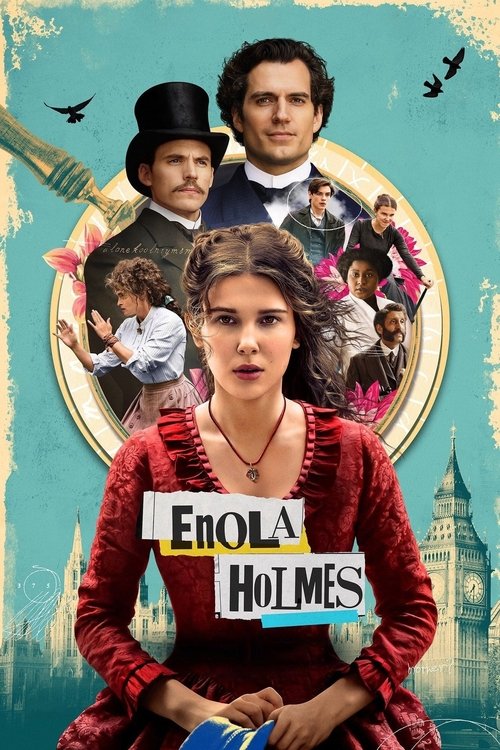
Enola Holmes
2020 · Harry Bradbeer
For a light, fun family night or a Sunday afternoon when you want adventure without stress — comfort viewing that still gives your brain a puzzle to play with.
What it's about
Enola Holmes, the much-younger teenage sister of Sherlock, wakes on her sixteenth birthday to find her unconventional mother has vanished. Rather than be packed off to finishing school by her stuffy brother Mycroft, she bolts to 1880s London in disguise to find her mother — and gets tangled up with a runaway young lord whose life may be in danger, giving her a mystery of her very own to solve.
The experience
Bright, brisk, and cheeky — Enola talks straight to the camera like she's letting you in on the caper, and the film skips along with disguises, decoded ciphers, and narrow escapes. It's a romp with just enough real feeling about mothers and daughters underneath.
Performances
Millie Bobby Brown carries the whole film with fizzy, direct-address charm, and Henry Cavill makes an unexpectedly warm, understated Sherlock; Helena Bonham Carter is a vivid presence as the missing mother.
The craft
Director Harry Bradbeer brings the fourth-wall-breaking wit of his television work to a handsome Victorian production — corsets, country houses, London fog — and Jack Thorne's script keeps the mystery clean and the energy up. The period detail is lush without ever turning stiff.
Why it matters
A streaming hit that launched a franchise, it confirmed Millie Bobby Brown as a leading lady and producer, and helped set the template for playful, youth-forward reinventions of classic literary characters.
Snapshot
Enola Holmes is a Netflix-distributed mystery-adventure adapted from Nancy Springer's young-adult novel series The Enola Holmes Mysteries (begun 2006), which invents a teenage younger sister for Arthur Conan Doyle's detective. Directed by Harry Bradbeer from a screenplay by Jack Thorne, the film pairs a heritage-cinema surface — 1880s England, corsetry, country houses, London fog — with a contemporary, fourth-wall-breaking address to camera that Bradbeer imported from his television work. Millie Bobby Brown, then best known from Stranger Things, headlines and also produced through her PCMA Productions banner; the supporting ensemble includes Henry Cavill as an unusually youthful and reserved Sherlock, Sam Claflin as the reactionary Mycroft, Helena Bonham Carter as the missing radical mother Eudoria, and Louis Partridge as the runaway Viscount Tewkesbury. The film's animating idea is to reroute the Holmes mythos through a girl's coming-of-age in an era of contested suffrage and reform, turning deduction into a metaphor for female self-determination. It was engineered as the launch of a franchise, a goal it achieved with a 2022 sequel.
Industry & production
The project sits at the intersection of a legacy-IP adaptation and a streaming-era pivot. Legendary Pictures developed the film and had positioned it for a theatrical release, but the COVID-19 pandemic's closure of cinemas in 2020 prompted a sale of distribution rights to Netflix, which released it globally on 23 September 2020. This makes Enola Holmes one of the signal examples of the pandemic-era reallocation of would-be theatrical titles to streaming platforms. Netflix does not report box-office grosses, and public viewership data for its titles is limited to figures the company chooses to release; Netflix stated the film reached a large audience in its opening weeks (a household figure in the tens of millions was reported), but such self-reported metrics should be treated as promotional rather than independently audited, and the precise numbers are not part of a verifiable public record in the way theatrical grosses are.
The production's most consequential off-screen event was a lawsuit. In June 2020 the Conan Doyle Estate filed suit against Netflix, Legendary, Springer, and others, alleging copyright and trademark infringement. The claim rested on the fact that a subset of late Holmes stories remained under U.S. copyright, and argued that the warmer, more emotionally expressive, more respectful-toward-women Sherlock depicted in the film drew on character traits developed only in those still-protected stories. The suit drew wide commentary as a test of where the public-domain Holmes ends and the protected Holmes begins; it was reportedly resolved out of court. The episode is historically notable less for its outcome than for exposing the copyright seams in a character usually assumed to be fully public domain.
Technology
Enola Holmes was produced with standard contemporary digital-capture and post-production workflows; the record on the specific camera and lens package is not something I can state with confidence, so I will not name a model I cannot verify. The film's technological interest lies less in acquisition than in the pandemic-driven shift of its distribution pipeline from theatrical projection to home-streaming delivery — a change that arguably shaped its afterlife more than any on-set tool. Its most audience-facing technique, the direct-address break, is a staging and editing decision rather than a technological innovation, but it depends on the smoothness of modern digital editing to intercut Enola's glances and asides seamlessly into scene coverage.
Technique
Cinematography
Cinematography is by Giles Nuttgens, a British-trained cinematographer whose credits range across arthouse and studio work and include the sun-bleak modern Western Hell or High Water. Here his palette is warmer and more storybook: burnished interiors, greens of the Holmes country estate, and a fog-and-gaslight London that reads as heritage-picturesque rather than grimy. The camera is notably mobile and collaborative with the performances — it frequently reframes to accommodate Brown's turns toward the lens, so that the compositions are built to absorb the fourth-wall breaks without feeling like static inserts. The look is bright and accessible, aligned with the film's young-adult address rather than the desaturated grit favored by other recent Holmes screen treatments.
Editing
The editing, by Adam Bosman, carries much of the film's distinctive voice. The central formal task is integrating direct address — Enola's confiding asides, raised eyebrows, and to-camera exposition — into conventional narrative coverage so that the breaks feel like an extension of character rather than an interruption. Bosman also handles brisk flashback montages of Enola's unconventional education with Eudoria, and the film's tempo is calibrated toward momentum and clarity, keeping the plot machinery legible for a broad audience. The rhythm owes something to the propulsive, character-forward cutting style of prestige television.
Mise-en-scène / staging
Production and costume design lean into recognizable Victorian iconography — corsets, country houses, railway carriages, and the theatrical density of London streets — but the staging repeatedly stages against those constraints. Costume becomes plot and theme: the corset as literal restriction, disguise as agency, boys' clothes and widow's weeds as tools of movement through a policed social world. The mise-en-scène is organized around thresholds and confinements (the estate, trains, boarding-school-adjacent institutions of feminine correction) that Enola must escape, physically dramatizing the film's argument about female mobility.
Sound
Daniel Pemberton composed the score. Pemberton, one of the more stylistically versatile British film composers of the period, supplies an energetic, playful, adventure-forward score that supports the film's comic and propulsive register while gesturing at period orchestration. The music works in tandem with the direct address to keep tone buoyant, cueing the audience toward the film's self-aware, spirited mode rather than the brooding atmospherics associated with darker Holmes adaptations.
Performance
Performance is the film's chief pleasure and its structural engine. Millie Bobby Brown's Enola is built for the fourth-wall device: her performance is calibrated to include the viewer as confidant, and much of the characterization happens in the glance to camera. Henry Cavill plays Sherlock with deliberate restraint and warmth — precisely the interpretive choice that became the object of the Conan Doyle Estate's legal complaint. Sam Claflin's Mycroft embodies patriarchal reaction; Helena Bonham Carter's Eudoria anchors the film's radical-maternal absence; Louis Partridge's Tewkesbury supplies romance and a parallel coming-of-age; and supporting turns from Fiona Shaw (as the finishing-school headmistress) and Adeel Akhtar (as Lestrade) fill out the period ensemble.
Narrative & dramatic mode
The film's boldest formal decision is its narrational mode: sustained direct address, in which Enola narrates, comments, and enlists the audience as accomplice. This yokes the detective story's tradition of the reasoning narrator to a confessional, intimate first-person voice, and it converts exposition — normally the drag on any mystery — into a source of charm. Structurally the film braids two investigations: the search for the vanished mother, which is the emotional and thematic spine, and the protection of the runaway young lord, which supplies the propulsive thriller plot and its reform-vote stakes. Dramatically it is a bildungsroman wearing the clothes of a mystery: the "case" Enola ultimately solves is the question of who she will be. The mode is comic, brisk, and self-aware rather than atmospheric or noir.
Genre & cycle
Enola Holmes belongs simultaneously to several cycles. It is a Sherlock Holmes screen adaptation, entering a lineage that in the same period included Guy Ritchie's action-inflected Sherlock Holmes films (2009, 2011) and the BBC's modernized Sherlock — but it distinguishes itself by decentering Sherlock in favor of an invented sister. It is a young-adult literary adaptation engineered as franchise-launcher, aligning it with the female-led YA-adventure wave. And it is a revisionist costume/heritage picture, using the period-film apparatus to critique the very gender order that classical heritage cinema often nostalgizes. The film's freshness comes from crossing the detective cycle with the coming-of-age girl-adventure, a combination whose most direct print antecedent is Springer's novels.
Authorship & method
The film is best read as an authorial collaboration between a director carrying a distinctive television grammar and a screenwriter with a large body of British adaptation work. Harry Bradbeer came to the film from acclaimed television — he directed Fleabag and episodes of Killing Eve — and the single most identifiable trait of Enola Holmes, its complicit address to camera, is a direct transplant of the Fleabag device into period-adventure form. Bradbeer's method treats the audience as a character, and the whole film is designed around that relationship. Jack Thorne, the screenwriter, is among the most prolific British dramatists of his generation (his credits include stage and screen work across a wide range); his script foregrounds theme and voice, translating Springer's premise into a reform-era political frame. Giles Nuttgens (cinematography), Adam Bosman (editing), and Daniel Pemberton (score) supply, respectively, a warm storybook look, an integration of the direct-address grammar, and a spirited adventure score. Millie Bobby Brown's role as producer is also part of the authorship story: the film is a vehicle consciously built around and by its young star.
Movement / national cinema
The film is a transatlantic production — American studio financing and a global streaming distributor married to a thoroughly British creative team, cast, setting, and sensibility. It sits within British costume/heritage filmmaking while participating in the streaming era's globalization of that tradition, in which recognizably British period product is produced for worldwide platform audiences. It also exemplifies the migration of prestige-television craft (and its makers) into feature filmmaking: Bradbeer's authorship is unimaginable without the preceding decade of British television's formal experimentation with direct address and character-forward comedy-drama.
Era / period
Two "eras" are relevant. The film is set in 1884 England and deliberately entangles its plot with the politics of franchise reform — a young lord's vote in the House of Lords becomes a thriller MacGuffin, and the mother's radicalism gestures toward the wider suffrage struggle. It is worth flagging, in the interest of accuracy, that the reform legislation of 1884 extended the vote to more men and did not enfranchise women; the film treats "reform" more as a thematic emblem of a society on the cusp of change than as a precise legislative history. The film was made and released in 2020, and its production era — the first year of the pandemic — is inseparable from its identity as a theatrical film rerouted to streaming.
Themes
The governing theme is female self-authorship against institutional constraint. Corsetry, finishing school, primogeniture, and the guardianship of women by men recur as literalized obstacles, and Enola's detective skill is coded as the practical form of an unconventional feminist education. The mother-daughter relationship supplies the emotional and political engine: Eudoria's radicalism is both an abandonment and an inheritance, and the film's resolution is less about capturing a culprit than about Enola choosing her own path between her mother's revolution and her brothers' conservatism. Secondary themes include the tension between reason and feeling (embodied in Cavill's softened Sherlock), the politics of reform and enfranchisement, and disguise/performance as instruments of agency. The direct-address form is itself thematic: it asserts a young woman's right to control her own narration.
Reception, canon & influence
Critically, Enola Holmes was received as a bright, well-crafted crowd-pleaser whose chief assets were Brown's charismatic lead performance and the freshness of its address-to-camera conceit; commentary frequently praised the star and the tone while noting that the film's mystery mechanics were secondary to its coming-of-age and thematic aims. Because it debuted on Netflix, its "success" was measured in platform-reported viewership rather than box office, and those figures — while large as announced by Netflix — are not independently verifiable, a caveat worth keeping in any account of its reception.
Influences on the film (backward): the immediate source is Nancy Springer's novel series, which itself derives from and revises the Conan Doyle canon; the broader lineage runs through more than a century of Holmes screen adaptations, the heritage/costume-drama tradition of British cinema, and — most distinctively — the direct-address, complicit-narrator grammar of recent British television, above all Bradbeer's own Fleabag. The female-led YA adventure and the revisionist-feminist period drama supply its generic templates.
Legacy / what it shaped (forward): the film's clearest legacy is franchise: it established a viable Enola Holmes screen property and led to Enola Holmes 2 (2022), which reunited the principal cast and creative team. More broadly it stands as a case study in two industry shifts — the pandemic-era pivot of theatrical titles to streaming, and the streaming platforms' appetite for female-led, four-quadrant YA franchises built around established stars. Its copyright litigation also entered the popular discourse around Sherlock Holmes's public-domain status, a legal footnote that outlasted many of the film's plot particulars. Its longer-term standing in the Holmes canon — as the adaptation that gave the detective a sister and the mythos a feminist reframing — is still settling, and the historical record on its ultimate influence remains, honestly, early.
A Deleuzian reading
She turns and looks at you.
The full Deleuzian reading of Enola Holmes →
Reception
A pandemic-era Netflix hit — it landed in September 2020 as pure lockdown comfort viewing and became one of the platform's most-watched originals that year. It hasn't needed a reappraisal: it settled comfortably into 'charming YA franchise-starter' status and spawned a 2022 sequel.
How Enola Holmes was received, from release to now →
How to watch Enola Holmes: what to notice on a first viewing
- Watch the frame leave a gap before Enola turns to you. Giles Nuttgens keeps a little air at the side of the shot and reframes to meet her glance, so the break arrives as continuity instead of as an insert stuck into the scene. The compositions are built around a person standing just outside 1884, and that person is you.
- Notice who Enola explains the clues to. Adam Bosman routes the exposition through her asides, so the explaining happens to the audience rather than to another character. Henry Cavill's Sherlock, by contrast, works things out quietly and keeps them in. The part of a mystery that usually stalls a film is the part that recruits you here.
- Watch what Enola puts on before each new move. Boys' clothes, widow's weeds, a corset she has to work around rather than wear. The clothes stop announcing who she is and start working as equipment for crossing a policed city. Costume is the plot here rather than decoration, and you can follow her plan by her wardrobe.
- Count the rooms and carriages Enola has to get out of. The country estate, the railway carriage, the finishing school, a guardian's house. Bradbeer keeps staging confinements that have a door in them and a person deciding whether to use it. Walking out of a room is the film's basic political act, repeated until you feel the weight of it.
- Listen for how quickly the music turns things playful. Daniel Pemberton writes energetic adventure cues with period orchestration under them, and the score keeps the tone buoyant through fights, disguises and a missing mother. The music promises nobody is in real danger, which is the contract the film makes with a young audience.
The whole guide to watching Enola Holmes, with the keys for a rewatch →
Influences: the films it descends from and the films it influenced
- Fleabag (2016) — Bradbeer's own series originated the complicit sidelong glance and confessional aside to camera that Enola transplants wholesale, treating the viewer as a co-conspirator character rather than a passive observer.
- Tom Jones (1963) — Established the roguish costume-romp hero who winks and speaks directly to the lens, proving fourth-wall address could power a fast, playful period adventure rather than a solemn heritage piece.
- Alfie (1966) — A protagonist who sustains an intimate, confessional direct address throughout, steering audience sympathy and narrating his own scheme—the same audience-as-confidant relationship Enola is built around.
- Annie Hall (1977) — Systematized fourth-wall breaks that interrupt and comment on the scene, cutting between address-to-camera and dramatized flashback, the editing rhythm Enola's cutaway asides depend on.
- Ferris Bueller's Day Off (1986) — Made the young protagonist a complicit narrator who turns to camera to enlist the viewer in a caper, the YA template of teen-as-tour-guide Enola adopts.
- The Private Life of Sherlock Holmes (1970) — Pioneered the revisionist, humanizing gambit of filling in the gaps and private life Doyle never wrote, licensing later adaptations like Enola to invent unrecorded Holmes family history.
- Young Sherlock Holmes (1985) — First reframed the detective as an adolescent in an origin-story adventure, establishing the YA-Holmes coming-of-age mode Enola extends to a sister.
- Sherlock (2010) — Modernized screen deduction with kinetic on-screen text and floating graphics that externalize the detective's reasoning, the visual-annotation grammar Enola borrows to render clues legible.
- A Room with a View (1985) — The Merchant-Ivory heritage look—warm natural light, meticulous period interiors, painterly landscape framing—is the costume-drama visual tradition Nuttgens's storybook cinematography both quotes and sweetens.
- Pride & Prejudice (2005) — Wright's golden-hour, tactile 'storybook' period look built around a spirited, self-possessed young heroine set the naturalistic-yet-romantic visual and tonal register Enola operates in.
- The King's Man (2021) — Period-British action-adventure in the post-Kingsman idiom — Edwardian/Victorian setting, breezy genre revisionism, and tailored-protagonist set pieces.
- Persuasion (2022) — Imports Fleabag's to-camera asides and complicit glances directly into an Austen adaptation, extending—and being widely read as chasing—the exact direct-address-in-period-drama move Enola popularized on film.
- Enola Holmes 2 (2022) — The direct sequel continues the identical complicit-address grammar and reunites Nuttgens, Pemberton, Thorne and Bradbeer, extending the same authored television-into-period-adventure method.
- Little Women (2019) — Revises a canonical nineteenth-century literary property into a study of a heroine literally authoring her own life, the female-self-authorship reframing device Enola applies to the Holmes canon.
- Emma. (2020) — Deploys heightened pastel storybook staging and costume-as-characterization in a knowing period comedy, sharing Enola's use of dress and production design as active narrative signals.
- The Personal History of David Copperfield (2019) — A self-aware, briskly playful literary adaptation that punctures period-drama solemnity through narrator-driven framing, the same tonal loosening of heritage material Enola pursues.
- Bridgerton (2020) — A four-quadrant streaming period property fronted by a knowing narrator (Lady Whistledown) who addresses the audience, the same revisionist, viewer-complicit costume-drama formula for the platform era.
Similar films
- Enola Holmes 2 (2022) — influence & lineage
- Little Women (2019) — influence & lineage
- Emma. (2020) — influence & lineage
- The Sheep Detectives (2026) — shared sensibility
- Sense and Sensibility (2026) — shared sensibility
- Black Widow (2021) — shared sensibility
- Detective Conan: The Phantom of Baker Street (2002) — shared sensibility
- Murder on the Orient Express (2017) — shared sensibility