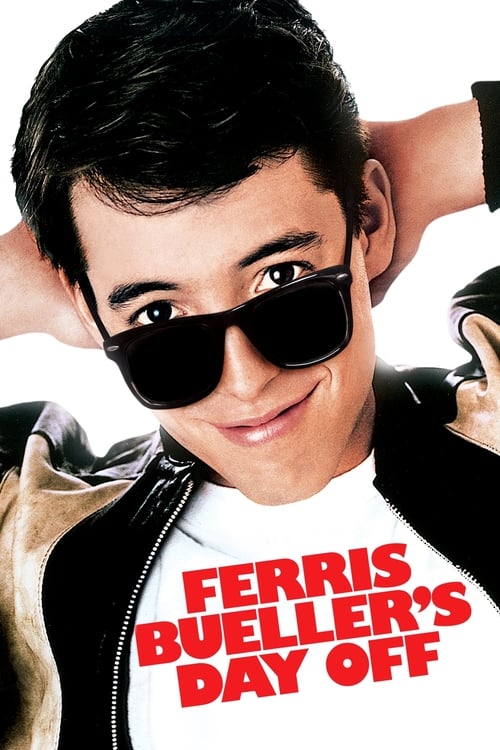
Ferris Bueller's Day Off
1986 · John Hughes
For when you need a guaranteed lift — the cinematic equivalent of playing hooky. A comfort watch of the first order, equally good solo, with friends, or with a teenager seeing it fresh.
What it's about
A supremely confident Chicago high-schooler fakes an illness, springs his anxious best friend and his girlfriend loose, and spends one glorious stolen day in the city — a borrowed Ferrari, a fancy lunch, a museum, a parade — while narrating his personal philosophy straight to the camera. Meanwhile his vengeful principal and his fed-up sister are each determined to catch him in the act.
The experience
Pure buoyant pleasure — fast, funny, and endlessly quotable, with the hero winking at you the whole way. What sneaks up on you is the melancholy underneath: it's secretly a film about a friendship, and about how fast the good days go.
Performances
Matthew Broderick makes borderline-insufferable cockiness completely winning, largely by talking to us like co-conspirators. But Alan Ruck's Cameron — hypochondriac, miserable, and quietly the film's real subject — is the performance that deepens with every rewatch.
The craft
John Hughes structures the whole film as an argument delivered to the audience, breaking the fourth wall with a casualness that still feels fresh, and stages Chicago as a playground worth skipping school for. The parade setpiece is one of the great joy-delivery sequences in American comedy.
Why it matters
The peak of Hughes's legendary mid-eighties teen-movie run and a permanent piece of pop culture — its catchphrases, its fourth-wall address, and its carpe-diem philosophy have been echoed by comedies ever since.
Snapshot
Ferris Bueller's Day Off is the film in which John Hughes stopped writing about adolescence as a condition to be survived and started writing about it as a philosophy to be argued. Released by Paramount in June 1986, it arrived at the crest of Hughes's extraordinary mid-eighties run — Sixteen Candles (1984), The Breakfast Club (1985), Weird Science (1985), Pretty in Pink (1986, which he wrote and produced) — and it deliberately breaks the mold those films had set. Where The Breakfast Club confined five teenagers to a library and made the room a pressure chamber, Ferris Bueller throws the doors open: a single day, a whole city, a protagonist who cannot be contained by any institution and who periodically stops the film to explain himself to the audience.
The structure is a picaresque hung on a stunt. Ferris (Matthew Broderick) fakes illness, extracts his depressive best friend Cameron (Alan Ruck) and his girlfriend Sloane (Mia Sara) from their obligations, commandeers Cameron's father's Ferrari, and spends a day in Chicago — the Art Institute, the Sears Tower, a Cubs game, a downtown parade — while Dean of Students Ed Rooney (Jeffrey Jones) and sister Jeanie (Jennifer Grey) mount separate campaigns to expose him. The comic engine is escalation and near-miss; the dramatic engine, almost buried under it, is Cameron's approach to a confrontation with his father that the film treats with genuine seriousness.
What makes the film durable is the gap between its surface and its structure. It plays as a lark, and it is one. But it is organized around a character who never changes, whose function is to act as a catalyst on someone who does, and it is narrated by a boy addressing a camera in a mode borrowed from vaudeville and Brechtian theater rather than from teen comedy. It has become one of the most widely quoted American films of its decade, and one of the most frequently misread — as an endorsement of charm over consequence, when its own final act is about the terror and necessity of facing consequence.
Industry & production
The film was made inside the studio machinery Hughes had earned the right to command. After The Breakfast Club and Sixteen Candles (both Universal) established him as a bankable voice for a teenage audience that the industry had long treated as an afterthought, he moved with Ferris Bueller to Paramount, where he wrote, directed, and produced. The production is closely associated with producer Tom Jacobson, a frequent Hughes collaborator of the period.
The most-repeated fact about the film's origin — that Hughes wrote the screenplay very quickly, in a matter of days — has circulated widely in interviews and retrospectives and is consistent with his documented working method, though the precise number of days varies between tellings and should be treated as anecdote rather than record. What is not in doubt is that Hughes wrote fast, wrote alone, and wrote from a position of unusual autonomy for a director in his mid-thirties working in a genre the industry considered disposable.
Casting shaped the film decisively. Matthew Broderick came to it from the New York stage and from WarGames (1983) with a light, quick, fundamentally likable presence — essential, because the character as written could easily curdle into smugness. Alan Ruck, notably older than the high-schooler he plays, gives Cameron a worn quality that reads as depression rather than adolescent moodiness. Jeffrey Jones, fresh from Amadeus (1984), plays Rooney with the wounded dignity of a man who believes himself the hero of a different film. Jennifer Grey's Jeanie carries the film's other real grievance. In small parts, Charlie Sheen appears as a police-station delinquent and Ben Stein as the economics teacher whose monotone roll call became one of the most quoted scenes in American comedy — Stein, a former speechwriter and lawyer rather than a trained actor, was reportedly cast in part for exactly that flat authenticity.
Production made extensive use of Chicago and its northern suburbs, the territory Hughes returned to across his career and treated with an affection unusual in American teen film, which had historically defaulted to California. Interiors were built and shot in the Los Angeles area, but the Chicago location work — the Art Institute, Wrigley Field, the Sears Tower Skydeck, Wacker Drive, the parade staged along Dearborn Street — is not backdrop. It is the film's second subject.
Technology
Ferris Bueller is not a technically innovative film, and it is worth saying so plainly: it uses mid-eighties studio filmmaking tools competently and without experiment. It is 35mm, anamorphic-era conventional, with no significant optical or effects work beyond the practical.
The film's relationship to technology is instead thematic and, in one respect, structural. Ferris's power is mediated. He operates through devices: the synthesizer that generates the fake cough, the doorbell rigged with a recorded snore, the mannequin-and-pulley in the bed, the answering machine, the phone system he manipulates to impersonate Sloane's father. The bedroom is a small control room, and the film's opening act is essentially a demonstration of a teenager's mastery over the domestic technology his parents cannot operate. This is a genuinely period-specific idea — consumer electronics had reached the point where a kid could out-engineer an adult in his own house — and it links Ferris Bueller to WarGames and to Hughes's own Weird Science as artifacts of the moment when the personal computer and the home stereo became instruments of adolescent agency.
Music technology matters too: the score and song selection lean on synthesizers and drum machines in a way that dates the film precisely and, in the ambient cues, gives the Chicago sequences a shimmer that live instrumentation would not have produced.
Technique
Cinematography
Tak Fujimoto shot the film. He was already an idiosyncratic choice — his credits ran through Terrence Malick's Badlands (1973), Jonathan Demme's Melvin and Howard (1980) and Something Wild (1986), and he would later shoot The Silence of the Lambs (1991). What he brings is a documentary-inflected naturalism grafted onto a comedy: available-light warmth in the suburban interiors, a bright and slightly overexposed clarity in the Chicago daylight sequences, and a willingness to let the city look like itself rather than like a set.
The film's most-discussed visual strategy is the direct address. Broderick speaks to the lens repeatedly, and the camera treats this as a normal grammatical operation rather than a stunt — Fujimoto and Hughes frame these moments in clean, centered compositions that make the audience a legitimate scene partner. The device is established in the first minutes, which is what licenses its use later without rupture.
The Art Institute sequence is the film's formal high point and its clearest departure from comedy grammar. As the three drift through the galleries to a cover of the Smiths' "Please, Please, Please, Let Me Get What I Want," the camera moves from group compositions into a series of increasingly tight, increasingly abstract shots of Cameron before Seurat's A Sunday Afternoon on the Island of La Grande Jatte — pushing in until the painting dissolves into its constituent dots and the face becomes unreadable. It is a visual argument about looking too closely at something and finding nothing there, and it is placed at the film's center as a statement of Cameron's condition. Hughes was reportedly personally attached to the Art Institute as a place of refuge in his own youth, and the sequence carries that weight.
Editing
Paul Hirsch cut the film, bringing the credentials of Star Wars (1977), The Empire Strikes Back (1980), and Blow Out (1981) — a cutter fluent in both propulsion and suspense. The film's rhythm is his central achievement: it runs three plot lines (Ferris's day, Rooney's pursuit, Jeanie's parallel unraveling) in near-continuous crosscut without ever losing the causal thread of the day's ticking clock.
Hirsch also manages the film's tonal shifts, which are severe. The cut out of the parade — the largest, most euphoric set piece — into the quiet of the parking garage and then into Cameron's catatonia at the pool is a hard gear change, and it works because the montage sequences have been built to end on a beat of stillness rather than a punchline. The picaresque episodes (the restaurant, the ballgame, the Skydeck) are each edited as compact self-contained units, which is what allows the film to feel loose while remaining tightly disciplined about running time.
The closing tag after the credits — Ferris returning to tell the audience it's over and to go home — is an editorial joke that depends entirely on placement, and it has become one of the best-known post-credit stingers in American film.
Mise-en-scène / staging
Hughes stages the film across a set of sharply differentiated spaces, each carrying a social argument. The Bueller house is warm, cluttered, permissive. Cameron's house is the film's most eloquent piece of production design: a modernist glass-and-steel pavilion in a wooded setting, immaculate, cold, and built around the garage that houses the Ferrari — a house organized as a display case for objects, in which a child is one more object improperly maintained. The Ferrari (a replica, as is well documented, rather than an authentic 1961 250 GT California) is the film's central symbol precisely because it is a beautiful thing kept from use.
The school is rendered as an institution in decay — Rooney's office as a bunker, the corridors as empty as a hospital. The Chicago sequences work in the opposite register: crowded, warm, saturated, staged in real space among real people. The parade set piece, in which Ferris commandeers a float and leads a crowd through "Danke Schoen" and "Twist and Shout," is staged as genuine spectacle, with the film's fiction absorbed into an actual civic event.
Sound
The soundtrack functions as a curatorial statement rather than a score in the conventional sense, and Hughes's music supervision — his taste ran to British new wave, post-punk, and Anglophile pop — is inseparable from his authorship. The choices are pointed: Yello's "Oh Yeah" as the leitmotif of the Ferrari's desirability (the cue that made the track a permanent shorthand for materialist lust in American film and advertising), the Dream Academy's instrumental Smiths cover in the museum, Sigue Sigue Sputnik's "Love Missile F1-11," the Beatles' "Twist and Shout" repurposed as mass civic euphoria. Ira Newborn provided original score work, and Arthur Baker and John Robie contributed to the film's electronic material.
The film's other significant sound decision is its treatment of adult speech. Ben Stein's droning economics lecture, the Smith-Hawley Tariff Act delivered in an unmodulated affectless line, is a sound gag before it is a verbal one — the joke lives in the prosody. Rooney's speech is by contrast overinflected. The adults in this film are characterized largely by how they talk.
Performance
Broderick's performance is a feat of calibration. Ferris is written as functionally invulnerable, which is dramatically inert; Broderick supplies charm without self-satisfaction, and — critically — plays the direct-address passages as sincere rather than knowing. The audience is not being winked at; it is being confided in.
Alan Ruck's Cameron is the film's actual performance in the dramatic sense, and it has aged into being widely regarded as its finest. The physical vocabulary is precise: the rigid posture, the shallow breathing, the catatonic stillness in the pool sequence, and then the eruption at the car. Ruck plays a clinically recognizable depression inside a comedy without ever tipping the film's register.
Jeffrey Jones commits to Rooney's escalating humiliation with a straight face that makes the slapstick land, and Jennifer Grey gives Jeanie a real and unresolved anger — her scene with Sheen in the police station is the film's one moment of genuine, unironic intimacy between strangers. Mia Sara's Sloane is the film's thinnest role; she functions as a witness more than an agent, and the screenplay does not give her much beyond composure.
Narrative & dramatic mode
The film's architecture is unusual for a studio comedy: its protagonist has no arc. Ferris begins the film complete and ends it unchanged, having gotten everything he wanted. He is not a character in the conventional dramatic sense so much as a principle — a force applied to other people. The dramatic weight is displaced onto Cameron, who moves from paralysis through a controlled psychotic break to the decision to face his father, and secondarily onto Jeanie, who abandons her grievance in a single scene of unexpected grace.
This displacement is what the direct address is for. By making Ferris the film's narrator and theorist — the one who explains the rules, the method, the philosophy — Hughes converts him from protagonist into essayist. The famous closing thesis, delivered to camera, about life moving fast and the necessity of stopping to look around, is the film's argument stated outright rather than dramatized, which is possible only because the film has established a mode in which stating things outright is legitimate.
The mode itself descends from stage comedy and vaudeville more than from cinema: the confiding rogue, the audience as accomplice. Its cinematic antecedents are scattered — Tom Jones addressing the camera in Tony Richardson's 1963 film, Woody Allen's asides in Annie Hall (1977) — but Ferris Bueller systematizes it into a full narrative device, with Ferris able to pause the action, address the camera, and resume.
Structurally the film is a picaresque bounded by a unity of time: one day, sunrise to the parents' return, with a hard deadline. The tension is generated almost entirely by clock and proximity rather than by stakes, since nothing catastrophic can actually happen to Ferris. This is a deliberate design choice, and it is why the Cameron material is load-bearing — it supplies the consequence the main plot refuses to.
Genre & cycle
The film sits at the center of the eighties American teen cycle, a body of work largely defined by Hughes himself, and it is the film in which he broke that cycle's dominant terms. The cycle's characteristic mode — social taxonomy, romantic anxiety, the high school as total institution — is present here only as material to be escaped. Ferris is not sorted into a clique; the film's opening voiceover explicitly notes his universal popularity across every social category, which is a direct inversion of The Breakfast Club's premise.
It belongs equally to a longer lineage of comedies about a single transgressive day: the escape-from-authority farce, the road picture compressed to city scale, and the "wrong day out" tradition that runs from screwball through to After Hours (1985) and Something Wild (1986). Where those films punish their protagonists for leaving the ordered world, Ferris Bueller rewards its own — a genuinely unusual moral posture that critics at the time flagged as either liberating or irresponsible depending on temperament.
The film also participates in the mid-eighties yuppie-adjacent comedy of consumption. The Ferrari, the restaurant, the clothes, the architecture — the film is fluent in the decade's material aspiration even as its plot is organized around wrecking the most expensive object in it.
Authorship & method
Hughes's method is unusually visible in this film. He wrote alone and fast, drew on the North Shore suburbs where he lived, cast against type when it suited him, and selected music personally with the attention of a fan rather than a supervisor. His authorial signature across Sixteen Candles, The Breakfast Club, and Ferris Bueller is a consistent proposition: that adolescent interiority deserves the seriousness usually reserved for adults, and that adults are, on the whole, not managing very well.
Ferris Bueller refines that into something closer to a thesis about work and time — a comedy in which the antagonists are all people doing their jobs, and the hero's crime is refusing to. Rooney is defeated not because he is wrong but because he is undignified in his rightness.
The key collaborators are a striking group for a teen comedy. Tak Fujimoto (cinematography) brought a naturalist eye from the American New Hollywood tradition. Paul Hirsch (editing) brought blockbuster propulsion and a fluency with crosscut suspense from De Palma and Lucas. Ira Newborn, a Hughes regular who also scored Sixteen Candles and The Blues Brothers' music department work, handled original score alongside the licensed material and electronic contributions from Arthur Baker and John Robie. The production and casting continuities across Hughes's films — including his long association with Chicago crews and locations — gave him something like a repertory operation, which is part of why the films of this period share a texture.
Movement / national cinema
Ferris Bueller is not a movement film, and it would be false to place it in one. Its context is straightforwardly American studio commercial filmmaking of the mid-eighties, in the specific post-Star Wars, post-Porky's environment in which the teenage audience had become the industry's primary target and youth comedy its most reliable low-cost product.
Its regional identity, however, is genuine and consequential. Hughes made a sustained case for Chicago and its suburbs as a legitimate setting for American mainstream cinema at a moment when the industry's default geography was Los Angeles or New York. Across his filmography — and in the parallel work of Chicago-based filmmakers of the period, including the productions that would eventually cluster around the city as a working film center — the North Shore becomes a coherent cinematic territory with its own class markers, architecture, and weather. The Chicago sequence in Ferris Bueller is, among other things, a tourist film made with real civic affection, and the city has reciprocated with decades of anniversary celebrations and location tourism.
Era / period
The film is a precise artifact of Reagan-era American affluence. Its suburbs are prosperous, its parents are absent because they are working, and its central object is an Italian sports car maintained as an investment. The economics lecture — a rote recitation of the Smoot-Hawley tariff and a garbled invocation of supply-side theory — is a joke about a school system unable to make the era's own governing ideas legible to the people living inside them.
It is also a pre-mobile, pre-internet film in a way that has become structurally significant. Every plot mechanism depends on information asymmetry that a cell phone would collapse in seconds: the landline, the answering machine, the impossibility of verifying where anyone is. The film has become, retroactively, a document of a communications regime rather than merely a comedy set in one.
And it belongs to the specific mid-eighties moment of the licensed-pop soundtrack as a commercial and aesthetic instrument, in which a film's music was simultaneously curated taste, marketing apparatus, and revenue stream.
Themes
Time and mortality. The film's stated thesis — life moves fast, stop and look — is a memento mori dressed as a lark. The day is bounded, the clock is visible, and the film's most serious sequence is a boy standing motionless in front of a painting.
Authority as absurdity, not evil. Rooney and Ed Rooney's institution are ridiculous rather than malign. The film's genuine antagonist never appears: Cameron's father, present only through his house, his car, and his son's terror.
Depression and paternal damage. The Cameron plot is the film's real subject and its most durable claim to seriousness. His illness is not comic; his father's neglect is not softened; his final decision to take responsibility for the wrecked car is framed as the only genuine act of courage in the film.
Privilege and its unexamined grammar. Ferris's freedom is materially underwritten — supportive parents, money, a friend with a Ferrari, a city that welcomes him. The film is generally uninterested in interrogating this, which is the most substantial critique leveled against it, and Jeanie's fury is the only voice inside the film that names the unfairness.
Performance and self-invention. Ferris's method is theatrical: costumes, voices, personas, an audience. He is a boy who has understood that adult life is largely a matter of confident assertion.
Reception, canon & influence
Contemporary reviews in 1986 were broadly positive, with the strongest praise going to Broderick's charm and Hughes's comic timing; the recurring reservation, articulated by several critics of the period, concerned the protagonist's frictionless invulnerability and the film's willingness to reward him without cost. Roger Ebert, writing from Chicago, was among the film's notable defenders. The film was a substantial commercial success for Paramount in the summer of 1986 — precise figures vary across sources, and I won't assign one — and it outperformed expectations for a genre still regarded as disposable.
Influences on the film (backward). The direct-address technique descends from theatrical comedy and from the Richardson–Osborne Tom Jones tradition, with Woody Allen's asides as a proximate American precedent. The picaresque day-out structure draws on screwball's compressed-time farce. The Chicago location aesthetic and the naturalist lighting come through Fujimoto's New Hollywood training under Malick and Demme. Hughes's own The Breakfast Club is the immediate antecedent, functioning almost as the film's negative image — the same social world, the opposite spatial and moral premise. Jacques Tati's comedy of modernist architecture is a plausible ancestor of the Frye house, though I have not seen this connection documented as a stated influence and offer it only as a resemblance.
Legacy (forward). The film's afterlife has been disproportionate to its modest genre origins. Its direct-address mode became a template widely reused in later comedy, most visibly in Deadpool (2016) and in television from Malcolm in the Middle to Fleabag, which extended the confiding aside into an instrument of genuine pathos. Its structural insight — that the charismatic hero can be a static catalyst while a secondary character carries the arc — recurs across teen and adult comedy alike. The post-credits sting became a convention. "Bueller… Bueller…" entered the language as a stock phrase for unanswered silence. The Art Institute sequence is regularly cited in discussions of how popular cinema can stage an encounter with a painting.
Culturally, the film has become inseparable from Chicago's self-image, and it was selected for preservation in the National Film Registry by the Library of Congress in 2014 — an institutional canonization of a comedy that was, at release, taken seriously by almost no one. Critical reassessment since the 2000s has largely shifted the film's center of gravity from Ferris to Cameron, reading it as a film about depression and paternal cruelty that happens to be narrated by someone having a wonderful day. That reading is now close to consensus among the film's serious critics, and it is the strongest argument for its permanence.
Reception
A genuine hit in the summer of '86 — though some critics sniffed at Ferris as a smug little brat — it has since hardened into the definitive '80s wish-fulfilment comedy, landing in the National Film Registry in 2014.
How Ferris Bueller's Day Off was received, from release to now →
How to watch Ferris Bueller's Day Off: what to notice on a first viewing
- Watch Ferris speak straight into the camera at you. Broderick breaks the fourth wall from the first minutes, treating you as a confidant rather than an audience. He returns to this address throughout, pausing and resuming the story. This up-front address is what lets Hughes state ideas outright later without breaking the film's rules.
- Notice how bare and cold Cameron's house looks inside. Hughes stages the Bueller house as warm and cluttered, but Cameron's house is glass, steel, and empty, built around a garage that holds a car. The architecture argues that Cameron is treated like another object on display, not a person.
- Listen for how flatly the teacher drones his lecture. Ben Stein's economics class runs on a completely unmodulated pitch, while Principal Rooney's speech is overinflated and theatrical by contrast. Hughes characterizes adults mostly by how they sound, not what they say.
- Follow the film as it cuts between three separate chases. Paul Hirsch crosscuts Ferris's day, Rooney's pursuit, and Jeanie's unraveling continuously, keeping the day's ticking clock legible across all three threads. The crosscutting builds urgency even though nothing serious can actually happen to Ferris.
- Notice how bright and overexposed the Chicago scenes look. Fujimoto shoots the suburban interiors in warm available light, then switches to a bright, near-blown-out clarity once the trio hits downtown Chicago. The shift in light marks the city as an escape from the muted, contained spaces of home and school.
The whole guide to watching Ferris Bueller's Day Off, with the keys for a rewatch →
Influences: the films it descends from and the films it influenced
- Tom Jones (1963) — Albert Finney's winks and spoken asides to the lens — Osborne adapting Fielding's picaresque as an episodic day-chain of escapes — is the direct source of Ferris's conspiratorial address and its rejection of the causal three-act plot in favor of stacked digressions.
- Alfie (1966) — Michael Caine breaks off mid-scene to explain his tactics to the camera as a charming amoral operator who never actually changes — the template for a protagonist-without-arc who narrates his own frictionless competence to an audience he flatters into complicity.
- Annie Hall (1977) — Opening on Alvy addressing the lens, then puncturing a diegetic argument by dragging McLuhan into frame, established the American comic grammar of the fourth-wall aside as a tool for reframing the scene you're inside — Ferris's kitchen and shower monologues use the identical stop-the-scene mechanic.
- Mon Oncle (1958) — The Villa Arpel stages modernist glass-and-steel architecture as the comic antagonist — a house whose owners are hostages to its surfaces — which is the design logic of the Frye garage pavilion, where the cantilevered glass box makes the Ferrari a display object that must not be touched.
- A Hard Day's Night (1964) — Lester cut pop songs as self-contained set pieces of truancy — the field sequence detaching from plot entirely — modeling the escape-from-institutional-handlers day-out where the needle-drop, not narrative causation, governs sequence length and rhythm.
- Badlands (1973) — Tak Fujimoto was among the credited cinematographers here, and the film's practice of exposing for available daylight and letting interiors fall into unfilled shadow is exactly the naturalist lighting he carried into a studio teen comedy that no one expected to be shot like a New Hollywood road picture.
- Melvin and Howard (1980) — Fujimoto's Demme collaboration developed the flat, unglamorized available-light rendering of American commercial vernacular — parking lots, diners, tract interiors — which is why Ferris's Chicago reads as documented geography rather than art-directed backdrop.
- American Graffiti (1973) — Wall-to-wall pop soundtrack as continuous connective tissue across four crosscut strands of a single night, with no protagonist arc driving the cutting — the structural precedent for both Hughes's curated-cue scoring and the parallel-strand day.
- Star Wars (1977) — Paul Hirsch's Oscar-winning trench-run climax braids three spatially separate lines (cockpit, rebel base, pursuing Vader) into one accelerating clock — the exact machine Hirsch rebuilt for the Ferris/Jeanie/Rooney race back to the house.
- Dressed to Kill (1980) — Hirsch cut De Palma's near-wordless Met museum sequence as a long dialogue-free movement carried by score and eyeline alone; the Art Institute montage — including the push-in that dissolves the Seurat into pure pigment — is the same editor applying that syntax to a child's gaze at a painting.
- The Breakfast Club (1985) — Hughes's immediate negative image: the same North Shore social taxonomy and adult-as-antagonist premise, but locked in one room with confession as the engine — Ferris inverts the spatial premise while keeping the conviction that teenage interiority carries adult dramatic weight.
- Sixteen Candles (1984) — Established the Hughes production grammar reused wholesale — Ira Newborn's synth-and-drum-machine underscore against personally selected pop needle-drops, and the specific affluent Illinois suburb shot as a real, named place.
- Goodfellas (1990) — Henry Hill's turn to the lens mid-testimony detonates the fourth wall at the climax rather than the opening, and the freeze-frame-plus-needle-drop chronology treats the pop record as the film's clock — the Hughes/Ferris device escalated into a moral instrument.
- Dazed and Confused (1993) — A plotless single-day ensemble picaresque in which no principal completes an arc, held together entirely by crosscutting between drifting strands and a wall-to-wall licensed period soundtrack — Ferris's structure with the charismatic center removed.
- Trainspotting (1996) — Renton's direct address over a freeze-frame roll-call of the cast, timed to a pop cue, is Ferris's opening move transposed — narrator as seductive tour guide who explains his own rule-breaking to you before the story consents to start.
- Election (1999) — Distributes the confiding aside across four unreliable narrators so the addresses contradict each other, and casts Broderick himself in the Rooney position — the humiliated authority figure — making the recasting a formal argument about who the earlier film let win.
- Deadpool (2016) — Explicitly closes with a bathrobe-clad post-credits sting telling the audience to go home, quoting Ferris's coda gesture verbatim, and adopts the same address model in which the hero's fourth-wall privilege doubles as narrative invulnerability.
- The Big Short (2015) — The specific cinematic precedent for direct-address narration: Ferris speaking directly to camera to position the audience as confidants and explain his situation is the convention the dossier names by title as Big Short's immediate inheritance for its narrators breaking the fourth wall.
- High Fidelity (2000) — Cited in the dossier as a direct influence for its sustained, intimate to-camera address in which the hero explains his worldview as the film proceeds, the fourth-wall play Rob extends.
- Spider-Man: Far From Home (2019) — Model for Watts's adolescent-POV tonal calibration — teen wish-fulfillment travelogue where comic register and romantic longing are held above the plot rather than crushed by spectacle.
- Enola Holmes (2020) — Made the young protagonist a complicit narrator who turns to camera to enlist the viewer in a caper, the YA template of teen-as-tour-guide Enola adopts.
- Deadpool & Wolverine (2024) — Model for sustained direct-to-camera address as a conspiratorial bond that recruits the viewer as accomplice rather than mere spectator.
- Enola Holmes 2 (2022) — Hughes's charismatic young lead who steps out of the plot to confide schemes and reactions to camera is the youth-coded direct-address charm Enola repurposes for adventure.
- Kneecap (2024) — Its charismatic, complicit direct address — flattering the viewer into siding with the rule-breaker — is the register Kneecap uses to make its narrator's unreliable to-camera bragging feel seductive rather than expository.
- Something Wild (1986) — Released the same year and shot by Fujimoto: an available-light picaresque in which a rule-follower is abducted into a road-day by a charismatic rule-breaker, with a curated soundtrack doing the tonal work the score refuses to do.
Similar films
- The Breakfast Club (1985) — influence & lineage
- Dazed and Confused (1993) — influence & lineage
- American Graffiti (1973) — influence & lineage
- Election (1999) — influence & lineage
- Mon Oncle (1958) — influence & lineage · often watched together
- The Graduate (1967) — often watched together
- Groundhog Day (1993) — often watched together
- Back to the Future (1985) — shared sensibility