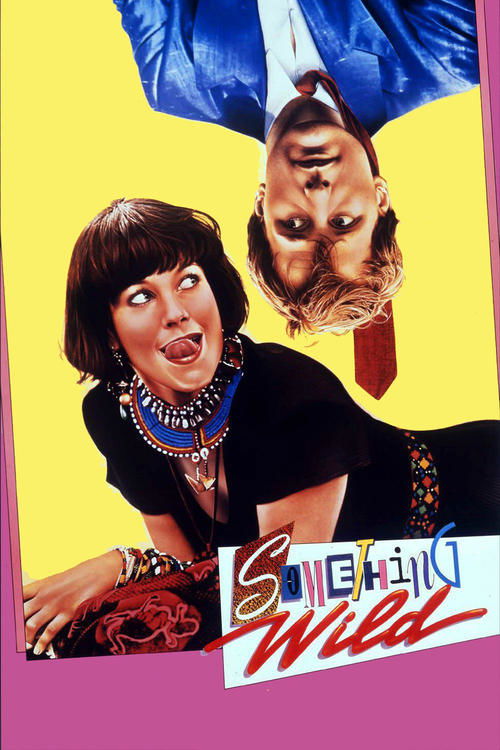
Something Wild
1986 · Jonathan Demme
For when you want a wild ride that keeps surprising you — date-night energy with a genuine edge of danger. Perfect if you're bored of movies where you can guess the next scene.
What it's about
A buttoned-down Manhattan tax consultant skips out on a lunch check and gets caught by Lulu, a bewitching stranger in a black bob who offers him a ride and promptly hijacks his life — handcuffs, motel rooms, back roads, and a trip to her small-town high school reunion under invented identities. Then her husband, fresh out of prison, walks in, and the joyride turns into something much more dangerous.
The experience
Starts as a fizzy, sexy screwball road comedy and then — mid-film, without warning — bares its teeth. The tonal swerve is the thrill: you're laughing, then you're gripping the armrest, and the film makes both feel true.
Performances
Melanie Griffith is irresistible as Lulu, shifting personas like outfits; Jeff Daniels makes the square's awakening funny and touching; and Ray Liotta, in his breakout role, is electrifying — charm and violence flickering in the same smile.
The craft
Jonathan Demme directs with his trademark generosity — every diner waitress and gas-station clerk gets a moment of life — and a fantastic wall-to-wall soundtrack of reggae, new wave, and roadside pop keeps the film buzzing. The swerve from comedy to menace is a masterclass in tonal control.
Why it matters
A touchstone of 1980s American independent-spirited studio filmmaking, it launched Ray Liotta, showcased Demme's humanism ahead of his later triumphs, and became the defining example of the comedy that turns dangerous.
Snapshot
Something Wild is the film in which Jonathan Demme's two great instincts — his affection for the American vernacular and his taste for genuine menace — collide in a single unbroken movement. A buttoned-down Manhattan tax consultant, Charles Driggs (Jeff Daniels), skips out on a lunch check and is caught at it by a woman in a black Louise Brooks bob who calls herself Lulu (Melanie Griffith). She offers him a ride, handcuffs him to a motel bed, phones his boss mid-coitus, drags him down the interstate through liquor stores and used-car lots to her mother's house in small-town Pennsylvania, and finally to her ten-year high school reunion — where her husband Ray Sinclair (Ray Liotta), freshly out of prison, walks in and takes the movie away from both of them.
The film is famous for that hinge. For roughly its first hour it is a screwball road comedy of erotic abduction, promiscuously scored, delighted by every roadside sign and stranger's face. Then Liotta arrives and the same locations, the same lighting, the same amiable extras curdle into a thriller. Nothing is restaged; the register simply shifts under the audience. It was a modest commercial performer on release for Orion Pictures in the fall of 1986 — the detailed grosses are not something to state with confidence here — but it has grown steadily in stature, and now reads as one of the defining American films of its decade: a Reagan-era comedy that discovers a knife inside the joke.
Industry & production
Something Wild arrives at a specific and legible moment in Demme's career. He came up through Roger Corman's New World Pictures — Caged Heat (1974), Crazy Mama (1975), Fighting Mad (1976) — and graduated into the loose, humane Americana of Citizens Band (1977) and Melvin and Howard (1980), which won critics but not audiences. His first big-studio assignment, Swing Shift (1984) at Warner Bros., ended badly: the picture was substantially reworked away from his cut. Demme's next film was Stop Making Sense (1984), the Talking Heads concert feature, which restored both his confidence and his reputation for kinetic, generous filmmaking.
Something Wild is his return to narrative feature work after that bruising, and it is legible as such — a film made deliberately outside the studio-supervision apparatus. It was produced by Demme with Kenneth Utt for Orion Pictures, the boutique-major that in these years functioned as an unusually hospitable home for directors (Woody Allen, the Coens, later Demme himself on Married to the Mob and The Silence of the Lambs). The screenplay was E. Max Frye's first produced script; Frye would later write Palmetto and co-write Foxcatcher. The specifics of the script's development and how far it drifted in production are not well documented in the public record.
Production was location-heavy — Manhattan, New Jersey, and a chain of small towns south and west of the city — and the film's economy shows in its casting: Demme fills the frame with regional faces, musicians, and friends rather than character actors. John Waters appears as a used-car salesman, John Sayles as a motorcycle cop, Charles Napier (a Demme fixture since New World) as a short-order cook, and Su Tissue of the band Suburban Lawns as a reunion wife. The New Jersey band The Feelies play the reunion's cover band. This is a production practice as much as a joke: it keeps the budget down and it keeps the world populated by people who look like they were already there.
Technology
The film is a straightforward 35mm production of its moment: spherical lenses, a 1.85:1 frame, Dolby Stereo optical release prints. Nothing about it is technologically adventurous, and that is consistent with Demme's method — he had no interest in effects and comparatively little in optical trickery. What is period-specific is the negative stock. By 1986 Eastman's faster tungsten emulsions had made available a genuinely usable low-light 35mm image, and Something Wild exploits it: motel rooms lit close to practical level, night highway, a liquor-store robbery played in ugly fluorescent, a climactic house sequence in near-darkness. A decade earlier this material would have required far more artificial fill and would have looked correspondingly staged.
The other technology at work is aural and commercial. Something Wild is one of the key films in the emergence of the pop-compilation soundtrack as a structural device rather than a marketing add-on. Its music is dense — dozens of cues, running across salsa, reggae, dancehall, post-punk, and soul — and it depends on the mid-1980s licensing infrastructure and the tie-in soundtrack album as a financing and promotional instrument. The film uses the record industry the way earlier films used a studio orchestra.
Technique
Cinematography
Tak Fujimoto shot it, as he shot most of Demme's best work from Caged Heat through Philadelphia, and he had already demonstrated on Malick's Badlands (1973) how to make American highway banality look both flat and transcendent. Here he works in bright, unfussy daylight for the first half — a deliberately unglamorous, almost documentary exposure that lets the roadside signage, the strip malls, and the Formica read at full saturation. The camera is mobile but not showy: handheld follows, car-mount traveling shots, a general willingness to let the frame be crowded and slightly off-balance.
The most consequential compositional choice is the frontal close-up. Demme and Fujimoto repeatedly place the camera on or very near the eyeline, so that actors appear to look directly into the lens. It is used gently in the first half — Lulu sizing Charlie up, Charlie failing to read her — and becomes claustrophobic once Ray arrives. This is the technique that would become world-famous five years later in The Silence of the Lambs, and Something Wild is where its emotional logic gets worked out: the shot collapses the distance between viewer and character, which is charming when the character is seducing you and unbearable when the character is threatening you.
Editing
Craig McKay cut the film, as he would cut Married to the Mob, The Silence of the Lambs and Philadelphia. His work here is essentially about tempo control across the tonal break. The first act moves in a loose, associative rhythm — cutaways to signs, faces, passing cars, a montage sensibility inherited partly from concert filmmaking — with music frequently carrying the cut across geography. The reunion sequence functions as the film's fulcrum: it is edited as a long, warm, ensemble set piece, and Ray's entrance is planted inside it almost offhandedly, so that the audience registers the danger a beat late. From that point the cutting tightens considerably, the associative cutaways stop, and the film's coverage becomes conventional thriller grammar. The shift is precisely the point: the movie stops being able to look around.
Mise-en-scène / staging
Demme stages in depth and in clutter. Backgrounds are busy with real commerce — product, signage, bystanders who are doing something rather than pretending to. The film's environments track its argument: the antiseptic Manhattan office, the anonymous motel, the mother's modest house full of accumulated small objects, the reunion gymnasium with its hand-made decorations, and finally a suburban home invaded.
Costume carries an unusual amount of the film's meaning. Lulu's first-half look — black bob wig, layered ethnic jewelry, bold prints — is a constructed persona, and its dismantling into Audrey Hankel, blonde and modestly dressed for her mother and her classmates, is the film's central reveal executed entirely through wardrobe and hair. Charlie undergoes the inverse: the suit comes apart across the film until he is finally, and violently, out of it. Both characters are lying about who they are — she about her name and marriage, he about a wife and children who have in fact left him — and the staging keeps insisting that appearance is a working con.
Sound
The music is by John Cale and Laurie Anderson, an unusual and inspired pairing whose contribution is largely the connective, uneasy underscore rather than the pop cues. Their work becomes audible mostly in the second half, where it supplies a nervous, art-music undertow beneath what had been an all-diegetic, all-pop soundworld.
The needle drops are the film's signature. It opens on David Byrne and Celia Cruz's "Loco de Amor," commissioned for the film, and closes with Sister Carol East performing a dancehall "Wild Thing" straight to camera over the credits — the film's title having been a Troggs allusion all along, and Sister Carol having appeared earlier in the picture as a character. In between: New Order's "Temptation," Fine Young Cannibals' cover of the Buzzcocks' "Ever Fallen in Love," The Feelies playing covers on the reunion bandstand. The programming is pointedly polyglot — Cuban, Jamaican, British post-punk, American soul — and constitutes a small argument about what American popular culture actually sounds like, against the whiteness of the yuppie milieu the film is skewering.
Performance
Griffith's Lulu/Audrey is the performance the film lives on: a breathy, apparently affectless line delivery that reads first as flakiness and gradually discloses fear and calculation underneath. It is a genuinely difficult piece of work because the character must be a fantasy object for an hour and then be revealed as a person who has been running from something. Daniels plays Charlie with an almost heroic commitment to being unattractive — squeamish, priggish, complicit — which makes his eventual capacity for violence land as disturbance rather than triumph.
Liotta's Ray is the breakout. It is a performance built on charm as a delivery system for threat; he is funny, socially fluent, and physically unpredictable, and he plays scenes of ordinary conversation as though a fight might start inside them. It was his first major film role and it recalibrated the picture around him. Liotta's subsequent casting in Goodfellas (1990) is widely credited to the impression he made here, though the precise chain of events is the sort of industry anecdote that has hardened without full documentation.
Narrative & dramatic mode
The film is structured as a two-movement work with a concealed seam. Movement one is picaresque: a series of episodes on the road, each a small transgression escalating from the last (the skipped check, the stolen car ride, the handcuffs, the liquor-store robbery, the impersonation of a married couple at the reunion). Its dramatic engine is not plot but escalation of consent — how far will Charlie go, and at what point does he stop being abducted and start volunteering?
Movement two converts the same material into a pursuit thriller. Crucially, the second half is not a betrayal of the first; it is its consequence. Everything Ray does to Charlie is a coarser version of what Lulu already did — the coercive ride, the imposed intimacy, the theft. The film's structural joke is that Charlie enjoyed it when the person forcing him was beautiful, and the story simply removes that variable.
Demme resists reconciling the two modes at the end. The violence is sordid rather than cathartic; Charlie's survival costs him his composure permanently, and the final image — Audrey waiting for him outside a luncheonette, back where they began — is offered as an open, unearned, slightly precarious grace note.
Genre & cycle
The film's backward genre debt is to 1930s screwball, specifically the road-and-class comedies of Capra's It Happened One Night (1934) and Hawks's Bringing Up Baby (1938): the anarchic woman, the constrained man, the journey as courtship, the improvised marriage-of-convenience. Its second half draws on domestic-invasion noir and, structurally, on the Hitchcock precedent of a film that changes species mid-run.
Its contemporary cycle is the one critics came to call the "yuppie nightmare" — the mid-1980s run of films in which an affluent professional man is delivered into a chaotic underworld: Scorsese's After Hours (1985), Susan Seidelman's Desperately Seeking Susan (1985), and, most tellingly, David Lynch's Blue Velvet, released the same year. All of these use genre dislocation to expose something rotten under Reagan-era prosperity; Something Wild is the most sociable and least surrealist of them, which is exactly why its turn to violence stings.
Authorship & method
Demme's authorship here is a matter of ethics of attention. His camera is genuinely curious about minor characters — the motel clerk, the gas station attendant, the reunion guests — and grants them dignity and screen time disproportionate to plot function. He casts musicians and non-actors, he shoots real places rather than sets, and he builds his soundtracks from music he personally loved, particularly Caribbean and African diasporic music. The result is a populism that is not condescending, and it distinguishes his 1980s work sharply from the more contemptuous satire around it.
The collaborators are the ones who define his mature period: Fujimoto's unglamorous mobile camera, McKay's rhythm, Kenneth Utt's production management, and — new here — Frye's script, whose structural audacity gave Demme a shape for his tonal range. Cale and Anderson are a one-off collaboration, but a revealing one: Demme habitually recruited musicians from outside the film-scoring world.
Movement / national cinema
Something Wild sits in the pre-history of the American independent boom. It predates sex, lies, and videotape (1989) and the Sundance-driven institutionalization of indie cinema, and it belongs instead to the Corman-graduate lineage of directors making personal genre films inside or alongside the studio system. Orion's willingness to underwrite director-driven work in these years is a significant industrial fact of American cinema in the late 1980s; the company's later collapse removed one of the few reliable homes for exactly this kind of picture.
The film is also emphatically a New York film in a downtown-cultural sense — its casting, its music, and its sensibility connect it to the same milieu that produced Talking Heads, the Feelies, and the no-wave/art-rock crossover of the period.
Era / period
The film is a document of 1986 America with unusual precision. Charlie is a tax specialist in a decade organized around financial abstraction; the picture opened in the same season that the Wall Street insider-trading scandals broke into public consciousness, and its portrait of a mild functionary who quietly enjoys getting away with things reads as of a piece with that moment. The landscape it drives through — chain motels, fast-food strips, used-car lots, malls — is the built environment of Reagan-era consumption, filmed neither nostalgically nor contemptuously.
There is also a sexual-historical dimension. A 1986 film about a stranger who abducts a man into unprotected, high-risk erotic adventure cannot be entirely separated from the arrival of AIDS in mainstream American consciousness. The film does not address this directly, and any strong reading of authorial intent here would be speculation — but the period charge of its sexual danger is real.
Themes
Masquerade is the organizing theme: everyone is running a version of themselves, and the film is unusually even-handed about it — Charlie's lie is as substantial as Audrey's. Class tourism is the second: the film understands that Charlie's weekend is a consumption experience, an appetite for "wildness" purchased at no expected cost, and it arranges for the bill to arrive.
Beneath both runs a critique of the fantasy of the liberating woman. Lulu is constructed as pure escape-object for an hour, then revealed to be a frightened person with a violent husband and a mother in a small town — the film retroactively indicts its own opening premise. This is why Something Wild recurs in later criticism as an early and self-aware instance of a figure that would eventually be named the "manic pixie dream girl": it builds the type and then, unusually, dismantles it from inside.
Finally, the film is about the proximity of pleasure and violence in American life — the same road, the same music, the same friendly strangers, seen twice.
Reception, canon & influence
Contemporary reviews were substantially positive, with particular attention to Griffith's performance, to Liotta's arrival, and to the audacity of the tonal break — though a minority of critics found the shift unearned or the ending sentimental. Awards recognition came chiefly in the supporting and lead-comic categories at the Golden Globes; the film was not a major awards presence, and it did not perform strongly enough commercially to alter Demme's standing at the time.
Backward, the film draws on 1930s screwball, on the Corman-school lesson that genre is a container you can fill with anything, on the American road movie from Bonnie and Clyde through Badlands (whose cinematographer Fujimoto brings that lineage in directly), and on Hitchcock's structural bad manners.
Forward, its influence is broad. It fed directly into Demme's own subsequent work — Married to the Mob (1988) reuses much of its cast, tone, and music policy, and The Silence of the Lambs (1991) systematizes its frontal close-up into a full visual grammar. Liotta's career, and through it a strand of 1990s American screen menace, begins here. The mode of the compilation soundtrack as narrative architecture — eclectic, curatorial, wielded by the director as an authorial signature — became standard in 1990s independent film, most visibly in Tarantino, whose True Romance screenplay (filmed 1993) works recognizably in Something Wild's lineage of romance-turned-atrocity, as does the wider cycle including Lynch's Wild at Heart (1990) and Kalifornia (1993).
Critically, the film has become a reference point for the "yuppie nightmare" grouping and for arguments about genre hybridity in 1980s American cinema. Its canonization was consolidated by a Criterion Collection edition, which restored it to circulation for a generation that had known it mostly as a repertory and cable object. It is now generally regarded as one of the two or three essential Demme features, and as the clearest available demonstration of what he could do that nobody else could: make a movie that is warm all the way down and frightening all the way through.
A Deleuzian reading
He skips out on a lunch check.
The full Deleuzian reading of Something Wild →
Reception
Well-reviewed but only a modest earner in 1986, it was overshadowed for years by Demme's later Oscar sweep — then a 2011 Criterion release cemented its rediscovery as the quintessential 'yuppie nightmare' movie of the Reagan era.
How Something Wild was received, from release to now →
How to watch Something Wild: what to notice on a first viewing
- Notice when a character looks straight into the camera lens. Demme and Fujimoto place the camera right on the eyeline, so Lulu, and later others, seem to look directly at you rather than at each other. The shot closes the distance between you and whoever is on screen, whether they are charming you or threatening you.
- Watch Lulu's wig, jewelry, and bold prints as a costume. Her whole first-hour look, a black bob and layered ethnic jewelry, reads as a built persona, worn on purpose rather than simply chosen. She is not hiding who she is so much as constructing who she is, piece by piece.
- Look at what strangers in the background are actually doing. Demme fills his frames with real commerce, signage, and bystanders who are doing something rather than posing as extras. The world looks like it would keep going even if the camera turned away from it.
- Listen for a song that carries you across a jump in location. A needle drop runs under a cut and keeps playing while the setting changes entirely, so the music does the traveling the plot skips. The soundtrack is doing structural work here, not just mood, stitching miles of road together in one breath.
- Notice how loose and slightly off-balance the camera feels. Fujimoto shoots handheld follows and car-mount traveling shots in plain daylight, letting the frame feel crowded and a little unsteady. The unglamorous look makes the ride feel like something actually happening, not staged for you.
The whole guide to watching Something Wild, with the keys for a rewatch →
Influences: the films it descends from and the films it influenced
- It Happened One Night (1934) — Supplies the road-comedy chassis E. Max Frye rebuilds — a rule-bound man detached from his scheduled life by a woman traveling under a false name — with the auto-camp/'walls of Jericho' motel bit rewritten as the Pennsylvania motel handcuff scene.
- Bringing Up Baby (1938) — The screwball engine of a woman who lies continuously and escalates the man's humiliation faster than he can correct it; Griffith's Lulu plays Hepburn's tempo of relentless forward improvisation, with the comedy generated by the male lead's failed attempts to reassert an appointment book.
- The 39 Steps (1935) — The handcuffed-strangers structure in which comic flirtation and lethal pursuit share the same scene without the film announcing which one is operative — the register Demme uses to keep the first hour funny while it is already a thriller.
- Psycho (1960) — The structural bad manners the dossier names: a mid-film hand-off that kills the movie you bought a ticket for and installs a different genre, hinged on a roadside motel — Demme's Ray Sinclair arrives at exactly that structural joint.
- Bonnie and Clyde (1967) — Banjo-scored comic picaresque colliding with unstylized bodily damage, cut by Dede Allen so the tonal break lands without warning; McKay's tempo shifts in the Pennsylvania third act are downstream of that editorial refusal to prepare the audience.
- Badlands (1973) — Fujimoto carries this over literally — available-light exteriors, the flat unglamorous American middle distance, camera riding in the car with the couple, and violence photographed without emphasis or coverage that would dignify it.
- Caged Heat (1974) — The Corman-school lesson that an exploitation frame is a container you can fill with anything — and the first John Cale score Demme commissioned, establishing the habit of hiring composers from outside the film-scoring world.
- Handle with Care (1977) — Polyphonic ensemble attention in which dispatchers and bit players get screen time disproportionate to plot function, and vernacular sound (CB chatter) does characterization work — the ethic behind the motel clerk, gas attendant and reunion guests.
- Melvin and Howard (1980) — Establishes the method of shooting real working-class locations with non-actor and near-non-actor faces and letting a one-scene supporting player own the frame, treating Americana as observed texture rather than as satirical target.
- Stop Making Sense (1984) — Sets the frontal, straight-to-lens performance framing and the principle that a song's own architecture can carry a sequence's structure; the Byrne/Celia Cruz 'Loco de Amor' that opens Something Wild is the direct hand-off.
- Married to the Mob (1988) — Direct continuation with Fujimoto, McKay and Utt, much of the same cast, the same cluttered real-location depth-and-clutter design, and the compilation-soundtrack policy extended into a slate of commissioned covers as authorial signature.
- Goodfellas (1990) — Liotta's charm-then-terror register — the switch Demme discovered and shot in frontal close-up — becomes Henry Hill; the wall-to-wall period compilation used as a narrative clock is the same soundtrack-as-architecture policy scaled up.
- Wild at Heart (1990) — Extends the romance-turned-atrocity road picture: curated needle-drops as authorial signature and violence that arrives inside a scene with no tonal preparation, the escalation structure Frye's script proved could hold.
- Miami Blues (1990) — Demme-produced, Corman-school genre hybrid using his production team — sunlit real-location Florida crime, non-actor faces in service roles, and comedy interrupted by abrupt physical brutality (the finger-breaking) played straight.
- The Silence of the Lambs (1991) — Systematizes Something Wild's frontal close-up into a full eyeline-to-lens grammar with Fujimoto and McKay, and makes the mid-film menace of Ray Sinclair — a charming man addressing you directly — the entire visual architecture.
- True Romance (1993) — Tarantino's script works openly in this lineage: an impulsive woman detonating a passive man's life, a charismatic intruder derailing act two, and eclectic curated cues (Hans Zimmer's marimba over the atrocity) deployed as the director's authorial voice.
- Licorice Pizza (2021) — Demme's method of directing musicians and non-professionals with warmth that elicits unguarded screen presence—casting by instinct for charisma over trained technique—provides the philosophy Anderson applies to Haim and Cooper Hoffman.
- Desperately Seeking Susan (1985) — Costume-as-reveal worked the same way — downtown thrift-store wardrobe as an identity swap that pulls a straight suburban woman into a stranger's life — with needle-drops doing the characterization that dialogue withholds.
- After Hours (1985) — The yuppie-nightmare mechanism in its purest form: a white-collar man's single night compounding into punishment administered by strangers, staged as comedy at a tempo that reads as dread.
- Blue Velvet (1986) — Same-year sibling that stages pop records as diegetic psychic events ('In Dreams') and builds its second half around a charismatic sadist who abducts the protagonist into his own genre — Frank Booth and Ray Sinclair are the same structural device.
- Ferris Bueller's Day Off (1986) — Released the same year and shot by Fujimoto: an available-light picaresque in which a rule-follower is abducted into a road-day by a charismatic rule-breaker, with a curated soundtrack doing the tonal work the score refuses to do.
Similar films
- Wild at Heart (1990) — influence & lineage
- Blue Velvet (1986) — influence & lineage
- After Hours (1985) — influence & lineage
- Strange Darling (2024) — shared sensibility
- Body Double (1984) — shared sensibility
- Down by Law (1986) — shared sensibility
- Thelma & Louise (1991) — shared sensibility
- Kiss Me Deadly (1955) — shared sensibility